Decision comparison
Collibra vs Elementary
Collibra and Elementary address data quality from fundamentally different angles. Collibra is an enterprise data governance platform that treats data quality as one component of an extensive governance, cataloging, privacy, lineage, and AI management ecosystem. It serves regulated industries like financial services, healthcare, and government where compliance, business context, and cross-organizational data management are primary concerns. Elementary is a data observability platform built specifically for data and analytics engineers who work with dbt. It focuses on automated monitoring, anomaly detection, code-first configuration, and column-level lineage within the data pipeline. The right choice depends on whether your primary need is enterprise-wide data governance or pipeline-level data observability.
Architecture choice. These take different approaches to the same problem. Read the table as a fit question rather than a feature race.
These are different kinds of product — Data Catalog and Data Observability.
Quick Comparison
| Decision factor | Collibra | Elementary |
|---|---|---|
| Best For | Regulated enterprises needing unified data governance, cataloging, and AI governance at scale | dbt-centric data teams seeking code-first observability and data quality monitoring |
| Core Approach | Platform-first governance covering data cataloging, lineage, privacy, quality, and AI use case management | Code-first observability with automated monitors, anomaly detection, and AI agents built around dbt |
| Pricing Model | Contact for pricing | Elementary publishes no amounts. Its open-source dbt package is free and self-hosted. Elementary Cloud is priced by seats and environments: Scale covers up to 10 editor seats and 1K tables, Enterprise up to 20 editor and 40 viewer seats and 3K tables, and Unlimited removes the seat caps; extra tables are charged per additional 1K. A free trial covers the Essentials feature set. Every paid tier is quote-only. |
| Open Source | No | Yes (Apache-2.0 license, 2,000+ GitHub stars) |
| Deployment | Cloud-based SaaS platform with enterprise-grade security and compliance certifications | Self-hosted open-source dbt package or Elementary Cloud SaaS |
| Learning Curve | Moderate to steep; requires organizational onboarding and governance process design | Low for dbt users; integrates directly into existing dbt projects and workflows |
Collibra
- Best For:
- Regulated enterprises needing unified data governance, cataloging, and AI governance at scale
- Core Approach:
- Platform-first governance covering data cataloging, lineage, privacy, quality, and AI use case management
- Pricing Model:
- Contact for pricing
- Open Source:
- No
- Deployment:
- Cloud-based SaaS platform with enterprise-grade security and compliance certifications
- Learning Curve:
- Moderate to steep; requires organizational onboarding and governance process design
Elementary
- Best For:
- dbt-centric data teams seeking code-first observability and data quality monitoring
- Core Approach:
- Code-first observability with automated monitors, anomaly detection, and AI agents built around dbt
- Pricing Model:
- Elementary publishes no amounts. Its open-source dbt package is free and self-hosted. Elementary Cloud is priced by seats and environments: Scale covers up to 10 editor seats and 1K tables, Enterprise up to 20 editor and 40 viewer seats and 3K tables, and Unlimited removes the seat caps; extra tables are charged per additional 1K. A free trial covers the Essentials feature set. Every paid tier is quote-only.
- Open Source:
- Yes (Apache-2.0 license, 2,000+ GitHub stars)
- Deployment:
- Self-hosted open-source dbt package or Elementary Cloud SaaS
- Learning Curve:
- Low for dbt users; integrates directly into existing dbt projects and workflows
Public signals
Verified factual signals only. Bars appear only for like-for-like metrics with five weekly assessments for every tool; missing evidence stays explicit. These signals do not establish enterprise adoption, product quality, or total cost.
| Metric | Collibra | Elementary |
|---|---|---|
| GitHub commits, 90d(Developer adoption) | 107 | Not available |
| GitHub stars(Developer adoption) | 36 | Not available |
| Search interest(Market interest) | 0 | Unavailable |
| Hacker News mentions, 90d(Community interest) | 0 | Not available |
| Stack Overflow questions(Community interest) | 10 | Not available |
| GitHub commits, 90d(Product adoption) | Not available | 19 |
| GitHub stars(Product adoption) | Not available | 2,000+ |
| PyPI weekly downloads(Product adoption) | Not available | 215.3k |
As of September 21, 2026 — updated weekly.
Health & risk evidence
Observed public-source checks for mapped package versions and repositories.
Collibra
Package vulnerabilities
Not available
Repository security score
Not available
Elementary
September 21, 2026Package vulnerabilities
PyPI · elementary-data@0.26.0
0 vulnerabilities
across 1 package
Repository security score
github.com/elementary-data/elementary
7.4/10
Interface Preview
Elementary
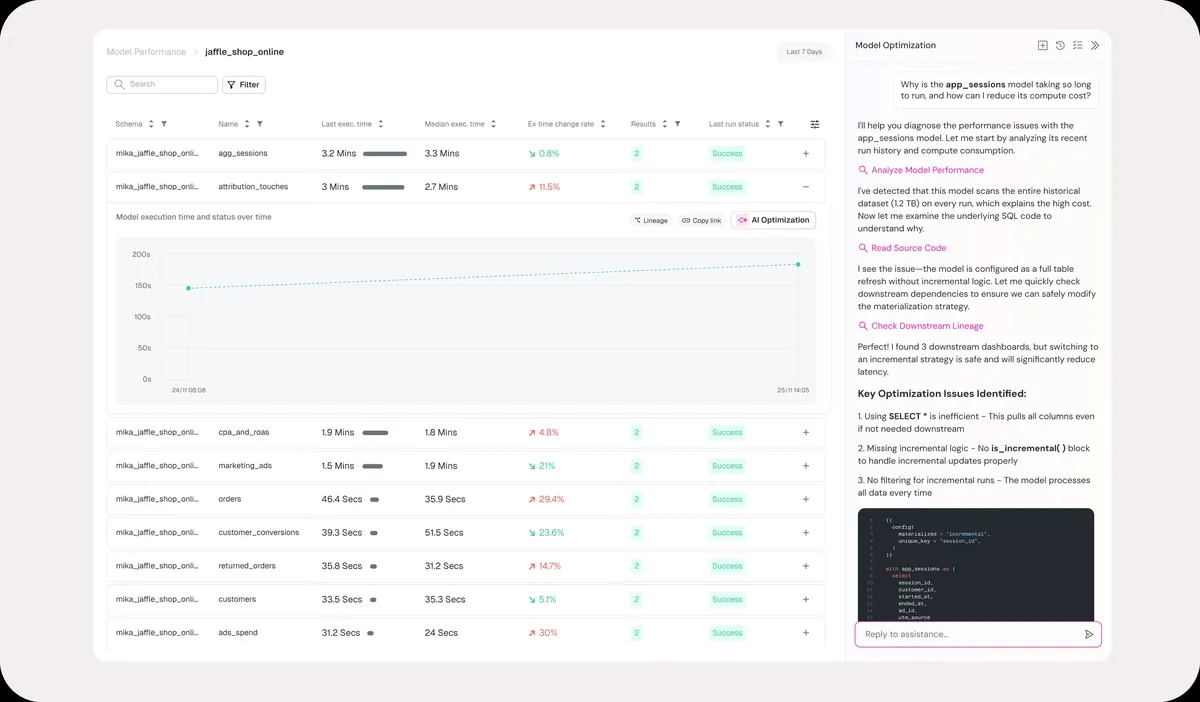
Feature Comparison
| Feature | Collibra | Elementary |
|---|---|---|
| Data Governance & Cataloging | ||
| Data Catalog | Full enterprise data catalog with semantic graph that bridges raw data and business meaning; enables discovery across the entire data landscape | Code-maintained catalog for exploring datasets including health, dependencies, ownership, and descriptions managed in dbt code |
| Data Governance Workflows | Automated governance workflows with an intuitive workflow designer for collaboration, compliance, and standardized processes across the organization | Governance through policy setting and enforcement for compliance and security; code-based configuration for version control |
| Data Privacy | Dedicated Data Privacy module that centralizes and automates workflows for regulatory requirements and global compliance | Not a primary focus; governance features address compliance through policy enforcement rather than dedicated privacy tooling |
| Data Quality & Observability | ||
| Automated Monitoring | Data quality and observability module monitors data quality and pipeline reliability with anomaly remediation capabilities | ML-based out-of-the-box monitors for freshness, volume, and schema changes activated automatically with low compute cost |
| Anomaly Detection | Data quality monitoring focused on remediation of anomalies across connected data sources | Detects anomalies in nullness, distribution, dimensions, and completeness with configurable seasonality, sensitivity, and where expressions |
| Data Testing | Quality rules enforced through governance policies and automated workflows within the platform | Unified solution for dbt tests, dbt-expectations, dbt-utils, and custom SQL tests; existing tests automatically become part of coverage |
| Lineage & Impact Analysis | ||
| Data Lineage | Automated lineage mapping relationships between systems, applications, and reports with cross-platform traceability across Vertex AI, SageMaker, and Databricks | Column-level lineage from code to BI tools enriched with test results to show incidents across the DAG |
| Impact Analysis | Enterprise-wide impact analysis through semantic graph connecting data assets, policies, and business context | Lineage-based incident tracking that groups related failures and shows which downstream assets are impacted by upstream issues |
| BI Tool Integration | Collibra Everywhere browser extension surfaces business context within Salesforce, Databricks, Tableau, and Slack | Integrations with Tableau, Looker, and other BI tools with column-level lineage extending to the BI layer |
| AI & Automation | ||
| AI Governance | Unified AI registry to catalog, assess, and monitor AI use cases, models, and agents with end-to-end AI traceability and lifecycle management | AI agents for data validation, triage, metadata enrichment, test coverage analysis, and query optimization |
| Semantic Layer | Automatic semantic layer generation connecting physical data with business terms through semantic mapping | Context engine that collects and applies metadata, lineage, tests, and usage patterns as shared context across the stack |
| MCP Server | A documented MCP server: connect an MCP-compatible client to the instance URL plus /rest/mcp and authenticate via OAuth. | MCP Server exposes context layer and agents through a standard interface for use in any AI tool |
| Integration & Developer Experience | ||
| dbt Integration | Connects to dbt as one of 100+ native integrations within the extensive platform ecosystem | dbt-native by design; open-source dbt package integrates tests and artifacts directly with the data warehouse |
| Configuration as Code | UI-based workflow designer with API access for automation; governance configurations managed within the platform | All configurations managed in dbt code enabling version control, code review, and CI/CD as part of the development process |
| Data CI/CD | Data contracts feature promotes alignment across teams through enhanced visibility and automation of data product delivery | Dedicated Data CI/CD prevents data quality issues at the pull request level; runs tests and previews impact before production |
Data Governance & Cataloging
Data Catalog
Data Governance Workflows
Data Privacy
Data Quality & Observability
Automated Monitoring
Anomaly Detection
Data Testing
Lineage & Impact Analysis
Data Lineage
Impact Analysis
BI Tool Integration
AI & Automation
AI Governance
Semantic Layer
MCP Server
Integration & Developer Experience
dbt Integration
Configuration as Code
Data CI/CD
Which approach fits
Collibra and Elementary address data quality from fundamentally different angles. Collibra is an enterprise data governance platform that treats data quality as one component of an extensive governance, cataloging, privacy, lineage, and AI management ecosystem. It serves regulated industries like financial services, healthcare, and government where compliance, business context, and cross-organizational data management are primary concerns. Elementary is a data observability platform built specifically for data and analytics engineers who work with dbt. It focuses on automated monitoring, anomaly detection, code-first configuration, and column-level lineage within the data pipeline. The right choice depends on whether your primary need is enterprise-wide data governance or pipeline-level data observability.
When each approach fits
Choose Collibra if:
Enterprise data organizations in regulated industries that need unified governance covering data cataloging, privacy, compliance, AI use case management, and cross-organizational collaboration. Collibra is the right choice when your priority is building a centralized foundation for overseeing data assets with business-led governance workflows, semantic context, and regulatory compliance automation. Organizations already using or evaluating tools like Snowflake, Databricks, Tableau, and Salesforce benefit from Collibra's 100+ native integrations and its Everywhere browser extension that surfaces governance context directly within those applications.
Choose Elementary if:
Data and analytics engineering teams running dbt who need code-first observability with automated monitors, column-level lineage, anomaly detection, and incident management embedded directly in their development workflow. Elementary is the strongest fit when your team values open-source foundations, version-controlled configuration, and a low barrier to entry. The free self-hosted dbt package lets teams start immediately, and Elementary Cloud scales up with AI agents, BI integrations, and an MCP Server for teams building AI-powered data workflows.
These scenarios reflect the available product evidence. Your requirements, existing stack, and team expertise should guide the final decision.
Frequently Asked Questions
Can Collibra and Elementary be used together?
Yes. Collibra and Elementary serve different layers of the data stack and can complement each other. Collibra provides enterprise-wide governance, business context, data cataloging, and compliance management, while Elementary handles pipeline-level observability, automated data quality monitoring, and dbt-native alerting. Organizations can use Elementary to monitor data quality within their dbt pipelines and Collibra to govern and catalog those same datasets at the organizational level.
Is Elementary free to use?
Elementary offers an open-source dbt package under the Apache-2.0 license that is completely free to self-host. It provides automated monitors, anomaly detection, lineage, and alerts within your dbt project at zero cost. Elementary Cloud adds premium features including AI agents, incident management, BI integrations, catalog, health scores, and an MCP Server across Scale, Enterprise, and Unlimited tiers that require contacting the Elementary team for pricing.
What industries is Collibra best suited for?
Collibra is built for regulated industries including financial services, healthcare, life sciences, federal government, and insurance. Its platform meets rigorous security and scalability requirements for highly regulated environments. Collibra is recognized as a Leader in the Gartner Magic Quadrant for Data and Analytics Governance Platforms and serves over 100 Fortune 500 companies including McDonald's, SAP, and MUFG.
Does Elementary work without dbt?
Elementary's open-source package is dbt-native by design and tightly coupled to dbt projects. However, Elementary Cloud extends observability beyond dbt with integrations across ingestion, semantic layers, BI tools, and AI workflows through its context engine. The platform supports end-to-end lineage across the full data stack, not just dbt transformations.
How do the AI capabilities of each platform compare?
Collibra focuses its AI capabilities on governance, offering a unified AI registry that catalogs, assesses, and monitors AI use cases, models, and agents across platforms like Vertex AI, SageMaker, and Databricks with automated traceability. Elementary's AI capabilities are oriented toward data engineering workflows, providing AI agents for data quality validation, issue triage, metadata enrichment, test coverage analysis, and query performance optimization. Elementary also offers an MCP Server that exposes its context layer to external AI tools, which Collibra does not currently provide.