Decision comparison
CrewAI vs Semantic Kernel
CrewAI and Semantic Kernel start from different places. CrewAI builds systems out of agents with roles, goals and tasks, coordinated as crews, with a managed platform option. Semantic Kernel is an SDK in C#, Python and Java for adding LLM capability inside an existing application, and Microsoft's new development has moved to the Agent Framework.
Semantic Kernel has a named successor from its own vendor
Microsoft merged Semantic Kernel and AutoGen into the Microsoft Agent Framework. Semantic Kernel v1.x remains supported for critical bugs and security issues, but the majority of new features are built for the Agent Framework instead.
Architecture choice. These take different approaches to the same problem. Read the table as a fit question rather than a feature race.
Applies to: application development workloads that need an open-source SDK with planners and plugin architecture
All 2 are agent frameworks.
Quick Comparison
| Decision factor | CrewAI | Semantic Kernel |
|---|---|---|
| What it is | A Python framework for multi-agent systems built around roles, tasks and crews, with flows for deterministic sequencing | Microsoft's SDK for adding LLM capability to applications through plugins and planners, available in C#, Python and Java |
| Languages | Python | C#, Python and Java |
| Model of work | Agents with roles and goals work through tasks, delegating to each other | Plugins expose capabilities to the model, sequenced by planners or explicit code |
| Where it fits | A system built around agents, run as its own service | LLM capability added inside an existing business application |
| Multi-agent | Crews of agents are the central abstraction, with flows for deterministic sequencing | Agent support exists, with the emphasis on integrating AI into application code |
| Vendor status | Independently developed, with a managed platform option | v1.x receives critical fixes; new development is in the Microsoft Agent Framework |
| Best fit | Problems that decompose into roles doing distinct jobs | Enterprise teams, particularly on .NET, adding AI to systems they already run |
CrewAI
- What it is:
- A Python framework for multi-agent systems built around roles, tasks and crews, with flows for deterministic sequencing
- Languages:
- Python
- Model of work:
- Agents with roles and goals work through tasks, delegating to each other
- Where it fits:
- A system built around agents, run as its own service
- Multi-agent:
- Crews of agents are the central abstraction, with flows for deterministic sequencing
- Vendor status:
- Independently developed, with a managed platform option
- Best fit:
- Problems that decompose into roles doing distinct jobs
Semantic Kernel
- What it is:
- Microsoft's SDK for adding LLM capability to applications through plugins and planners, available in C#, Python and Java
- Languages:
- C#, Python and Java
- Model of work:
- Plugins expose capabilities to the model, sequenced by planners or explicit code
- Where it fits:
- LLM capability added inside an existing business application
- Multi-agent:
- Agent support exists, with the emphasis on integrating AI into application code
- Vendor status:
- v1.x receives critical fixes; new development is in the Microsoft Agent Framework
- Best fit:
- Enterprise teams, particularly on .NET, adding AI to systems they already run
Public signals
Verified factual signals only. Bars appear only for like-for-like metrics with five weekly assessments for every tool; missing evidence stays explicit. These signals do not establish enterprise adoption, product quality, or total cost.
| Metric | CrewAI | Semantic Kernel |
|---|---|---|
| GitHub commits, 90d(Product adoption) | 335 | 83 |
| GitHub stars(Product adoption) | 58,000+ | 28,000+ |
| Search interest(Market interest) | 4 | 0 |
| Hacker News mentions, 90d(Community interest) | 8 | 1 |
| PyPI weekly downloads(Product adoption) | 585.4k | 63.1k |
| Stack Overflow questions(Community interest) | 40 | 58 |
As of September 14, 2026 — updated weekly.
Health & risk evidence
Observed public-source checks for mapped package versions and repositories.
CrewAI
September 14, 2026Package vulnerabilities
PyPI · crewai@1.15.21
0 vulnerabilities
across 1 package
Repository security score
Not available
Semantic Kernel
September 14, 2026Package vulnerabilities
PyPI · semantic-kernel@1.44.1
0 vulnerabilities
across 1 package
Repository security score
Not available
Interface Preview
CrewAI
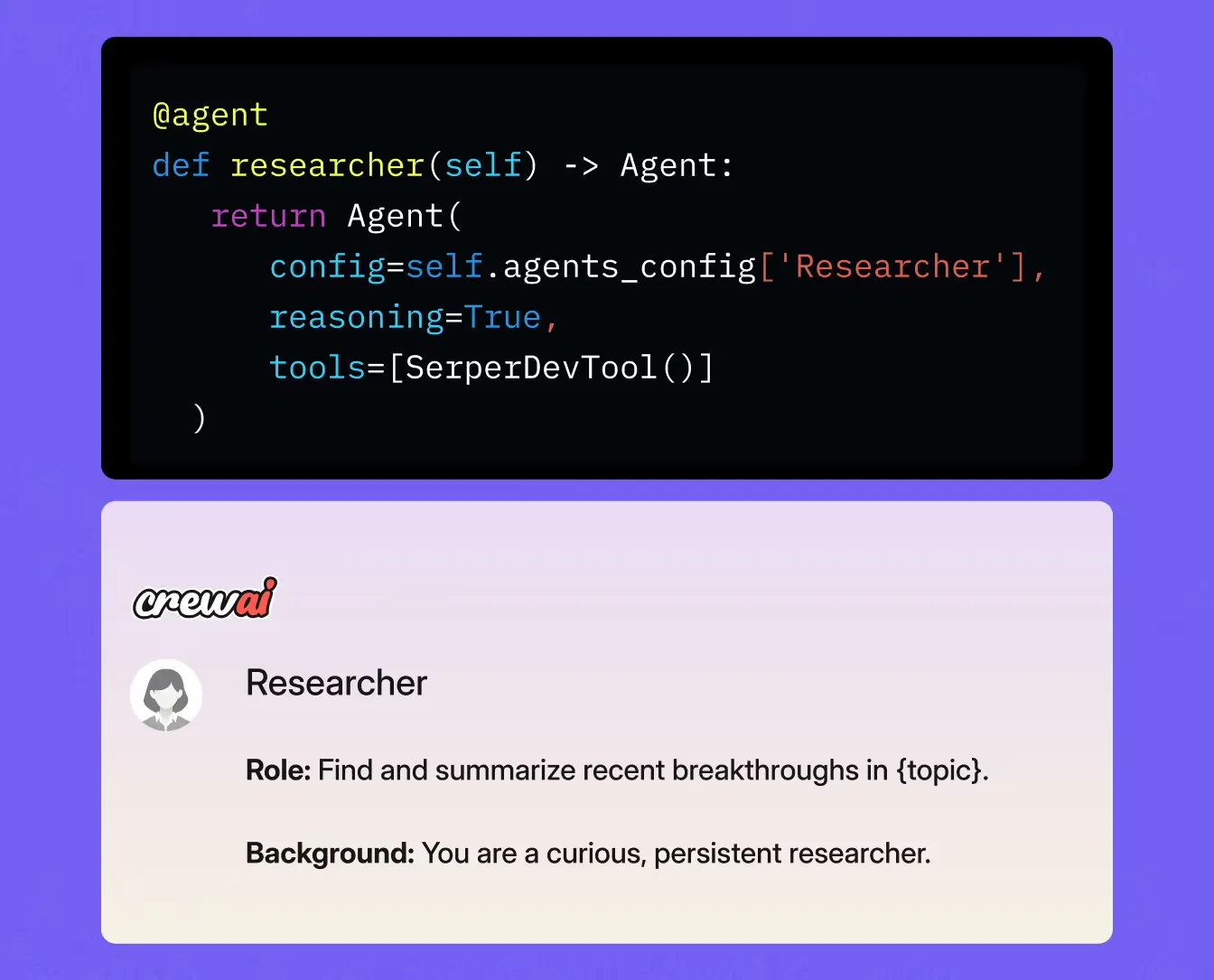
Feature Comparison
| Feature | CrewAI | Semantic Kernel |
|---|---|---|
| Building | ||
| Role-based agent definition | Full support | Partial support |
| Embeds into an existing application | Partial support | Full support |
| Tool and plugin calling | Full support | Full support |
| Model-agnostic across providers | Full support | Full support |
| Languages | ||
| Python support | Full support | Full support |
| C# support | Not verified | Full support |
| Java support | Not verified | Full support |
| REST integration | Full support | Full support |
| Coordination | ||
| Multiple agents on one task | Full support | Partial support |
| Deterministic sequencing option | Full support | Full support |
| Human-in-the-loop steps | Full support | Full support |
| Structured output enforcement | Full support | Full support |
| Platform | ||
| Managed platform option | Full support | Not verified |
| Receiving new features | Full support | Partial support |
| Named vendor successor | Not verified | Full support |
| Enterprise deployment track record | Partial support | Full support |
Building
Role-based agent definition
Embeds into an existing application
Tool and plugin calling
Model-agnostic across providers
Languages
Python support
C# support
Java support
REST integration
Coordination
Multiple agents on one task
Deterministic sequencing option
Human-in-the-loop steps
Structured output enforcement
Platform
Managed platform option
Receiving new features
Named vendor successor
Enterprise deployment track record
Which approach fits
CrewAI and Semantic Kernel start from different places. CrewAI builds systems out of agents with roles, goals and tasks, coordinated as crews, with a managed platform option. Semantic Kernel is an SDK in C#, Python and Java for adding LLM capability inside an existing application, and Microsoft's new development has moved to the Agent Framework.
When each approach fits
Choose CrewAI if:
Choose CrewAI when the work genuinely divides into roles — a researcher gathering material, a writer drafting, a reviewer checking — and the system you are building is organised around those agents. Delegation between them is handled by the framework, and flows constrain the sequence where the path needs to be predictable.
Choose Semantic Kernel if:
Choose Semantic Kernel when AI capability belongs inside an application you already have, particularly a .NET or Java one. Plugins expose your existing services to the model as callable functions, and the SDK fits normal application architecture, so deployment, identity and monitoring stay the ones you already operate.
These scenarios reflect the available product evidence. Your requirements, existing stack, and team expertise should guide the final decision.
Frequently Asked Questions
What is Semantic Kernel's status?
Microsoft merged AutoGen and Semantic Kernel into the Microsoft Agent Framework, which reached 1.0 in April 2026. Semantic Kernel v1.x continues to receive critical bug and security fixes while new development goes to the Agent Framework, and it remains installable and widely deployed. The practical question is how long your code will live and how much of it would change if you migrated to the successor.
Does role-based decomposition suit our problem?
It suits work that divides into parts needing different context and different tools. It suits less well a single task with labels attached, where extra agents add model calls and variability without separation. Ask whether each role needs different tools or different context; if the answer is no, one well-prompted agent inside your application is usually the simpler and cheaper design.
How much does C# and Java support matter?
In organisations whose business systems are written in those languages, a great deal. Adding an LLM feature to an existing .NET service is straightforward with a .NET SDK, and awkward when it means standing up a Python service alongside with its own deployment, monitoring and security review. Most frameworks in this category are Python-only, which makes this a genuine differentiator.
Can we use both?
Yes, and a sensible split is a Semantic Kernel integration inside the application for features triggered by users, with a separate agent service for longer-running multi-step work. The cost is two codebases and two sets of conventions, so justify it with a real difference in workload shape rather than adopting both out of curiosity.
What do these need to run?
A model provider API key and somewhere to run the process — a container on Kubernetes, a serverless function, or a service behind a REST endpoint returning JSON. Python is the common runtime, with C# and Java available on the Microsoft side. Retrieval adds a vector store, often PostgreSQL with pgvector. Nothing unusual is required for hosting; the operational weight is in tracing and cost control.
What does running one of these in production require?
Tracing every step with inputs, outputs, latency and token cost; a hard ceiling on iterations so a loop that fails to converge stops rather than spends; retries that distinguish a transient API error from a model producing unusable output; and evaluation that catches quality regressions when a prompt or model changes. Frameworks provide different amounts of that, and the gap is where the engineering effort goes.