Decision comparison
CrewAI vs MetaGPT
CrewAI and MetaGPT both coordinate several agents through roles, at different levels of specialisation. CrewAI is general: you define the roles, goals and tasks for whatever problem you have, with flows available when the sequence must be repeatable. MetaGPT provides software-company roles following standard operating procedures, producing requirements, designs, code and tests as artefacts.
Architecture choice. These take different approaches to the same problem. Read the table as a fit question rather than a feature race.
Applies to: when the evaluation is driven by the product-development journey it presents, while treating operational governance requirements as a separate validation area.
All 2 are agent frameworks.
Quick Comparison
| Decision factor | CrewAI | MetaGPT |
|---|---|---|
| What it is | A Python framework for multi-agent systems built around roles, tasks and crews, with flows for deterministic sequencing | A multi-agent framework that assigns software-company roles — product manager, architect, engineer — following standard operating procedures |
| Role definition | You define roles, goals and tasks for your own problem | Software-company roles come predefined, following standard operating procedures |
| Generality | General: any problem that divides into roles | Specialised towards software development workflows |
| Output | Whatever the tasks produce, with structured output enforcement available | Structured artefacts: requirements, design documents, code and tests |
| Control | Flows constrain the sequence where the path must be repeatable | Procedures define the sequence, with customisation on top |
| Ecosystem | Open-source Python framework with a managed platform option | Independently developed open-source project |
| Best fit | Any work that decomposes into distinct roles with different tools | Teams experimenting with automated software development pipelines |
CrewAI
- What it is:
- A Python framework for multi-agent systems built around roles, tasks and crews, with flows for deterministic sequencing
- Role definition:
- You define roles, goals and tasks for your own problem
- Generality:
- General: any problem that divides into roles
- Output:
- Whatever the tasks produce, with structured output enforcement available
- Control:
- Flows constrain the sequence where the path must be repeatable
- Ecosystem:
- Open-source Python framework with a managed platform option
- Best fit:
- Any work that decomposes into distinct roles with different tools
MetaGPT
- What it is:
- A multi-agent framework that assigns software-company roles — product manager, architect, engineer — following standard operating procedures
- Role definition:
- Software-company roles come predefined, following standard operating procedures
- Generality:
- Specialised towards software development workflows
- Output:
- Structured artefacts: requirements, design documents, code and tests
- Control:
- Procedures define the sequence, with customisation on top
- Ecosystem:
- Independently developed open-source project
- Best fit:
- Teams experimenting with automated software development pipelines
Public signals
Verified factual signals only. Bars appear only for like-for-like metrics with five weekly assessments for every tool; missing evidence stays explicit. These signals do not establish enterprise adoption, product quality, or total cost.
| Metric | CrewAI | MetaGPT |
|---|---|---|
| GitHub commits, 90d(Product adoption) | 335 | 0 |
| GitHub stars(Product adoption) | 58,000+ | 70,000+ |
| Search interest(Market interest) | 4 | 0 |
| Hacker News mentions, 90d(Community interest) | 8 | 0 |
| PyPI weekly downloads(Product adoption) | 585.4k | 1.2k |
| Stack Overflow questions(Community interest) | 40 | Not available |
As of September 14, 2026 — updated weekly.
Health & risk evidence
Observed public-source checks for mapped package versions and repositories.
CrewAI
September 14, 2026Package vulnerabilities
PyPI · crewai@1.15.21
0 vulnerabilities
across 1 package
Repository security score
Not available
MetaGPT
September 14, 2026Package vulnerabilities
PyPI · metagpt@0.8.2
8 vulnerabilities
across 1 package
Repository security score
Not available
Interface Preview
CrewAI
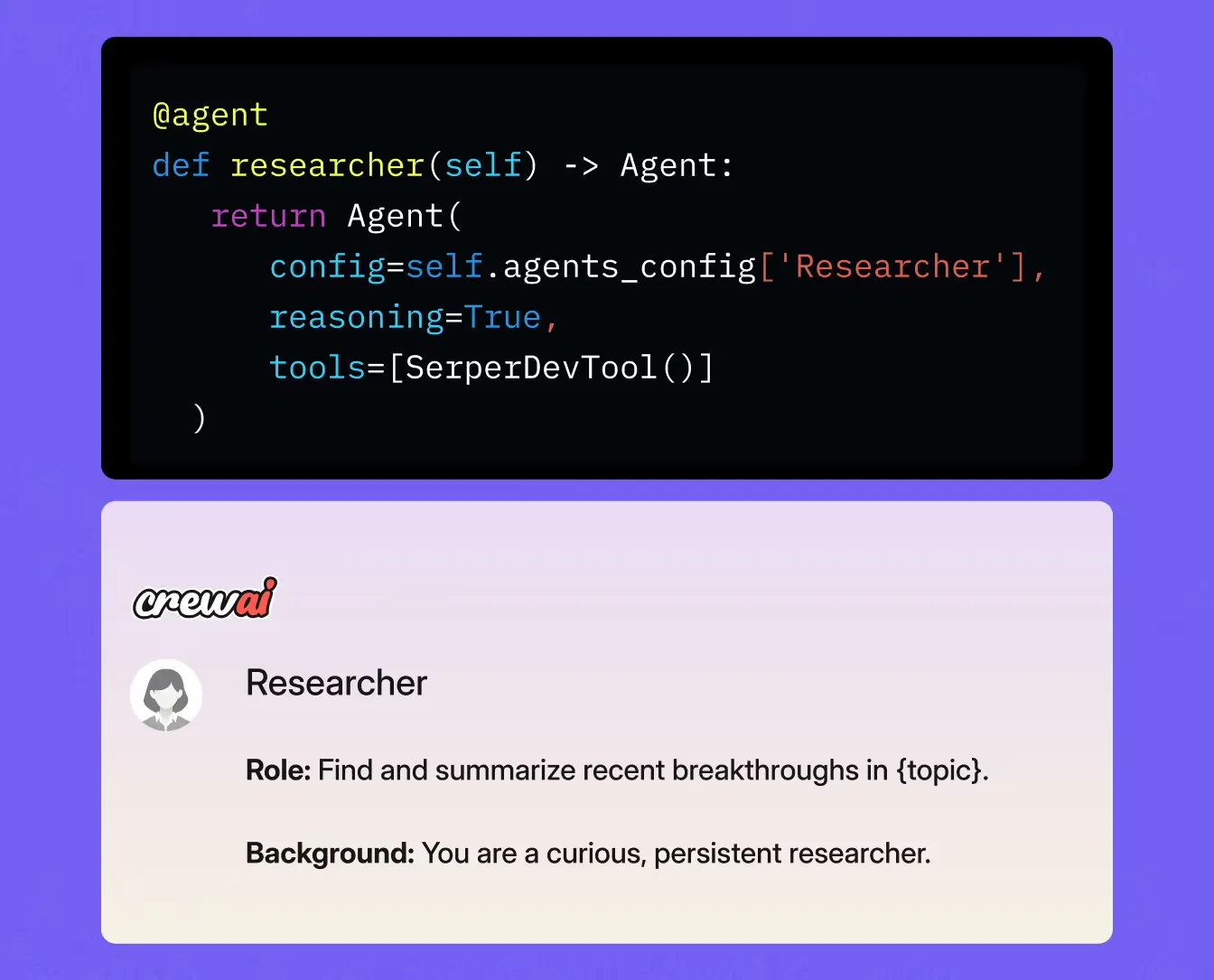
Feature Comparison
| Feature | CrewAI | MetaGPT |
|---|---|---|
| Coordination | ||
| Multiple agents on one task | Full support | Full support |
| Predefined role templates | Partial support | Full support |
| Custom role definition | Full support | Full support |
| Agent-to-agent delegation | Full support | Full support |
| Output | ||
| Structured output enforcement | Full support | Partial support |
| Code generation | Full support | Full support |
| Sandboxed code execution | Partial support | Full support |
| Document and specification generation | Partial support | Full support |
| Control | ||
| Deterministic sequencing option | Full support | Full support |
| Human-in-the-loop steps | Full support | Full support |
| Iteration limits | Full support | Full support |
| Tool calling | Full support | Full support |
| Platform | ||
| Python framework | Full support | Full support |
| Managed platform option | Full support | Not verified |
| Model-agnostic across providers | Full support | Full support |
| Active development | Full support | Full support |
Coordination
Multiple agents on one task
Predefined role templates
Custom role definition
Agent-to-agent delegation
Output
Structured output enforcement
Code generation
Sandboxed code execution
Document and specification generation
Control
Deterministic sequencing option
Human-in-the-loop steps
Iteration limits
Tool calling
Platform
Python framework
Managed platform option
Model-agnostic across providers
Active development
Which approach fits
CrewAI and MetaGPT both coordinate several agents through roles, at different levels of specialisation. CrewAI is general: you define the roles, goals and tasks for whatever problem you have, with flows available when the sequence must be repeatable. MetaGPT provides software-company roles following standard operating procedures, producing requirements, designs, code and tests as artefacts.
When each approach fits
Choose CrewAI if:
Choose CrewAI when the problem is not specifically software development, or when you want to define the roles yourself. Describing a researcher, an analyst and a reviewer is a direct way to express work that has those parts, delegation is handled by the framework, and flows constrain the path where repeatability matters.
Choose MetaGPT if:
Choose MetaGPT when you are automating software development and want the role structure provided rather than designed. Predefined roles following standard procedures produce identifiable artefacts — requirements, design documents, code and tests — rather than a conversation transcript you then have to interpret.
These scenarios reflect the available product evidence. Your requirements, existing stack, and team expertise should guide the final decision.
Frequently Asked Questions
Does specialisation help or constrain?
It helps when your problem matches the assumed shape, because a set of design decisions is already made and you start with a working structure. It constrains when it does not, because customising predefined roles is often more work than composing simple ones. MetaGPT assumes requirements flowing into design flowing into implementation; check whether your task actually looks like that.
Is automated software development usable yet?
For well-specified, self-contained tasks with clear acceptance criteria, these systems produce usable starting points. For work requiring understanding of an existing codebase, its conventions and the reasons behind past decisions, output needs substantial revision. Treat results as drafts to review, and measure how much editing they need before scaling the approach across a team.
How predictable is the execution path?
Model-driven delegation can take different paths on the same input, which suits open-ended work and complicates anything with an audit requirement or a downstream system expecting consistent output. Both frameworks offer ways to constrain the sequence — flows in one, procedures in the other. Decide early which mode you need, because retrofitting determinism is harder than designing for it.
How do we keep token costs under control?
Cap iterations and set a per-run token budget, then look at what goes into each prompt. Retrieving three relevant passages instead of thirty, and summarising conversation history rather than replaying it, cuts cost directly. Route classification and simple decisions to a small fast model and reserve a large one for steps where reasoning quality changes the answer. Without tracing, a prompt change that triples spend is invisible until the invoice.
What do these need to run?
Python 3.10 or later, an API key for a model provider, and somewhere to run the process — a container on Kubernetes, a serverless function, or a service behind a REST endpoint returning JSON. Retrieval adds a vector store, often PostgreSQL with pgvector. Agents that execute generated code need a sandbox: a Docker container with no network access, a CPU limit and a timeout, which is the one genuinely unusual requirement here.
What does running one of these in production require?
Tracing every step with inputs, outputs, latency and token cost; a hard ceiling on iterations so a loop that fails to converge stops rather than spends; retries that distinguish a transient API error from a model producing unusable output; and evaluation that catches quality regressions when a prompt or model changes. Frameworks provide different amounts of that, and the gap is where the engineering effort goes.