Decision comparison
AutoGPT vs CrewAI
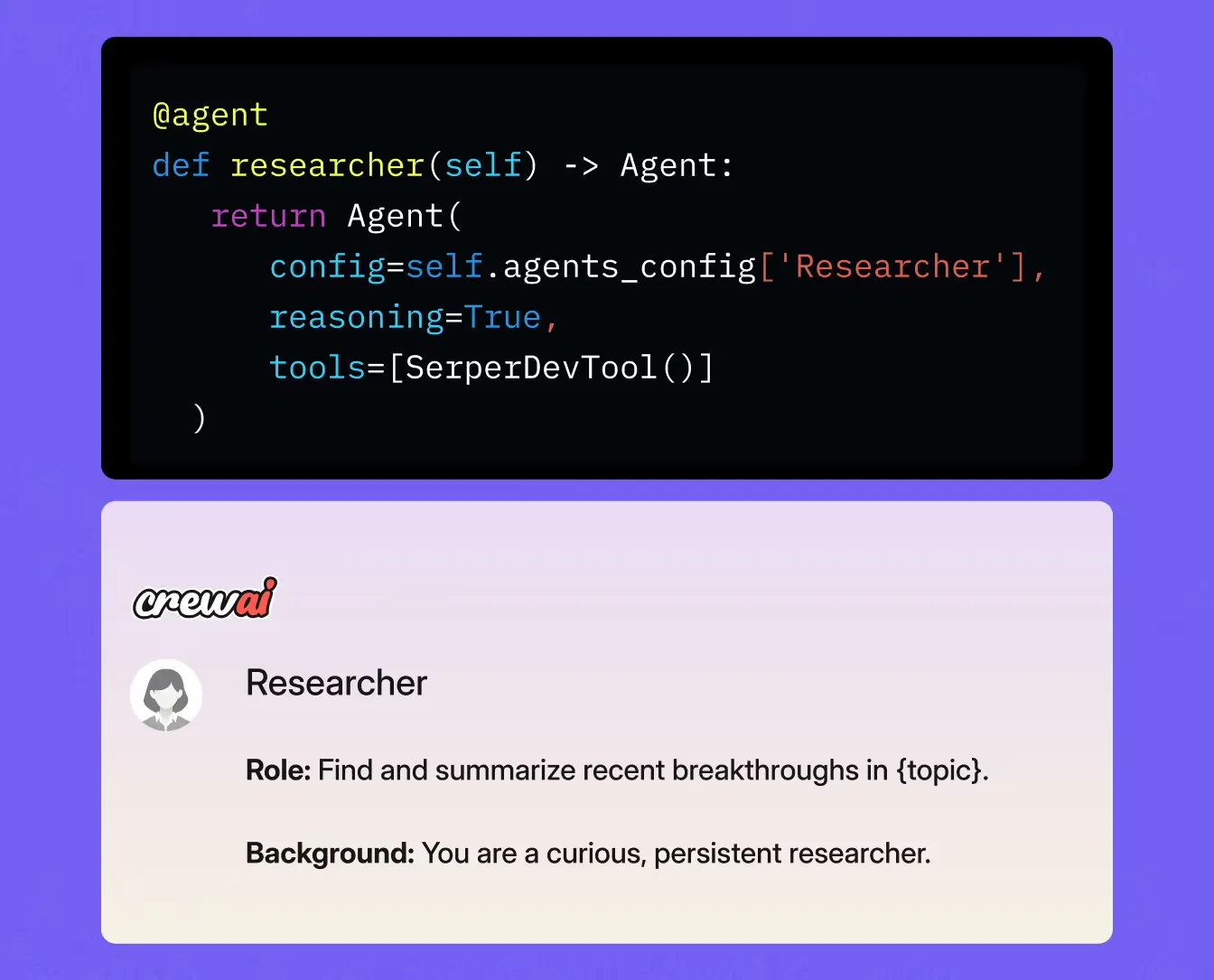
AutoGPT and CrewAI organise agent work differently. AutoGPT runs a goal-driven loop, assembled largely in a visual builder and run continuously or on a schedule by the platform. CrewAI is a Python framework where several agents with distinct roles work through assigned tasks and delegate to each other, with flows available when the sequence must be predictable.
Architecture choice. These take different approaches to the same problem. Read the table as a fit question rather than a feature race.
Applies to: digital workflow automation workloads built around intelligent assistants and hosted automation credits
All 2 are agent frameworks.
Quick Comparison
| Decision factor | AutoGPT | CrewAI |
|---|---|---|
| What it is | A platform for building and running continuous autonomous agents, grown out of the original goal-driven agent project | A Python framework for multi-agent systems built around roles, tasks and crews, with flows for deterministic sequencing |
| Shape | A platform with a visual builder and hosted running | A Python framework, with an optional managed platform |
| Model of work | A goal-driven loop of planning, acting and evaluating, run continuously or on a schedule | Agents with roles and goals work through assigned tasks, delegating to each other |
| Structure | One agent pursuing a goal, with configured blocks for actions | Several agents with distinct responsibilities coordinated as a crew |
| Predictability | Run length depends on how quickly the goal is met | Model-driven delegation varies between runs; flows constrain the path when needed |
| Where the work is | Assembling blocks and defining the goal | Writing role descriptions, goals and task definitions in Python |
| Best fit | Standalone agents that run on their own schedule with less code | Problems that decompose into roles doing distinct jobs |
AutoGPT
- What it is:
- A platform for building and running continuous autonomous agents, grown out of the original goal-driven agent project
- Shape:
- A platform with a visual builder and hosted running
- Model of work:
- A goal-driven loop of planning, acting and evaluating, run continuously or on a schedule
- Structure:
- One agent pursuing a goal, with configured blocks for actions
- Predictability:
- Run length depends on how quickly the goal is met
- Where the work is:
- Assembling blocks and defining the goal
- Best fit:
- Standalone agents that run on their own schedule with less code
CrewAI
- What it is:
- A Python framework for multi-agent systems built around roles, tasks and crews, with flows for deterministic sequencing
- Shape:
- A Python framework, with an optional managed platform
- Model of work:
- Agents with roles and goals work through assigned tasks, delegating to each other
- Structure:
- Several agents with distinct responsibilities coordinated as a crew
- Predictability:
- Model-driven delegation varies between runs; flows constrain the path when needed
- Where the work is:
- Writing role descriptions, goals and task definitions in Python
- Best fit:
- Problems that decompose into roles doing distinct jobs
Public signals
Verified factual signals only. Bars appear only for like-for-like metrics with five weekly assessments for every tool; missing evidence stays explicit. These signals do not establish enterprise adoption, product quality, or total cost.
| Metric | AutoGPT | CrewAI |
|---|---|---|
| Docker Hub pulls(Product adoption) | 4.4k | Not available |
| GitHub commits, 90d(Product adoption) | 334 | 335 |
| GitHub stars(Product adoption) | 187,000+ | 58,000+ |
| Search interest(Market interest) | 1 | 4 |
| Hacker News mentions, 90d(Community interest) | 0 | 8 |
| Stack Overflow questions(Community interest) | 17 | 40 |
| PyPI weekly downloads(Product adoption) | Not available | 585.4k |
As of September 14, 2026 — updated weekly.
Health & risk evidence
Observed public-source checks for mapped package versions and repositories.
AutoGPT
Package vulnerabilities
Not available
Repository security score
Not available
CrewAI
September 14, 2026Package vulnerabilities
PyPI · crewai@1.15.21
0 vulnerabilities
across 1 package
Repository security score
Not available
Interface Preview
CrewAI
Feature Comparison
| Feature | AutoGPT | CrewAI |
|---|---|---|
| Building | ||
| Visual or low-code builder | Full support | Not verified |
| Python framework | Partial support | Full support |
| Role-based agent definition | Partial support | Full support |
| Tool calling | Full support | Full support |
| Coordination | ||
| Multiple agents on one task | Partial support | Full support |
| Agent-to-agent delegation | Partial support | Full support |
| Deterministic sequencing option | Partial support | Full support |
| Human-in-the-loop steps | Full support | Full support |
| Operation | ||
| Continuous or scheduled running | Full support | Partial support |
| Hosted platform option | Full support | Full support |
| Built-in step tracing | Full support | Partial support |
| Iteration limits | Full support | Full support |
| Platform | ||
| Model-agnostic across providers | Full support | Full support |
| Structured output enforcement | Partial support | Full support |
| Open source | Full support | Full support |
| Active development | Full support | Full support |
Building
Visual or low-code builder
Python framework
Role-based agent definition
Tool calling
Coordination
Multiple agents on one task
Agent-to-agent delegation
Deterministic sequencing option
Human-in-the-loop steps
Operation
Continuous or scheduled running
Hosted platform option
Built-in step tracing
Iteration limits
Platform
Model-agnostic across providers
Structured output enforcement
Open source
Active development
Which approach fits
AutoGPT and CrewAI organise agent work differently. AutoGPT runs a goal-driven loop, assembled largely in a visual builder and run continuously or on a schedule by the platform. CrewAI is a Python framework where several agents with distinct roles work through assigned tasks and delegate to each other, with flows available when the sequence must be predictable.
When each approach fits
Choose AutoGPT if:
Choose AutoGPT when the agent is a standalone thing that runs on its own schedule and you would rather assemble it than write integration code. The builder reduces the code required, the platform handles running agents over time, and step tracing is provided rather than added afterwards.
Choose CrewAI if:
Choose CrewAI when the work genuinely divides into roles — a researcher gathering material, a writer drafting, a reviewer checking — and you want that expressed in Python you control. Delegation between agents is handled by the framework, and flows constrain the sequence where the path needs to be repeatable.
These scenarios reflect the available product evidence. Your requirements, existing stack, and team expertise should guide the final decision.
Frequently Asked Questions
One agent with a goal, or several with roles?
Several roles help when the parts need different context and different tools, because each agent's prompt stays focused and its context window stays small. One goal-driven agent is simpler when the work is a single line of reasoning with tool calls along the way. Adding roles to a task that does not divide costs extra model calls and adds variability without buying separation.
How do we stop an agent looping forever?
Set a hard iteration ceiling and a per-run token budget, and make exceeding either a terminal failure that reports rather than a condition that retries. Goal-driven loops are the most expensive failure mode in this category, because a task the model cannot complete produces attempts indefinitely. Both support limits; leaving them at generous defaults is the common mistake.
How do we keep token costs under control?
Cap iterations and set a per-run token budget, then look at what goes into each prompt. Retrieving three relevant passages instead of thirty, and summarising conversation history rather than replaying it, cuts cost directly. Route classification and simple decisions to a small fast model and reserve a large one for steps where reasoning quality changes the answer. Without tracing, a prompt change that triples spend is invisible until the invoice.
What do these need to run?
Python 3.10 or later, an API key for a model provider, and somewhere to run the process — a container on Kubernetes, a serverless function, or a service behind a REST endpoint returning JSON. Retrieval adds a vector store, often PostgreSQL with pgvector. Agents that execute generated code need a sandbox: a Docker container with no network access, a CPU limit and a timeout, which is the one genuinely unusual requirement here.
What does running one of these in production require?
Tracing every step with inputs, outputs, latency and token cost; a hard ceiling on iterations so a loop that fails to converge stops rather than spends; retries that distinguish a transient API error from a model producing unusable output; and evaluation that catches quality regressions when a prompt or model changes. Frameworks provide different amounts of that, and the gap is where the engineering effort goes.
How predictable does the execution path need to be?
Decide this early, because it shapes the design. Open-ended exploration benefits from letting the model choose what to do next. Anything with an audit requirement, a service level, or a downstream system expecting consistent output benefits from a fixed sequence. CrewAI's flows exist for that second case, and the mistake is discovering the requirement after building for the first.