Decision comparison
CrewAI vs Haystack
CrewAI and Haystack organise LLM work around different ideas. CrewAI builds crews of agents with roles, goals and tasks, delegating to each other, which suits problems that decompose into distinct jobs. Haystack builds typed component pipelines with document stores, retrievers and rankers as core parts, which suits systems where retrieval quality is the hard problem.
Architecture choice. These take different approaches to the same problem. Read the table as a fit question rather than a feature race.
Applies to: role-based multi-agent collaboration workloads
All 2 are agent frameworks.
Quick Comparison
| Decision factor | CrewAI | Haystack |
|---|---|---|
| What it is | A Python framework for multi-agent systems built around roles, tasks and crews, with flows for deterministic sequencing | An open-source Python framework from deepset for building search, retrieval-augmented generation and agent pipelines |
| Core abstraction | Agents with roles and goals, grouped into crews that work through tasks | A pipeline of components connected by typed inputs and outputs |
| Coordination | Agents delegate to each other and hand off work, with flows for deterministic sequencing | Components run in a defined order, with branching where needed |
| Retrieval | Available through tools and integrations | Document stores, retrievers, rankers and preprocessors are core framework parts |
| Where the work is | Writing role descriptions, goals and task definitions | Wiring components and tuning retrieval quality |
| Predictability | Agent delegation is model-driven, so the path varies between runs; flows constrain it | Pipelines execute a defined structure, so the path is the same each time |
| Best fit | Problems that decompose into roles doing distinct jobs | Search and retrieval-augmented generation where context quality is the problem |
CrewAI
- What it is:
- A Python framework for multi-agent systems built around roles, tasks and crews, with flows for deterministic sequencing
- Core abstraction:
- Agents with roles and goals, grouped into crews that work through tasks
- Coordination:
- Agents delegate to each other and hand off work, with flows for deterministic sequencing
- Retrieval:
- Available through tools and integrations
- Where the work is:
- Writing role descriptions, goals and task definitions
- Predictability:
- Agent delegation is model-driven, so the path varies between runs; flows constrain it
- Best fit:
- Problems that decompose into roles doing distinct jobs
Haystack
- What it is:
- An open-source Python framework from deepset for building search, retrieval-augmented generation and agent pipelines
- Core abstraction:
- A pipeline of components connected by typed inputs and outputs
- Coordination:
- Components run in a defined order, with branching where needed
- Retrieval:
- Document stores, retrievers, rankers and preprocessors are core framework parts
- Where the work is:
- Wiring components and tuning retrieval quality
- Predictability:
- Pipelines execute a defined structure, so the path is the same each time
- Best fit:
- Search and retrieval-augmented generation where context quality is the problem
Public signals
Verified factual signals only. Bars appear only for like-for-like metrics with five weekly assessments for every tool; missing evidence stays explicit. These signals do not establish enterprise adoption, product quality, or total cost.
| Metric | CrewAI | Haystack |
|---|---|---|
| GitHub commits, 90d(Product adoption) | 335 | 749 |
| GitHub stars(Product adoption) | 58,000+ | 26,000+ |
| Search interest(Market interest) | 4 | Unavailable |
| Hacker News mentions, 90d(Community interest) | 8 | 6 |
| PyPI weekly downloads(Product adoption) | 585.4k | 126.0k |
| Stack Overflow questions(Community interest) | 40 | 77 |
| Docker Hub pulls(Product adoption) | Not available | 717.2k |
| Hugging Face downloads(Product adoption) | Not available | 954.6k |
| Hugging Face likes(Product adoption) | Not available | 1.3k |
As of September 14, 2026 — updated weekly.
Health & risk evidence
Observed public-source checks for mapped package versions and repositories.
CrewAI
September 14, 2026Package vulnerabilities
PyPI · crewai@1.15.21
0 vulnerabilities
across 1 package
Repository security score
Not available
Haystack
September 14, 2026Package vulnerabilities
PyPI · haystack-ai@3.1.1
0 vulnerabilities
across 1 package
Repository security score
Not available
Interface Preview
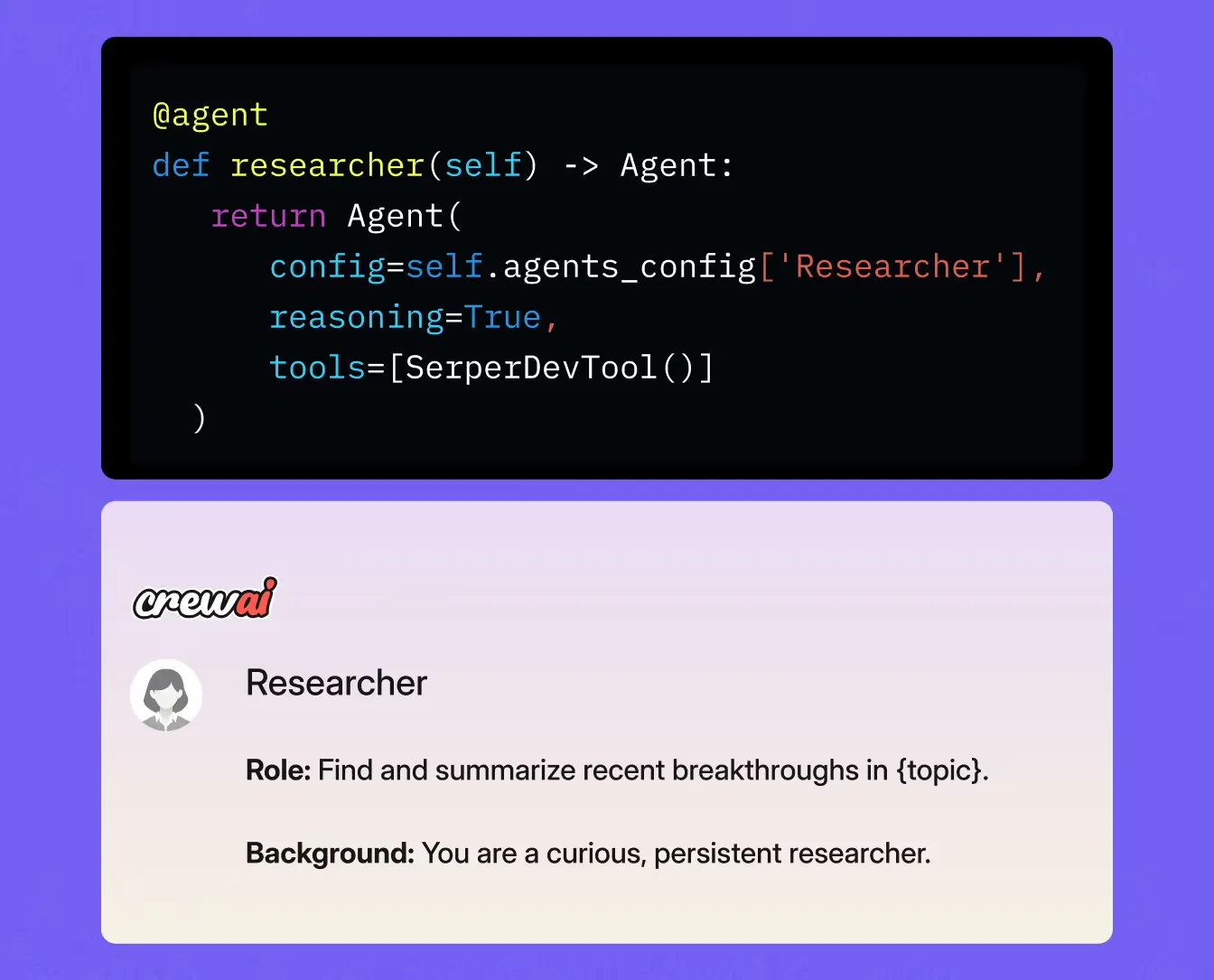
CrewAI
Haystack
Feature Comparison
| Feature | CrewAI | Haystack |
|---|---|---|
| Building | ||
| Role-based agent definition | Full support | Partial support |
| Typed component pipelines | Not verified | Full support |
| Tool calling | Full support | Full support |
| Structured output enforcement | Full support | Full support |
| Retrieval | ||
| Document stores and retrievers built in | Partial support | Full support |
| Rankers and preprocessing components | Partial support | Full support |
| Hybrid search support | Partial support | Full support |
| Retrieval evaluation | Partial support | Full support |
| Control | ||
| Deterministic execution path | Partial support | Full support |
| Agent-to-agent delegation | Full support | Partial support |
| Conditional branching | Full support | Full support |
| Human-in-the-loop steps | Full support | Partial support |
| Platform | ||
| Python-first | Full support | Full support |
| Model-agnostic | Full support | Full support |
| Managed platform option | Full support | Partial support |
| Streaming responses | Full support | Full support |
Building
Role-based agent definition
Typed component pipelines
Tool calling
Structured output enforcement
Retrieval
Document stores and retrievers built in
Rankers and preprocessing components
Hybrid search support
Retrieval evaluation
Control
Deterministic execution path
Agent-to-agent delegation
Conditional branching
Human-in-the-loop steps
Platform
Python-first
Model-agnostic
Managed platform option
Streaming responses
Which approach fits
CrewAI and Haystack organise LLM work around different ideas. CrewAI builds crews of agents with roles, goals and tasks, delegating to each other, which suits problems that decompose into distinct jobs. Haystack builds typed component pipelines with document stores, retrievers and rankers as core parts, which suits systems where retrieval quality is the hard problem.
When each approach fits
Choose CrewAI if:
Choose CrewAI when the work genuinely divides into roles — a researcher gathering material, a writer drafting, a reviewer checking. Describing agents by role and goal is a fast way to express that, delegation between them is handled by the framework, and flows constrain the sequence where you need the path to be predictable.
Choose Haystack if:
Choose Haystack when the difficulty is getting the right context in front of the model. Document stores, retrievers, rankers, preprocessors and retrieval evaluation are framework components, typed connections catch wiring mistakes before runtime, and the pipeline executes the same way every run.
These scenarios reflect the available product evidence. Your requirements, existing stack, and team expertise should guide the final decision.
Frequently Asked Questions
Does role-based decomposition actually help?
It helps when the roles correspond to genuinely different work with different context and different tools — research, drafting, review. It helps less when the roles are labels on one linear process, where you pay for extra model calls and added variability without gaining separation. Ask whether each role needs different tools or different context; if not, one agent with a good prompt is usually the better answer.
How predictable is the execution path?
A pipeline runs the same components in the same order every time, which makes testing and debugging conventional. Model-driven delegation means the path can differ between runs on the same input, which is powerful for open-ended tasks and awkward when you need the same behaviour every time. CrewAI's flows exist to constrain that where determinism matters.
When is retrieval the hard part?
When the model could answer correctly but keeps receiving the wrong context. The symptoms are answers citing the wrong source or missing information you know is in the corpus. That is fixed by chunking, embedding choice, hybrid search, reranking and measurement, and having those as framework components is worth more than any agent abstraction.
What do these need to run?
Python 3.10 or later in both cases, an API key for whichever model provider you use, and somewhere to run the process — a container on Kubernetes, a serverless function, or a FastAPI service behind a REST endpoint returning JSON. Retrieval adds a vector store: PostgreSQL with pgvector, or a dedicated store. Nothing here requires unusual infrastructure; the operational weight is in observability and cost control rather than in hosting.
What does it take to run one of these in production?
Tracing every step with its inputs, outputs, latency and token cost; a hard ceiling on iterations so a loop that fails to converge stops rather than spends; retries that distinguish a transient API error from a model producing unusable output; and evaluation that catches quality regressions when a prompt or model changes. Frameworks differ in how much of that they provide, and the gap is where most of the engineering effort goes.
Can we combine them?
Yes — a retrieval pipeline exposed as a tool that agents call is a clean division, and keeps each framework doing what it is good at. The cost is two dependency sets and two sets of conventions for your team to hold. Justified when both retrieval and coordination are genuinely hard; unnecessary when one clearly dominates.
Which is more maintainable a year on?
A typed pipeline is explicit: what connects to what is in the code, and a change that breaks a connection fails at construction. Role-based crews concentrate behaviour in prompt text, which is faster to write and harder to reason about later, because changing one role's description can shift what the others receive. Neither is wrong, but the maintenance profiles differ.