Decision comparison
Hevo Data vs Rivery
Hevo Data and Rivery are both managed, no-code data integration platforms, and they differ in scope. Hevo concentrates on moving data from sources into the warehouse reliably, with near real-time replication and in-pipeline transformation. Rivery covers that plus workflow orchestration with dependencies and branching, and reverse ETL sending warehouse data back to operational systems.
Architecture choice. These take different approaches to the same problem. Read the table as a fit question rather than a feature race.
All 2 are ELT platforms.
Quick Comparison
| Decision factor | Hevo Data | Rivery |
|---|---|---|
| What it is | A managed no-code ELT platform with pre-built connectors and near real-time replication | A managed data integration platform combining ELT, orchestration and reverse ETL in one product |
| Scope | Getting data from sources into the warehouse, with transformations available in the pipeline | Ingestion, transformation logic, workflow orchestration and pushing data back out to business tools |
| Pipeline building | Connectors configured in a browser, no code required | Rivers configured in a browser, with Python and SQL logic steps for custom work |
| Orchestration | Scheduling per pipeline, with dependencies handled in the warehouse or an external scheduler | Multi-step workflows with dependencies, conditions and branching inside the platform |
| Reverse ETL | Focused on loading into the warehouse | Sends warehouse data back to CRM and other operational systems |
| Pricing shape | Free plan is free forever for a limited connector set, with up to 1 million events per month. Starter is $265 per month billed annually or $299 billed monthly, from 5 million events. Professional is $750 per month billed annually or $849 billed monthly, from 20 million events. Business Critical is custom priced. Plans scale with monthly event volume, not rows. | Professional free, Pro Plus and Enterprise Contact Sales. Other amounts mentioned: $100, $1,200. |
| Best fit | Teams whose problem is getting sources into the warehouse reliably | Teams that also need orchestration and data flowing back out to business systems |
Hevo Data
- What it is:
- A managed no-code ELT platform with pre-built connectors and near real-time replication
- Scope:
- Getting data from sources into the warehouse, with transformations available in the pipeline
- Pipeline building:
- Connectors configured in a browser, no code required
- Orchestration:
- Scheduling per pipeline, with dependencies handled in the warehouse or an external scheduler
- Reverse ETL:
- Focused on loading into the warehouse
- Pricing shape:
- Free plan is free forever for a limited connector set, with up to 1 million events per month. Starter is $265 per month billed annually or $299 billed monthly, from 5 million events. Professional is $750 per month billed annually or $849 billed monthly, from 20 million events. Business Critical is custom priced. Plans scale with monthly event volume, not rows.
- Best fit:
- Teams whose problem is getting sources into the warehouse reliably
Rivery
- What it is:
- A managed data integration platform combining ELT, orchestration and reverse ETL in one product
- Scope:
- Ingestion, transformation logic, workflow orchestration and pushing data back out to business tools
- Pipeline building:
- Rivers configured in a browser, with Python and SQL logic steps for custom work
- Orchestration:
- Multi-step workflows with dependencies, conditions and branching inside the platform
- Reverse ETL:
- Sends warehouse data back to CRM and other operational systems
- Pricing shape:
- Professional free, Pro Plus and Enterprise Contact Sales. Other amounts mentioned: $100, $1,200.
- Best fit:
- Teams that also need orchestration and data flowing back out to business systems
Public signals
Verified factual signals only. Bars appear only for like-for-like metrics with five weekly assessments for every tool; missing evidence stays explicit. These signals do not establish enterprise adoption, product quality, or total cost.
| Metric | Hevo Data | Rivery |
|---|---|---|
| Search interest(Market interest) | 0 | Unavailable |
| Product Hunt comments(Community interest) | 2 | Not available |
| Product Hunt reviews(Community interest) | 0 | Not available |
| Product Hunt votes(Community interest) | 90 | Not available |
| GitHub commits, 90d(Developer adoption) | Not available | 0 |
| GitHub stars(Developer adoption) | Not available | 17 |
As of September 21, 2026 — updated weekly.
Interface Preview
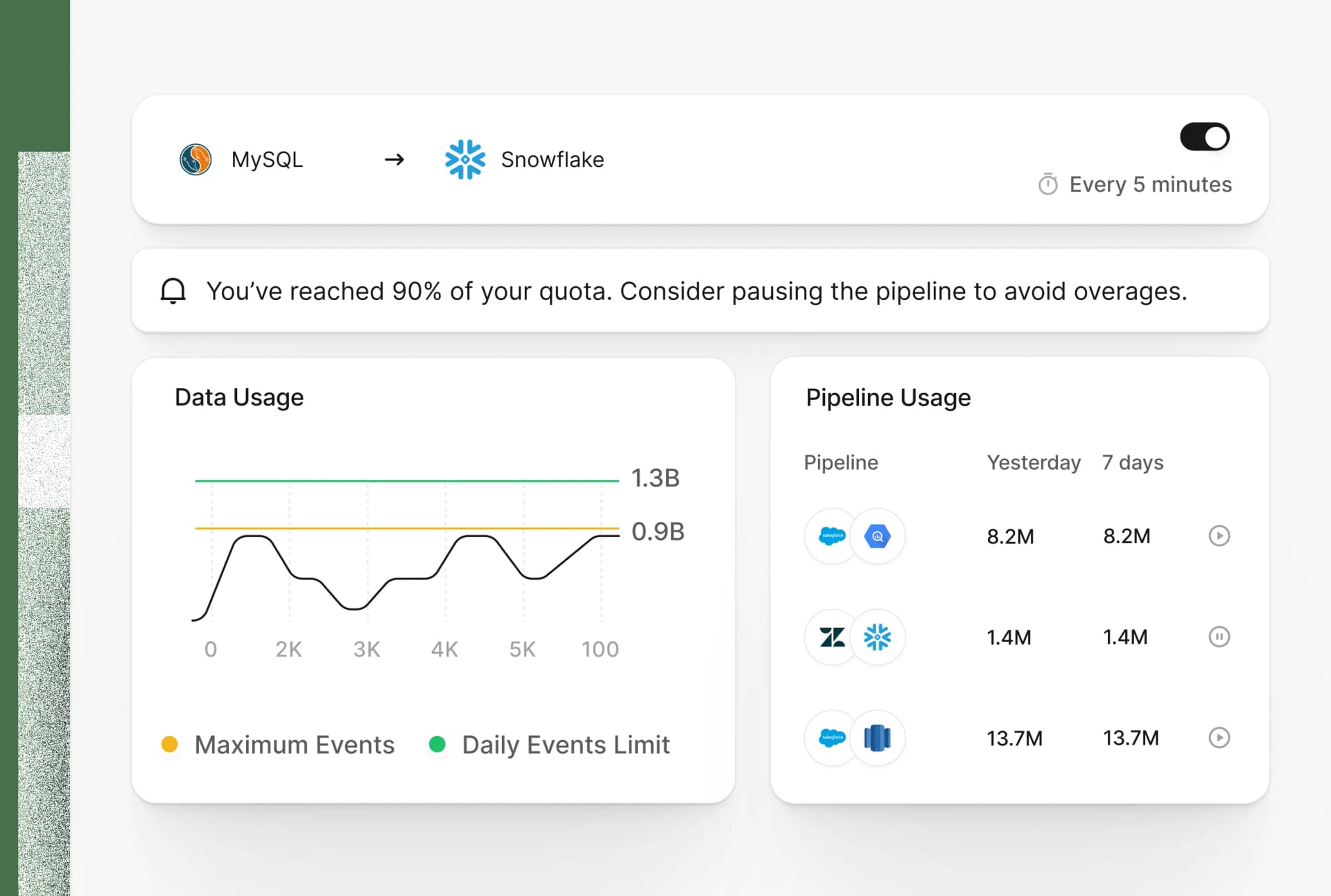
Hevo Data
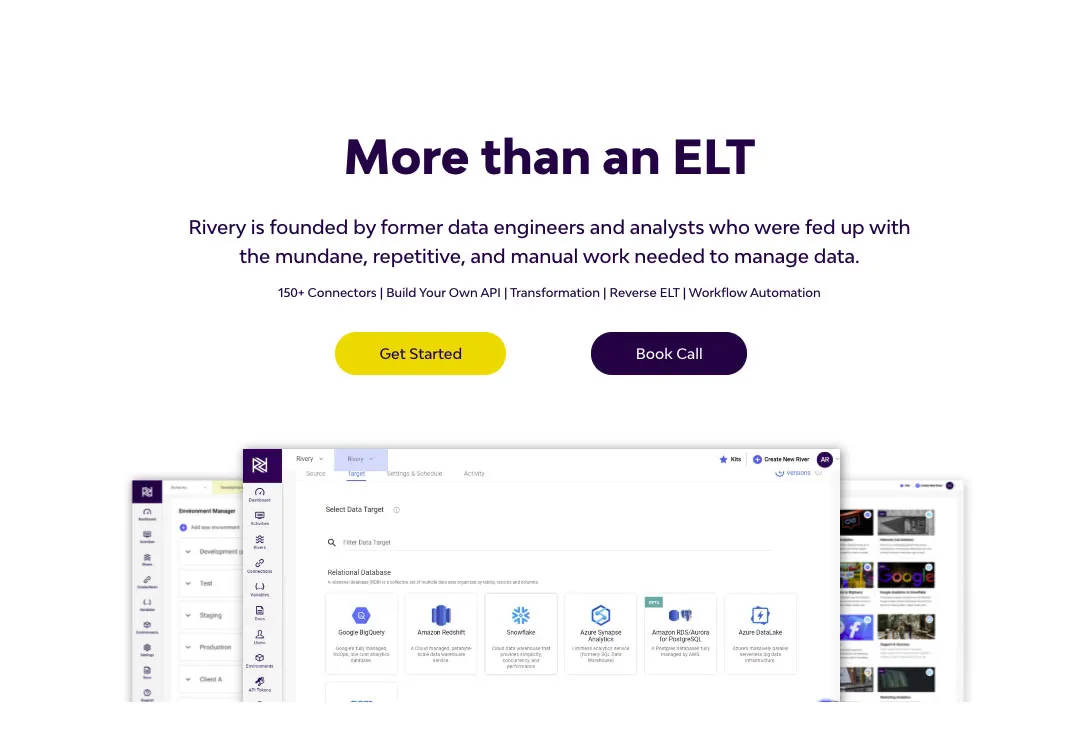
Rivery
Feature Comparison
| Feature | Hevo Data | Rivery |
|---|---|---|
| Ingestion | ||
| Pre-built vendor-maintained connectors | Full support | Full support |
| Change data capture from databases | Full support | Full support |
| Near real-time replication | Full support | Partial support |
| Automatic schema drift handling | Full support | Full support |
| Processing | ||
| In-pipeline transformations | Full support | Full support |
| Python logic steps | Full support | Full support |
| SQL transformation in the warehouse | Full support | Full support |
| dbt integration | Full support | Full support |
| Workflow | ||
| Multi-step orchestration with dependencies | Partial support | Full support |
| Conditional branching | Partial support | Full support |
| Reverse ETL to business systems | Not verified | Full support |
| Alerting on failure | Full support | Full support |
| Platform | ||
| Fully managed | Full support | Full support |
| REST API and automation | Full support | Full support |
| Self-hosted option | Not verified | Not verified |
| Role-based access control | Full support | Full support |
Ingestion
Pre-built vendor-maintained connectors
Change data capture from databases
Near real-time replication
Automatic schema drift handling
Processing
In-pipeline transformations
Python logic steps
SQL transformation in the warehouse
dbt integration
Workflow
Multi-step orchestration with dependencies
Conditional branching
Reverse ETL to business systems
Alerting on failure
Platform
Fully managed
REST API and automation
Self-hosted option
Role-based access control
Which approach fits
Hevo Data and Rivery are both managed, no-code data integration platforms, and they differ in scope. Hevo concentrates on moving data from sources into the warehouse reliably, with near real-time replication and in-pipeline transformation. Rivery covers that plus workflow orchestration with dependencies and branching, and reverse ETL sending warehouse data back to operational systems.
When each approach fits
Choose Hevo Data if:
Choose Hevo Data when the problem is ingestion and you already have orchestration. Vendor-maintained connectors handle API changes, schema drift is applied automatically, near real-time replication covers sources where hourly batches fall short, and transformations can run in Python or SQL before data lands in the warehouse.
Choose Rivery if:
Choose Rivery when you want ingestion, orchestration and reverse ETL in one platform. Multi-step workflows with dependencies and conditions remove the need for a separate scheduler, Python and SQL logic steps handle custom work, and sending enriched warehouse data back to a CRM closes the loop without another tool.
These scenarios reflect the available product evidence. Your requirements, existing stack, and team expertise should guide the final decision.
Frequently Asked Questions
Do we need orchestration inside the integration platform?
Not if you already run Airflow, Dagster or an equivalent, because dependencies between loads and transformations belong wherever the rest of your scheduling lives. It helps when you have no scheduler and do not want to run one: a platform that loads three sources, waits for all of them, then runs a transformation is doing real work you would otherwise build.
What is reverse ETL for?
Getting computed values out of the warehouse and into the tools people use. A customer health score calculated in SQL is useless sitting in a table; it becomes useful in the CRM where the account manager sees it. Rivery includes that path. If nobody has asked for warehouse data in Salesforce or HubSpot, it is capability you would not use.
How do the pricing models compare?
Hevo prices on records processed, so the bill follows data volume and your noisiest source dominates it. Rivery uses consumption credits, so the bill follows what the platform runs, including orchestration and transformation steps. Neither is predictable from a rate card: list your sources with monthly volumes and your expected workflow runs, and ask both vendors to price that list.
What happens when a source API changes?
Both are managed, so the vendor updates the connector. The practical question is how quickly, and the way to find out is to ask each for recent examples — a specific source that changed, and how long the fix took. Assurances are easy; a named incident with a date is evidence. This is the main thing you are buying from either platform.
Can either run in our own infrastructure?
Neither offers self-hosting. Both are managed SaaS, which means your source data passes through the vendor's systems on the way to your warehouse. If a residency rule or security policy forbids that, the comparison to make is against self-hostable options rather than between these two.
How should we evaluate them?
Take your three most awkward sources — the one with a strange API, the one with the highest volume, and the one that changes schema most often — and build those pipelines in a trial on both. Two weeks of that shows connector quality, schema handling and support responsiveness far better than a catalogue count, and those are the properties that determine whether the platform is still working a year from now.