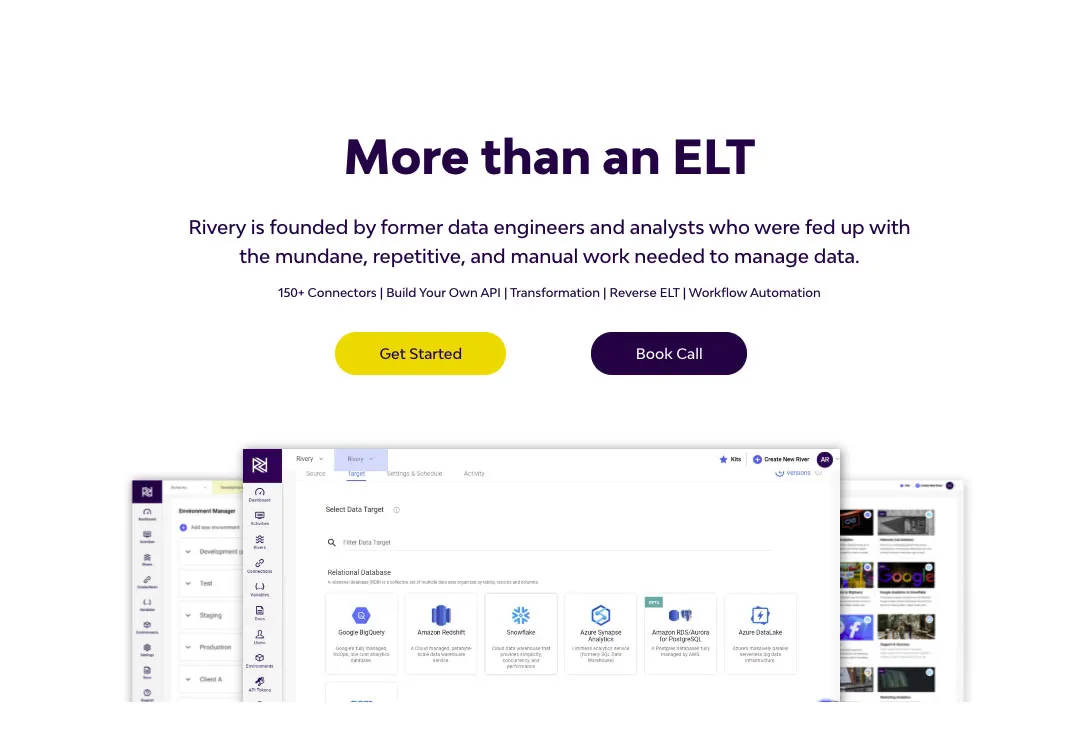
Rivery: product and architecture
Our Rivery review verdict: Rivery is best for data teams that want a fully managed cloud ELT platform spanning ingestion, transformation, orchestration, and activation without committing to a purely code-first workflow. Its strongest position is with marketing, sales, and operational data pipelines where teams value pre-built connectors, managed API and CDC replication, and the option to combine no-code development with SQL or Python. We recommend Rivery for teams that need one SaaS platform to move data into a cloud data warehouse or data lake and then operationalize it; avoid it if your evaluation requires transparent, fixed public pricing beyond its free Professional plan.
Overview
Rivery is a SaaS data integration platform in the data-pipeline category. It specializes in marketing, sales, and operational data, offering pre-built connectors and automated data pipelines. The product positions itself as a fully managed cloud ELT tool designed to help teams solve complex pipeline challenges while reducing the operational work of running integration infrastructure.
The platform’s stated workflow covers five stages: ingest, transform, orchestrate, activate, and scale. That scope matters because Rivery is not presented as only a connector catalog or only a transformation environment. Instead, it is designed to support end-to-end ELT pipelines, from extracting data from apps and databases to loading it into a data lake or cloud data warehouse, transforming it into business models, and controlling dependencies across the workflow.
Rivery supports both no-code and custom-code approaches. That makes it relevant to mixed data organizations: analytics engineers can use SQL or Python for transformations, while less code-centric users can build and manage parts of a pipeline through the platform’s visual capabilities. The trade-off is that a broad platform requires teams to evaluate governance, workflow conventions, and vendor dependence across more of their data stack than they would with a narrowly scoped ingestion tool.
The available product information explicitly highlights analytics and AI use cases. However, it does not provide public benchmark data, connector counts, customer counts, uptime figures, or documented limits for replication throughput. Those gaps do not invalidate the product, but they mean teams should test their own source volumes, scheduling needs, and warehouse targets during the free Professional tier or a sales-led evaluation.
Key Features and Architecture
Rivery’s architecture is organized around an end-to-end ELT lifecycle rather than a single integration function. The product description identifies ingestion, transformation, orchestration, activation, and scaling as core stages. For teams assessing the platform, this means the evaluation should focus on how those stages work together in a production pipeline rather than treating Rivery as a simple point-to-point data mover.
Key capabilities include:
-
Managed API and CDC replication: Rivery states that users can extract data from applications or databases and load it into a data lake or cloud data warehouse through managed API and CDC replication. This is important for operational and database-sourced data because it places both API-based extraction and change-data-capture replication within the platform’s ingestion model.
-
Pre-built connectors: The platform specializes in marketing, sales, and operational data and provides pre-built connectors. These connectors are intended to reduce the amount of custom extraction work required for common business-system data flows. The supplied data does not specify the connector catalog size or name individual connector endpoints, so teams should validate their exact systems directly.
-
No-code pipeline construction: Rivery supports no-code development for building end-to-end ELT pipelines. This is useful when analytics or operations teams need to participate in pipeline development without making every workflow a software-engineering project. The cost is that teams still need disciplined ownership and change-management practices; no-code does not remove the need to understand source schemas or downstream business logic.
-
Custom SQL and Python transformations: Raw data can be turned into business data models using SQL or Python. This gives engineering-oriented teams a route to express transformations in familiar languages while keeping those transformations connected to the ingestion and orchestration environment.
-
Transformation workflows and pre-built data model kits: Rivery describes advanced transformation workflows alongside pre-built data model kits. These capabilities can shorten the path from raw extracted data to modeled business data. The provided information does not define the available kits, their industries, or their implementation details, so buyers should request examples relevant to their warehouse and reporting model.
-
Orchestration and dependency management: Rivery is designed to control data flow from start to finish and manage dependencies between and within processes. This is a meaningful architectural feature because production ELT systems fail at handoffs: an ingestion job completing is not enough if dependent transformations or activation steps are not coordinated.
-
Activation: The platform includes activation as part of its stated workflow. That extends Rivery’s scope beyond loading and modeling data, positioning it for teams that need data movement connected to operational business processes. The supplied data does not identify activation destinations or activation mechanisms, so this area requires direct product validation.
-
Data Connector Agent and GenAI positioning: The website description includes “Data Connector Agent” and describes building data pipelines faster with GenAI. These are product-positioning signals worth examining, but the supplied information does not document the agent’s supported tasks, model behavior, security controls, or technical limits. We would not make an architecture decision based on the GenAI claim alone.
The practical strength of this architecture is consolidation. A team can evaluate a single managed platform for extraction, loading, SQL or Python transformation, and workflow dependencies. The practical risk is concentration: if Rivery becomes the control plane for multiple pipeline stages, migrations and platform changes can affect more than one part of the data estate. Teams should therefore define where Rivery ends and where their warehouse, code repository, and downstream operational systems remain authoritative.
Ideal Use Cases
Rivery fits best when a data team wants a managed ELT platform for business-system data and does not want to assemble separate services for ingestion, transformations, and orchestration. Its focus on marketing, sales, and operational data makes it especially relevant to organizations whose analytical questions depend on combining customer-facing and internal operational sources. A team that needs to load those sources into a cloud data warehouse or data lake, model them in SQL or Python, and sequence dependent workflows is squarely within Rivery’s stated scope.
One suitable scenario is a small analytics engineering team supporting marketing and revenue operations. The team can use pre-built connectors and managed API replication for business applications, then use SQL or Python to turn raw records into business data models. This setup is strongest when the group needs governed recurring pipelines but does not want to operate its own extraction infrastructure. The team should still establish review practices for transformations and dependency changes because visual development does not automatically prevent incorrect business logic.
A second use case is a data organization modernizing operational reporting into a cloud data warehouse or data lake. Rivery’s stated ability to extract from applications and databases, then load through managed API and CDC replication, matches a program where the data estate includes both SaaS systems and databases. Orchestration becomes valuable when ingestion must finish before downstream transformations and activation processes run. This is a better match than a tool that only replicates source data and leaves the team to coordinate the rest elsewhere.
A third use case is a mixed technical team where analysts, analytics engineers, and data engineers need different levels of control. No-code construction can reduce friction for repeatable pipeline patterns, while SQL and Python give technical contributors a path for custom transformations. We recommend Rivery for these mixed teams when they want one platform to manage the handoff from raw data to business models without requiring every contributor to write extraction code.
Don’t use Rivery if your procurement process requires fixed, publicly published prices for production plans. Rivery’s Professional tier is free, but Pro Plus and Enterprise require contacting sales, and the available information does not publish their plan prices or usage thresholds. Also look elsewhere if your selection depends on documented connector counts, named activation destinations, throughput benchmarks, or public service-level metrics, because those facts are not contained in the supplied product data.
Strengths & Trade-offs
Rivery’s advantages are most meaningful for teams that want managed ELT breadth without committing entirely to either visual development or custom code. Its limitations are equally important: the supplied evidence supports strong platform scope, but it does not supply many of the operational and commercial details that a mature procurement review needs.
Pros
-
Managed API and CDC replication support both application and database ingestion. Rivery explicitly supports loading data from apps or databases into a data lake or cloud data warehouse through managed API and CDC replication. This is valuable for teams combining business-system data with database changes in one integration platform.
-
It covers more than ingestion. Rivery’s defined flow includes ingest, transform, orchestrate, activate, and scale. Teams can evaluate a connected workflow rather than stitching a connector tool to separate transformation and dependency-management systems.
-
SQL and Python provide a technical escape hatch. Rivery is not limited to no-code configuration: it states that teams can transform raw data into business data models with SQL or Python. That is particularly useful when standardized visual patterns are insufficient for a required modeling step.
-
No-code and code can serve different contributors. The platform explicitly supports no-code or custom code. This makes Rivery practical for organizations where analytics engineers and data engineers need code-level control while adjacent users need simpler pipeline construction.
-
Its product focus aligns with business-facing datasets. Rivery specializes in marketing, sales, and operational data and offers pre-built connectors. That positioning is more specific than a generic infrastructure-oriented data movement tool and can reduce effort for teams centered on commercial and operational analytics.
Cons
-
Paid-plan pricing is not publicly quantified in the supplied data. Pro Plus and Enterprise are both listed as Contact Sales, and no dollar amounts are assigned to either tier. This makes upfront cost comparison difficult for data leaders building a budget or evaluating total cost across vendors.
-
The free Professional plan’s limits are undisclosed. Professional is free, but the supplied pricing page data does not state limits for users, usage, connectors, pipelines, or included features. A free evaluation is useful, but it does not tell a buyer when production usage will require an upgrade.
-
Public technical evidence is incomplete for high-scale decisions. The supplied information does not provide performance metrics, replication throughput, connector counts, named connector coverage, uptime commitments, or customer-scale data. Rivery may be suitable, but those omissions mean buyers should not infer scale characteristics from the product positioning.
-
Activation is described without implementation detail. Rivery includes activation in its stated workflow, but the available data does not identify destinations, configuration options, or operational behavior. Teams with a critical reverse-data-flow requirement should verify this directly rather than assuming it covers their target systems.
-
GenAI claims are not enough to assess governance. The website description references a Data Connector Agent and GenAI pipeline building, but the supplied data does not define supported tasks, limits, controls, or security behavior. This is weak evidence for teams whose architecture review requires concrete AI governance details.