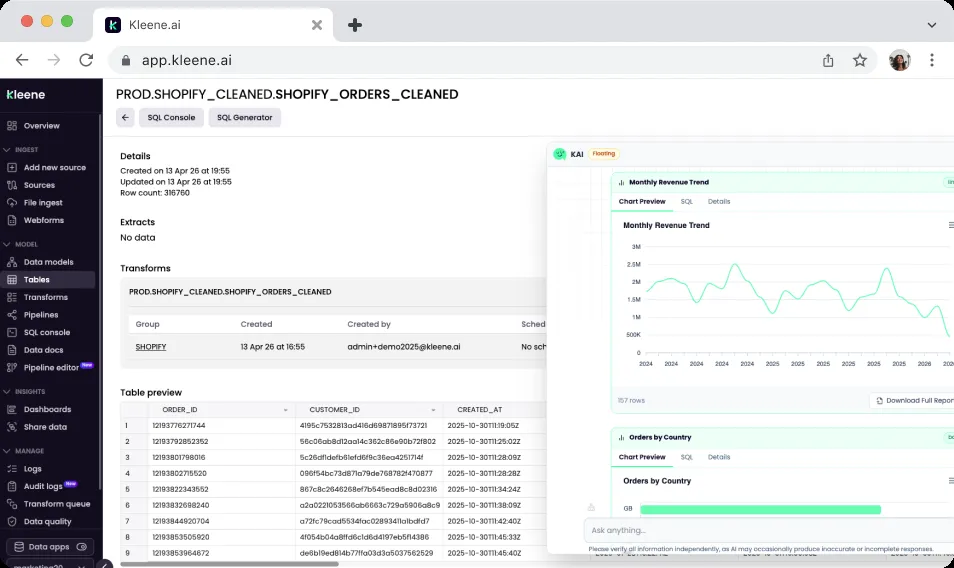
Kleene.ai: product and architecture
Kleene.ai review research quickly reveals that this is not a conventional self-service data integration product. Kleene.ai combines a cloud data platform with an implementation and support service: its team helps connect sources, build and test transformations, establish a customer-owned warehouse, and deliver analytics or AI applications. The proposition is aimed mainly at mid-market companies that want a functioning data capability without hiring a large specialist team or assembling several vendors themselves.
Overview
Kleene.ai packages ingestion, transformation, warehousing, analytics delivery, and ongoing data engineering into one commercial relationship. Customer data is loaded into the customer's own supported warehouse—currently BigQuery, Snowflake, or Redshift—rather than being retained in a Kleene-owned analytics store. Kleene says implementation is included, packages are flat recurring subscriptions tied partly to connector count, and support continues after launch.
That delivery model is the defining feature. A buyer is purchasing software and an operating partner, not simply licenses. It can reduce the coordination burden for a lean data team, but it also means Kleene.ai is less suitable for organizations seeking a fully self-directed, component-by-component stack. The product sits between a data platform, a managed analytics service, and an AI deployment partner.
Kleene publishes three packages—Scale, Accelerate, and Enterprise—and asks buyers to contact sales. Its current pricing page limits Scale to three connectors, Accelerate to eight, and Enterprise to unlimited connectors. Scope, required applications, implementation complexity, and contract terms therefore matter more than a per-seat calculation.
Key Features and Architecture
Kleene.ai covers the core path from operational data to a usable analytical product. Its documentation lists more than 600 source connectors, while noting that some connectors must be requested. Pipelines move source data into a customer-controlled cloud warehouse. Teams can then use SQL-based transformations, automated testing, pipeline logs, dependency information, and Git-backed workflows to prepare modeled data.
The delivery layer includes dashboards and analytics, plus KAI products such as KAI Assistant and KAI Analytics. Kleene also documents a Model Context Protocol server that can expose governed data-platform context to compatible AI clients. This gives teams an AI access route without replacing the underlying warehouse and data models.
The architecture is intentionally warehouse-centered. Kleene states that it does not retain customer data, supports role-based access control, and is ISO 27001 certified. Its FAQ also describes GDPR-aligned handling. Those claims are useful starting points for security review, but buyers should still validate identity integration, regional hosting, recovery objectives, audit requirements, and the exact access granted to Kleene personnel during implementation and support.
Ideal Use Cases
Kleene.ai is best aligned with organizations that have important data questions but limited capacity to build and operate a modern stack. Common fits include a growing company consolidating finance, commercial, and product data; an operations team replacing spreadsheet-heavy reporting; or an executive group that wants governed metrics and AI-assisted analysis without creating a large central data function.
It is also relevant when speed-to-outcome matters more than selecting every component independently. The included implementation can cover connector setup, warehouse configuration, transformations, and initial analytics delivery. That makes the offer easier to evaluate against the combined cost of software, implementation partners, and internal engineering—not just an ingestion subscription.
A weaker fit is an engineering-led organization with an established platform team, strong preferences for individual open-source components, or a requirement to operate every layer internally. Very small teams needing only a single connector may find a lighter ELT service sufficient. At the other end, highly regulated enterprises should examine detailed controls and contractual responsibilities rather than infer that a managed package automatically satisfies their governance model.
Strengths & Trade-offs
Pros
- The combined platform-and-service model can remove much of the integration work that otherwise falls to a small internal team.
- A customer-owned warehouse reduces lock-in at the data-storage layer and keeps the analytical source of truth in the buyer's environment.
- Ingestion, SQL transformation, testing, monitoring, analytics delivery, and AI access are presented as one coordinated workflow.
- Connector-based packages and included implementation can be simpler to budget than several disconnected licenses and a separate consultancy.
- Published security statements include ISO 27001 certification, role-based access control, GDPR alignment, and no retention of customer data.
Cons
- There is no public fixed price card, so meaningful budget comparison requires a sales process and a scoped proposal.
- A standard 24-month term in Kleene's own illustrative example may be a substantial commitment for teams still proving demand.
- Organizations that want direct control over every open-source component may find the managed operating model restrictive.
- Connector count is only one cost driver; warehouse usage, BI tools, AI products, and unusual implementation requirements can change total cost.
- The breadth of the offer makes diligence important: buyers should distinguish product capabilities, included services, and third-party services in the contract.