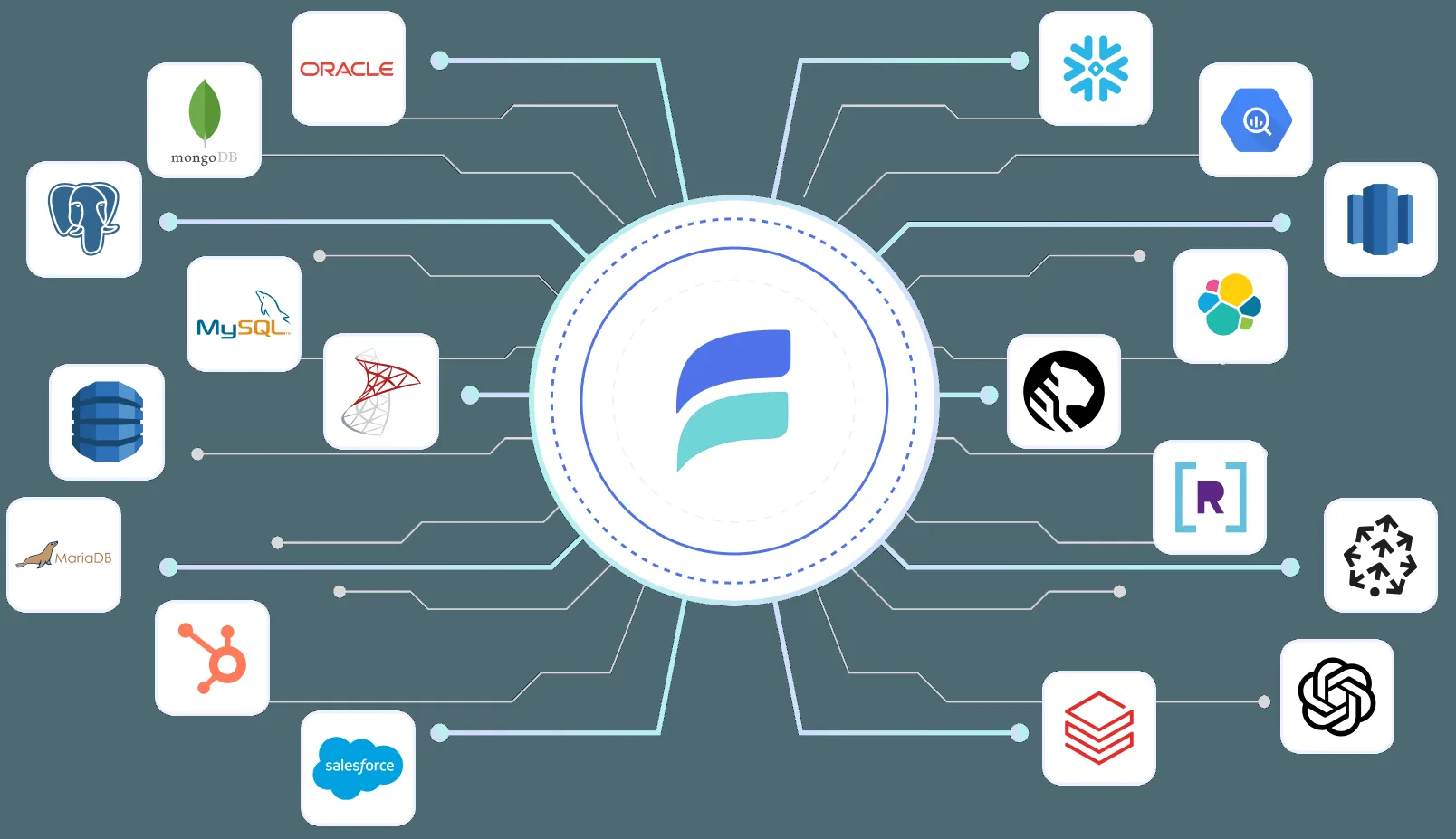
Estuary Flow: product and architecture
Our verdict in this Estuary Flow review: it is a strong choice for teams that need one managed platform for both real-time and batch data movement, especially when change data capture (CDC) must serve analytics, operations, and AI workloads. Estuary reports under-100 ms latency, 99.9% uptime, 5,500+ users, and 3 petabytes per month of moved data; these are meaningful public product signals, although they are not a substitute for validating requirements in a production proof of concept.
Estuary Flow’s central proposition is unusually focused: combine batch ETL/ELT, CDC, and real-time streams without requiring the customer to manage the underlying infrastructure. We recommend it for data teams that value right-time data delivery and can accept a platform-oriented workflow rather than assembling a separate orchestration, replication, and reverse-ETL stack. Avoid it if your primary need is a narrowly scoped, conventional batch pipeline with no real-time requirement, because Flow’s value is tied to its unified streaming-and-batch design.
Overview
Estuary Flow is a real-time ETL and ELT data-pipeline platform designed to activate organizational data without infrastructure management. Its stated scope covers batch workloads for analytics and streaming workloads for operations and AI, making it relevant to data engineers who need continuously synchronized systems rather than periodic extracts alone. The platform positions “right-time” data as its operating model: data should arrive when an analytical, operational, or AI use case needs it, rather than only on a fixed batch schedule.
The product combines batch and streaming into one platform and states that it moves and transforms data across more than 200 systems. Its website specifically describes connectors for databases, data warehouses, files, applications, and cloud services. CDC is central to this design: Flow uses it to support low-latency ETL and ELT pipelines and to put database changes to work across analytics, operations, and AI destinations.
This is not primarily a tool for teams looking to manage infrastructure themselves. Estuary’s stated value is removing that operational responsibility while bringing together CDC, real-time processing, and batch processing with modern data-engineering practices. The trade-off is clear: teams gain a managed, integrated delivery model, but should evaluate whether that platform model fits their preferred engineering controls and operating patterns.
Public repository data supports that Estuary Flow is actively maintained. The repository has 959 GitHub stars, uses Rust as its primary language, was last pushed on August 13, 2026, and lists v0.6.13 as the latest release on August 10, 2026. Those details are useful activity and community proxies, but they do not independently establish enterprise adoption, security posture, or fit for a particular organization.
Key Features and Architecture
Estuary Flow’s defining architectural feature is its combination of CDC, real-time streams, and batch processing in a single managed platform. CDC captures changes from systems where data lives and supports continuously synchronizing those changes to systems where teams want the data to live. This matters when a warehouse-oriented pipeline must coexist with operational or AI use cases that cannot wait for a later batch window.
The platform supports ETL and ELT workflows. That distinction gives teams flexibility in where transformation occurs: ETL describes transforming data as part of the pipeline, while ELT supports delivery to an analytical destination for later transformation. Estuary explicitly states that it can move and transform data, so its scope extends beyond a connector catalog to data-flow management.
Key capabilities include:
- CDC-powered synchronization: Estuary Flow uses change data capture to power low-latency ETL and ELT pipelines from databases toward analytics, operations, and AI use cases.
- Unified batch and streaming operation: The platform supports batch for analytics and streaming for operations and AI, rather than presenting them as separate products.
- Managed infrastructure model: Estuary’s product description states that organizations can activate data without managing infrastructure, reducing responsibility for the underlying pipeline platform.
- Broad connector coverage: Estuary advertises more than 200 systems and the Developer plan includes access to 200+ fully managed connectors.
- Multiple source and destination categories: The website names files, databases, applications, cloud services, analytics systems, operational systems, and AI as part of the data-movement model.
- Low-latency delivery: Estuary reports latency below 100 ms, while also supporting batch delivery when low-latency movement is not required.
- Flow management orientation: The project repository describes the product as continuously synchronizing systems by managing data flows, which frames Flow as an ongoing synchronization platform rather than a one-time migration utility.
The architecture is most compelling when source change events need to feed several types of consumers. A team can use one conceptual platform for warehouse-bound analytical data, operational destinations, and AI-related workflows. The cost of that breadth is evaluation complexity: the team must validate connector behavior, CDC suitability, transformation needs, and destination requirements instead of treating the purchase as a simple file-transfer decision.
Estuary’s GitHub topics include change-data-capture, data collection, data engineering, data integration, data pipeline, ELT, and ETL. These labels align with the product’s documented functional scope, and the repository license is listed as NOASSERTION. Organizations with formal open-source review processes should treat that license field as a concrete diligence item before making assumptions about repository licensing.
Ideal Use Cases
Estuary Flow is best for data engineering teams that need both current operational data and warehouse-ready analytical data. A team maintaining a database-backed product can use CDC-oriented flows when changes must reach analytics, operations, or AI systems with low latency, while still supporting batch-oriented analytical work. The platform’s under-100 ms latency claim makes it particularly relevant where delivery delay is a first-class requirement rather than an incidental optimization.
A strong scenario is a mid-sized data organization that wants to consolidate data movement across more than one workload type. For example, a team with a warehouse for analytics, operational systems that depend on fresh records, and AI workloads that need newly changed data can evaluate a single Flow implementation instead of separately adopting a batch-only movement layer and a streaming-only layer. Estuary’s stated ability to connect files, databases, applications, and cloud services gives that team a broad starting surface.
Another good scenario is a data team that has limited appetite for pipeline infrastructure operations. Estuary explicitly targets organizations that want to activate data without managing infrastructure, so the value proposition is strongest when operating a self-managed data-flow platform would distract the team from data products and delivery. The Developer plan also permits unlimited users, which can be practical for a small cross-functional team evaluating shared access without per-user limits.
A third scenario is an analytics engineering organization that needs to blend conventional batch delivery with continuously updated source data. Batch remains relevant for analytics, while CDC and real-time streams can provide fresher inputs for downstream workflows. Estuary Flow gives this team a way to evaluate those modes together rather than assuming that all data products should be refreshed with one cadence.
We recommend Estuary Flow for teams that have a concrete requirement to combine CDC, real-time data delivery, and batch pipelines while avoiding infrastructure management. Its stated 3-petabyte-per-month movement figure indicates that the platform is built for substantial data movement, but every team should validate its own source patterns, connector needs, and expected volumes. Public scale claims are useful context, not a capacity guarantee for an individual deployment.
Don’t use this if your team only needs a simple periodic batch extract and has no need for CDC, streaming, or right-time operational delivery. In that situation, Flow’s unified architecture may be more platform than the problem requires. Also avoid making a decision based solely on the 5,500+ user figure or the 959 GitHub stars; neither measure proves fit for a regulated environment, a particular data topology, or a specific integration requirement.
Strengths & Trade-offs
In our evaluation, Estuary Flow’s advantages are tightly connected to its managed, unified data-flow approach. That approach can remove operational overhead and reduce the need to split batch and real-time requirements across separate systems. But its strengths do not eliminate the need for technical diligence: every connector, source pattern, and destination remains part of the implementation risk.
Pros
- CDC, streaming, and batch are documented as one platform capability. This is valuable for teams that need low-latency operational or AI delivery alongside analytical batch pipelines.
- The platform advertises under-100 ms latency. For use cases where freshness is part of the product requirement, that is a concrete stated capability rather than a generic “near real-time” claim.
- More than 200 systems are part of Estuary’s stated integration surface. The free Developer tier specifically includes 200+ fully managed connectors, giving evaluators a broad connector catalog to test.
- Infrastructure management is explicitly outside the customer’s core burden. Estuary’s stated purpose is helping organizations activate data without managing infrastructure, which is useful for smaller platform teams.
- The free tier has practical evaluation features. It includes unlimited users, two concurrent connectors, 10 GB per month, and millisecond latency or batch at no extra charge.
- Repository maintenance is visible. The project lists Rust as its primary language, 959 GitHub stars, a last push on August 13, 2026, and release v0.6.13 on August 10, 2026.
Cons
- The free tier is limited to 10 GB per month. That may be insufficient for realistic high-volume trials, particularly when a team wants to validate CDC across multiple sources.
- Only two concurrent connectors are included in the Developer tier. This is a specific constraint for evaluations involving several databases, applications, files, or destinations at once.
- Paid-tier scope is not fully documented in the supplied pricing information. Although $50, $100, and $1,000 monthly price points are listed, the corresponding plan names and entitlements are not specified.
- The repository license is
NOASSERTION. Teams that rely on an identified open-source license for internal review cannot treat the repository metadata as a resolved licensing answer. - The platform’s value depends on a real-time or CDC need. If an organization only requires periodic batch movement, Estuary Flow’s combined architecture can be unnecessary complexity.