Decision comparison
Dagster vs Estuary Flow
Dagster and Estuary Flow serve fundamentally different roles in the modern data stack. Dagster excels as an orchestration platform that manages complex pipeline dependencies, data asset lineage, and workflow scheduling across your entire data infrastructure. Estuary Flow specializes in real-time data movement, delivering sub-100ms CDC and streaming pipelines with minimal setup. Many teams use both tools together — Estuary Flow handles the data ingestion and movement layer while Dagster orchestrates the broader pipeline logic, transformations, and downstream workflows.
Used together. These are normally used together rather than chosen between. The comparison explains what each one does in the stack.
These are different kinds of product — Workflow Orchestrator and ELT Platform.
Quick Comparison
| Decision factor | Dagster | Estuary Flow |
|---|---|---|
| Primary Use Case | Data orchestration and pipeline management across ETL, dbt, ML, and AI workflows | Real-time ETL and ELT data movement with CDC across databases, SaaS apps, and warehouses |
| Architecture | Asset-centric orchestrator with declarative DAGs, lineage tracking, and built-in observability | Streaming-first platform with decoupled storage-compute, exactly-once delivery, and no-code connectors |
| Pricing Model | Open-source self-hosted free (Apache-2.0), Solo Plan $10/mo, Starter Plan $100/mo, Starter $1200/mo, Pro and Enterprise Plan contact sales | Developer is free for up to 10 GB/month and 2 concurrent connector instances. Cloud is $0.50 per GB plus $100 per connector, billed monthly, with a 30-day free trial. Enterprise is quote-based, with volume-based discounts and annual contracts for private or BYOC deployments. |
| Real-Time Support | Primarily batch-oriented scheduling; real-time requires external streaming tools | Native sub-100ms end-to-end latency with streaming CDC and flexible batch scheduling |
| Deployment Options | Self-hosted (single server or Kubernetes), Dagster Cloud (hybrid or serverless), multi-tenant | Public cloud (managed), private deployment, bring-your-own-cloud (BYOC) with US/EU regions |
| Learning Curve | Moderate — Python-native with strong documentation and Dagster University training resources | Low — no-code connector setup with UI and CLI; minimal coding required for basic pipelines |
Dagster
- Primary Use Case:
- Data orchestration and pipeline management across ETL, dbt, ML, and AI workflows
- Architecture:
- Asset-centric orchestrator with declarative DAGs, lineage tracking, and built-in observability
- Pricing Model:
- Open-source self-hosted free (Apache-2.0), Solo Plan $10/mo, Starter Plan $100/mo, Starter $1200/mo, Pro and Enterprise Plan contact sales
- Real-Time Support:
- Primarily batch-oriented scheduling; real-time requires external streaming tools
- Deployment Options:
- Self-hosted (single server or Kubernetes), Dagster Cloud (hybrid or serverless), multi-tenant
- Learning Curve:
- Moderate — Python-native with strong documentation and Dagster University training resources
Estuary Flow
- Primary Use Case:
- Real-time ETL and ELT data movement with CDC across databases, SaaS apps, and warehouses
- Architecture:
- Streaming-first platform with decoupled storage-compute, exactly-once delivery, and no-code connectors
- Pricing Model:
- Developer is free for up to 10 GB/month and 2 concurrent connector instances. Cloud is $0.50 per GB plus $100 per connector, billed monthly, with a 30-day free trial. Enterprise is quote-based, with volume-based discounts and annual contracts for private or BYOC deployments.
- Real-Time Support:
- Native sub-100ms end-to-end latency with streaming CDC and flexible batch scheduling
- Deployment Options:
- Public cloud (managed), private deployment, bring-your-own-cloud (BYOC) with US/EU regions
- Learning Curve:
- Low — no-code connector setup with UI and CLI; minimal coding required for basic pipelines
Public signals
Verified factual signals only. Bars appear only for like-for-like metrics with five weekly assessments for every tool; missing evidence stays explicit. These signals do not establish enterprise adoption, product quality, or total cost.
| Metric | Dagster | Estuary Flow |
|---|---|---|
| Docker Hub pulls(Developer adoption) | 6.2M | Not available |
| GitHub commits, 90d(Product adoption) | 265 | 421 |
| GitHub stars(Product adoption) | 16,000+ | 978 |
| Search interest(Market interest) | 1 | 0 |
| Hacker News mentions, 90d(Community interest) | 3 | 0 |
| Product Hunt comments(Community interest) | 11 | 115 |
| Product Hunt rating(Community interest) | 5.0/5 | 5.0/5 |
| Product Hunt reviews(Community interest) | 1 | 1 |
| Product Hunt votes(Community interest) | 112 | 225 |
| PyPI weekly downloads(Product adoption) | 1.8M | Not available |
| Stack Overflow questions(Community interest) | 171 | Not available |
As of September 21, 2026 — updated weekly.
Health & risk evidence
Observed public-source checks for mapped package versions and repositories.
Dagster
September 21, 2026Package vulnerabilities
PyPI · dagster@1.13.23
0 vulnerabilities
across 1 package
Repository security score
github.com/dagster-io/dagster
5.1/10
Estuary Flow
September 21, 2026Package vulnerabilities
Not available
Repository security score
github.com/estuary/flow
4.9/10
Interface Preview
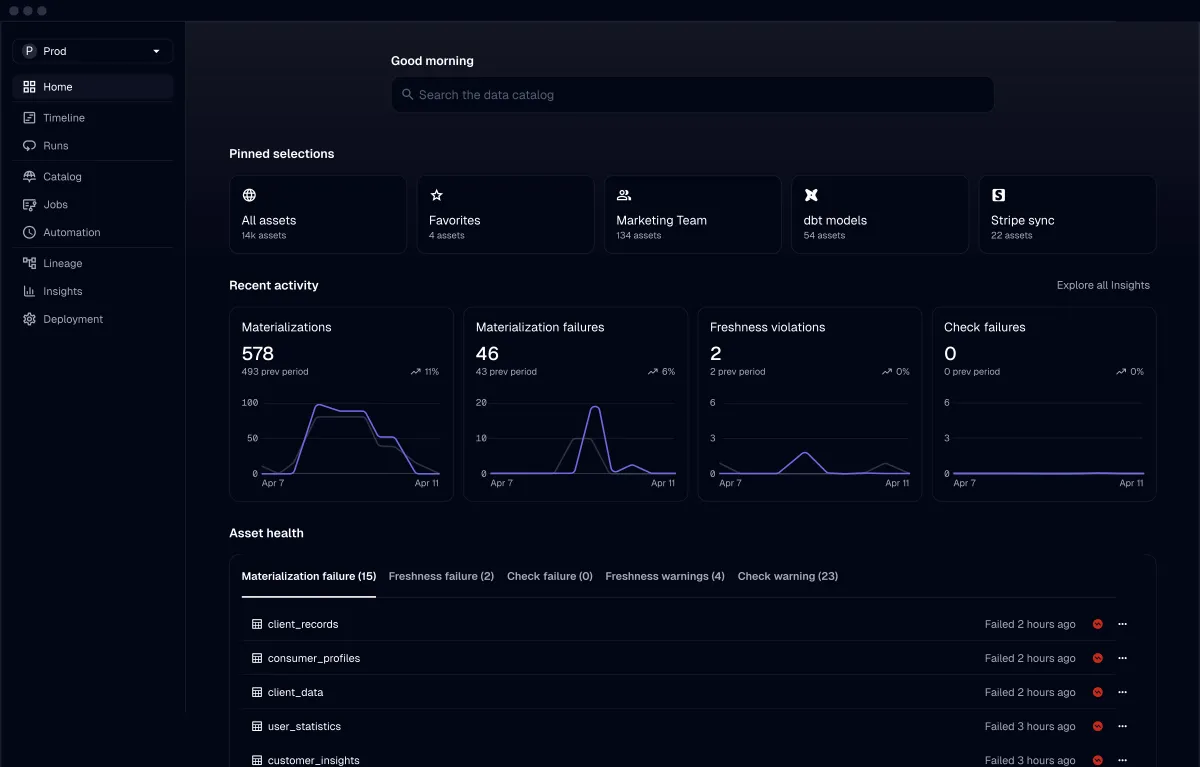
Dagster
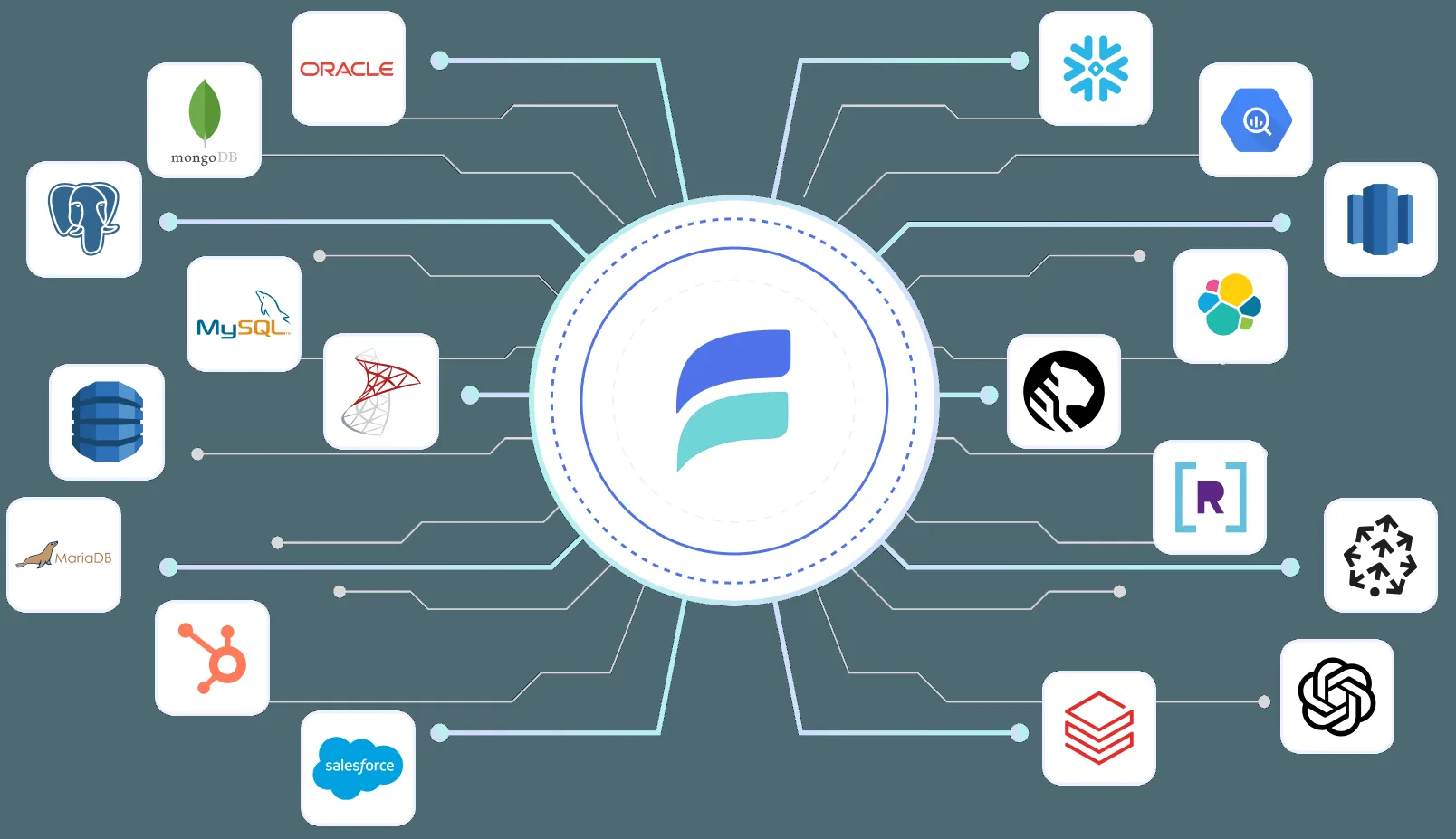
Estuary Flow
Feature Comparison
| Feature | Dagster | Estuary Flow |
|---|---|---|
| Data Movement & Integration | ||
| Change Data Capture (CDC) | Supported via external integrations (Fivetran, Airbyte) | Native end-to-end streaming CDC with incremental backfill |
| Pre-Built Connectors | Native integrations for Snowflake, BigQuery, dbt, Databricks, Spark, and more | 200+ no-code connectors for databases, SaaS apps, and data warehouses |
| Real-Time Streaming | Not natively supported; relies on external streaming tools | Sub-100ms latency with exactly-once delivery guarantees |
| Pipeline Orchestration | ||
| Asset-Centric Orchestration | Core paradigm — pipelines modeled as data assets with dependencies and lineage | Not applicable — focuses on data movement rather than asset orchestration |
| DAG-Based Scheduling | Full DAG support with partitioning, incremental runs, and sensor-based triggers | Continuous streaming pipelines; batch scheduling at configurable intervals |
| dbt Integration | First-class native dbt integration with asset mapping and lineage | dbt Cloud integration for ELT transformations in the warehouse |
| Observability & Governance | ||
| Data Lineage | Built-in lineage graphs with asset-level dependency tracking and documentation | End-to-end schema inference and evolution tracking across pipelines |
| Monitoring & Alerting | Integrated dashboards, Slack alerts, AI-powered debugging, and health metrics | Real-time monitoring with alerting, load balancing, and automatic failover |
| Data Quality | Built-in validation, freshness checks, and asset-level quality tests | Continuous data validation with automated schema evolution |
| Security & Compliance | ||
| Compliance Certifications | SOC 2 Type II and HIPAA compliant with audit logs | SOC 2 Type II, HIPAA, GDPR, CCPA, and CPRA compliant |
| Access Controls | SSO, RBAC, SCIM provisioning with Google, GitHub, and SAML IdPs | Role-based access control (RBAC) with SSO for enterprise tier |
| Data Residency | North American and European regions on Dagster Cloud | US/EU data processing regions with private cloud storage options |
| Developer Experience | ||
| Programming Language | Python-native with full SDK, unit testing, and CI/CD support | No-code UI plus CLI (flowctl); SQL and TypeScript for transformations |
| Local Development | Strong local dev support with branch deployments and testing frameworks | CLI-based development with flowctl for pipeline configuration |
| Open Source | Fully open-source core under Apache-2.0 with 16,000+ GitHub stars | Open-source runtime on GitHub with 900+ stars (Rust-based) |
Data Movement & Integration
Change Data Capture (CDC)
Pre-Built Connectors
Real-Time Streaming
Pipeline Orchestration
Asset-Centric Orchestration
DAG-Based Scheduling
dbt Integration
Observability & Governance
Data Lineage
Monitoring & Alerting
Data Quality
Security & Compliance
Compliance Certifications
Access Controls
Data Residency
Developer Experience
Programming Language
Local Development
Open Source
How they fit together
Dagster and Estuary Flow serve fundamentally different roles in the modern data stack. Dagster excels as an orchestration platform that manages complex pipeline dependencies, data asset lineage, and workflow scheduling across your entire data infrastructure. Estuary Flow specializes in real-time data movement, delivering sub-100ms CDC and streaming pipelines with minimal setup. Many teams use both tools together — Estuary Flow handles the data ingestion and movement layer while Dagster orchestrates the broader pipeline logic, transformations, and downstream workflows.
What each one handles
Use Dagster for:
Choose Dagster when you need a unified orchestration layer for complex data workflows that span ETL, dbt transformations, ML training, and AI operations. Dagster is the stronger choice for teams that rely on Python-heavy pipelines and require asset-level lineage, built-in quality checks, and a developer-friendly testing framework. Its declarative, asset-centric model makes it particularly well-suited for data engineering teams managing dozens or hundreds of interdependent data assets across Snowflake, BigQuery, Databricks, and other warehouse platforms.
Use Estuary Flow for:
Choose Estuary Flow when your priority is moving data between systems quickly and reliably, especially if you need real-time CDC from production databases into analytics warehouses, operational stores, or AI applications. Estuary Flow is the better fit for teams that want to replace batch-only ELT tools with a streaming-capable alternative that also handles batch workloads. Its no-code connectors and managed infrastructure mean you can set up production pipelines in minutes without dedicated data engineering resources, and the exactly-once delivery guarantees eliminate data integrity concerns.
These roles reflect the available product evidence. Most teams run both; which one owns a given job depends on your stack and team.
Frequently Asked Questions
Can Dagster and Estuary Flow be used together?
Yes, they complement each other well. Estuary Flow can handle the data ingestion and movement layer, streaming CDC and batch data from sources into your warehouse or lake. Dagster then orchestrates the downstream workflows — dbt transformations, data quality checks, ML model training, and asset materialization. This combination gives you real-time data movement with structured pipeline orchestration.
Which tool is better for real-time data pipelines?
Estuary Flow is purpose-built for real-time data movement with sub-100ms end-to-end latency and native CDC support. Dagster focuses on batch-oriented orchestration and scheduling. If you need streaming data delivery for operational systems or AI applications, Estuary Flow is the clear choice. Dagster can trigger workflows based on sensor events, but it does not natively process streaming data.
How do the pricing models compare for small teams?
Both tools offer free tiers. Dagster provides a fully open-source self-hosted option under Apache-2.0, with Dagster Cloud starting at $10/mo for the Solo plan. Estuary Flow has a free Developer tier with 10GB/mo and 2 connectors, with the Cloud plan at $0.50 per GB plus $100 per connector. For small teams with limited data volumes, Dagster's self-hosted option costs nothing beyond infrastructure, while Estuary Flow's free tier lets you test real-time pipelines without commitment.
Does Dagster support Change Data Capture (CDC)?
Dagster does not have native CDC capabilities. It integrates with CDC tools like Fivetran, Airbyte, and Estuary Flow to capture change data from source systems. Dagster's role is to orchestrate when and how those CDC pipelines run, manage dependencies between ingestion and transformation, and track the lineage of ingested assets. Estuary Flow, by contrast, performs CDC natively with streaming transaction log capture and incremental backfill.