Informatica Cloud: product and architecture
This Informatica Cloud review examines one of the most established enterprise data integration platforms on the market today. Informatica has spent decades building data management tools, and its cloud-native offering — the Intelligent Data Management Cloud (IDMC) — represents the culmination of that experience. IDMC handles ETL/ELT workloads, data quality, data governance, and master data management under a single platform. For organizations dealing with hundreds of data sources across hybrid and multi-cloud environments, Informatica Cloud delivers the kind of depth that simpler tools cannot match. But that power comes with real tradeoffs in cost and complexity that every data team should understand before committing.
Overview
Informatica Cloud, officially branded as the Intelligent Data Management Cloud (IDMC), is a cloud-native platform built on top of Informatica's PowerCenter heritage. It provides a unified environment for data integration, data quality, data governance, API management, and master data management. The platform runs on all major cloud providers — AWS, Azure, and Google Cloud — and connects to over 1,000 data sources through pre-built connectors.
The core engine uses what Informatica calls the CLAIRE AI engine, which applies machine learning to automate mapping suggestions, data profiling, and anomaly detection. Unlike point solutions that handle only extraction and loading, IDMC covers the full data lifecycle from ingestion through transformation, quality enforcement, cataloging, and governance. This makes it a strong fit for enterprises that need a single control plane across their entire data estate rather than stitching together multiple specialized tools.
Key Features and Architecture
IDMC is built on a microservices architecture with a shared metadata backbone. Every service — integration, quality, governance, cataloging — reads from and writes to the same metadata layer. This means a data quality rule defined in one context automatically applies across pipelines, catalogs, and governance workflows.
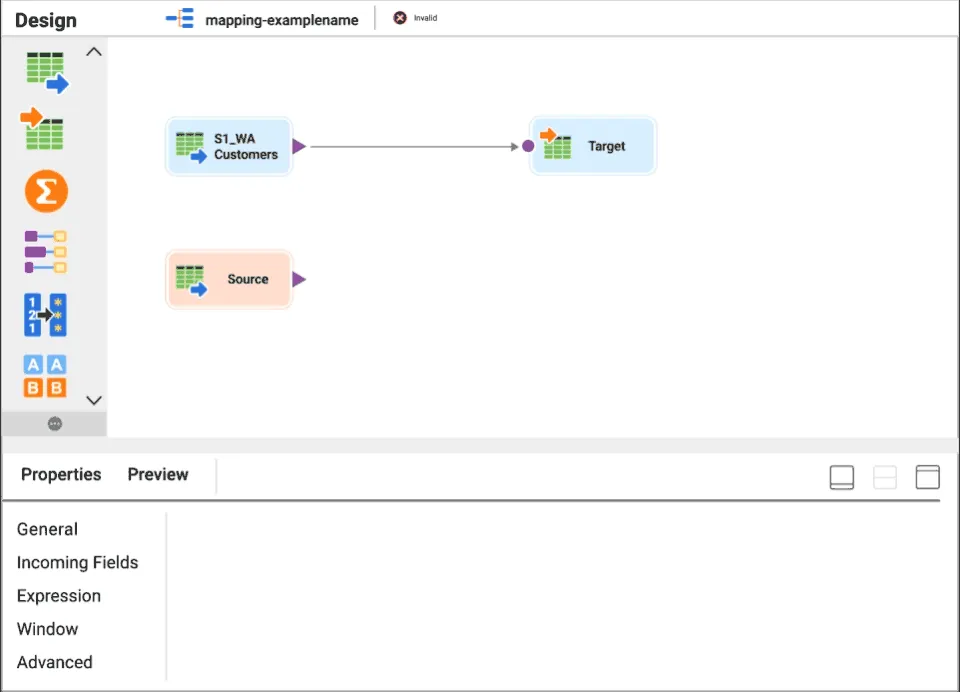
Data Integration and ETL/ELT The integration engine supports both traditional ETL (extract-transform-load) and modern ELT patterns. You can design mappings visually through the Data Integration console or define them programmatically. The engine handles batch processing, real-time streaming via Change Data Capture (CDC), and API-based integrations. Pushdown optimization lets you push transformation logic into the target database engine, which reduces data movement and improves performance on platforms like Snowflake, Databricks, and BigQuery.
CLAIRE AI Engine CLAIRE scans metadata across your environment to recommend column mappings, detect schema drift, flag data quality issues, and suggest transformations. It learns from usage patterns over time. While it does not replace manual pipeline design, it accelerates repetitive tasks like mapping hundreds of source columns to target schemas.
Data Quality and Profiling Built-in data profiling runs statistical analysis on your datasets — null rates, cardinality, pattern distribution, and outlier detection. You can define quality rules (referential integrity checks, format validation, business rules) and enforce them inline within pipelines or as standalone quality jobs.
Data Governance and Catalog The governance module includes a data catalog, business glossary, lineage tracking, and access policy management. Lineage is automatically captured from pipeline execution, so you get end-to-end visibility from source systems through transformations to downstream consumption. This is particularly valuable for regulatory compliance (GDPR, CCPA, SOX) where proving data provenance is mandatory.
Connectivity Over 1,000 pre-built connectors cover SaaS applications (Salesforce, SAP, Workday), databases (Oracle, SQL Server, PostgreSQL), cloud storage (S3, ADLS, GCS), streaming platforms (Kafka, Kinesis), and mainframe systems. The Secure Agent architecture lets you connect to on-premises systems without opening inbound firewall ports.
Ideal Use Cases
Informatica Cloud fits best in mid-to-large enterprises with complex data environments spanning multiple clouds, on-premises systems, and SaaS applications. If your organization runs SAP alongside Salesforce and needs to consolidate data into Snowflake or Databricks while enforcing data quality and governance policies, IDMC handles that workflow natively.
Regulated industries — financial services, healthcare, pharmaceuticals — benefit from the built-in lineage, cataloging, and governance capabilities. Teams that need to demonstrate data provenance for audits will find real value in the automatic lineage tracking.
Organizations consolidating from multiple point tools (a separate ETL tool, a separate catalog, a separate quality tool) into a single platform represent another strong use case. The total cost of ownership math often works out when you factor in the operational overhead of maintaining five separate tools versus one integrated platform.
Conversely, small teams with straightforward ELT needs — loading data from a handful of SaaS sources into a warehouse — will find IDMC over-engineered and overpriced for their requirements.
Strengths & Trade-offs
Pros
- Unified platform covering integration, quality, governance, and cataloging under one roof
- Over 1,000 pre-built connectors including mainframe and legacy systems
- Automatic end-to-end data lineage tracking for compliance requirements
- CLAIRE AI engine accelerates repetitive mapping and profiling tasks
- Pushdown optimization reduces data movement on modern cloud warehouses
- Mature Secure Agent architecture for hybrid cloud/on-premises connectivity
Cons
- IPU pricing is opaque and difficult to forecast accurately before production use
- Steep learning curve — the platform surface area is enormous and documentation varies in quality
- No free tier or transparent self-service pricing; requires sales engagement
- Over-engineered for teams that only need basic ELT or a handful of source integrations