Decision comparison
Dagster vs Rivery
Dagster is the stronger choice for engineering teams that need asset-centric orchestration with deep lineage, testing, and open-source flexibility. Rivery wins for teams prioritizing fast no-code ELT with 200+ pre-built connectors and zero infrastructure management.
Used together. These are normally used together rather than chosen between. The comparison explains what each one does in the stack.
These are different kinds of product — Workflow Orchestrator and ELT Platform.
Quick Comparison
| Decision factor | Dagster | Rivery |
|---|---|---|
| Best For | Engineering teams building asset-centric orchestration with full lineage, testing, and CI/CD workflows | Data teams needing no-code ELT with 200+ pre-built connectors for marketing and sales data |
| Deployment Model | Open-source self-hosted, Kubernetes, or Dagster Cloud managed service with hybrid options | Fully managed SaaS platform with zero infrastructure provisioning or maintenance required |
| Ease of Setup | Requires Python development skills; local dev and unit testing built in from day one | No-code interface with pre-built connectors; new pipelines deployable in minutes without coding |
| Connector Ecosystem | Native integrations for Snowflake, BigQuery, dbt, Databricks, Fivetran, Spark, and Great Expectations | 200+ pre-built connectors for apps, databases, file storage, plus custom API connector support |
| Pricing Entry Point | Open-source self-hosted free (Apache-2.0), Solo Plan $10/mo, Starter Plan $100/mo, Starter $1200/mo, Pro and Enterprise Plan contact sales | Professional free, Pro Plus and Enterprise Contact Sales. Other amounts mentioned: $100, $1,200. |
| Core Strength | Asset-aware orchestration with built-in data catalog, lineage graphs, and quality checks | End-to-end ELT with ingestion, transformation, orchestration, reverse ETL, and DataOps in one SaaS |
Dagster
- Best For:
- Engineering teams building asset-centric orchestration with full lineage, testing, and CI/CD workflows
- Deployment Model:
- Open-source self-hosted, Kubernetes, or Dagster Cloud managed service with hybrid options
- Ease of Setup:
- Requires Python development skills; local dev and unit testing built in from day one
- Connector Ecosystem:
- Native integrations for Snowflake, BigQuery, dbt, Databricks, Fivetran, Spark, and Great Expectations
- Pricing Entry Point:
- Open-source self-hosted free (Apache-2.0), Solo Plan $10/mo, Starter Plan $100/mo, Starter $1200/mo, Pro and Enterprise Plan contact sales
- Core Strength:
- Asset-aware orchestration with built-in data catalog, lineage graphs, and quality checks
Rivery
- Best For:
- Data teams needing no-code ELT with 200+ pre-built connectors for marketing and sales data
- Deployment Model:
- Fully managed SaaS platform with zero infrastructure provisioning or maintenance required
- Ease of Setup:
- No-code interface with pre-built connectors; new pipelines deployable in minutes without coding
- Connector Ecosystem:
- 200+ pre-built connectors for apps, databases, file storage, plus custom API connector support
- Pricing Entry Point:
- Professional free, Pro Plus and Enterprise Contact Sales. Other amounts mentioned: $100, $1,200.
- Core Strength:
- End-to-end ELT with ingestion, transformation, orchestration, reverse ETL, and DataOps in one SaaS
Public signals
Verified factual signals only. Bars appear only for like-for-like metrics with five weekly assessments for every tool; missing evidence stays explicit. These signals do not establish enterprise adoption, product quality, or total cost.
| Metric | Dagster | Rivery |
|---|---|---|
| Docker Hub pulls(Developer adoption) | 6.2M | Not available |
| GitHub commits, 90d(Product adoption) | 265 | Not available |
| GitHub stars(Product adoption) | 16,000+ | Not available |
| Search interest(Market interest) | 1 | Unavailable |
| Hacker News mentions, 90d(Community interest) | 3 | Not available |
| Product Hunt comments(Community interest) | 11 | Not available |
| Product Hunt rating(Community interest) | 5.0/5 | Not available |
| Product Hunt reviews(Community interest) | 1 | Not available |
| Product Hunt votes(Community interest) | 112 | Not available |
| PyPI weekly downloads(Product adoption) | 1.8M | Not available |
| Stack Overflow questions(Community interest) | 171 | Not available |
| GitHub commits, 90d(Developer adoption) | Not available | 0 |
| GitHub stars(Developer adoption) | Not available | 17 |
As of September 21, 2026 — updated weekly.
Health & risk evidence
Observed public-source checks for mapped package versions and repositories.
Dagster
September 21, 2026Package vulnerabilities
PyPI · dagster@1.13.23
0 vulnerabilities
across 1 package
Repository security score
github.com/dagster-io/dagster
5.1/10
Rivery
Package vulnerabilities
Not available
Repository security score
Not available
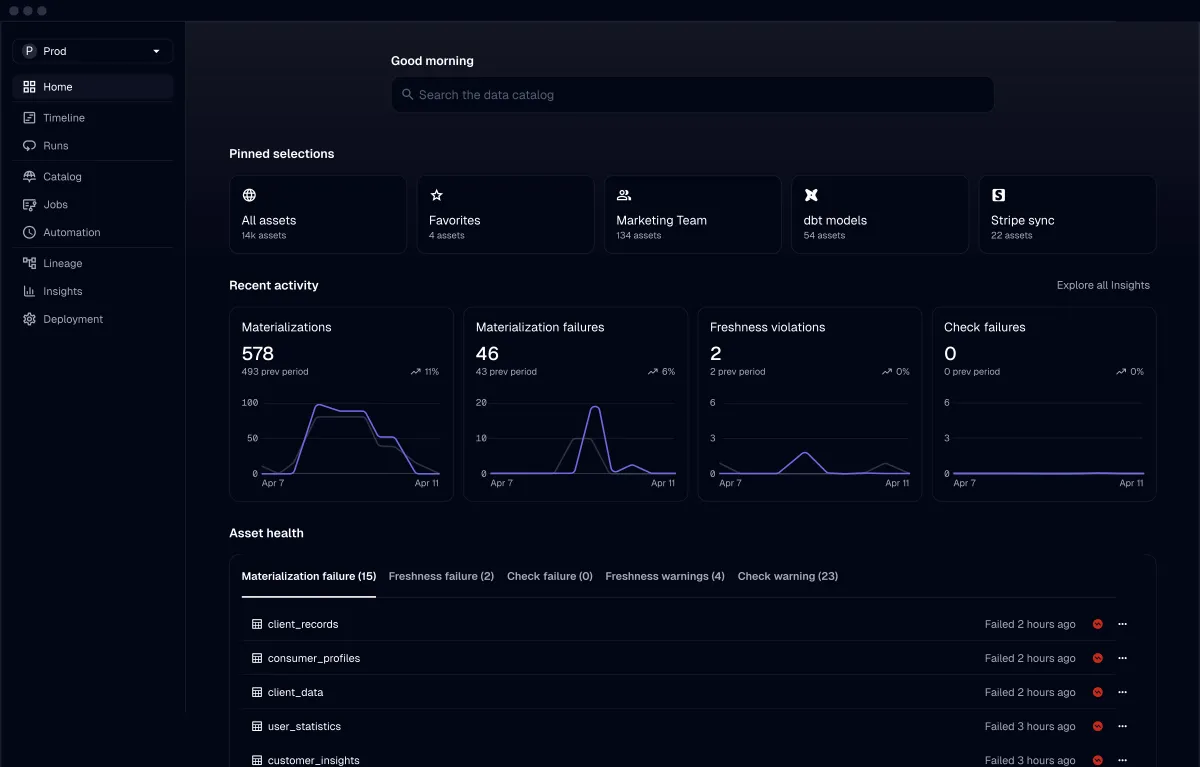
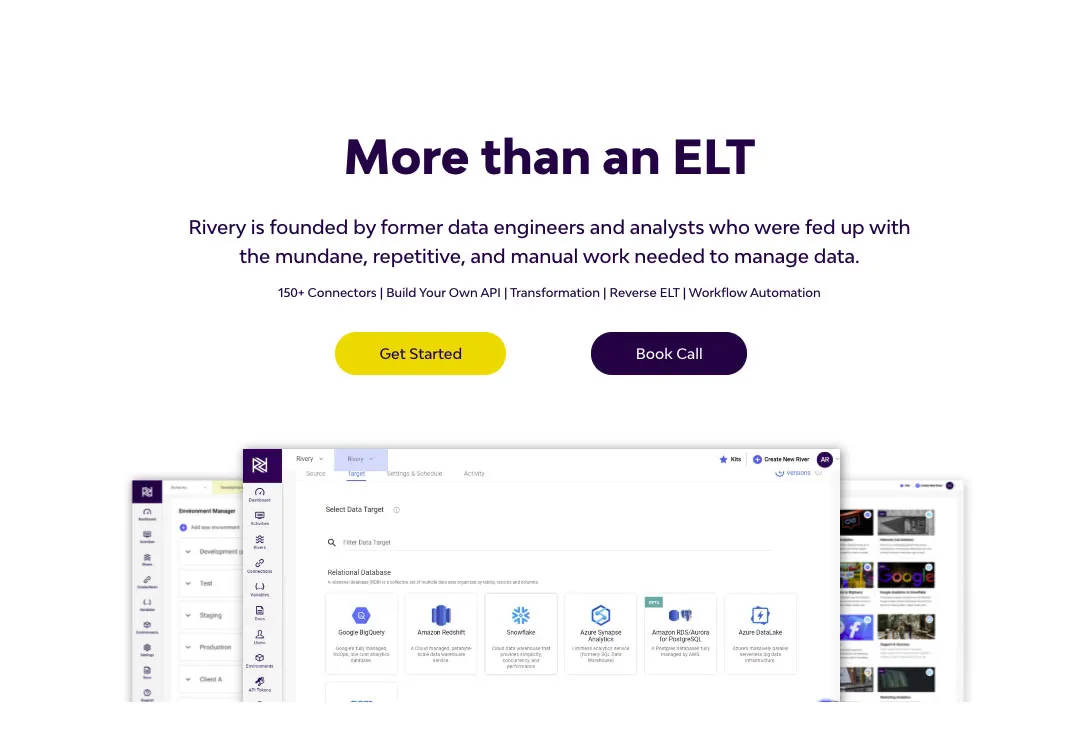
Interface Preview
Dagster
Rivery
Feature Comparison
| Feature | Dagster | Rivery |
|---|---|---|
| Data Integration | ||
| Pre-built Connectors | Native integrations for Snowflake, BigQuery, dbt, Databricks, Fivetran, Spark, and Great Expectations via Dagster Pipes | 200+ fully managed pre-built connectors for applications, databases, file storage, and data warehouses with automatic API updates |
| Custom Data Sources | Python-based custom integrations using Dagster's asset and op APIs with full type checking and metadata tracking | Custom API connector pulls data from any REST API in a few clicks, loading directly into the data warehouse |
| CDC / Replication | Supports incremental materialization and partitioned assets for change-tracking data pipelines | Built-in CDC support for replicating data from databases to cloud data warehouses with managed reliability |
| Data Transformation | ||
| SQL Transformations | Orchestrates dbt models and SQL-based transformations through native dbt integration with full lineage tracking | Multi-step SQL-based transformations run directly inside the cloud data warehouse with workflow automation |
| Python Support | First-class Python support as the primary development language with full IDE integration and unit testing | Native Python and DataFrames support as a source or target without writing connectivity code |
| Pre-built Data Models | Community-contributed integrations and examples available through Dagster University and documentation | Pre-built data model kits and Rivery Kits deploy complete production-level workflow templates in minutes |
| Orchestration & Workflow | ||
| Pipeline Orchestration | Asset-centric orchestration with declarative dependencies, partitions, incremental runs, and fault tolerance | Workflow automation with conditional logic, containers, loops, branching, and advanced scheduling controls |
| Environment Management | Branch deployments for CI/CD with separate staging and production environments on Dagster Cloud | Separate walled-off environments for dev, staging, and production with fine-tuned deployment controls |
| Version Control | Git-native workflows with CI/CD integration, branch deployments, and GitOps governance via Compass | Built-in version control with one-click change reversion and environment-based deployment management |
| Observability & Governance | ||
| Data Lineage | Built-in asset lineage graphs showing dependencies across the entire data platform with auto-generated documentation | Centralized reporting dashboard showing data flow across pipelines with drill-down to individual events |
| Monitoring & Alerting | Intelligent alerts in Slack with AI-powered debugging, impact analysis, and real-time health metrics tracking | Proactive pipeline health monitoring with configurable alerts for stakeholders to identify and control issues |
| Data Quality | Built-in validation, automated testing, freshness checks, and partitioned asset checks embedded in pipeline code | SQL-based data quality checks to validate data integrity within pipelines before downstream consumption |
| Security & Enterprise | ||
| Access Control | SSO with Google, GitHub, and SAML IdPs plus RBAC and SCIM provisioning with audit logs and retention policies | Role-based access control (RBAC) for governing team access with enterprise-grade privacy standards |
| Compliance | SOC 2 Type II and HIPAA certified with independent auditing and custom security questionnaires for enterprise | Industry-leading security standards built into network, product, and policies with enterprise-grade privacy |
| Reverse ETL / Data Activation | Supports data activation through Compass, pushing warehouse answers into tools stakeholders already use | Native reverse ETL pushes data from warehouse back into CRM, Slack, Tableau, and other business tools |
Data Integration
Pre-built Connectors
Custom Data Sources
CDC / Replication
Data Transformation
SQL Transformations
Python Support
Pre-built Data Models
Orchestration & Workflow
Pipeline Orchestration
Environment Management
Version Control
Observability & Governance
Data Lineage
Monitoring & Alerting
Data Quality
Security & Enterprise
Access Control
Compliance
Reverse ETL / Data Activation
How they fit together
Dagster is the stronger choice for engineering teams that need asset-centric orchestration with deep lineage, testing, and open-source flexibility. Rivery wins for teams prioritizing fast no-code ELT with 200+ pre-built connectors and zero infrastructure management.
What each one handles
Use Dagster for:
We recommend Dagster for data engineering teams that write Python, need full control over their orchestration layer, and value asset-centric design with built-in lineage and quality checks. Dagster excels when your team manages complex dependency graphs across dbt, Snowflake, BigQuery, and Databricks. The open-source Apache-2.0 license gives you zero vendor lock-in, and Dagster Cloud adds managed hosting starting at just $10/month for solo developers. Choose Dagster when you need CI/CD-native workflows, branch deployments, and the ability to unit test every pipeline locally before production.
Use Rivery for:
We recommend Rivery for data teams that need to consolidate marketing, sales, and operational data quickly without writing code. Rivery's 200+ pre-built connectors and starter kits let you deploy production-level pipelines in minutes rather than weeks. The fully managed SaaS model eliminates infrastructure provisioning entirely, and the free Professional tier lets you start without financial commitment. Choose Rivery when your priority is fast time-to-value for ELT workflows, your team includes analysts who prefer SQL over Python, and you need built-in reverse ETL to push data back into CRM, Slack, and Tableau.
These roles reflect the available product evidence. Most teams run both; which one owns a given job depends on your stack and team.
Frequently Asked Questions
Is Dagster open-source and free to use?
Dagster is fully open-source under the Apache-2.0 license, which means you can self-host it at no cost on your own infrastructure. The project has over 15,000+ GitHub stars and an active community. For teams that prefer managed hosting, Dagster Cloud offers a Solo plan at $10/month and a Starter plan at $100/month, both with 30-day free trials. Pro and Enterprise plans with unlimited deployments, uptime SLAs, and dedicated support require contacting sales for pricing.
Can Rivery handle complex data transformations or is it only for simple ELT?
Rivery goes beyond simple ELT ingestion. The platform supports multi-step SQL transformations that run directly inside your cloud data warehouse, native Python and DataFrames for advanced logic, and robust workflow automation with conditional branching, loops, and containers. Pre-built data model kits and Rivery Kits provide production-level templates that accelerate complex pipeline development. That said, teams requiring deep programmatic control over orchestration logic and asset dependencies will find Dagster's Python-first approach more flexible.
Which platform has better connector coverage for data sources?
Rivery offers broader out-of-the-box connector coverage with 200+ pre-built, fully managed connectors spanning marketing platforms, CRMs, databases, file storage, and cloud data warehouses. Rivery also provides a custom API connector for sources without pre-built support. Dagster takes a different approach with native integrations for key data infrastructure tools like Snowflake, BigQuery, dbt, Databricks, Fivetran, and Spark, plus Dagster Pipes for observability of external jobs. Dagster's integration model is deeper but narrower, focused on orchestration rather than extraction.
How do Dagster and Rivery compare on deployment and infrastructure management?
Rivery is a fully managed SaaS platform that requires zero infrastructure provisioning or maintenance. You sign up and start building pipelines immediately with auto-scaling and no EC2 or VM management. Dagster offers more deployment flexibility: you can self-host on a single server or Kubernetes, use Dagster Cloud with hybrid bring-your-own-infrastructure patterns, or run fully managed with support for North American and European regions. Dagster requires more operational investment but gives teams complete control over their deployment architecture and data residency.