Decision comparison
Modal vs Runcrate
Modal and Runcrate both rent GPUs by the second, but they sell different ways of working. Modal turns Python functions into autoscaling GPU containers and charges nothing while they sit at zero, which suits uneven traffic and large parallel jobs. Runcrate rents a whole machine with a shell and adds a per-token API for 127 open models, which suits interactive work, long single runs and calling hosted models. We compared both on November 1, 2026 from each vendor's pricing and product pages: billing unit, GPU rates, plan fees, inference options and storage.
Architecture choice. These take different approaches to the same problem. Read the table as a fit question rather than a feature race.
All 2 are model hosting platforms.
Quick Comparison
| Decision factor | Modal | Runcrate |
|---|---|---|
| Best for | Python teams that want GPU work to scale with demand without managing machines. You define functions, container images and hardware in Python with the Modal SDK, and Modal starts containers when work arrives, bursts to thousands of GPUs at peak and scales back to zero when work ends. It suits inference endpoints with uneven traffic, large parallel batch jobs, single-GPU to multi-node training and sandboxes for coding agents. | Developers and coding agents that want a whole GPU machine with a shell, or per-token calls to open models, on one prepaid balance. An instance has SSH, Jupyter and VS Code in the browser and runs until you delete it, so existing scripts run unchanged. It suits interactive work, long single runs and teams that want to call hosted open models without deploying a server. |
| How work runs | Serverless functions. Code runs in containers that Modal starts on demand and scales down to zero between requests. You describe the environment and GPU type in Python, deploy, and call the function or its web endpoint. Scheduled functions, web functions, a distributed queue and a distributed dict are part of the platform. Modal routes work across 20+ clouds, and logs and metrics come through its dashboard. | Rented GPU instances. You pick one of 22 GPU types, launch it from the console, CLI, SDK or MCP server, and work over SSH, Jupyter or VS Code in the browser. The instance runs until you delete it, unless you set an auto stop by maximum runtime or idle time. A job mode runs one command and stops when it ends. Storage volumes stay when the instance is deleted and mount on the next one. |
| GPU-hour rates | Per second, including application load time and, by default, 60 seconds after the last input, then nothing once containers scale to zero. An H100 costs about $3.95 an hour, and CPU and memory are billed on top: $0.0000131 per physical core per second and $0.00000222 per GiB per second. Choosing a region multiplies base prices by 1.15 to 1.75, and non-preemptible execution costs 3 times base prices. | Per GPU-hour at live rates refreshed every 5 minutes, billed by the second on most GPUs, and booting is not billed. Rates start at $0.36 per GPU-hour. Runcrate's own example on November 1, 2026: $20 bought 8 hours on one H100. On that day we saw its H100 rate move by about 30% within an hour, so read the live table before a long job, or prepay a machine for 1 to 12 months at a discount. |
| Plans and free credits | Starter is $0 a month plus compute, with $30 of free credits a month, 3 seats, 100 containers and 10 GPUs at once. Team is $250 a month plus compute, with $100 of credits, unlimited seats, 5,000 containers and 50 GPUs at once. Enterprise is custom, with SSO, audit logs and HIPAA. Startups and academics can apply for credit grants, and Enterprise customers can use AWS or GCP committed spend. | No plans or seats: one prepaid balance with no monthly fee. You add $20 to $10,000 at a time, and the balance does not expire. A launch needs $10 or an hour of the machine, whichever is more, or just $10 with auto-recharge on. Under $1.00, running instances are deleted after a 15-minute warning, or sooner at -$10.00. Five open models have a free weekly allowance for a GitHub account at least 30 days old. |
| Model inference | Two routes. Shared Endpoints give OpenAI-compatible access to open models, billed per token from the first request and not covered by the plan's free compute. Or you deploy any model or inference stack as a Modal function or server, billed for the GPU seconds it uses and scaled to zero between requests, so you own the serving code and choose the GPU. | A hosted OpenAI-compatible API with 127 models, billed per token, per image or per second of video. On November 1, 2026 Kimi K2.6 cost $0.788 input and $3.68 output per 1M tokens, and DeepSeek V3.2 cost $0.273 and $0.399. For your own weights, the route is a GPU instance: load the weights and serve them with your own stack, and the instance bills while it runs. |
| Storage | Volumes cost $0.09 per GiB a month, and the first 1 TiB each month is free. Plans also include free network egress each month: 1 TiB on Starter and 10 TiB on Team. | Storage volumes cost $0.03 per GB a month, prepaid a week at a time while they exist, with unused days refunded on delete: $3.00 a month for 100 GB and $30.00 for 1 TB. A volume holds 10 GB to 10,000 GB and survives instance deletion. |
Modal
- Best for:
- Python teams that want GPU work to scale with demand without managing machines. You define functions, container images and hardware in Python with the Modal SDK, and Modal starts containers when work arrives, bursts to thousands of GPUs at peak and scales back to zero when work ends. It suits inference endpoints with uneven traffic, large parallel batch jobs, single-GPU to multi-node training and sandboxes for coding agents.
- How work runs:
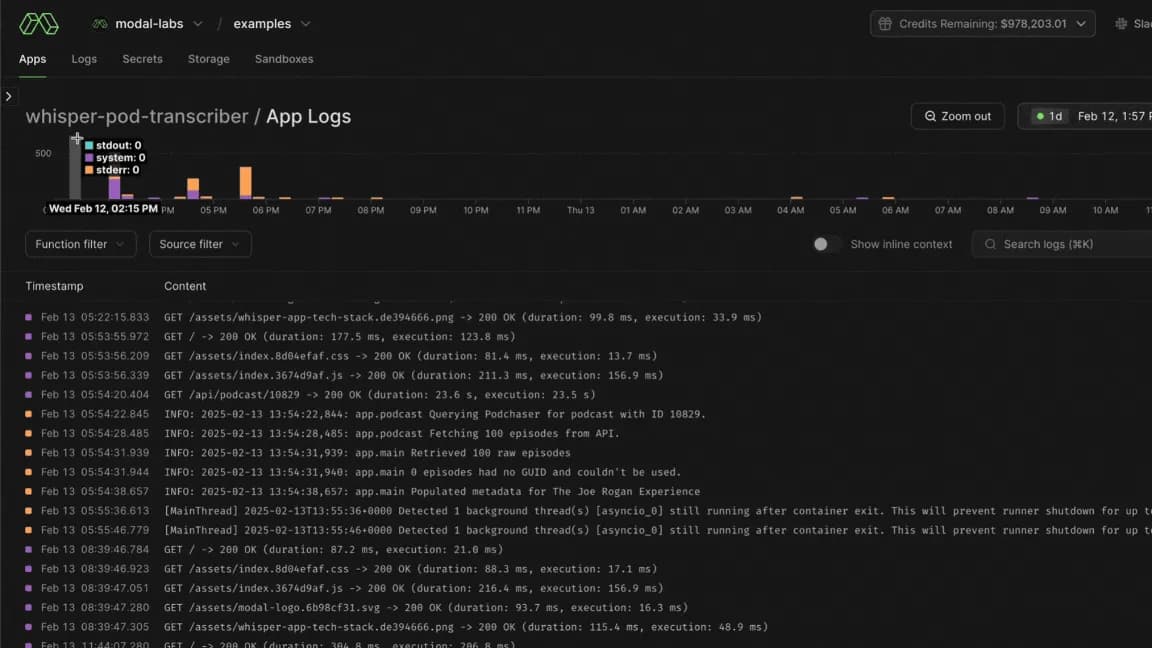
- Serverless functions. Code runs in containers that Modal starts on demand and scales down to zero between requests. You describe the environment and GPU type in Python, deploy, and call the function or its web endpoint. Scheduled functions, web functions, a distributed queue and a distributed dict are part of the platform. Modal routes work across 20+ clouds, and logs and metrics come through its dashboard.
- GPU-hour rates:
- Per second, including application load time and, by default, 60 seconds after the last input, then nothing once containers scale to zero. An H100 costs about $3.95 an hour, and CPU and memory are billed on top: $0.0000131 per physical core per second and $0.00000222 per GiB per second. Choosing a region multiplies base prices by 1.15 to 1.75, and non-preemptible execution costs 3 times base prices.
- Plans and free credits:
- Starter is $0 a month plus compute, with $30 of free credits a month, 3 seats, 100 containers and 10 GPUs at once. Team is $250 a month plus compute, with $100 of credits, unlimited seats, 5,000 containers and 50 GPUs at once. Enterprise is custom, with SSO, audit logs and HIPAA. Startups and academics can apply for credit grants, and Enterprise customers can use AWS or GCP committed spend.
- Model inference:
- Two routes. Shared Endpoints give OpenAI-compatible access to open models, billed per token from the first request and not covered by the plan's free compute. Or you deploy any model or inference stack as a Modal function or server, billed for the GPU seconds it uses and scaled to zero between requests, so you own the serving code and choose the GPU.
- Storage:
- Volumes cost $0.09 per GiB a month, and the first 1 TiB each month is free. Plans also include free network egress each month: 1 TiB on Starter and 10 TiB on Team.
Runcrate
- Best for:
- Developers and coding agents that want a whole GPU machine with a shell, or per-token calls to open models, on one prepaid balance. An instance has SSH, Jupyter and VS Code in the browser and runs until you delete it, so existing scripts run unchanged. It suits interactive work, long single runs and teams that want to call hosted open models without deploying a server.
- How work runs:
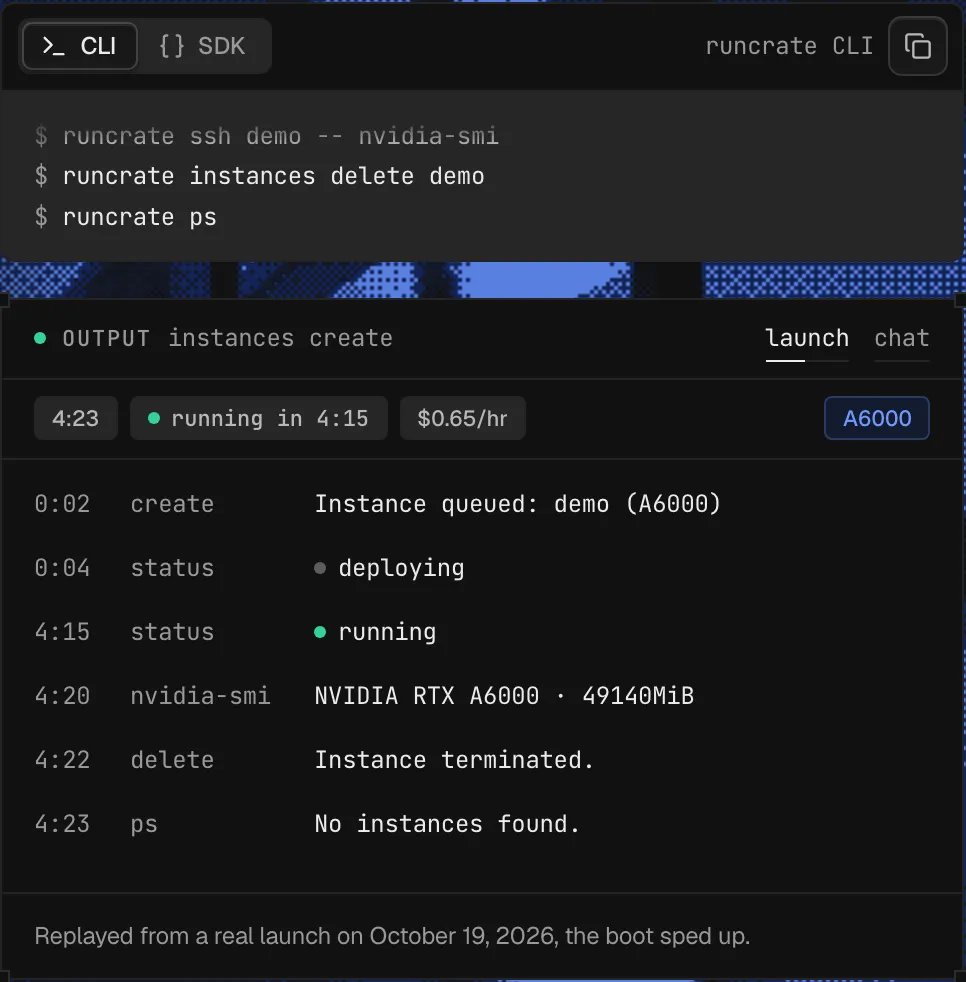
- Rented GPU instances. You pick one of 22 GPU types, launch it from the console, CLI, SDK or MCP server, and work over SSH, Jupyter or VS Code in the browser. The instance runs until you delete it, unless you set an auto stop by maximum runtime or idle time. A job mode runs one command and stops when it ends. Storage volumes stay when the instance is deleted and mount on the next one.
- GPU-hour rates:
- Per GPU-hour at live rates refreshed every 5 minutes, billed by the second on most GPUs, and booting is not billed. Rates start at $0.36 per GPU-hour. Runcrate's own example on November 1, 2026: $20 bought 8 hours on one H100. On that day we saw its H100 rate move by about 30% within an hour, so read the live table before a long job, or prepay a machine for 1 to 12 months at a discount.
- Plans and free credits:
- No plans or seats: one prepaid balance with no monthly fee. You add $20 to $10,000 at a time, and the balance does not expire. A launch needs $10 or an hour of the machine, whichever is more, or just $10 with auto-recharge on. Under $1.00, running instances are deleted after a 15-minute warning, or sooner at -$10.00. Five open models have a free weekly allowance for a GitHub account at least 30 days old.
- Model inference:
- A hosted OpenAI-compatible API with 127 models, billed per token, per image or per second of video. On November 1, 2026 Kimi K2.6 cost $0.788 input and $3.68 output per 1M tokens, and DeepSeek V3.2 cost $0.273 and $0.399. For your own weights, the route is a GPU instance: load the weights and serve them with your own stack, and the instance bills while it runs.
- Storage:
- Storage volumes cost $0.03 per GB a month, prepaid a week at a time while they exist, with unused days refunded on delete: $3.00 a month for 100 GB and $30.00 for 1 TB. A volume holds 10 GB to 10,000 GB and survives instance deletion.
Public signals
Verified factual signals only. Bars appear only for like-for-like metrics with five weekly assessments for every tool; missing evidence stays explicit. These signals do not establish enterprise adoption, product quality, or total cost.
| Metric | Modal | Runcrate |
|---|---|---|
| GitHub commits, 90d(Developer adoption) | Not available | 16 |
| GitHub stars(Developer adoption) | Not available | 2 |
| Hacker News mentions, 90d(Community interest) | 0 | 0 |
| Product Hunt comments(Community interest) | 1 | Not available |
| Product Hunt rating(Community interest) | 5.0/5 | Not available |
| Product Hunt reviews(Community interest) | 67 | Not available |
| Product Hunt votes(Community interest) | 69 | Not available |
| PyPI weekly downloads(Product adoption) | 12.3M | Not available |
| npm weekly downloads(Developer adoption) | Not available | 52 |
| PyPI weekly downloads(Developer adoption) | Not available | 36 |
As of November 9, 2026 — updated weekly.
Health & risk evidence
Observed public-source checks for mapped package versions and repositories.
Modal
November 9, 2026Package vulnerabilities
PyPI · modal@1.6.3
0 vulnerabilities
across 1 package
Repository security score
Not available
Runcrate
November 9, 2026Package vulnerabilities
npm · @runcrate/sdk@0.5.0 · PyPI · runcrate-sdk@0.5.0
0 vulnerabilities
across 2 packages
Repository security score
Not available
Interface Preview
Modal
Runcrate
Feature Comparison
| Feature | Modal | Runcrate |
|---|---|---|
| Compute model | ||
| Unit of work | A Python function in an autoscaling container | A GPU instance you keep until you delete it |
| Billing granularity | Per second for GPU, CPU and memory | Per second on most GPUs, per minute on a few |
| Start-up time | Billed, including application load time | Booting not billed |
| Idle time | Containers stay up 60 seconds after the last input by default, then scale to zero | Billed while running; auto stop by maximum runtime or idle time |
| Access | Modal SDK, web endpoints, logs and dashboard | SSH, Jupyter and VS Code in the browser |
| Scale-out | Thousands of GPUs at peak; 10 at once on Starter, 50 on Team | Self-serve multi-node clusters; reserved clusters from GPU owners |
| GPU range | 11 types, from T4 to B300 | 22 types, from V100 to B300 |
| Pricing | ||
| H100 rate | About $3.95 an hour, billed per second | Live rate; $20 bought 8 hours on November 1, 2026 |
| Monthly fee | $0 on Starter, $250 on Team, custom on Enterprise | None; prepaid balance from $20 |
| Included credits | $30 a month on Starter, $100 on Team | Free weekly allowance on 5 open models |
| Long-term options | Enterprise: volume discounts and AWS or GCP committed spend | Prepay a machine for 1 to 12 months at a discount; reserved clusters |
| Storage | $0.09 per GiB a month, 1 TiB a month free | $0.03 per GB a month |
| Models and agents | ||
| Hosted model API | Shared Endpoints, OpenAI-compatible, billed per token | 127 models through an OpenAI-compatible API |
| Agent tooling | Sandboxes for coding agents and RL rollouts | Remote MCP server, CLI and SDKs that launch GPUs |
Compute model
Unit of work
Billing granularity
Start-up time
Idle time
Access
Scale-out
GPU range
Pricing
H100 rate
Monthly fee
Included credits
Long-term options
Storage
Models and agents
Hosted model API
Agent tooling
Which approach fits
Modal and Runcrate both rent GPUs by the second, but they sell different ways of working. Modal turns Python functions into autoscaling GPU containers and charges nothing while they sit at zero, which suits uneven traffic and large parallel jobs. Runcrate rents a whole machine with a shell and adds a per-token API for 127 open models, which suits interactive work, long single runs and calling hosted models. We compared both on November 1, 2026 from each vendor's pricing and product pages: billing unit, GPU rates, plan fees, inference options and storage.
When each approach fits
Choose Modal if:
Choose Modal when the workload comes and goes: an inference endpoint with uneven traffic, a nightly batch of thousands of GPU tasks, or parallel hyperparameter sweeps. Containers scale to zero between requests, so idle time stops costing money a minute after the last request, and the Team plan runs 50 GPUs at once with unlimited seats for $250 a month plus compute. SOC 2 on every plan, with HIPAA, SSO and audit logs on Enterprise, helps a company that needs a security review. Runcrate loses here because an instance bills for every second it runs, busy or idle, and scaling out means launching more machines yourself. Modal is the weaker fit if your code expects a normal Linux machine you can SSH into and leave running for days.
Choose Runcrate if:
Choose Runcrate when you want a GPU that behaves like your own machine: SSH in, install what you need and run the script you already have, with no SDK to learn. Runcrate's own example put 8 hours on one H100 at $20 on November 1, 2026, with storage at $0.03 per GB a month and no monthly fee. The same balance pays for 127 hosted models, so an agent can call a model and launch a GPU with one key. Modal loses here because code has to be shaped into Modal functions, and its plan credits do not cover per-token Shared Endpoints. Runcrate is the weaker fit for bursty traffic, because idle instances keep billing until auto stop or deletion.
These scenarios reflect the available product evidence. Your requirements, existing stack, and team expertise should guide the final decision.
Frequently Asked Questions
Which is better for an inference endpoint with uneven traffic?
Modal, if you run your own model. It scales containers to zero between requests and back up when traffic arrives, so you pay for the seconds that serve requests plus a short idle window. On Runcrate, a self-served model runs on an instance that bills while it runs. If your model is in Runcrate's catalogue, its per-token API avoids the server altogether.
How do I move a training script from Modal to Runcrate?
Runcrate's guide is three CLI steps: create an instance with runcrate instances create --name my-gpu --gpu H100, copy your code with runcrate cp, and run it over runcrate ssh. Keep datasets and checkpoints on a storage volume, at $0.03 per GB a month, so they survive when you delete the instance.
What does each cost before any compute?
Modal's Starter plan is $0 a month and includes $30 of credits; Team is $250 a month and includes $100. Runcrate has no monthly fee: you top up from $20, the balance does not expire, and storage volumes are billed at $0.03 per GB a month while they exist.
Which handles many GPUs at once?
Modal runs 10 GPUs at once on Starter and 50 on Team, with more on Enterprise, and handles multi-node training capacity for you. Runcrate lets you launch 8 or more GPUs yourself, offers self-serve multi-node clusters, and quotes reserved clusters of a month or longer from GPU owners after it checks your company and your need.