Decision comparison
Fireworks AI vs Runcrate
Both sell open-model inference through an OpenAI-compatible API from a prepaid balance, so an application can move between them by changing the base URL and the model name. The difference is what sits behind the API. Fireworks AI runs the whole serving side: speed tiers, managed fine-tuning, tuned models at base-model prices and dedicated deployments it scales for you. Runcrate pairs a per-token catalogue of 127 models with raw GPU machines you control, at marketplace rates that change during the day. We compared both on November 1, 2026 from each vendor's own pricing and product pages: per-token rates on models both serve, GPU billing, balance rules, fine-tuning and developer tooling.
Direct comparison. These are reviewed substitutes bought for the same job, so the differences below are the ones that decide between them.
All 2 are model hosting platforms.
Quick Comparison
| Decision factor | Fireworks AI | Runcrate |
|---|---|---|
| Best for | Teams that serve open models to a production application and want the provider to run the serving stack. Fireworks AI offers serverless per-token endpoints with Standard, Priority and Fast serving paths, managed fine-tuning, and on-demand deployments of a model on dedicated GPUs. It says it runs in 30+ regions with data residency options, in your cloud or its own. Pick it when the work is calling models at scale and nobody on the team needs a shell on the GPU. | Developers and coding agents that want per-token model calls and rented GPU machines on one prepaid balance. Runcrate serves 127 models through an OpenAI-compatible API and rents 22 GPU types with SSH, Jupyter and VS Code in the browser. Pick it when an application calls open models most of the time, but some work, such as a fine-tune, a batch job or a test of your own weights, needs a whole machine you control. |
| Per-token rates | Per token, billed on input, output and cached tokens. On October 26, 2026 its home page listed MiniMax M3.1 Flash at $0.15 input and $0.60 output per 1M tokens, and DeepSeek V4.1 Flash 1017 at $0.30 and $1.20. Serverless models without their own rate are priced by size: $0.10 per 1M tokens under 4B parameters and $0.90 per 1M tokens over 16B. Embeddings start at $0.008 per 1M input tokens. | Per token for language models, per image for most image models and per second for video. On November 1, 2026 it listed MiniMax M3.1 Flash at $0.158 input and $0.63 output per 1M tokens, Kimi K2.6 at $0.788 and $3.68, and DeepSeek V3.2 at $0.273 and $0.399. DeepSeek V4.1 Flash 1017 was $0.0515 input and $0.154 output on shared capacity, rising to $0.103 and $0.309 when that capacity is busy. Five open models have a free weekly allowance for a GitHub account at least 30 days old. |
| GPU-hour rates | On-demand deployments are billed per GPU second, with no charge for start-up time: H100 80 GB and H200 141 GB at $8.00 an hour, B200 at $13.00, B300 at $15.00 and GB300 at $20.00. Region-restricted deployments cost 1.5 times these rates. The price buys a dedicated deployment of a model that Fireworks AI serves and scales for you. | Instances are billed per GPU-hour at live rates refreshed every 5 minutes, by the second on most GPUs, and booting is not billed. Rates start at $0.36 per GPU-hour. Runcrate's own example on November 1, 2026: $20 bought 8 hours on one H100. On that day we saw its H100 rate move by about 30% within an hour, so read the live table before a long job, or prepay a machine for 1 to 12 months at a discount. |
| Billing and balance rules | Prepaid credits. You add a payment method, buy credits, and usage is deducted from the balance. Auto Reload tops the balance up when it runs low, and a monthly spend limit caps usage. Enterprise deployments with higher rate limits are arranged with its sales team. | One prepaid balance for GPUs, models and storage, with no monthly fee. You add $20 to $10,000 at a time by card, and the balance does not expire. Auto-recharge takes a threshold of $20 to $5,000 and a target of $50 to $10,000. A launch needs $10 or an hour of the machine, whichever is more. Under $1.00, Runcrate emails you and deletes running instances after 15 minutes, or sooner at -$10.00, so long jobs need auto-recharge. |
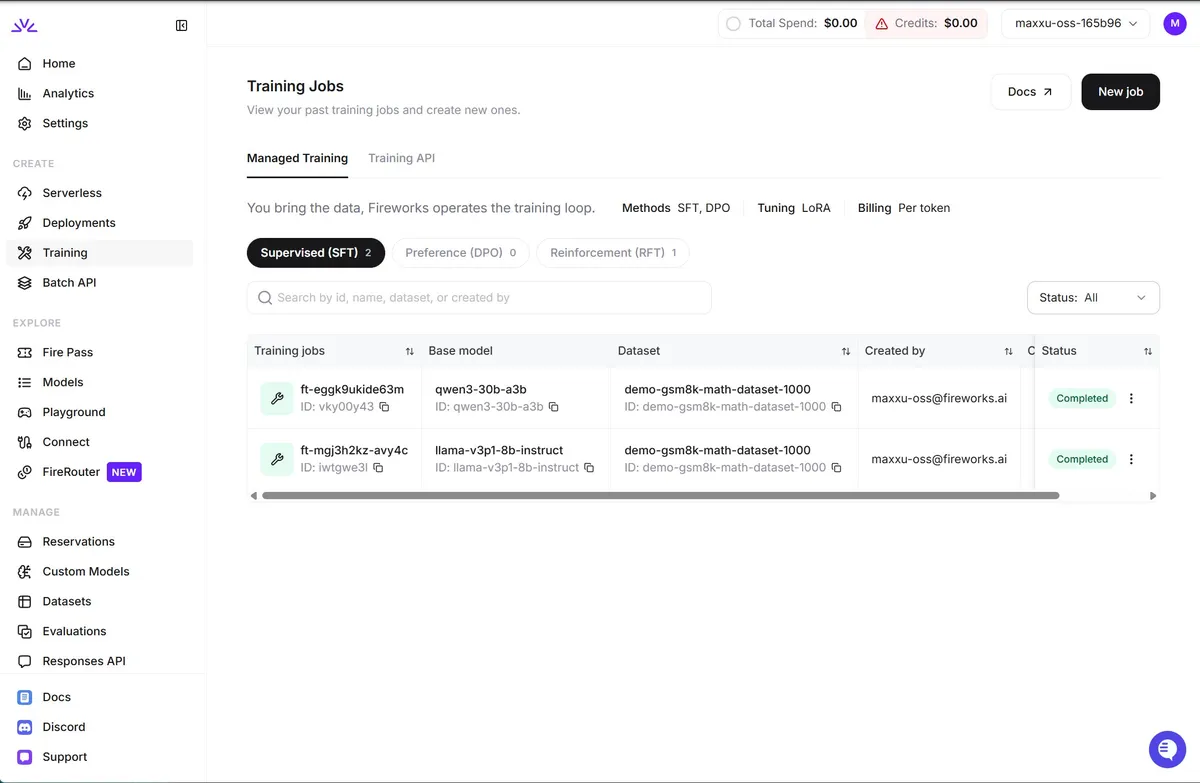
| Custom and fine-tuned models | Managed fine-tuning priced per 1M training tokens. LoRA SFT costs $0.50 for models up to 16B parameters, $3.00 for 16.1B to 80B, $6.00 for 80B to 300B and $10.00 above 300B; DPO and full-parameter tuning cost more. Fine-tuned models are served at the same price as their base models, so a tuned model needs no dedicated GPU of its own. | Fine-tuning runs on a GPU instance you rent, using Runcrate's ready images for fine-tuning and serving. To serve your own or fine-tuned weights, you load them on an instance and serve them with the stack you already use. You run, watch and restart that server yourself, and the instance bills for every second it runs. |
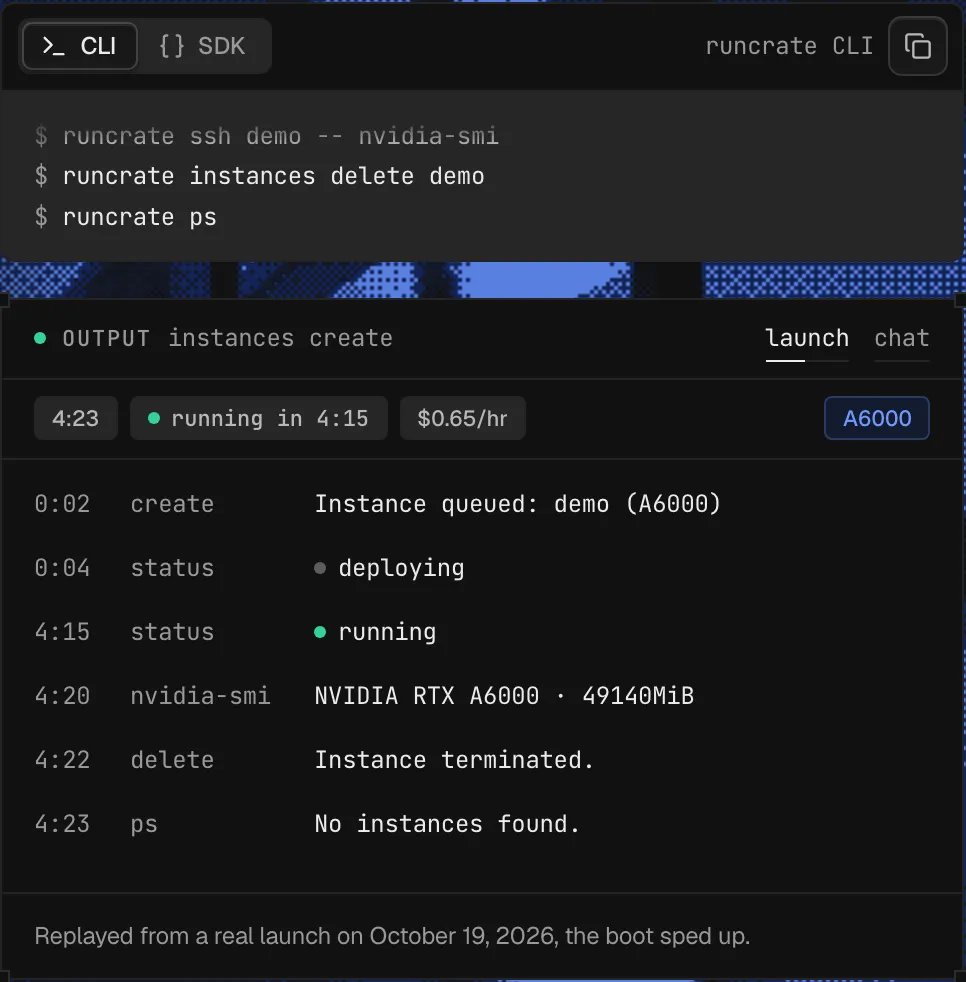
| Developer access | OpenAI-compatible endpoints with function calling and JSON mode, an official Python SDK under the Apache-2.0 licence. Fireworks AI says it can run in your cloud or its own, and serverless use can move to reserved throughput as traffic grows. | An OpenAI-compatible API at https://api.runcrate.ai/v1, a CLI for Linux, macOS and Windows, Python and TypeScript SDKs, and a remote MCP server with browser sign-in. With these, a coding agent can launch a GPU, copy files to it, run a command over SSH and delete it without a person in the loop. |
Fireworks AI
- Best for:
- Teams that serve open models to a production application and want the provider to run the serving stack. Fireworks AI offers serverless per-token endpoints with Standard, Priority and Fast serving paths, managed fine-tuning, and on-demand deployments of a model on dedicated GPUs. It says it runs in 30+ regions with data residency options, in your cloud or its own. Pick it when the work is calling models at scale and nobody on the team needs a shell on the GPU.
- Per-token rates:
- Per token, billed on input, output and cached tokens. On October 26, 2026 its home page listed MiniMax M3.1 Flash at $0.15 input and $0.60 output per 1M tokens, and DeepSeek V4.1 Flash 1017 at $0.30 and $1.20. Serverless models without their own rate are priced by size: $0.10 per 1M tokens under 4B parameters and $0.90 per 1M tokens over 16B. Embeddings start at $0.008 per 1M input tokens.
- GPU-hour rates:
- On-demand deployments are billed per GPU second, with no charge for start-up time: H100 80 GB and H200 141 GB at $8.00 an hour, B200 at $13.00, B300 at $15.00 and GB300 at $20.00. Region-restricted deployments cost 1.5 times these rates. The price buys a dedicated deployment of a model that Fireworks AI serves and scales for you.
- Billing and balance rules:
- Prepaid credits. You add a payment method, buy credits, and usage is deducted from the balance. Auto Reload tops the balance up when it runs low, and a monthly spend limit caps usage. Enterprise deployments with higher rate limits are arranged with its sales team.
- Custom and fine-tuned models:
- Managed fine-tuning priced per 1M training tokens. LoRA SFT costs $0.50 for models up to 16B parameters, $3.00 for 16.1B to 80B, $6.00 for 80B to 300B and $10.00 above 300B; DPO and full-parameter tuning cost more. Fine-tuned models are served at the same price as their base models, so a tuned model needs no dedicated GPU of its own.
- Developer access:
- OpenAI-compatible endpoints with function calling and JSON mode, an official Python SDK under the Apache-2.0 licence. Fireworks AI says it can run in your cloud or its own, and serverless use can move to reserved throughput as traffic grows.
Runcrate
- Best for:
- Developers and coding agents that want per-token model calls and rented GPU machines on one prepaid balance. Runcrate serves 127 models through an OpenAI-compatible API and rents 22 GPU types with SSH, Jupyter and VS Code in the browser. Pick it when an application calls open models most of the time, but some work, such as a fine-tune, a batch job or a test of your own weights, needs a whole machine you control.
- Per-token rates:
- Per token for language models, per image for most image models and per second for video. On November 1, 2026 it listed MiniMax M3.1 Flash at $0.158 input and $0.63 output per 1M tokens, Kimi K2.6 at $0.788 and $3.68, and DeepSeek V3.2 at $0.273 and $0.399. DeepSeek V4.1 Flash 1017 was $0.0515 input and $0.154 output on shared capacity, rising to $0.103 and $0.309 when that capacity is busy. Five open models have a free weekly allowance for a GitHub account at least 30 days old.
- GPU-hour rates:
- Instances are billed per GPU-hour at live rates refreshed every 5 minutes, by the second on most GPUs, and booting is not billed. Rates start at $0.36 per GPU-hour. Runcrate's own example on November 1, 2026: $20 bought 8 hours on one H100. On that day we saw its H100 rate move by about 30% within an hour, so read the live table before a long job, or prepay a machine for 1 to 12 months at a discount.
- Billing and balance rules:
- One prepaid balance for GPUs, models and storage, with no monthly fee. You add $20 to $10,000 at a time by card, and the balance does not expire. Auto-recharge takes a threshold of $20 to $5,000 and a target of $50 to $10,000. A launch needs $10 or an hour of the machine, whichever is more. Under $1.00, Runcrate emails you and deletes running instances after 15 minutes, or sooner at -$10.00, so long jobs need auto-recharge.
- Custom and fine-tuned models:
- Fine-tuning runs on a GPU instance you rent, using Runcrate's ready images for fine-tuning and serving. To serve your own or fine-tuned weights, you load them on an instance and serve them with the stack you already use. You run, watch and restart that server yourself, and the instance bills for every second it runs.
- Developer access:
- An OpenAI-compatible API at https://api.runcrate.ai/v1, a CLI for Linux, macOS and Windows, Python and TypeScript SDKs, and a remote MCP server with browser sign-in. With these, a coding agent can launch a GPU, copy files to it, run a command over SSH and delete it without a person in the loop.
Public signals
Verified factual signals only. Bars appear only for like-for-like metrics with five weekly assessments for every tool; missing evidence stays explicit. These signals do not establish enterprise adoption, product quality, or total cost.
| Metric | Fireworks AI | Runcrate |
|---|---|---|
| GitHub commits, 90d(Developer adoption) | 60 | 16 |
| GitHub stars(Developer adoption) | 11 | 2 |
| Search interest(Market interest) | 1 | Unavailable |
| Hacker News mentions, 90d(Community interest) | 0 | 0 |
| Hugging Face downloads(Product adoption) | 410 | Not available |
| Hugging Face likes(Product adoption) | 341 | Not available |
| PyPI weekly downloads(Developer adoption) | 432.6k | 36 |
| npm weekly downloads(Developer adoption) | Not available | 52 |
As of November 9, 2026 — updated weekly.
Health & risk evidence
Observed public-source checks for mapped package versions and repositories.
Fireworks AI
November 9, 2026Package vulnerabilities
PyPI · fireworks-ai@1.2.33
0 vulnerabilities
across 1 package
Repository security score
Not available
Runcrate
November 9, 2026Package vulnerabilities
npm · @runcrate/sdk@0.5.0 · PyPI · runcrate-sdk@0.5.0
0 vulnerabilities
across 2 packages
Repository security score
Not available
Interface Preview
Fireworks AI
Runcrate
Feature Comparison
| Feature | Fireworks AI | Runcrate |
|---|---|---|
| Inference | ||
| API format | OpenAI-compatible endpoints | OpenAI-compatible, base URL api.runcrate.ai/v1 |
| Model catalogue | Open and custom models; per-model rates in its serverless pricing docs | 127 models across text, vision, image, video and audio |
| Serving options | Standard, Priority and Fast serving paths; reserved throughput | One listed rate per model; some models add a busy-time rate |
| Cached input | Billed as its own token class; Fireworks AI says cached input costs half or less | Listed per model, for example $0.158 per 1M tokens on Kimi K2.6 |
| Models without a listed rate | Priced by size: $0.10 per 1M tokens under 4B, $0.90 over 16B | Every catalogue model has its own listed rate |
| GPU compute | ||
| Billing unit | Per GPU second, start-up not billed | Per second on most GPUs, per minute on a few; booting not billed |
| What a GPU-hour buys | A dedicated deployment of one model, served by Fireworks AI | A whole instance with SSH, Jupyter and VS Code in the browser |
| H100 rate | $8.00 per hour | Live rate; $20 bought 8 hours on November 1, 2026 |
| Price changes | Fixed list rates; region-restricted deployments at 1.5x | Live rates refreshed every 5 minutes; prepay 1 to 12 months for a discount |
| Training and billing | ||
| Fine-tuning | Managed LoRA, DPO and full-parameter jobs, priced per 1M training tokens | On your own rented GPU, with ready fine-tuning images |
| Serving tuned weights | Same per-token price as the base model | Serve them yourself on an instance |
| Payment | Prepaid credits with Auto Reload and a monthly spend limit | Prepaid balance, $20 to $10,000 per top-up, with auto-recharge |
| Agent tooling | Python SDK and OpenAI client libraries | CLI, Python and TypeScript SDKs, remote MCP server |
Inference
API format
Model catalogue
Serving options
Cached input
Models without a listed rate
GPU compute
Billing unit
What a GPU-hour buys
H100 rate
Price changes
Training and billing
Fine-tuning
Serving tuned weights
Payment
Agent tooling
Which to choose
Both sell open-model inference through an OpenAI-compatible API from a prepaid balance, so an application can move between them by changing the base URL and the model name. The difference is what sits behind the API. Fireworks AI runs the whole serving side: speed tiers, managed fine-tuning, tuned models at base-model prices and dedicated deployments it scales for you. Runcrate pairs a per-token catalogue of 127 models with raw GPU machines you control, at marketplace rates that change during the day. We compared both on November 1, 2026 from each vendor's own pricing and product pages: per-token rates on models both serve, GPU billing, balance rules, fine-tuning and developer tooling.
Best-fit scenarios
Choose Fireworks AI if:
Choose Fireworks AI when inference is the product and you want the provider to own its quality and scale. You get Standard, Priority and Fast serving paths, managed LoRA and full-parameter fine-tuning with tuned models served at base-model prices, and dedicated deployments that it operates in 30+ regions with data residency options. That last point matters for regulated buyers. Runcrate loses here because a tuned or custom model on Runcrate means running your own server on a rented instance, with your own restarts, monitoring and idle hours. Fireworks AI is the weaker fit for open-ended GPU work: its $8.00 H100 hour buys a model deployment, not a machine where you can install anything and run a training script.
Choose Runcrate if:
Choose Runcrate when one developer or one coding agent does both kinds of work: calling hosted models and running its own code on a GPU. The same balance pays for MiniMax M3.1 Flash at $0.158 input per 1M tokens and for an H100 instance with SSH, and the CLI, SDKs and MCP server let an agent launch and delete that GPU itself. There is no monthly fee, and top-ups start at $20. Fireworks AI loses here because its GPUs only serve models. Runcrate is the weaker fit for a production endpoint that needs speed tiers, managed fine-tuning or a dedicated deployment someone else operates, and its low-balance rule deletes running instances, so set auto-recharge before long jobs.
These scenarios reflect the available product evidence. Your requirements, existing stack, and team expertise should guide the final decision.
Frequently Asked Questions
Can I move an application between Fireworks AI and Runcrate?
Yes, for models both serve. Both expose OpenAI-compatible APIs, so you change the base URL, the API key and the model name. Model names differ between catalogues, so check that your model is listed on both. On the dates we checked, MiniMax M3.1 Flash and DeepSeek V4.1 Flash 1017 were listed by both.
What do the same models cost per token on each?
On October 26, 2026 Fireworks AI listed MiniMax M3.1 Flash at $0.15 input and $0.60 output per 1M tokens, and DeepSeek V4.1 Flash 1017 at $0.30 and $1.20. On November 1, 2026 Runcrate listed MiniMax M3.1 Flash at $0.158 and $0.63, and DeepSeek V4.1 Flash 1017 at $0.0515 and $0.154 on shared capacity, or $0.103 and $0.309 when busy. Price the exact model you ship, on the day you buy.
What does a GPU-hour buy on each?
On Fireworks AI, $8.00 an hour buys a dedicated H100 deployment of a model that Fireworks AI serves and scales, billed per second with no start-up charge. On Runcrate, an H100 hour buys a bare machine with a shell: $20 bought 8 hours on November 1, 2026, and you install and run whatever you need.
Where do I fine-tune a model?
Fireworks AI runs fine-tuning for you and charges per 1M training tokens, from $0.50 for LoRA SFT on models up to 16B parameters, then serves the result at the base model's price. On Runcrate you rent a GPU, use a ready fine-tuning image, and serve the result on an instance yourself.
What happens when my balance runs low?
On Fireworks AI, Auto Reload tops up the credits and a monthly spend limit caps usage. On Runcrate, below $1.00 it tries auto-recharge, then emails you and deletes running instances after 15 minutes, or sooner at -$10.00. Each instance is billed up to that moment.