Decision comparison
Snowflake vs TimescaleDB
Snowflake and Timescale serve fundamentally different data workloads. Snowflake is the stronger choice for teams building a general-purpose cloud data warehouse that handles structured and semi-structured analytics across departments. Timescale is purpose-built for time-series data and delivers superior performance for IoT, DevOps monitoring, and financial telemetry workloads while keeping you on a full PostgreSQL stack.
Architecture choice. These take different approaches to the same problem. Read the table as a fit question rather than a feature race.
These are different kinds of product — Cloud Data Warehouse and Time-Series Database.
Quick Comparison
| Decision factor | Snowflake | TimescaleDB |
|---|---|---|
| Primary Use Case | General-purpose cloud data warehousing and analytics across structured and semi-structured data | Time-series data workloads including IoT, DevOps monitoring, and financial data |
| Pricing Model | Snowflake prices on consumption, not a subscription: its pricing page states "We keep pricing simple with a consumption-based pricing model" and publishes no monthly or per-user price. Editions are Standard, Enterprise, Business Critical and Virtual Private Snowflake. Per-credit rates are scoped by edition, cloud and region: the Service Consumption Table effective 2026-09-09 lists on-demand AWS US East at $2.00 (Standard), $3.00 (Enterprise), $4.00 (Business Critical) and $6.00 (VPS), rising to $2.60/$3.90/$5.20 in AWS EU Dublin, so no single platform-wide credit price exists. Storage is billed separately at $23.00 per TB per month on demand in US East, less under capacity commitments. A 30-day free trial ends when the period or the included credit balance runs out; that is a trial, not a free tier. Verified 2026-09-16. | Self-hosted free (Time-series, PostgreSQL extension, Full features), Cloud pricing starts at $0.177/GB-month, $30/mo, $36/mo, with a free trial offering $20 in credits |
| Architecture | Fully managed, separates compute and storage across AWS, Azure, and GCP | Built on unforked PostgreSQL with automatic time-based partitioning (hypertables) |
| Data Types | Structured and semi-structured data (JSON, Avro, Parquet); general-purpose analytics | Time-series, telemetry, sensor, event, and tick data with hybrid row-columnar storage |
| Scalability | Elastic compute with multi-cluster warehouses; independent storage and compute scaling | Automatic partitioning by time and key; tiered storage with SSD and object storage; compression up to 95% |
| SQL Compatibility | ANSI SQL with proprietary extensions; Snowpark for Python, Java, and Scala | Full PostgreSQL compatibility with 200+ specialized time-series SQL functions |
Snowflake
- Primary Use Case:
- General-purpose cloud data warehousing and analytics across structured and semi-structured data
- Pricing Model:
- Snowflake prices on consumption, not a subscription: its pricing page states "We keep pricing simple with a consumption-based pricing model" and publishes no monthly or per-user price. Editions are Standard, Enterprise, Business Critical and Virtual Private Snowflake. Per-credit rates are scoped by edition, cloud and region: the Service Consumption Table effective 2026-09-09 lists on-demand AWS US East at $2.00 (Standard), $3.00 (Enterprise), $4.00 (Business Critical) and $6.00 (VPS), rising to $2.60/$3.90/$5.20 in AWS EU Dublin, so no single platform-wide credit price exists. Storage is billed separately at $23.00 per TB per month on demand in US East, less under capacity commitments. A 30-day free trial ends when the period or the included credit balance runs out; that is a trial, not a free tier. Verified 2026-09-16.
- Architecture:
- Fully managed, separates compute and storage across AWS, Azure, and GCP
- Data Types:
- Structured and semi-structured data (JSON, Avro, Parquet); general-purpose analytics
- Scalability:
- Elastic compute with multi-cluster warehouses; independent storage and compute scaling
- SQL Compatibility:
- ANSI SQL with proprietary extensions; Snowpark for Python, Java, and Scala
TimescaleDB
- Primary Use Case:
- Time-series data workloads including IoT, DevOps monitoring, and financial data
- Pricing Model:
- Self-hosted free (Time-series, PostgreSQL extension, Full features), Cloud pricing starts at $0.177/GB-month, $30/mo, $36/mo, with a free trial offering $20 in credits
- Architecture:
- Built on unforked PostgreSQL with automatic time-based partitioning (hypertables)
- Data Types:
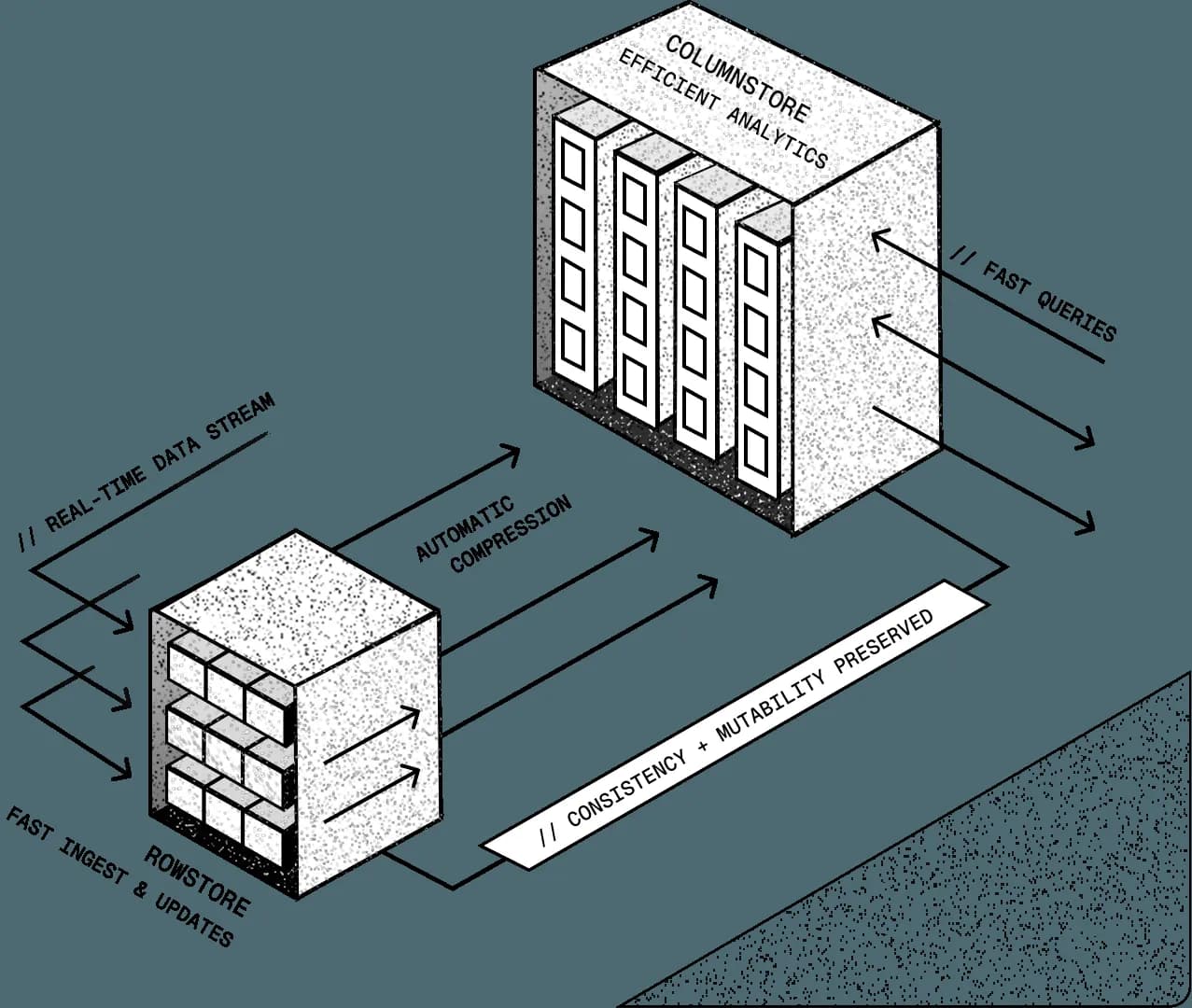
- Time-series, telemetry, sensor, event, and tick data with hybrid row-columnar storage
- Scalability:
- Automatic partitioning by time and key; tiered storage with SSD and object storage; compression up to 95%
- SQL Compatibility:
- Full PostgreSQL compatibility with 200+ specialized time-series SQL functions
Public signals
Verified factual signals only. Bars appear only for like-for-like metrics with five weekly assessments for every tool; missing evidence stays explicit. These signals do not establish enterprise adoption, product quality, or total cost.
| Metric | Snowflake | TimescaleDB |
|---|---|---|
| GitHub commits, 90d(Developer adoption) | 68 | Not available |
| GitHub stars(Developer adoption) | 730 | Not available |
| Search interest(Market interest) | 2 | 0 |
| Hacker News mentions, 90d(Community interest) | 0 | 1 |
| npm weekly downloads(Developer adoption) | 1.7M | Not available |
| PyPI weekly downloads(Developer adoption) | 22.9M | Not available |
| Stack Overflow questions(Community interest) | 12.2k | 775 |
| Docker Hub pulls(Product adoption) | Not available | 34.9M |
| GitHub commits, 90d(Product adoption) | Not available | 341 |
| GitHub stars(Product adoption) | Not available | 23,000+ |
| npm weekly downloads(Ecosystem adoption) | Not available | 38.5M |
| Product Hunt comments(Community interest) | Not available | 1 |
| Product Hunt rating(Community interest) | Not available | 5.0/5 |
| Product Hunt reviews(Community interest) | Not available | 5 |
| Product Hunt votes(Community interest) | Not available | 9 |
| PyPI weekly downloads(Ecosystem adoption) | Not available | 575 |
As of September 21, 2026 — updated weekly.
Health & risk evidence
Observed public-source checks for mapped package versions and repositories.
Snowflake
September 21, 2026Package vulnerabilities
PyPI · snowflake-connector-python@4.7.4 · npm · snowflake-sdk@3.3.0
0 vulnerabilities
across 2 packages
Repository security score
github.com/snowflakedb/snowflake-connector-python
5.0/10
TimescaleDB
September 21, 2026Package vulnerabilities
npm · pg@8.23.0 · PyPI · timescaledb@0.2.1
0 vulnerabilities
across 2 packages
Repository security score
Not available
Interface Preview
TimescaleDB
Feature Comparison
| Feature | Snowflake | TimescaleDB |
|---|---|---|
| Data Management | ||
| Automatic Data Partitioning | Micro-partitioning managed automatically by the platform | Hypertables with automatic time- and key-based partitioning |
| Data Compression | Automatic compression with optimized storage | Native compression up to 95% with row-columnar storage |
| Tiered Storage | Not applicable; unified cloud storage layer | Hot data on SSD, colder data on low-cost object storage |
| Analytics & Query Capabilities | ||
| Time-Series Functions | Standard SQL window functions and date/time operations | 200+ specialized SQL functions for time-based analytics |
| Continuous Aggregates | Materialized views with manual refresh | Incrementally refreshed continuous aggregates for real-time dashboards |
| Hybrid Search | Not natively supported; requires external tooling | Native keyword (BM25), vector, and hybrid search built into Postgres |
| Platform & Integration | ||
| Cloud Provider Support | Runs on AWS, Azure, and Google Cloud with cross-cloud data sharing | Tiger Cloud deployed on AWS; self-hosted TimescaleDB on any cloud |
| Lakehouse Integration | Interoperability with open table formats (Iceberg) | Ingest from Kafka and S3, replicate to Iceberg via Tiger Lake |
| Data Sharing & Collaboration | Live data sharing across clouds and organizations; Data Clean Rooms | Connectors for Kafka, S3, and Postgres streaming |
| Security & Compliance | ||
| Encryption | Automatic encryption of all data; Tri-Secret Secure on Business Critical | Encryption at rest and in transit with private networking |
| Compliance Certifications | Enterprise-grade governance, disaster recovery, and private connectivity | SOC 2 Type II, GDPR support, and enterprise security standards |
| High Availability | Failover and failback for disaster recovery (Business Critical tier) | 99.9% uptime SLA, automated backups, and up to 14-day point-in-time recovery |
| AI & Advanced Features | ||
| AI/ML Capabilities | Snowpark for deploying LLMs and ML models; Snowflake Intelligence for natural language queries | Vector search via pgvectorscale for embedding-based retrieval |
| Data Pipeline Support | Native continuous data pipelines with Snowpipe; multi-language support | SQL-based streaming from Kafka, S3, and Postgres connectors |
| Open Source Component | Proprietary platform; no open-source edition | TimescaleDB is open source; Tiger Cloud is the managed service |
Data Management
Automatic Data Partitioning
Data Compression
Tiered Storage
Analytics & Query Capabilities
Time-Series Functions
Continuous Aggregates
Hybrid Search
Platform & Integration
Cloud Provider Support
Lakehouse Integration
Data Sharing & Collaboration
Security & Compliance
Encryption
Compliance Certifications
High Availability
AI & Advanced Features
AI/ML Capabilities
Data Pipeline Support
Open Source Component
Which approach fits
Snowflake and Timescale serve fundamentally different data workloads. Snowflake is the stronger choice for teams building a general-purpose cloud data warehouse that handles structured and semi-structured analytics across departments. Timescale is purpose-built for time-series data and delivers superior performance for IoT, DevOps monitoring, and financial telemetry workloads while keeping you on a full PostgreSQL stack.
When each approach fits
Choose Snowflake if:
We recommend Snowflake for organizations that need a centralized, multi-cloud data warehouse supporting diverse analytics workloads. Snowflake excels when your team works with structured and semi-structured data across departments, needs cross-cloud data sharing with partners, and requires enterprise-grade governance with features like Data Clean Rooms and Snowflake Intelligence. The consumption-based credit model works well for variable workloads where compute and storage need to scale independently.
Choose TimescaleDB if:
We recommend Timescale for teams whose primary workload involves time-series, telemetry, sensor, or event data. Built on unforked PostgreSQL, Timescale gives you full SQL compatibility with 200+ specialized time-series functions, automatic hypertable partitioning, and native compression up to 95% that dramatically reduces storage costs. The free trial and usage-based pricing make it accessible for startups and prototyping, while Tiger Cloud on AWS scales to petabyte-level workloads with a 99.9% uptime SLA. If your stack already relies on PostgreSQL, Timescale slots in without requiring your team to learn a new query language or manage a separate data platform. Enterprises processing trillions of metrics daily, such as those in IoT, oil and gas, or telecommunications, will find Timescale purpose-built for their ingest and query patterns.
These scenarios reflect the available product evidence. Your requirements, existing stack, and team expertise should guide the final decision.
Frequently Asked Questions
Can Timescale replace Snowflake for general analytics?
Timescale is optimized for time-series workloads and runs on PostgreSQL, so it handles general SQL analytics well for smaller datasets. However, Snowflake provides purpose-built features for large-scale multi-department analytics, including multi-cluster warehouses, cross-cloud data sharing, and Data Clean Rooms. If your primary workload is time-series data with some general analytics, Timescale can serve both needs. For organizations with diverse, large-scale analytical workloads across structured and semi-structured data, Snowflake remains the more comprehensive platform.
How do Snowflake and Timescale compare on pricing for small teams?
Timescale offers a free trial and usage-based pricing that makes it significantly more accessible for small teams getting started. Snowflake uses consumption-based credit pricing starting at approximately $2/credit for the Standard edition, with small analytics teams typically spending $500-$2,000/month depending on query frequency and data volume. For teams just getting started with limited budgets, Timescale provides a lower barrier to entry. Snowflake's costs scale with usage, which can be advantageous for variable workloads but requires careful monitoring to avoid unexpected bills.
Which platform is better for IoT and sensor data?
Timescale is purpose-built for IoT and sensor data workloads. Its hypertable architecture automatically partitions data by time for fast ingest, native compression reduces storage costs by up to 95%, and 200+ time-series SQL functions handle common analytical patterns like downsampling and gap filling. Companies like Axpo and Flowco use Timescale to process data from connected systems at scale. Snowflake can store and query IoT data, but it lacks the specialized time-series primitives and automatic partitioning that make Timescale significantly faster for high-frequency ingest and time-range queries.
Do both platforms support data lakehouse architectures?
Yes. Snowflake supports interoperability with open table formats like Apache Iceberg, allowing you to query data in external storage alongside Snowflake-managed tables. Timescale offers Tiger Lake, which automatically synchronizes hypertables and relational tables with Apache Iceberg tables in Amazon S3. Both platforms also integrate with Kafka for streaming ingestion. Snowflake's lakehouse support spans AWS, Azure, and GCP, while Timescale's Tiger Lake is currently deployed on AWS.
Can we use both Snowflake and Timescale together?
Yes, and many data teams do. A common pattern is to use Timescale as the operational time-series database for high-frequency ingest from IoT sensors or application metrics, then replicate aggregated data to Snowflake for cross-departmental analytics and business intelligence. Timescale's Kafka and S3 connectors make it straightforward to stream data into Snowflake. This approach lets each platform handle the workload it was designed for while giving analysts a unified view in Snowflake's data warehouse.