Decision comparison
Spotfire vs ThoughtSpot
Spotfire and ThoughtSpot serve opposite users. Spotfire is built for analysts: linked visualisations, drill paths and R or Python beside the charts, for questions that change as you follow them. ThoughtSpot is built for everybody else: a search box over a governed model, so a manager can ask directly rather than filing a request.
Direct comparison. These are reviewed substitutes bought for the same job, so the differences below are the ones that decide between them.
All 2 are BI platforms.
Quick Comparison
| Decision factor | Spotfire | ThoughtSpot |
|---|---|---|
| What it is | An analytics platform built around interactive visual exploration, with R and Python available beside the charts | An analytics platform where the primary interface is a search box, aimed at business users asking their own questions |
| Primary user | Analysts who explore data as their job | Business users asking their own questions without an analyst |
| Interface | Linked visualisations, drill paths and a canvas built for iteration | A search box over a governed model |
| Advanced analytics | R and Python beside the visualisations for statistical work | Automated insights over the modelled dataset |
| Prerequisite | An analyst who knows the data and what they are looking for | A modelled, well-named dataset the search interface can interpret |
| Deployment | Cloud or on-premise, depending on licensing | Cloud, with deployment options depending on agreement |
| Best fit | Deep exploratory and statistical work by specialists | Removing the queue in front of the data team for straightforward questions |
| Connectivity | Connects to Snowflake, BigQuery, Redshift and Databricks over standard drivers, with REST APIs for automation | Connects to Snowflake, BigQuery, Redshift and Databricks over standard drivers, with REST APIs for automation |
Spotfire
- What it is:
- An analytics platform built around interactive visual exploration, with R and Python available beside the charts
- Primary user:
- Analysts who explore data as their job
- Interface:
- Linked visualisations, drill paths and a canvas built for iteration
- Advanced analytics:
- R and Python beside the visualisations for statistical work
- Prerequisite:
- An analyst who knows the data and what they are looking for
- Deployment:
- Cloud or on-premise, depending on licensing
- Best fit:
- Deep exploratory and statistical work by specialists
- Connectivity:
- Connects to Snowflake, BigQuery, Redshift and Databricks over standard drivers, with REST APIs for automation
ThoughtSpot
- What it is:
- An analytics platform where the primary interface is a search box, aimed at business users asking their own questions
- Primary user:
- Business users asking their own questions without an analyst
- Interface:
- A search box over a governed model
- Advanced analytics:
- Automated insights over the modelled dataset
- Prerequisite:
- A modelled, well-named dataset the search interface can interpret
- Deployment:
- Cloud, with deployment options depending on agreement
- Best fit:
- Removing the queue in front of the data team for straightforward questions
- Connectivity:
- Connects to Snowflake, BigQuery, Redshift and Databricks over standard drivers, with REST APIs for automation
Public signals
Verified factual signals only. Bars appear only for like-for-like metrics with five weekly assessments for every tool; missing evidence stays explicit. These signals do not establish enterprise adoption, product quality, or total cost.
| Metric | Spotfire | ThoughtSpot |
|---|---|---|
| GitHub commits, 90d(Developer adoption) | 10 | 79 |
| GitHub stars(Developer adoption) | 62 | 13 |
| Search interest(Market interest) | 1 | 1 |
| Hacker News mentions, 90d(Community interest) | 0 | 0 |
| npm weekly downloads(Developer adoption) | 22 | 71.7k |
| PyPI weekly downloads(Developer adoption) | 1.5k | 127 |
| Stack Overflow questions(Community interest) | 1.6k | Not available |
| Product Hunt comments(Community interest) | Not available | 3 |
| Product Hunt reviews(Community interest) | Not available | 0 |
| Product Hunt votes(Community interest) | Not available | 105 |
As of September 21, 2026 — updated weekly.
Health & risk evidence
Observed public-source checks for mapped package versions and repositories.
Spotfire
September 21, 2026Package vulnerabilities
npm · @spotfire/mods-sdk@1.2.0 · PyPI · spotfire@2.4.2
0 vulnerabilities
across 2 packages
Repository security score
Not available
ThoughtSpot
September 21, 2026Package vulnerabilities
npm · @thoughtspot/visual-embed-sdk@1.52.1 · PyPI · thoughtspot-rest-api-sdk@2.28.0
0 vulnerabilities
across 2 packages
Repository security score
github.com/thoughtspot/visual-embed-sdk
6.4/10
Interface Preview
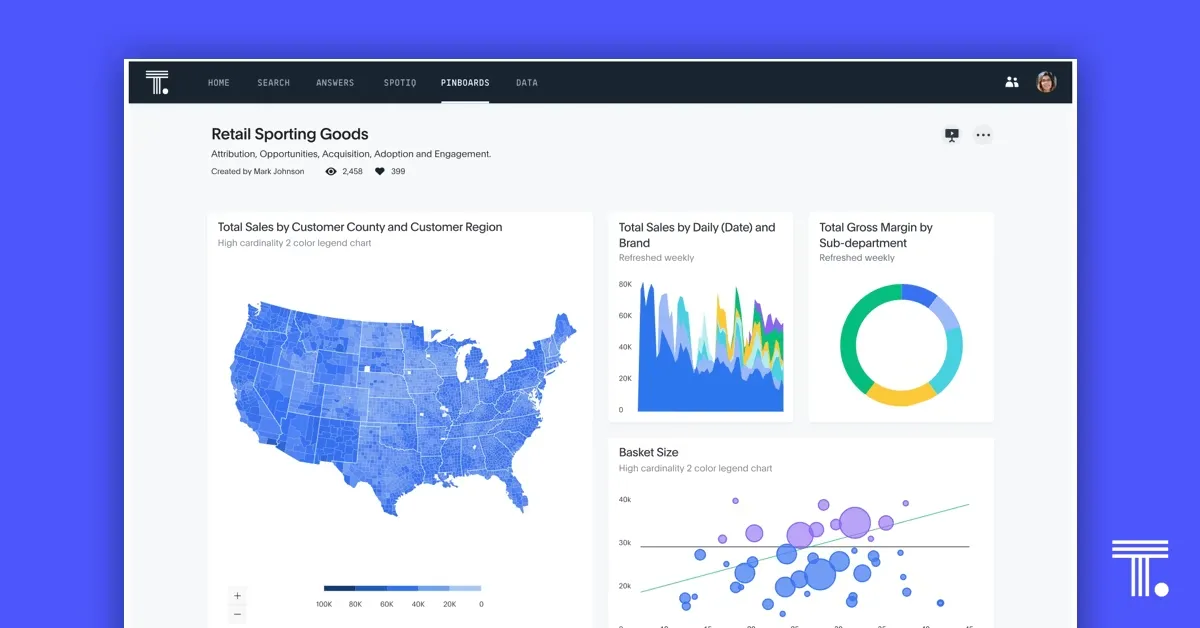
ThoughtSpot
Feature Comparison
| Feature | Spotfire | ThoughtSpot |
|---|---|---|
| Analysis | ||
| Linked visualisations and drill paths | Full support | Partial support |
| R and Python integration | Full support | Partial support |
| Search-driven question answering | Not verified | Full support |
| Automated insight generation | Partial support | Full support |
| Audience | ||
| Ad-hoc exploration by business users | Partial support | Full support |
| Depth for specialist analysts | Full support | Partial support |
| Governed metric definitions | Partial support | Full support |
| Natural language querying | Partial support | Full support |
| Operations | ||
| On-premise deployment | Full support | Partial support |
| Embedding in your own application | Full support | Full support |
| Alerting on data changes | Full support | Full support |
| Mobile access | Partial support | Full support |
| Platform | ||
| Warehouse connectivity | Full support | Full support |
| Scheduled distribution | Full support | Full support |
| Row-level security | Full support | Full support |
| REST API for automation | Full support | Full support |
Analysis
Linked visualisations and drill paths
R and Python integration
Search-driven question answering
Automated insight generation
Audience
Ad-hoc exploration by business users
Depth for specialist analysts
Governed metric definitions
Natural language querying
Operations
On-premise deployment
Embedding in your own application
Alerting on data changes
Mobile access
Platform
Warehouse connectivity
Scheduled distribution
Row-level security
REST API for automation
Which to choose
Spotfire and ThoughtSpot serve opposite users. Spotfire is built for analysts: linked visualisations, drill paths and R or Python beside the charts, for questions that change as you follow them. ThoughtSpot is built for everybody else: a search box over a governed model, so a manager can ask directly rather than filing a request.
Best-fit scenarios
Choose Spotfire if:
Choose Spotfire when the hard analytical work is done by specialists. Following a lead through linked visualisations, reaching past a prepared view, and running statistical work in the same canvas are what an analyst needs and what a search box cannot provide.
Choose ThoughtSpot if:
Choose ThoughtSpot when the bottleneck is the queue rather than the analysis. If the questions arriving at the data team are mostly slices of data that already exists, letting people ask directly removes a wait that no additional dashboard will.
These scenarios reflect the available product evidence. Your requirements, existing stack, and team expertise should guide the final decision.
Frequently Asked Questions
What has to be true before search-first analytics works?
The model underneath has to be good. A search interface over well-modelled, well-named, governed tables is genuinely useful; the same interface over raw tables with cryptic column names produces confident answers to questions it has misunderstood, which is worse than no answer because nobody knows to check it. Modelling first, search second — in that order.
Does it actually shorten the analyst queue?
It can, and only for the questions the model anticipates. A manager asking which region grew fastest last quarter gets an answer without filing a ticket, which is real relief. A question requiring a join nobody modelled still goes to the data team. The gain is proportional to how much of your ad-hoc demand is straightforward slicing rather than new modelling.
Can one platform serve both audiences?
Partly, and the compromise usually disappoints one of them. A search interface constrained to a governed model cannot answer the analyst's question that requires reaching past it, and an exploration canvas is intimidating to a manager who wants one number. Organisations with both needs commonly run an exploration tool for the data team and a self-service interface for everybody else, which costs two licences and less frustration.
Where do metric definitions live in each?
ThoughtSpot makes the model the product: search only works over well-named, governed tables, so worksheets and column metadata are the artefact you maintain and every surface reads the same definitions. Spotfire is looser by design, because exploratory analysis frequently needs a measure that exists only for this investigation — which is appropriate for analysis and dangerous if those ad-hoc definitions become the reported numbers. The workable arrangement is usually both: governed definitions in the warehouse for anything reported, and freedom inside the analytical workbench for work that has not been standardised yet.
Does it query the warehouse, or a copy?
Spotfire commonly works on in-memory data, because the analysis it is built for — iterating on a method, re-running a model over the same rows — is painful against a live connection, and it also connects live when that is the requirement. ThoughtSpot queries the cloud warehouse live, so answers reflect current data and governance stays in one place, and every search becomes warehouse compute. The difference reflects the work: exploration wants a stable dataset to iterate against, routine answering wants the current one.
How does licensing behave as the audience grows?
They grow along different axes. Spotfire's audience is specialists and per-user licensing for a department of analysts stays predictable, because the population does not scale with headcount. ThoughtSpot's consumption model is aimed at a wide audience asking questions regularly, and its cost grows with how much the organisation uses it — which is the intent. The mistake is pricing one against the other's audience. Count the specialists who need methods and the general population who need answers separately, because they are usually different people and often different budgets.
How should we evaluate them?
Build the same two things on both: the dashboard your executives read every Monday, and the open-ended question an analyst raised last quarter. The first tests modelling, refresh, delivery and governance; the second tests exploration. Most teams find one platform suited to each, which turns an abstract comparison into a decision about which half of the work matters more.