Decision comparison
Spotfire vs Tableau
Spotfire and Tableau are both powerful business intelligence platforms, but they serve distinctly different user profiles and use cases. Spotfire excels in advanced statistical analytics, predictive modeling, and scientific data exploration with its built-in TERR engine and native R/Python runtime. Tableau is prominent in visual analytics accessibility, community ecosystem, and enterprise-wide adoption with its intuitive drag-and-drop interface and Salesforce-powered agentic analytics. Neither tool is universally superior; the right choice depends entirely on whether your priority is deep analytical computation or broad organizational data literacy.
Architecture choice. These take different approaches to the same problem. Read the table as a fit question rather than a feature race.
All 2 are BI platforms.
Quick Comparison
| Decision factor | Spotfire | Tableau |
|---|---|---|
| Best For | Data scientists and analysts needing embedded predictive analytics, geospatial mapping, and AI-driven statistical insights within a single platform | Business analysts and organizations seeking intuitive drag-and-drop visual analytics with broad data source connectivity and Salesforce CRM integration |
| Data Visualization | Specialized in scientific and engineering visualizations with built-in TERR statistical engine, treemaps, and advanced geospatial plotting capabilities | Prominent interactive dashboard creation with drag-and-drop interface, built-in visual best practices, and a public gallery for community sharing |
| Pricing Model | Spotfire Analytics is listed with a 365-day duration. The supplied plan data includes 3000.0 but does not state a currency, so it is not a usable public price. | Tableau Cloud Standard Edition: Viewer $15/user/month, Explorer $42/user/month, Creator $75/user/month; Enterprise Edition: Viewer $35/user/month, Explorer $70/user/month, Creator $115/user/month; Tableau+ Bundle requires contact sales for pricing details. |
| Ease of Use | Steeper learning curve suited to technical users who need R and Python integration, statistical modeling, and custom expression language | Widely praised for intuitive drag-and-drop interface with minimal training required; rated 8.4/10 by over 2,300 reviewers on ease of use |
| Advanced Analytics | Built-in predictive analytics engine with native R and Python runtime, real-time streaming data support, and automated statistical modeling workflows | Agentic analytics through Tableau Next with Agentforce integration, AI-assisted semantic modeling, and natural language querying via Slack channels |
| Deployment Options | Spotfire Enterprise supports deployment across cloud, on-premises, or hybrid environments with enterprise-grade performance and security. | Tableau Cloud fully hosted SaaS, Tableau Server for self-hosted control, Tableau Desktop for offline authoring, and Tableau Next for API-first composable analytics |
Spotfire
- Best For:
- Data scientists and analysts needing embedded predictive analytics, geospatial mapping, and AI-driven statistical insights within a single platform
- Data Visualization:
- Specialized in scientific and engineering visualizations with built-in TERR statistical engine, treemaps, and advanced geospatial plotting capabilities
- Pricing Model:
- Spotfire Analytics is listed with a 365-day duration. The supplied plan data includes 3000.0 but does not state a currency, so it is not a usable public price.
- Ease of Use:
- Steeper learning curve suited to technical users who need R and Python integration, statistical modeling, and custom expression language
- Advanced Analytics:
- Built-in predictive analytics engine with native R and Python runtime, real-time streaming data support, and automated statistical modeling workflows
- Deployment Options:
- Spotfire Enterprise supports deployment across cloud, on-premises, or hybrid environments with enterprise-grade performance and security.
Tableau
- Best For:
- Business analysts and organizations seeking intuitive drag-and-drop visual analytics with broad data source connectivity and Salesforce CRM integration
- Data Visualization:
- Prominent interactive dashboard creation with drag-and-drop interface, built-in visual best practices, and a public gallery for community sharing
- Pricing Model:
- Tableau Cloud Standard Edition: Viewer $15/user/month, Explorer $42/user/month, Creator $75/user/month; Enterprise Edition: Viewer $35/user/month, Explorer $70/user/month, Creator $115/user/month; Tableau+ Bundle requires contact sales for pricing details.
- Ease of Use:
- Widely praised for intuitive drag-and-drop interface with minimal training required; rated 8.4/10 by over 2,300 reviewers on ease of use
- Advanced Analytics:
- Agentic analytics through Tableau Next with Agentforce integration, AI-assisted semantic modeling, and natural language querying via Slack channels
- Deployment Options:
- Tableau Cloud fully hosted SaaS, Tableau Server for self-hosted control, Tableau Desktop for offline authoring, and Tableau Next for API-first composable analytics
Public signals
Verified factual signals only. Bars appear only for like-for-like metrics with five weekly assessments for every tool; missing evidence stays explicit. These signals do not establish enterprise adoption, product quality, or total cost.
| Metric | Spotfire | Tableau |
|---|---|---|
| GitHub commits, 90d(Developer adoption) | 10 | 37 |
| GitHub stars(Developer adoption) | 62 | 716 |
| Search interest(Market interest) | 1 | 85 |
| Hacker News mentions, 90d(Community interest) | 0 | 2 |
| npm weekly downloads(Developer adoption) | 22 | 32.2k |
| PyPI weekly downloads(Developer adoption) | 1.5k | 965.7k |
| Stack Overflow questions(Community interest) | 1.6k | 5.4k |
| Product Hunt comments(Community interest) | Not available | 3 |
| Product Hunt rating(Community interest) | Not available | 4.2/5 |
| Product Hunt reviews(Community interest) | Not available | 5 |
| Product Hunt votes(Community interest) | Not available | 7 |
As of September 21, 2026 — updated weekly.
Health & risk evidence
Observed public-source checks for mapped package versions and repositories.
Spotfire
September 21, 2026Package vulnerabilities
npm · @spotfire/mods-sdk@1.2.0 · PyPI · spotfire@2.4.2
0 vulnerabilities
across 2 packages
Repository security score
Not available
Tableau
September 21, 2026Package vulnerabilities
npm · @tableau/embedding-api@3.16.1 · PyPI · tableauserverclient@0.41
0 vulnerabilities
across 2 packages
Repository security score
github.com/tableau/server-client-python
5.5/10
Interface Preview
Tableau
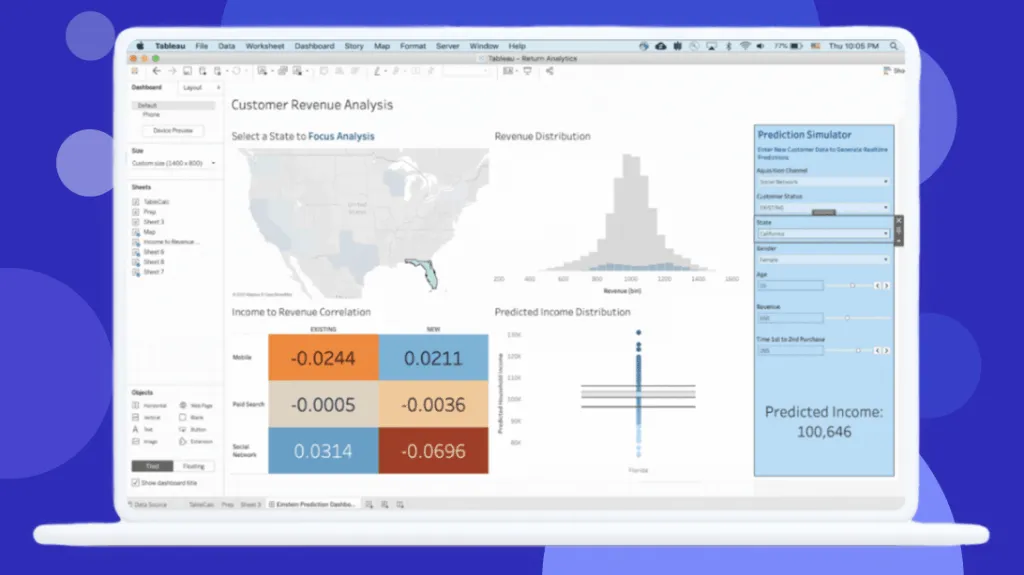
Feature Comparison
| Feature | Spotfire | Tableau |
|---|---|---|
| Data Visualization & Dashboards | ||
| Interactive Dashboard Creation | Expression-based dashboard builder with custom visualization templates, on-the-fly calculations, and data-on-demand loading for large datasets | Drag-and-drop dashboard canvas with automatic layout suggestions, built-in visual best practices, and device-specific responsive design modes |
| Geospatial Analysis | Native geospatial engine with built-in map layers, spatial calculations, and support for GIS file formats like shapefiles and KML directly in the platform | Map-based visualizations with Mapbox integration, custom geocoding, and dual-axis mapping for layered geographic analysis in dashboards |
| Real-Time Data Streaming | Built-in streaming data connector with configurable refresh intervals for IoT sensor data, manufacturing telemetry, and live operational monitoring | Live data connections to supported sources with configurable extract refresh schedules; Cloud standard allows up to 10 scheduled refreshes per day |
| Advanced Analytics & AI | ||
| Predictive Analytics Engine | Integrated TERR statistical engine with one-click predictive modeling, regression analysis, clustering, and time-series forecasting built into the visual layer | Basic trend lines, forecasting, and clustering available natively; advanced predictive modeling requires integration with external R or Python servers |
| R and Python Integration | Native TERR runtime for R execution within visualizations plus IronPython scripting for custom data functions, all running server-side without external dependencies | TabPy server for Python integration and Rserve for R connectivity; requires separate server configuration and additional infrastructure management |
| AI-Powered Insights | AI-driven recommendations engine that suggests relevant visualizations based on data patterns and automatically identifies statistically significant outliers | Agentforce-powered agentic analytics in Tableau Next with natural language Q&A, AI-assisted semantic model creation, and proactive insight generation |
| Data Connectivity & Preparation | ||
| Data Source Connectors | Connectors for enterprise databases, SAP HANA, TIBCO Data Virtualization, and custom ODBC sources with Information Links for reusable query definitions | Over 100 native connectors including Snowflake, BigQuery, Redshift, Salesforce CRM, and cloud file storage with community-built connectors via Tableau Exchange |
| Data Preparation Tools | Built-in data wrangling with column transformations, pivot operations, and calculated columns directly inside the analytics canvas without switching tools | Tableau Prep Builder included with Creator license for visual ETL workflows with drag-and-drop cleaning, pivoting, joining, and output scheduling |
| Semantic Layer | Information Links provide reusable data access definitions but lack a dedicated enterprise semantic layer for cross-tool metric consistency enforcement | Tableau Semantics powered by Data 360 provides an AI-infused semantic layer that enforces consistent metric definitions across all consuming applications |
| Collaboration & Sharing | ||
| Enterprise Collaboration | Server-based sharing with role-based access control, scheduled report distribution, and library management for organizing shared analysis projects | Tableau Cloud with permission-aware sharing, commenting, subscriptions, alerts, and direct Slack integration for analytics discussions in team channels |
| Mobile Access | Mobile-optimized web player for viewing dashboards on tablets and smartphones with touch-enabled interactivity and offline caching capabilities | Dedicated Tableau Mobile app for iOS and Android with offline snapshot access, touch-optimized interactions, and push notification alerts for data changes |
| Community Ecosystem | Focused specialized community focused on scientific and industrial analytics with TIBCO Community forums and partner-driven solution templates | Massive DataFam community with millions of members, Tableau Public gallery for sharing visualizations, annual Tableau Conference, and active user groups worldwide |
| Deployment & Administration | ||
| Cloud Deployment | Spotfire Business cloud edition with managed infrastructure; cloud pricing varies by deployment size and is available through direct sales engagement | Tableau Cloud fully hosted on Hyperforce with automatic updates, built-in disaster recovery, and zero infrastructure management required from customers |
| On-Premises Deployment | Spotfire Enterprise supports deployment across cloud, on-premises, or hybrid environments with enterprise-grade performance and security. | Tableau Server self-hosted with 100-user minimum for Viewer and Explorer; requires dedicated hardware estimated at $10,000 to $30,000/year additional |
| Embedded Analytics | OEM embedding program with white-label options for ISVs who want to embed Spotfire analytics directly into their own software products for end customers | Embedded analytics available through Enterprise edition with additional licensing; costs range from $10,000 to $50,000+ per year depending on external user count |
Data Visualization & Dashboards
Interactive Dashboard Creation
Geospatial Analysis
Real-Time Data Streaming
Advanced Analytics & AI
Predictive Analytics Engine
R and Python Integration
AI-Powered Insights
Data Connectivity & Preparation
Data Source Connectors
Data Preparation Tools
Semantic Layer
Collaboration & Sharing
Enterprise Collaboration
Mobile Access
Community Ecosystem
Deployment & Administration
Cloud Deployment
On-Premises Deployment
Embedded Analytics
Which approach fits
Spotfire and Tableau are both powerful business intelligence platforms, but they serve distinctly different user profiles and use cases. Spotfire excels in advanced statistical analytics, predictive modeling, and scientific data exploration with its built-in TERR engine and native R/Python runtime. Tableau is prominent in visual analytics accessibility, community ecosystem, and enterprise-wide adoption with its intuitive drag-and-drop interface and Salesforce-powered agentic analytics. Neither tool is universally superior; the right choice depends entirely on whether your priority is deep analytical computation or broad organizational data literacy.
When each approach fits
Choose Spotfire if:
Choose Spotfire when your team consists primarily of data scientists, engineers, or technical analysts who need built-in predictive analytics and statistical modeling without relying on external tools. Spotfire is the stronger choice for organizations in manufacturing, life sciences, oil and gas, or any industry where geospatial analysis, real-time streaming data from IoT sensors, and embedded R or Python execution are critical requirements. Its Analyst license at $875/user/year is cost-effective for small teams of power users who will leverage the full depth of its statistical capabilities, though the server license starting at $20,000/year means the total cost of ownership scales differently than per-seat models.
Choose Tableau if:
Choose Tableau when your goal is broad organizational data literacy and you need a platform that business users can adopt with minimal training. Tableau is the better choice for companies that prioritize visual storytelling, executive dashboards, and self-service analytics across departments. With Viewer licenses starting at $15/user/month and a community of millions of DataFam members, Tableau delivers quick time to value for non-technical users. Its Salesforce integration, agentic analytics through Tableau Next, and recognition as a 2025 Gartner Magic Quadrant Leader make it the safer enterprise bet, though a mid-size deployment of 5 Creators, 15 Explorers, and 50 Viewers can reach $60,900/year before training and infrastructure costs.
These scenarios reflect the available product evidence. Your requirements, existing stack, and team expertise should guide the final decision.
Frequently Asked Questions
How do Spotfire and Tableau compare on total cost for a mid-size team?
The supplied evidence does not support a reliable like-for-like total-cost comparison. It lists Spotfire Analytics with a 365-day duration and a numeric amount of 3000.0, but does not state a currency; it also does not provide supported pricing for the other licenses, server deployment, or Tableau plans referenced in the prior comparison.
Can Spotfire handle the same drag-and-drop simplicity that Tableau offers?
Spotfire does offer drag-and-drop functionality for building visualizations, but the overall experience differs substantially from Tableau. Tableau was designed from the ground up for intuitive visual exploration, and its interface consistently receives praise from reviewers for being easy to learn and user-friendly, achieving an 8.4/10 rating from over 2,300 reviews. Spotfire's interface prioritizes analytical depth over simplicity, with a steeper learning curve that benefits users who need to write custom expressions, configure statistical models, or integrate R and Python code directly into their analyses. Business users with limited technical backgrounds will generally find Tableau more approachable, while data scientists and statisticians often prefer Spotfire's more powerful analytical canvas. Budget $3,000 to $5,000 per analyst for Tableau training to reach full proficiency, and expect a longer ramp-up period for Spotfire's advanced features.
Which platform is better for real-time data and IoT analytics?
Spotfire has a meaningful advantage for real-time streaming data and IoT analytics use cases. Its built-in streaming data connector supports configurable refresh intervals for sensor data, manufacturing telemetry, and operational monitoring dashboards, making it a natural fit for industries like oil and gas, pharmaceuticals, and industrial manufacturing. Tableau supports live data connections to compatible sources, but its Cloud Standard edition limits scheduled extract refreshes to 10 per day, which can be restrictive for high-frequency monitoring scenarios. Tableau users needing more frequent refreshes must upgrade their plan or implement architectural workarounds. For truly real-time dashboards displaying sub-minute data updates from IoT devices, Spotfire's native streaming support provides a more straightforward implementation path without the refresh limitations that Tableau Cloud imposes.
How do the two platforms compare for enterprise-scale deployment and governance?
Both platforms offer enterprise deployment options, but they approach governance differently. Tableau's Enterprise edition at $35 to $115/user/month adds advanced data management, row-level security, Tableau Pulse for proactive insights, and enterprise-grade SSO integration. Tableau Cloud runs on Salesforce Hyperforce infrastructure, providing built-in compliance, disaster recovery, and automatic updates. Spotfire Enterprise supports deployment across cloud, on-premises, or hybrid environments with enterprise-grade performance and security. For organizations already invested in the Salesforce ecosystem, Tableau offers tighter CRM integration through its Salesforce acquisition. For organizations in regulated industries requiring complete on-premises data sovereignty, Spotfire Server provides the necessary infrastructure control. Both platforms support embedded analytics for OEM use cases, though Tableau charges an additional $10,000 to $50,000+ per year for external embedding while Spotfire offers dedicated OEM partnership programs with white-label options.