Decision comparison
Looker vs ThoughtSpot
Looker and ThoughtSpot represent two fundamentally different philosophies for enterprise business intelligence. Looker is the platform for data teams that want complete control over their semantic layer, with LookML providing a governed, version-controlled modeling language that ensures every dashboard and metric across the organization uses the same trusted definitions. ThoughtSpot is the platform for organizations that want to put analytics directly into the hands of every business user, with natural language search and AI agents removing the bottleneck of waiting for data teams to build dashboards. Looker excels at depth of governance, embedded analytics customization, and serving as the backbone of data-driven SaaS products. ThoughtSpot excels at breadth of adoption, speed of insight delivery, and lowering the barrier to data access for non-technical users. The right choice depends on whether your primary challenge is governing and modeling data for consistent enterprise-wide consumption, or democratizing data access so every team member can get answers without technical intermediaries.
Direct comparison. These are reviewed substitutes bought for the same job, so the differences below are the ones that decide between them.
All 2 are BI platforms.
Quick Comparison
| Decision factor | Looker | ThoughtSpot |
|---|---|---|
| Primary Approach | Code-first BI with governed semantic modeling and API-driven embedded analytics | AI-first agentic analytics with natural language search for business users |
| Self-Service Model | Explores and dashboards built on top of curated LookML models defined by data teams | Direct natural language queries by any user on live data without needing curated views |
| Semantic Layer | LookML modeling language with Git-integrated version control and centralized metric definitions | SpotterModel for automated semantic modeling with guided human validation |
| AI Capabilities | Conversational Analytics powered by Gemini for natural language queries on governed data | Spotter 3 agentic AI with autonomous multi-step analysis, SpotterViz, and SpotterCode |
| Pricing Model | Looker (Google Cloud core) publishes no platform or per-user price. It offers three platform editions — Standard for organisations under 50 users, Enterprise, and Embed — each including one production instance, 10 Standard Users and 2 Developer Users, and each requiring a custom quote. Data-token overages beyond an instance's monthly allocation are published, at $3.00 per 1M input tokens and $20.00 per 1M output tokens. | ThoughtSpot publishes per-user and usage-based options. Essentials starts as low as $25 per user per month billed annually, for 5 to 50 users and up to 25M rows of data. A usage-based option starts as low as $0.10 per unit. Pro and Enterprise are custom priced, with Enterprise covering up to 1,000 users and 250M rows. |
| Best For | Data teams that need a governed semantic layer, embedded analytics, and deep Google Cloud integration | Business users who need instant self-service insights without SQL or data team bottlenecks |
Looker
- Primary Approach:
- Code-first BI with governed semantic modeling and API-driven embedded analytics
- Self-Service Model:
- Explores and dashboards built on top of curated LookML models defined by data teams
- Semantic Layer:
- LookML modeling language with Git-integrated version control and centralized metric definitions
- AI Capabilities:
- Conversational Analytics powered by Gemini for natural language queries on governed data
- Pricing Model:
- Looker (Google Cloud core) publishes no platform or per-user price. It offers three platform editions — Standard for organisations under 50 users, Enterprise, and Embed — each including one production instance, 10 Standard Users and 2 Developer Users, and each requiring a custom quote. Data-token overages beyond an instance's monthly allocation are published, at $3.00 per 1M input tokens and $20.00 per 1M output tokens.
- Best For:
- Data teams that need a governed semantic layer, embedded analytics, and deep Google Cloud integration
ThoughtSpot
- Primary Approach:
- AI-first agentic analytics with natural language search for business users
- Self-Service Model:
- Direct natural language queries by any user on live data without needing curated views
- Semantic Layer:
- SpotterModel for automated semantic modeling with guided human validation
- AI Capabilities:
- Spotter 3 agentic AI with autonomous multi-step analysis, SpotterViz, and SpotterCode
- Pricing Model:
- ThoughtSpot publishes per-user and usage-based options. Essentials starts as low as $25 per user per month billed annually, for 5 to 50 users and up to 25M rows of data. A usage-based option starts as low as $0.10 per unit. Pro and Enterprise are custom priced, with Enterprise covering up to 1,000 users and 250M rows.
- Best For:
- Business users who need instant self-service insights without SQL or data team bottlenecks
Public signals
Verified factual signals only. Bars appear only for like-for-like metrics with five weekly assessments for every tool; missing evidence stays explicit. These signals do not establish enterprise adoption, product quality, or total cost.
| Metric | Looker | ThoughtSpot |
|---|---|---|
| Search interest(Market interest) | 2 | 1 |
| Hacker News mentions, 90d(Community interest) | 2 | 0 |
| npm weekly downloads(Developer adoption) | 104.6k | 71.7k |
| Product Hunt comments(Community interest) | 5 | 3 |
| Product Hunt reviews(Community interest) | 0 | 0 |
| Product Hunt votes(Community interest) | 83 | 105 |
| PyPI weekly downloads(Developer adoption) | 2.0M | 127 |
| Stack Overflow questions(Community interest) | 226 | Not available |
| GitHub commits, 90d(Developer adoption) | Not available | 79 |
| GitHub stars(Developer adoption) | Not available | 13 |
As of September 21, 2026 — updated weekly.
Health & risk evidence
Observed public-source checks for mapped package versions and repositories.
Looker
September 21, 2026Package vulnerabilities
npm · @looker/sdk@26.12.0 · PyPI · looker-sdk@26.12.0
0 vulnerabilities
across 2 packages
Repository security score
Not available
ThoughtSpot
September 21, 2026Package vulnerabilities
npm · @thoughtspot/visual-embed-sdk@1.52.1 · PyPI · thoughtspot-rest-api-sdk@2.28.0
0 vulnerabilities
across 2 packages
Repository security score
github.com/thoughtspot/visual-embed-sdk
6.4/10
Interface Preview
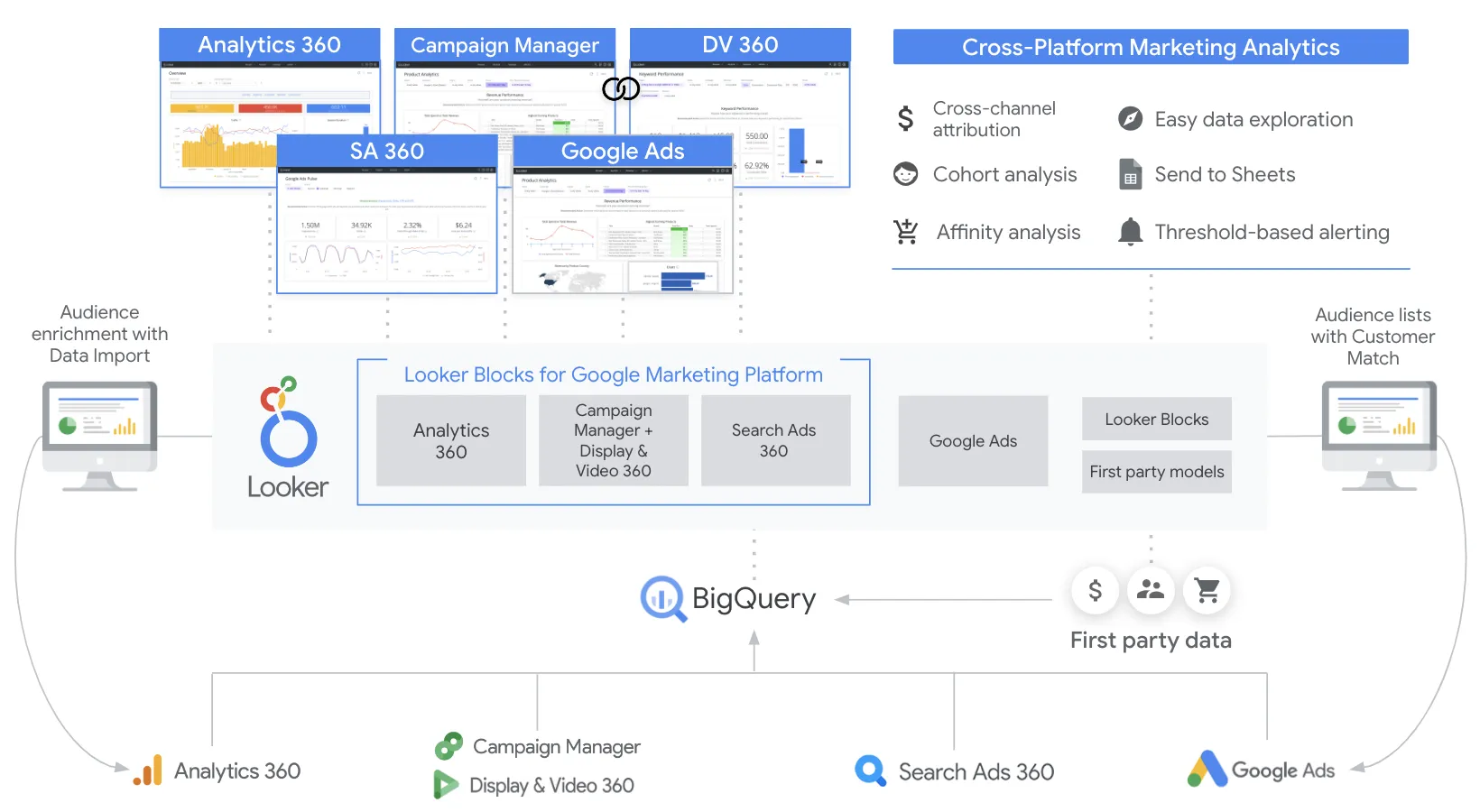
Looker
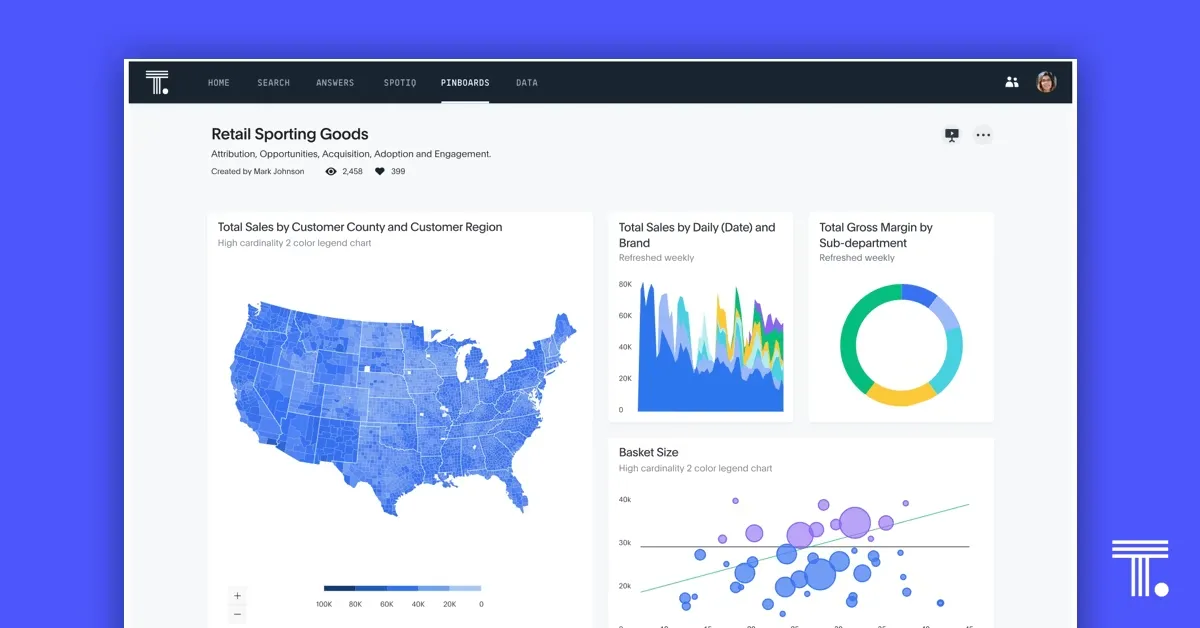
ThoughtSpot
Feature Comparison
| Feature | Looker | ThoughtSpot |
|---|---|---|
| Self-Service Analytics | ||
| Natural Language Search | Conversational Analytics powered by Gemini for chat-with-your-data on governed models | Core platform capability with AI-powered search returning instant answers from live data |
| Dashboard Exploration | Explores with drill-down, filter expansion, and row-level detail on governed data | Liveboards with AI-augmented insights, automated trend and anomaly surfacing |
| Ad Hoc Analysis | Looker Studio for drag-and-drop ad hoc reports with 1,000+ data connectors | Analyst Studio with SQL, Python, and spreadsheet-based data prep and exploration |
| Semantic Modeling & Governance | ||
| Semantic Layer | LookML with centralized metric definitions, reusable models, and computed fields | SpotterModel for automated semantic modeling with dimension and measure mapping |
| Version Control | Native Git integration for LookML models with branching and pull request workflows | No native version control for semantic models |
| Data Security | Row-level and column-level security with enterprise audit features and SSO via Google Cloud IAM | Row-level security across all plans; SSO via SAML/OAuth/OIDC on Pro and Enterprise tiers |
| Embedded Analytics | ||
| Embedding Capabilities | Fully interactive embedded dashboards with white-labeling and robust API coverage | Low-code embedded SDK with flexible pricing and developer-friendly tools |
| API & Developer Tools | REST APIs, SDKs, and Vertex AI extensions for custom AI workflows within Looker | APIs, SDKs, and SpotterCode AI-assisted coding for generating embed logic from prompts |
| Data App Development | Looker extensions framework integrated with Vertex AI for custom data applications | Workflow automation and insights-to-actions for embedding analytics into business apps |
| AI & Automation | ||
| AI Agent Framework | Gemini-powered Conversational Analytics with API access for custom AI applications | Spotter 3 autonomous agent with multi-step analysis across structured and unstructured data |
| Automated Insights | Dashboard-level insights through governed data exploration and Gemini integration | Built-in AI that automatically surfaces key trends, drivers, and anomaly alerts |
| Agentic MCP Server | Not offered as a standalone capability | Agentic MCP Server for delivering insights inside external agents, apps, and platforms |
| Data Connectivity & Deployment | ||
| Cloud Data Warehouse Support | Direct query against BigQuery, Snowflake, Redshift, and 60+ SQL databases with no data storage | Connects to Snowflake, BigQuery, Databricks, Redshift, and Azure Synapse with live querying |
| Cloud Platform Integration | Deep Google Cloud integration with SSO, private networking, and seamless BigQuery connectivity | Cloud-agnostic platform supporting multi-cloud deployments across major providers |
| Data Caching | No data storage; always queries warehouse directly for fresh results | SpotCache for high-volume AI agent queries with zero-copy in-memory processing |
Self-Service Analytics
Natural Language Search
Dashboard Exploration
Ad Hoc Analysis
Semantic Modeling & Governance
Semantic Layer
Version Control
Data Security
Embedded Analytics
Embedding Capabilities
API & Developer Tools
Data App Development
AI & Automation
AI Agent Framework
Automated Insights
Agentic MCP Server
Data Connectivity & Deployment
Cloud Data Warehouse Support
Cloud Platform Integration
Data Caching
Which to choose
Looker and ThoughtSpot represent two fundamentally different philosophies for enterprise business intelligence. Looker is the platform for data teams that want complete control over their semantic layer, with LookML providing a governed, version-controlled modeling language that ensures every dashboard and metric across the organization uses the same trusted definitions. ThoughtSpot is the platform for organizations that want to put analytics directly into the hands of every business user, with natural language search and AI agents removing the bottleneck of waiting for data teams to build dashboards. Looker excels at depth of governance, embedded analytics customization, and serving as the backbone of data-driven SaaS products. ThoughtSpot excels at breadth of adoption, speed of insight delivery, and lowering the barrier to data access for non-technical users. The right choice depends on whether your primary challenge is governing and modeling data for consistent enterprise-wide consumption, or democratizing data access so every team member can get answers without technical intermediaries.
Best-fit scenarios
Choose Looker if:
Choose Looker if your organization has a dedicated data team that needs to build a governed, centralized semantic layer. Looker's LookML modeling language gives data engineers full control over metric definitions, joins, access permissions, and derived tables, all version-controlled through Git. It is the stronger choice for companies building embedded analytics into SaaS products, teams heavily invested in the Google Cloud ecosystem, and enterprises where data consistency and governance are the top priorities. Looker's API-first architecture and Vertex AI integration also make it a powerful foundation for building custom data applications and AI-powered workflows.
Choose ThoughtSpot if:
Choose ThoughtSpot if your primary goal is maximizing analytics adoption across the organization. ThoughtSpot's natural language search and Spotter AI agent let any business user, from sales reps to executives, get answers from live data without writing SQL or waiting for a dashboard to be built. It is the stronger choice for organizations battling dashboard sprawl, teams where the data team is a bottleneck, and companies that want AI-driven automated insights surfaced proactively. ThoughtSpot's published pricing tiers and free trial also make it easier to evaluate and budget for compared to Looker's custom quoting process.
These scenarios reflect the available product evidence. Your requirements, existing stack, and team expertise should guide the final decision.
Frequently Asked Questions
What is the main difference between Looker and ThoughtSpot?
Looker is a code-first BI platform built around LookML, a semantic modeling language that lets data teams define centralized, governed metrics and expose them through explores, dashboards, and APIs. ThoughtSpot is an AI-first analytics platform where business users ask data questions in natural language and get instant, interactive answers powered by the Spotter AI agent. Looker puts data teams in the driver's seat with governed models; ThoughtSpot empowers business users to self-serve without waiting for dashboard builds.
Which platform is better for non-technical business users?
ThoughtSpot is built specifically for non-technical users. Its core experience is a natural language search bar where anyone can type a question and get an answer from live data, with no SQL or data modeling knowledge required. Looker provides self-service through curated Explores and dashboards, but these are built and maintained by data teams using LookML. Business users in Looker work within pre-defined views rather than querying data directly. ThoughtSpot is the stronger choice when maximizing adoption across non-technical teams is the primary goal.
How do Looker and ThoughtSpot compare on pricing?
ThoughtSpot publishes tiered pricing starting at $25/user/month for Essentials (up to 50 users, 25M rows), $50/user/month for Pro (up to 1,000 users, 250M rows), and custom Enterprise pricing averaging around $137k/year. Looker uses custom annual commitment pricing with usage-based and per-seat components, requiring a sales conversation for any quote. Third-party sources indicate Looker contracts typically start in the mid-five-figure range annually. ThoughtSpot offers more pricing transparency, while Looker's costs scale with data volume and infrastructure complexity.
Which tool has better embedded analytics capabilities?
Both platforms offer strong embedded analytics, but they serve different needs. Looker provides fully interactive embedded dashboards with white-labeling, robust REST API coverage, and deep programmatic control over content, permissions, and embedding workflows. It is widely regarded as one of the strongest embedded BI platforms on the market, particularly for SaaS products that need fine-grained customization. ThoughtSpot Embedded offers a low-code SDK with natural language search embedded directly into applications, along with SpotterCode for AI-assisted embed development. Looker wins on depth of customization; ThoughtSpot wins on speed of implementation and AI-native experiences.
Can Looker and ThoughtSpot connect to the same data warehouses?
Yes. Both platforms connect to all major cloud data warehouses including Snowflake, Google BigQuery, Amazon Redshift, and Databricks. Looker supports 60+ SQL databases and queries warehouses directly without storing data. ThoughtSpot connects to these warehouses plus Azure Synapse and offers SpotCache for high-volume in-memory processing. The key difference is not in connectivity but in how each platform interacts with the warehouse: Looker generates SQL from LookML models, while ThoughtSpot translates natural language queries into optimized database queries.