Decision comparison
GoodData vs Looker
Choose GoodData when the primary product requirement is white-label embedded analytics for SaaS customers, with API-first delivery, governed semantics, and agent-oriented workflows. Choose Looker when an enterprise needs a Git-managed LookML modeling practice over its warehouse, direct-query analytics, and Google Cloud-oriented governance.
Direct comparison. These are reviewed substitutes bought for the same job, so the differences below are the ones that decide between them.
All 2 are BI platforms.
Quick Comparison
| Decision factor | GoodData | Looker |
|---|---|---|
| Best For | SaaS companies delivering white-label, embedded analytics and agent-oriented customer decision workflows through APIs. | Enterprise teams centralizing governed metrics in LookML while serving warehouse analytics, embedded products, and APIs. |
| Architecture | API-first embedded analytics platform with governed semantic foundation, open architecture, lineage, policies, and AI-ready orchestration. | Google Cloud BI platform using Git-versioned LookML semantic models, direct warehouse queries, Explores, dashboards, REST APIs, and SDKs. |
| Pricing Model | Contact for pricing | Looker (Google Cloud core) publishes no platform or per-user price. It offers three platform editions — Standard for organisations under 50 users, Enterprise, and Embed — each including one production instance, 10 Standard Users and 2 Developer Users, and each requiring a custom quote. Data-token overages beyond an instance's monthly allocation are published, at $3.00 per 1M input tokens and $20.00 per 1M output tokens. |
| Ease of Use | Users rate it 8.9/10 across 237 reviews, citing datasets, visualization, and user friendliness; adjustments can be complicated. | Users rate it 8.4/10 across 457 reviews, praising interface and drag-and-drop while reporting a LookML learning curve. |
| Scalability | Built for enterprise-scale, customizable embedded insights, governed semantics, policy compliance, and cloud-ecosystem integration. | Cloud-first platform queries connected warehouses directly, applying reusable models, permissions, audit features, and API-driven automation. |
| Community/Support | Users cite customer service and support as strengths; its Cloud Python SDK repository has 36 GitHub stars. | Google Cloud provides commercial support and Marketplace blocks; users value end-user usability but report occasional slow loading. |
GoodData
- Best For:
- SaaS companies delivering white-label, embedded analytics and agent-oriented customer decision workflows through APIs.
- Architecture:
- API-first embedded analytics platform with governed semantic foundation, open architecture, lineage, policies, and AI-ready orchestration.
- Pricing Model:
- Contact for pricing
- Ease of Use:
- Users rate it 8.9/10 across 237 reviews, citing datasets, visualization, and user friendliness; adjustments can be complicated.
- Scalability:
- Built for enterprise-scale, customizable embedded insights, governed semantics, policy compliance, and cloud-ecosystem integration.
- Community/Support:
- Users cite customer service and support as strengths; its Cloud Python SDK repository has 36 GitHub stars.
Looker
- Best For:
- Enterprise teams centralizing governed metrics in LookML while serving warehouse analytics, embedded products, and APIs.
- Architecture:
- Google Cloud BI platform using Git-versioned LookML semantic models, direct warehouse queries, Explores, dashboards, REST APIs, and SDKs.
- Pricing Model:
- Looker (Google Cloud core) publishes no platform or per-user price. It offers three platform editions — Standard for organisations under 50 users, Enterprise, and Embed — each including one production instance, 10 Standard Users and 2 Developer Users, and each requiring a custom quote. Data-token overages beyond an instance's monthly allocation are published, at $3.00 per 1M input tokens and $20.00 per 1M output tokens.
- Ease of Use:
- Users rate it 8.4/10 across 457 reviews, praising interface and drag-and-drop while reporting a LookML learning curve.
- Scalability:
- Cloud-first platform queries connected warehouses directly, applying reusable models, permissions, audit features, and API-driven automation.
- Community/Support:
- Google Cloud provides commercial support and Marketplace blocks; users value end-user usability but report occasional slow loading.
Public signals
Verified factual signals only. Bars appear only for like-for-like metrics with five weekly assessments for every tool; missing evidence stays explicit. These signals do not establish enterprise adoption, product quality, or total cost.
| Metric | GoodData | Looker |
|---|---|---|
| GitHub commits, 90d(Developer adoption) | 204 | Not available |
| GitHub stars(Developer adoption) | 36 | Not available |
| Search interest(Market interest) | 0 | 2 |
| PyPI weekly downloads(Developer adoption) | 17.1k | 2.0M |
| Stack Overflow questions(Community interest) | 167 | 226 |
| Hacker News mentions, 90d(Community interest) | Not available | 2 |
| npm weekly downloads(Developer adoption) | Not available | 104.6k |
| Product Hunt comments(Community interest) | Not available | 5 |
| Product Hunt reviews(Community interest) | Not available | 0 |
| Product Hunt votes(Community interest) | Not available | 83 |
As of September 21, 2026 — updated weekly.
Health & risk evidence
Observed public-source checks for mapped package versions and repositories.
GoodData
September 21, 2026Package vulnerabilities
PyPI · gooddata-sdk@1.75.0
0 vulnerabilities
across 1 package
Repository security score
github.com/gooddata/gooddata-python-sdk
3.7/10
Looker
September 21, 2026Package vulnerabilities
npm · @looker/sdk@26.12.0 · PyPI · looker-sdk@26.12.0
0 vulnerabilities
across 2 packages
Repository security score
Not available
Interface Preview
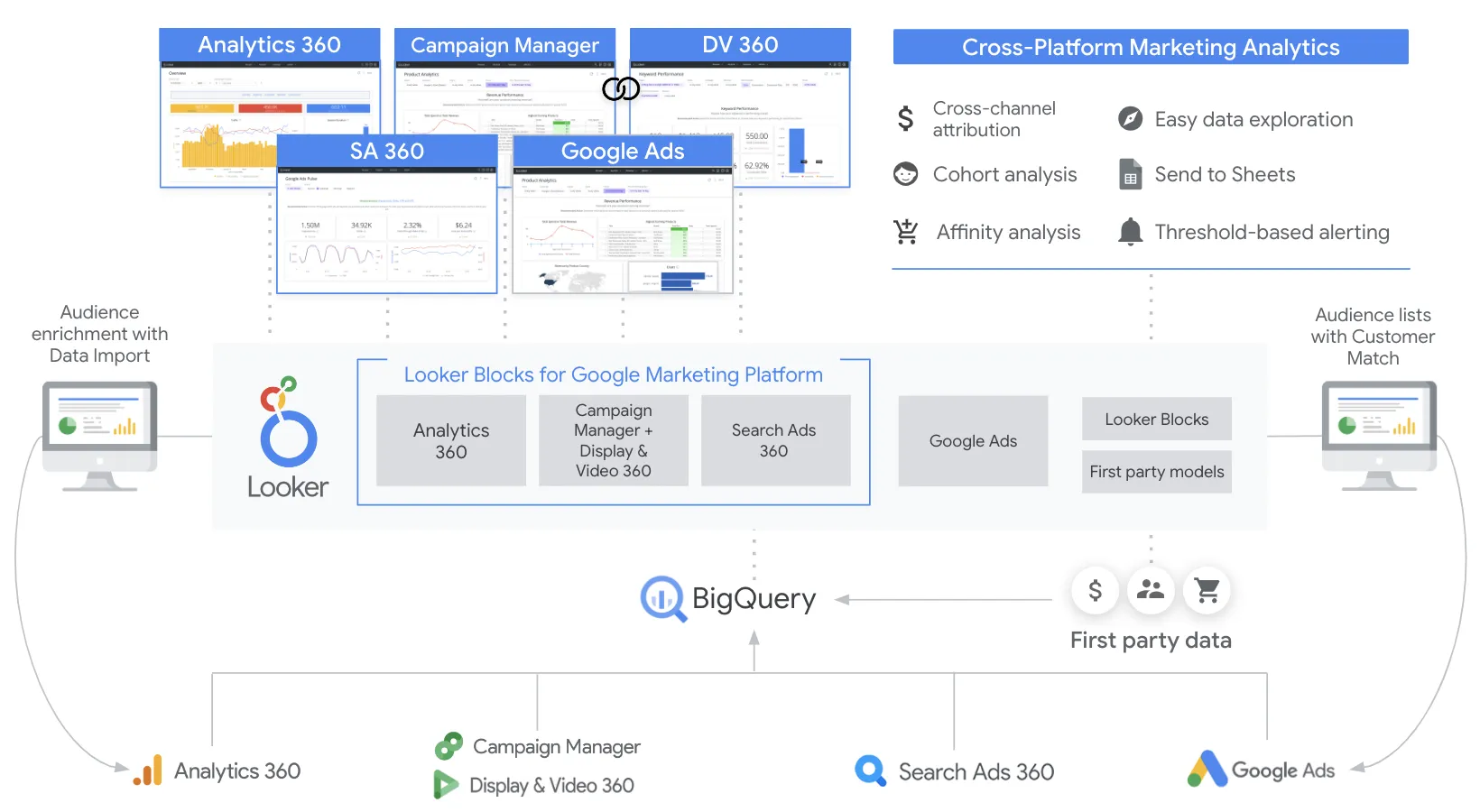
Looker
Feature Comparison
| Feature | GoodData | Looker |
|---|---|---|
| Semantic layer and governance | ||
| Business logic modeling | Defines business logic once in a governed semantic layer. | Uses LookML to define reusable metrics, joins, and derived tables. |
| Policy and data controls | Applies lineage and policy compliance around governed semantic definitions. | Applies row-level and column-level security with audit capabilities. |
| Model change management | Provides governed semantics for consistent dashboard and agent insights. | Stores LookML models in Git for version-controlled changes. |
| Embedded and developer delivery | ||
| Embedded analytics | Delivers white-label dashboards and embedded customer analytics for SaaS. | Embeds governed analytics with white-label options for SaaS products. |
| Programmatic integration | Uses API-first architecture for agents and embedded analytics workflows. | Offers REST APIs and SDKs for content and permission automation. |
| Application intelligence | Supports personalized apps and agent-oriented embedded decision-making channels. | Builds AI-powered applications on modeled, governed data. |
| Analytics experience | ||
| Self-service exploration | Provides customizable self-service analytics and data visualization experiences. | Provides Explores for self-service analysis over governed models. |
| Dashboard delivery | Creates scalable dashboards from governed semantic business logic. | Builds Google-easy dashboards from LookML-based data models. |
| Insight freshness | Supports real-time decisions within AI-enabled analytics workflows. | Queries connected warehouses directly without storing copied data. |
| AI and platform architecture | ||
| AI enablement | Orchestrates AI-ready analytics through a governed semantic foundation. | Combines foundational AI with business-friendly governed analytics. |
| Cloud integration | Uses open architecture for cloud-ecosystem integration at enterprise scale. | Runs as a cloud-first BI platform within Google Cloud. |
| Operational scale | Scales customizable insights, customer data, and embedded deployments. | Scales reusable warehouse models across dashboards, APIs, and users. |
| Commercial model and ecosystem | ||
| Published plan structure | Publishes Professional and Enterprise tiers, each requiring sales contact. | Lists Standard at $99 monthly, Premium at $299 monthly, Enterprise custom. |
| Contract and metering signals | Signals usage-based, enterprise, open-source, and contact-sales purchasing models. | Signals per-seat, usage-based, annual-commitment, and contact-sales purchasing. |
| Extensibility ecosystem | Provides a GoodData Cloud Python SDK, latest release v1.73.0. | Provides Marketplace blocks, applications, custom plug-ins, APIs, and SDKs. |
Semantic layer and governance
Business logic modeling
Policy and data controls
Model change management
Embedded and developer delivery
Embedded analytics
Programmatic integration
Application intelligence
Analytics experience
Self-service exploration
Dashboard delivery
Insight freshness
AI and platform architecture
AI enablement
Cloud integration
Operational scale
Commercial model and ecosystem
Published plan structure
Contract and metering signals
Extensibility ecosystem
Which to choose
Choose GoodData when the primary product requirement is white-label embedded analytics for SaaS customers, with API-first delivery, governed semantics, and agent-oriented workflows. Choose Looker when an enterprise needs a Git-managed LookML modeling practice over its warehouse, direct-query analytics, and Google Cloud-oriented governance.
Best-fit scenarios
Choose GoodData if:
Choose GoodData for a SaaS product that must expose branded customer dashboards, self-service analytics, and API-driven embedded or agent workflows. It is also a strong fit when governed semantics, lineage, and policy compliance must travel across dashboards and embedded experiences.
Choose Looker if:
Choose Looker for teams prepared to invest in LookML and Git to centralize metrics, joins, permissions, and derived tables. It fits warehouse-centric enterprises needing direct-query Explores, row- and column-level controls, audit capabilities, and REST/SDK automation.
These scenarios reflect the available product evidence. Your requirements, existing stack, and team expertise should guide the final decision.
Frequently Asked Questions
What is the main difference between GoodData and Looker?
GoodData is positioned around embedded, white-label analytics for SaaS companies, with an API-first architecture, governed semantic foundation, and AI-ready orchestration for dashboards, agents, and customer-facing workflows. Looker is a Google Cloud enterprise BI platform centered on LookML: teams model reusable metrics, joins, permissions, and derived tables in version-controlled Git projects. Looker emphasizes direct warehouse querying through Explores and dashboards; GoodData emphasizes scalable embedded delivery and customizable customer analytics.
Which is better for small teams?
For a small team building analytics into a SaaS product, GoodData may be the more direct fit because its supplied positioning focuses on white-label dashboards, customer data, API-first integration, and embedded self-service analytics. Its user feedback is also positive on ease of use, with an 8.9/10 rating from 237 reviews, although some users report complicated adjustments. For an internal analytics team, Looker can fit if the team has LookML and Git capacity, but reviewers specifically cite a learning curve and occasional slow loading. Budget still requires sales discussions for GoodData and official Looker annual commitments.
Can I migrate from GoodData to Looker?
Yes, but this is a modeling and content migration rather than a simple dashboard export. Inventory GoodData semantic definitions, datasets, metrics, dashboard filters, embedded integrations, permissions, and policy requirements first. Then recreate reusable metrics, joins, permissions, and derived tables in LookML, store the model in Git, and rebuild dashboards as Looker Explores and dashboards. Validate results against the same underlying warehouse data, especially metric definitions and row-level access. Customer-facing embeds and API calls also need redesign because GoodData’s API-first embedded workflow patterns differ from Looker’s embedding, REST API, and SDK mechanisms.
What are the pricing differences?
GoodData publishes Professional and Enterprise tiers, but both require contacting sales; the supplied commercial signals are usage-based, enterprise, open-source, and contact-sales. No public dollar amount or metering unit is provided, so a buyer should ask which usage measure and contract terms apply to its embedded customers, users, and workloads. Looker is listed with Standard at $99 per month, Premium at $299 per month, and Enterprise custom pricing. Its official pricing information also describes an annual commitment with cost available through sales, alongside per-seat and usage-based signals. Confirm whether the stated monthly figures, annual commitment, and usage charges apply to the desired deployment.