Decision comparison
GoodData vs Metabase
GoodData and Metabase serve different segments of the BI market. GoodData is the stronger choice for enterprises that need a governed, AI-ready analytics platform embedded into SaaS products at scale. Metabase wins for teams that want fast, affordable, open-source business intelligence with a gentle learning curve and strong community support.
Direct comparison. These are reviewed substitutes bought for the same job, so the differences below are the ones that decide between them.
All 2 are BI platforms.
Quick Comparison
| Decision factor | GoodData | Metabase |
|---|---|---|
| Best For | Enterprise teams embedding governed, AI-ready analytics into SaaS products | Startups and mid-market teams wanting fast, open-source BI with minimal setup |
| Architecture | Composable, API-first platform with semantic layer and multi-tenant design | Open-source query and visualization layer sitting on top of existing databases |
| Pricing Model | Contact for pricing | Community Edition is free, open-source and self-hosted, with unlimited users. Paid Metabase Cloud plans start with Starter at $100/month, or $90/month billed annually, including the first 5 users, then $6 per user/month. Pro is $575/month, or $517.50/month annually, including the first 10 users, then $12 per user/month. Enterprise is custom pricing starting at $20,000/year. Both paid plans offer a 14 days free trial. |
| Ease of Use | Powerful but steeper learning curve; rated 8.9/10 by users | Extremely accessible no-code query builder; rated 8.4/10 by users |
| Scalability | Built for enterprise-scale with multi-tenant workspace isolation | Scales from single-instance to multi-tenant embedded deployments |
| Community/Support | Professional services, forward-deployed engineers, 222 TrustRadius reviews | 48,000+ GitHub stars, active open-source community, Slack and email support |
GoodData
- Best For:
- Enterprise teams embedding governed, AI-ready analytics into SaaS products
- Architecture:
- Composable, API-first platform with semantic layer and multi-tenant design
- Pricing Model:
- Contact for pricing
- Ease of Use:
- Powerful but steeper learning curve; rated 8.9/10 by users
- Scalability:
- Built for enterprise-scale with multi-tenant workspace isolation
- Community/Support:
- Professional services, forward-deployed engineers, 222 TrustRadius reviews
Metabase
- Best For:
- Startups and mid-market teams wanting fast, open-source BI with minimal setup
- Architecture:
- Open-source query and visualization layer sitting on top of existing databases
- Pricing Model:
- Community Edition is free, open-source and self-hosted, with unlimited users. Paid Metabase Cloud plans start with Starter at $100/month, or $90/month billed annually, including the first 5 users, then $6 per user/month. Pro is $575/month, or $517.50/month annually, including the first 10 users, then $12 per user/month. Enterprise is custom pricing starting at $20,000/year. Both paid plans offer a 14 days free trial.
- Ease of Use:
- Extremely accessible no-code query builder; rated 8.4/10 by users
- Scalability:
- Scales from single-instance to multi-tenant embedded deployments
- Community/Support:
- 48,000+ GitHub stars, active open-source community, Slack and email support
Public signals
Verified factual signals only. Bars appear only for like-for-like metrics with five weekly assessments for every tool; missing evidence stays explicit. These signals do not establish enterprise adoption, product quality, or total cost.
| Metric | GoodData | Metabase |
|---|---|---|
| GitHub commits, 90d(Developer adoption) | 204 | Not available |
| GitHub stars(Developer adoption) | 36 | Not available |
| Search interest(Market interest) | 0 | Not available |
| PyPI weekly downloads(Developer adoption) | 17.1k | Not available |
| Stack Overflow questions(Community interest) | 167 | 374 |
| Docker Hub pulls(Product adoption) | Not available | 272.7M |
| GitHub commits, 90d(Product adoption) | Not available | 2.0k |
| GitHub stars(Product adoption) | Not available | 49,000+ |
| Hacker News mentions, 90d(Community interest) | Not available | 12 |
| npm weekly downloads(Developer adoption) | Not available | 36.8k |
| Product Hunt comments(Community interest) | Not available | 30 |
| Product Hunt rating(Community interest) | Not available | 4.9/5 |
| Product Hunt reviews(Community interest) | Not available | 24 |
| Product Hunt votes(Community interest) | Not available | 310 |
As of September 21, 2026 — updated weekly.
Health & risk evidence
Observed public-source checks for mapped package versions and repositories.
GoodData
September 21, 2026Package vulnerabilities
PyPI · gooddata-sdk@1.75.0
0 vulnerabilities
across 1 package
Repository security score
github.com/gooddata/gooddata-python-sdk
3.7/10
Metabase
September 21, 2026Package vulnerabilities
npm · @metabase/embedding-sdk-react@0.63.1
0 vulnerabilities
across 1 package
Repository security score
github.com/metabase/metabase
7.1/10
Interface Preview
Metabase
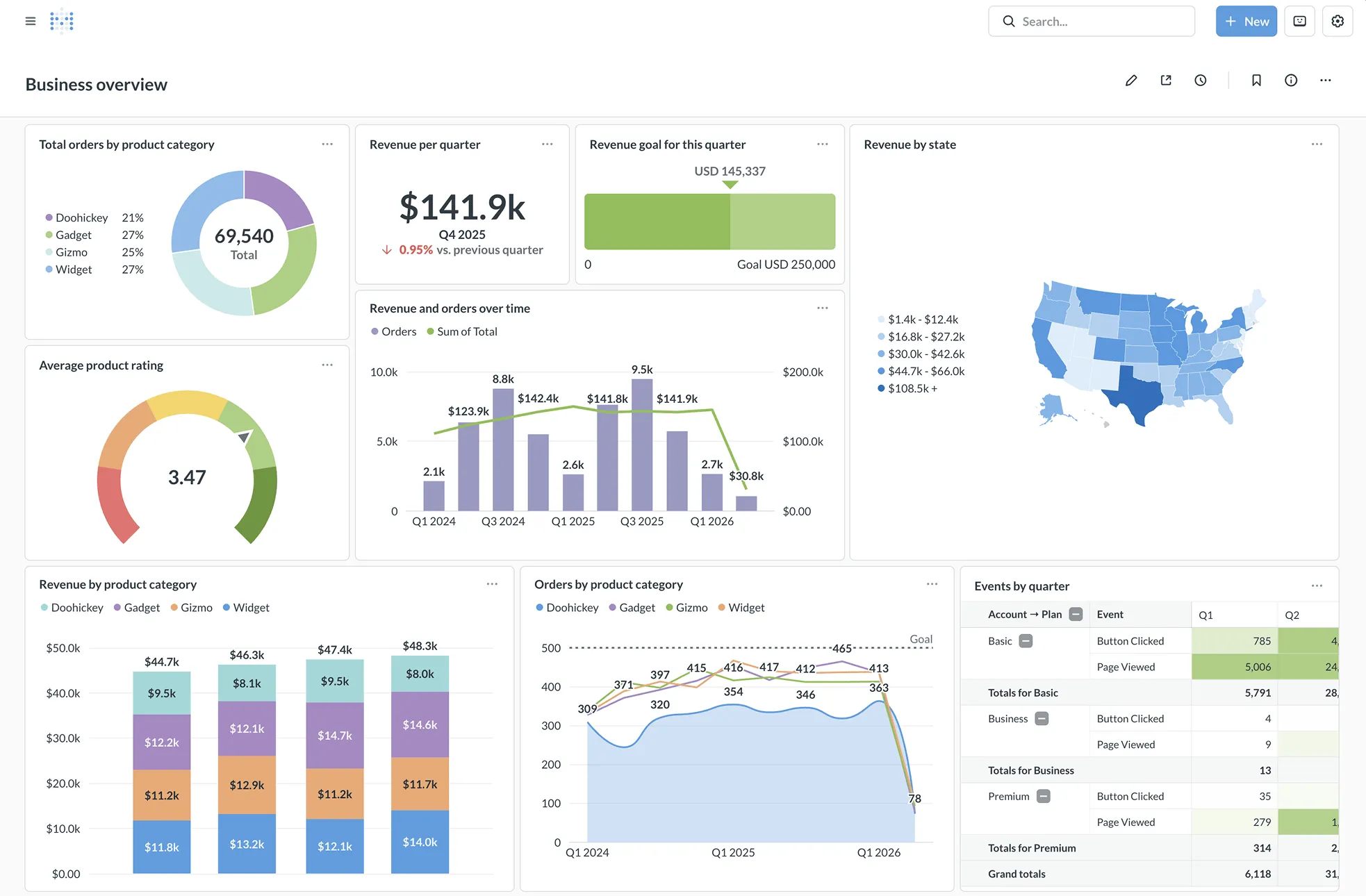
Feature Comparison
| Feature | GoodData | Metabase |
|---|---|---|
| Data Querying & Exploration | ||
| Visual Query Builder | Governed semantic layer for structured query access | No-code drag-and-drop query builder for non-technical users |
| SQL Support | Not verified | Native SQL editor for power users and complex analysis |
| AI-Powered Analytics | AI-ready orchestration with agentic analytics and copilots | Metabot AI for single-shot SQL generation and natural language queries |
| Embedded Analytics | ||
| White-Label Embedding | Full white-label dashboards and agents for SaaS products | White-labeling with iframes or React SDK for customization |
| Multi-Tenant Data Segregation | Built-in multitenancy with workspace isolation at enterprise scale | Granular permissions with row and column-level access controls |
| API-First Architecture | Rich SDKs, APIs, IDE extensions, and MCP server for agents | API keys and open APIs for integration and embedding |
| Data Governance & Security | ||
| Semantic Layer | Governed semantic foundation defining business logic once across all outputs | Data Studio with models, metrics, glossary, and segments |
| Lineage & Compliance | Full lineage tracking and policy compliance with auditable decision paths | Dependencies graph and diagnostics for tracking data relationships |
| SSO & Authentication | Enterprise-grade security with cloud or on-prem deployment | SAML, LDAP, JWT, and Google SSO with group mapping |
| Deployment & Infrastructure | ||
| Self-Hosted Option | Cloud or self-hosted with same codebase for both options | Docker-based self-hosting or managed Metabase Cloud deployment |
| Database Connectors | Multiple data source connections via FlexConnect custom connectors | 20+ native database connectors including MySQL and PostgreSQL |
| Open Source Availability | Not available as open source | Fully open-source core with 48,000+ GitHub stars |
| Visualization & Reporting | ||
| Dashboards & Charts | AI-enabled dashboards with signal analysis and recommended actions | Unlimited charts, dashboards, and interactive drill-through menus |
| Scheduled Alerts & Delivery | Alerts on dashboard widgets fire when a metric crosses a threshold, and dashboard exports can be scheduled. | Email and Slack scheduled delivery with custom filter support |
| Automatic Data Discovery | Not verified | Automatic data model discovery and x-ray reports on connection |
Data Querying & Exploration
Visual Query Builder
SQL Support
AI-Powered Analytics
Embedded Analytics
White-Label Embedding
Multi-Tenant Data Segregation
API-First Architecture
Data Governance & Security
Semantic Layer
Lineage & Compliance
SSO & Authentication
Deployment & Infrastructure
Self-Hosted Option
Database Connectors
Open Source Availability
Visualization & Reporting
Dashboards & Charts
Scheduled Alerts & Delivery
Automatic Data Discovery
Which to choose
GoodData and Metabase serve different segments of the BI market. GoodData is the stronger choice for enterprises that need a governed, AI-ready analytics platform embedded into SaaS products at scale. Metabase wins for teams that want fast, affordable, open-source business intelligence with a gentle learning curve and strong community support.
Best-fit scenarios
Choose GoodData if:
Choose GoodData when you need enterprise-grade embedded analytics with a governed semantic layer, AI-powered agentic workflows, and multi-tenant architecture for SaaS product delivery.
Choose Metabase if:
Choose Metabase when you want fast time-to-value with open-source BI, a no-code query builder for non-technical users, and transparent pricing that scales from startup to mid-market.
These scenarios reflect the available product evidence. Your requirements, existing stack, and team expertise should guide the final decision.
Frequently Asked Questions
Can GoodData and Metabase both be used for embedded analytics?
Yes, both platforms support embedded analytics with white-labeling. GoodData provides a full composable platform with AI agents, copilots, and multi-tenant workspaces designed for SaaS product embedding. Metabase offers embedding via iframes or its React SDK, with white-label styling and interactive controls. GoodData targets enterprise-scale embedded use cases, while Metabase provides a lighter-weight approach suited to startups and growing companies.
Is Metabase truly free to use?
Metabase offers a fully functional open-source edition that you can self-host at no cost using Docker. Paid plans start at $100/mo for Starter (cloud-hosted) and $575/mo for Pro (cloud or self-hosted). The Enterprise is custom pricing from $20,000 per year with priority support. The open-source version covers core BI functionality, while paid tiers add features like advanced permissions, audit logs, and official support.
Which platform has better AI capabilities?
GoodData has invested heavily in AI with its agentic analytics platform, offering AI-powered agents, assistants, copilots, and autopilots that can act on data, answer questions, and automate workflows. Metabase offers Metabot AI as an add-on, focused on natural language SQL generation and conversational database queries. GoodData's AI capabilities are broader and more deeply integrated, while Metabase's AI features are more accessible and focused on query simplification.
How do GoodData and Metabase handle data security differently?
GoodData provides enterprise-grade security with full lineage tracking, policy compliance, auditable decision paths, and deployment options including cloud and on-premises. Metabase offers SOC1, SOC2, GDPR, and CCPA compliance, with granular row-level and column-level permissions, SSO integration via SAML, LDAP, JWT, and Google, and usage analytics for monitoring data access. Both platforms take security seriously, but GoodData focuses on governance at the semantic layer while Metabase emphasizes granular access controls.