Best RAG / Enterprise AI Search Stack (2026)
Retrieval-augmented generation is how most companies actually put an LLM to work on their own content. The model is not trained on your documents; it is handed the relevant ones at question time. That makes the stack a retrieval problem first and a generation problem second, and it is why teams who start with the model and add search later usually rebuild.
Who is this for?
- Teams building an internal assistant over documentation, tickets, or contracts
- Product teams adding search that answers rather than lists links
- Engineers who tried a single-file prototype and now need evaluation and cost control
- Anyone deciding between LlamaIndex, LangChain, and Haystack for retrieval
How it works
A retrieval framework (LlamaIndex, LangChain, Haystack) loads and chunks your documents, calls an embedding model, and writes the vectors to a store. A vector database (Pinecone, Qdrant, Weaviate, pgvector) holds them and answers the nearest-neighbour query. At question time the framework retrieves the matching chunks, builds a prompt around them, and sends it to an LLM provider. Tracing and evaluation (Langfuse, Arize Phoenix, Braintrust) record what was retrieved and what was answered, which is the only way to tell a retrieval failure from a generation failure.
Scroll horizontally to inspect every architecture layer.
Evidence-backed reference architecture based on selected constraints, public adoption signals, product evidence, and available integration data. See how recommendations are scored.
Estimated cost: Free to start
Why this recommendation
- Optimized for a default rag / enterprise ai search architecture across the required stack layers.
- Balances role fit, your stated requirements, and available integration evidence.
- Public activity is not part of Fit. It only separates candidates that fit equally well and are equally well evidenced.
Recommended tools
Retrieval Framework
Create agentic, context engineered AI systems using Haystack’s modular and customizable building blocks, built for real-world, production-ready applications.
Haystack and LangChain both meet every requirement you set for this layer. Nothing you stated separates them and neither fits better, so the wider public use of Haystack decided it — a last resort between products we know equally well, and not evidence that it suits you better.
Runner-up: LangChain
Vector Store
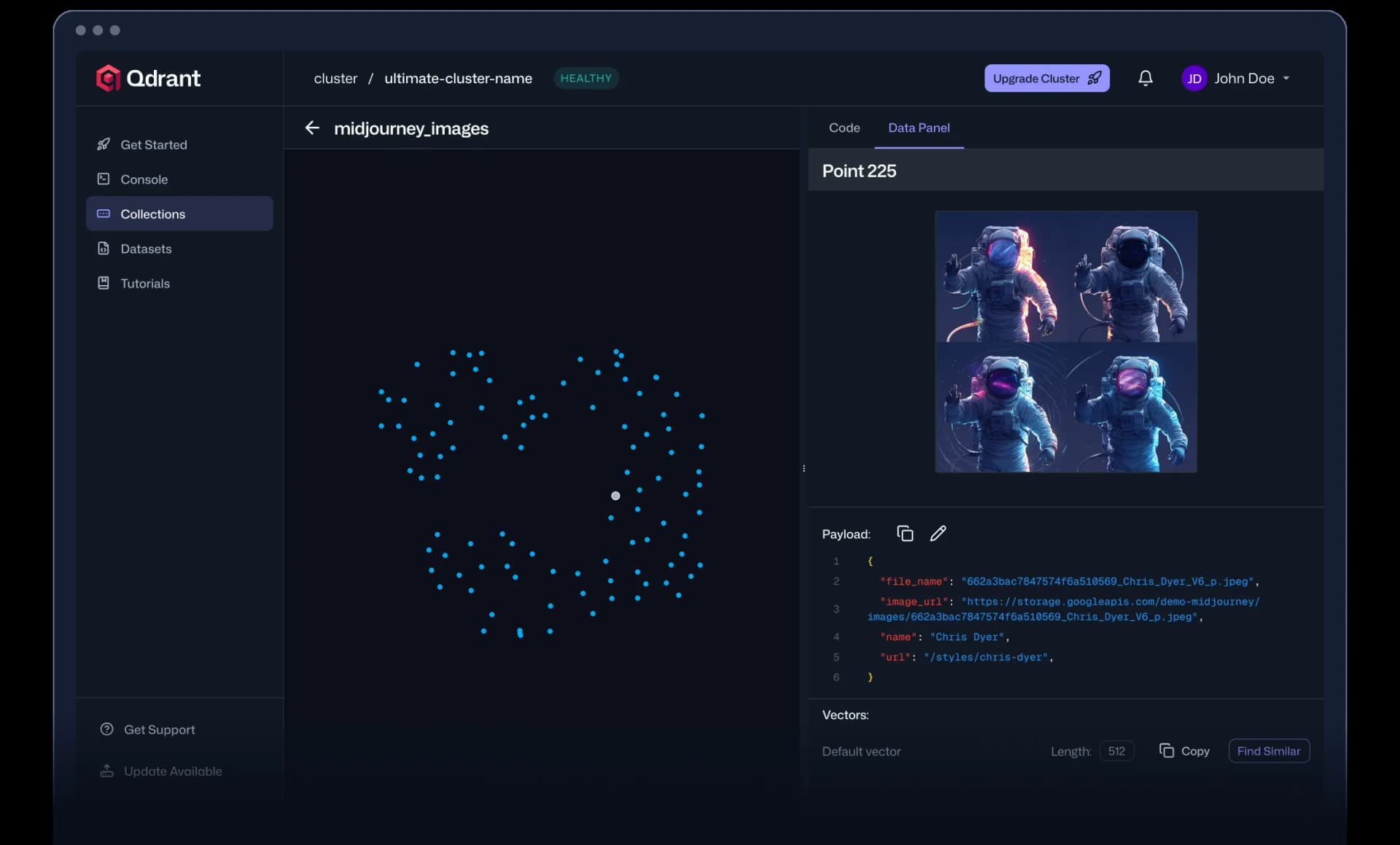
Qdrant is an Open-Source Vector Search Engine written in Rust. It provides fast and scalable vector similarity search service with convenient API.
Qdrant and Weaviate both meet every requirement you set for this layer. Nothing you stated separates them and neither fits better, so the wider public use of Qdrant decided it — a last resort between products we know equally well, and not evidence that it suits you better.
Runner-up: Weaviate
LLM Provider
Anthropic is an AI safety and research company that's working to build reliable, interpretable, and steerable AI systems.
Anthropic and Anyscale both meet every requirement you set for this layer. Nothing we can assess separates them, so Anthropic comes first by a fixed ordering rather than by any advantage over Anyscale.
Runner-up: Anyscale
How recommendations change with your constraints
The same architecture adapts to your cloud, budget, and deployment preferences. Here's what our algorithm recommends for common scenarios:
Managed Enterprise Search
Managed retrieval and model access for a production search assistant over a large document corpus.
Customize this scenario →Open Source, Self-hosted
Every layer open source and running on your own infrastructure — no document and no prompt leaves your network.
Customize this scenario →Cost-sensitive Startup
Managed everything on a small budget: a hosted vector store and a metered model API rather than GPUs to operate.
Customize this scenario →Frequently asked questions
Why is there no embeddings layer?▾
Because it is not a purchase. Embeddings come from the model provider you already chose, or from an open model you run yourself, so the decision belongs to the model layer rather than to a layer of its own. A layer nothing can fill is a permanent gap, not coverage.
Do I need a vector database, or will Postgres do?▾
pgvector is in this catalogue for that reason, and for a few million chunks on a database you already run it is a reasonable answer. A dedicated store earns its place when you need hybrid search, metadata filtering at scale, or you do not want retrieval load on your transactional database.
Where does reranking fit?▾
Inside the products already in the stack. The model providers and several of the vector stores ship rerankers, so it is a setting rather than a shortlist. Nothing in this catalogue is bought for reranking alone.
Is tracing worth it before we have traffic?▾
It is the layer teams add last and wish they had added first. Without recorded retrievals you cannot tell whether a wrong answer came from a chunk that was never retrieved or from a model that ignored it, and those have opposite fixes.
Build your rag / enterprise ai search
These recommendations use public adoption signals, product evidence, and verified integrations. Customize them for your specific requirements and review the methodology behind the available evidence.