Snapshot
Scroll sideways to see all columns. With a keyboard, focus this table and use the arrow keys.
| Decision point | What the vendor states |
|---|---|
Licence and cost basis | Free and open source, dual-licensed MIT OR Apache-2.0, with no per-row, per-connector or per-seat billing. What you fund is the infrastructure you provision and operate. |
How it is installed | Desktop builds for Windows, macOS and Linux with no account; |
Where it runs | Your own server, cloud account or workstation. Docker, EC2, ECS, EKS, Azure and Google Cloud are documented. |
Production runtime |
|
Engine and artifact | Visual, SQL and Python pipelines all compile to readable SQL executed in-process by DuckDB, and every pipeline is one file in git. |
Component scope | The site FAQ states 426 components, 409 of them available today, across 204 sources and destinations, and the repository description states 426 components; the product tour section of the same site states 385 components and 116 sources / 72 destinations. |
Data handling | No account, no telemetry and no phone-home; data leaves your infrastructure only when a pipeline you built writes to a remote destination. |
Our take
If custody of the data is the binding constraint — air-gapped, on-premise or compliance-sensitive work — Duckle fits, and the cost of trying it is a download rather than a contract. If you want a vendor to run the schedule, Duckle is the wrong shape: the pipeline runs on a server, cloud account or workstation you control, scheduled by duckle-runner serve.
Evaluate Duckle
Comparisons
Where it stands out
Nothing is hidden at runtime: every node shows the SQL it compiles to, a failed stage reports the exact compiled SQL and the DuckDB message, and column lineage per node traces each output back to its source columns. Diagnosis stays inside the pipeline.
Vendor-measured runs give you something concrete to re-test: 96 million rows out of Postgres to Parquet in 39.9 s, and a 1,466,723-row, 236-column Oracle table written to SNAPPY Parquet in about 65 s, against about 68.6 s for python-oracledb with pyarrow doing the same job on the same machine.
Change handling is part of the engine: 100,000 changes mirrored into DuckDB in 1.7 s with upsert and delete propagation, exactly-once on success, and incremental loads where later runs read only rows past the saved watermark.
Duckle runs dbt on DuckDB with a visual GUI, using a fast build engine by default and falling back to dbt-core when needed, so you build, test and schedule dbt projects without leaving the studio.
The AI path needs no third party: Duckie runs Qwen 2.5 Coder in-process through llama.cpp with no API key and no telemetry, and the built-in MCP server gives an external agent 19 tools that discover real connectors, compile-check before anything runs and return column-level lineage.
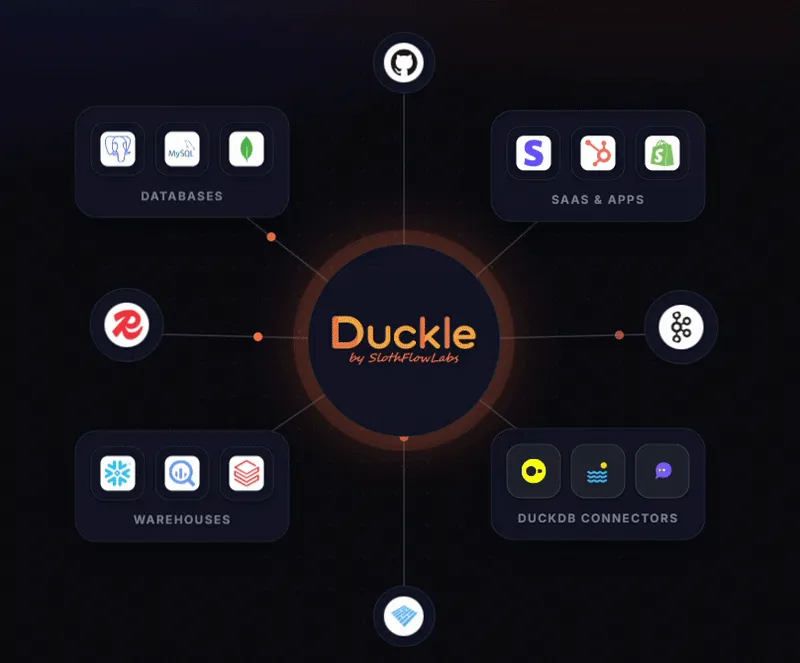
Product screenshot
Trade-offs to weigh
Throughput is a provisioning decision: Duckle runs on EC2, EKS or a box you own and uses every core you give it, which the vendor frames as a bigger instance being a faster pipeline.
The published timings are the vendor's own measurements on its machines and table shapes. Re-run them against your largest table before you size hardware on them.
Not every component in the stated catalogue is available today, and the counts differ between sections of the same site. Confirm the exact source and destination you need ships now before you commit a migration to it.
The visual Map editor joins a main input to up to three lookups with per-output typed expressions and an inline filter. Joins beyond that shape mean dropping into SQL or Python, which the tool supports but which raises the skill floor for a no-code team.
Public signals
About these signals
Verified factual signals from public sources. They indicate observable activity or interest, not total adoption, product quality, or cost.
810 GitHub commits 90d1.6k GitHub stars0 vulnerabilities across 1 package
See all signals from 3 sources
PyPI · duckle@0.8.0
Alternatives to Duckle
The reviewed substitutes for Duckle among the ETL platforms, and what would make each one the better answer.
Direct alternatives
Reviewed substitutes: products bought for the same job, where a team picks one.
- Talend
- Qlik Talend Cloud is a commercial suite that combines visual data integration, data quality and governance across hybrid environments, sold as a vendor-managed subscription. Duckle covers the same pipeline-building, data quality and lineage needs as open-source software that the buyer deploys and runs, so the decision depends on whether the buyer wants enterprise governance and vendor support or full control of the infrastructure without vendor licensing.Applies to: visual ETL with built-in data quality and lineage
- Matillion
- Matillion is a commercial, cloud-native low-code ELT platform that pushes transformations down into Snowflake, BigQuery, Redshift or Synapse, with dbt support and an agentic AI layer. Duckle offers similar visual pipelines, SQL and dbt, but runs open-source on the buyer's own servers on a DuckDB engine with no consumption billing, so the choice comes down to a managed, warehouse-centric SaaS versus self-hosting with predictable costs.Applies to: low-code visual ELT into an analytics warehouse
Other approaches
A different approach to the same problem. Each substitutes only for the workload named beside it.
- Apache NiFi
- Apache NiFi is an open-source, self-hosted, flow-based system for routing, transforming and distributing data, aimed at continuous event streams and data movement between many systems. Duckle is also open-source and self-hosted, but it focuses on analytical ETL/ELT with SQL, dbt, CDC and reverse ETL on DuckDB, so NiFi is the better fit for streaming and data-distribution flows and Duckle for analytics-oriented batch transformation.Applies to: self-hosted open-source data pipelines