Decision comparison
Duckle vs Talend
Duckle suits teams that want to own their visual ETL. It is Apache-2.0, runs on DuckDB on your own servers, keeps each pipeline as a git file and includes validators, CDC and column lineage at no license cost. Talend (Qlik Talend Cloud) suits enterprises that need managed or hybrid deployment, a governance and data catalog layer, Spark-scale processing and SAP/Mainframe connectivity, and that will accept sales-quoted, usage-metered pricing plus reported admin and memory-management friction.
Direct comparison. These are reviewed substitutes bought for the same job, so the differences below are the ones that decide between them.
All 2 are ETL platforms.
Quick Comparison
| Decision factor | Duckle | Talend |
|---|---|---|
| Best For | Teams that want visual or SQL ETL with validators, CDC and column lineage, run on their own servers with no vendor cloud and no per-row billing | Enterprises that need governed data integration with end-to-end data quality, SAP/Mainframe connectivity and hybrid deployment inside the Qlik ecosystem |
| Architecture | Rust app built on DuckDB 2.0. You build pipelines on a canvas, in Python or SQL, and duckle-runner serve runs them headless in Docker, on EC2/EKS or on your own box | Qlik Talend Cloud runs as a managed SaaS, client-managed or hybrid. Talend Data Fabric is still sold for cloud and on-premises. Premium adds Spark batch processing |
| Pricing Model | Open source under the Apache-2.0 license; source code at https://github.com/slothflowlabs/duckle. | Qlik publishes no prices for Talend. Qlik Talend Cloud has four editions (Starter, Standard, Premium and Enterprise), each marked Contact Us on qlik.com. Customers subscribe to a capacity of usage for the chosen edition, measured by data volume moved, number of job executions and execution duration. |
| Ease of Use | Drag-and-drop canvas, a Map editor for joins and expressions, and the generated SQL for each node shown in the Plan tab. The on-device Duckie assistant helps you build pipelines | Rated 8.8/10 across 74 user reviews. Users praise the UI and integration tools but cite a steep learning curve for new users and pain with configuration files and the admin console |
| Scalability | Scales up on one machine and uses every core you give it, so a bigger instance runs faster. v0.8.0 added several servers on one workspace | Scales out with Spark batch processing, lakehouse automation and log-based CDC. Users report memory management problems on heavy jobs |
| Community/Support | Open-source GitHub project with 1,574 stars, actively developed (v0.8.0 released 2026-11-09). Support comes through GitHub and SlothFlowLabs' contact form; no published enterprise SLA | Commercial vendor support, partner network and Global System Integrators. Users praise the support team but also report slow responses |
Duckle
- Best For:
- Teams that want visual or SQL ETL with validators, CDC and column lineage, run on their own servers with no vendor cloud and no per-row billing
- Architecture:
- Rust app built on DuckDB 2.0. You build pipelines on a canvas, in Python or SQL, and duckle-runner serve runs them headless in Docker, on EC2/EKS or on your own box
- Pricing Model:
- Open source under the Apache-2.0 license; source code at https://github.com/slothflowlabs/duckle.
- Ease of Use:
- Drag-and-drop canvas, a Map editor for joins and expressions, and the generated SQL for each node shown in the Plan tab. The on-device Duckie assistant helps you build pipelines
- Scalability:
- Scales up on one machine and uses every core you give it, so a bigger instance runs faster. v0.8.0 added several servers on one workspace
- Community/Support:
- Open-source GitHub project with 1,574 stars, actively developed (v0.8.0 released 2026-11-09). Support comes through GitHub and SlothFlowLabs' contact form; no published enterprise SLA
Talend
- Best For:
- Enterprises that need governed data integration with end-to-end data quality, SAP/Mainframe connectivity and hybrid deployment inside the Qlik ecosystem
- Architecture:
- Qlik Talend Cloud runs as a managed SaaS, client-managed or hybrid. Talend Data Fabric is still sold for cloud and on-premises. Premium adds Spark batch processing
- Pricing Model:
- Qlik publishes no prices for Talend. Qlik Talend Cloud has four editions (Starter, Standard, Premium and Enterprise), each marked Contact Us on qlik.com. Customers subscribe to a capacity of usage for the chosen edition, measured by data volume moved, number of job executions and execution duration.
- Ease of Use:
- Rated 8.8/10 across 74 user reviews. Users praise the UI and integration tools but cite a steep learning curve for new users and pain with configuration files and the admin console
- Scalability:
- Scales out with Spark batch processing, lakehouse automation and log-based CDC. Users report memory management problems on heavy jobs
- Community/Support:
- Commercial vendor support, partner network and Global System Integrators. Users praise the support team but also report slow responses
Public signals
Verified factual signals only. Bars appear only for like-for-like metrics with five weekly assessments for every tool; missing evidence stays explicit. These signals do not establish enterprise adoption, product quality, or total cost.
| Metric | Duckle | Talend |
|---|---|---|
| GitHub commits, 90d(Product adoption) | 810 | Not available |
| GitHub stars(Product adoption) | 1,500+ | Not available |
| PyPI weekly downloads(Developer adoption) | 1.7k | Not available |
| Search interest(Market interest) | Not available | 1 |
| Hacker News mentions, 90d(Community interest) | Not available | 0 |
| Stack Overflow questions(Community interest) | Not available | 2.7k |
As of November 16, 2026 — updated weekly.
Health & risk evidence
Observed public-source checks for mapped package versions and repositories.
Duckle
November 16, 2026Package vulnerabilities
PyPI · duckle@0.8.0
0 vulnerabilities
across 1 package
Repository security score
Not available
Talend
Package vulnerabilities
Not available
Repository security score
Not available
Interface Preview
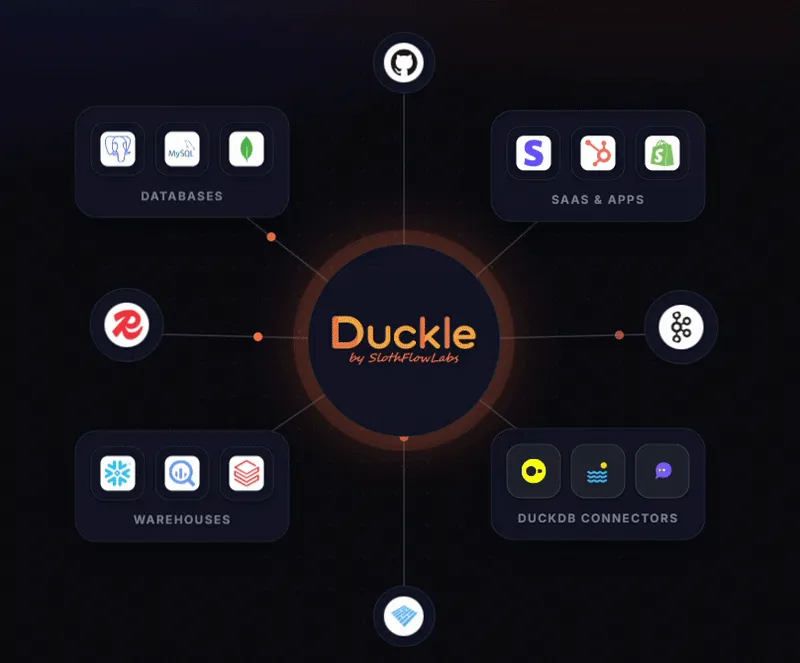
Duckle
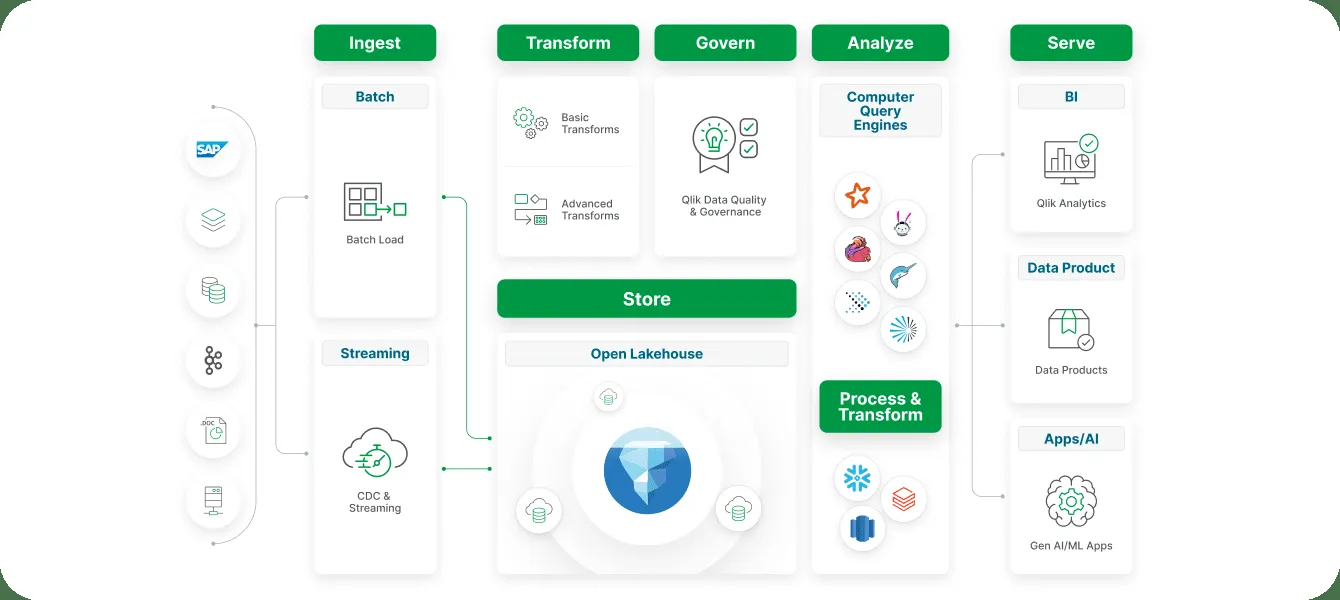
Talend
Feature Comparison
| Feature | Duckle | Talend |
|---|---|---|
| Pipeline Authoring | ||
| Visual pipeline design | Drag-and-drop canvas of sources, transforms and sinks, with a Map join editor | AI-augmented no-code pipelines plus self-service data preparation (Premium) |
| Code and SQL transparency | Generated SQL for each node in the Plan tab; also author in Python or SQL | Supports custom coding; multiple transformation options using ELT or ETL |
| Version control | Each pipeline is stored as one file in git | Users cite version control as a weakness of the platform |
| Data Quality & Governance | ||
| Data quality enforcement | Validators send bad rows to a reject port; Tests tab added in v0.8.0 | End-to-end data quality capabilities that deliver curated, trusted data |
| Lineage | Column-level lineage for each pipeline node | End-to-end column-level lineage and impact analysis in the Premium edition |
| Cataloging and governance | Web console with roles and an audit trail for headless runs | Data catalog of accessible datasets (Starter) plus data governance suite |
| Connectivity & Replication | ||
| Connector breadth | 204 connectors across databases, warehouses, files and SaaS | Hundreds of pre-defined integrations, including SaaS sources and cloud warehouses |
| Change data capture | CDC that also propagates deletes to targets | Real-time log-based CDC synchronization from the Standard edition up |
| Enterprise legacy sources | ADBC and SQLite dimensions plus database connectors; no SAP/Mainframe listed | Full SAP application and Mainframe connectivity in the Enterprise edition |
| Execution & Deployment | ||
| Execution engine | Embedded DuckDB 2.0 that uses every available core on one host | Managed cloud pipelines; Spark batch processing for high-volume data movement |
| Deployment options | Self-hosted only: Docker, EC2, EKS or your own server | Cloud, client-managed or hybrid; Data Fabric is also available on-premises |
| Scheduling and operations | duckle-runner serve runs scheduled jobs headless with a web console | Managed and secure cloud pipelines; admin console that users criticize |
| Transformation & AI | ||
| dbt and warehouse modeling | Runs dbt projects locally on DuckDB | Warehouse, lake and lakehouse automation with automated data mart creation |
| AI assistance | Duckie on-device AI assistant with a built-in MCP server for agents | Integrated LLM extensibility and GenAI pipeline creation in the Enterprise edition |
| Reverse ETL and cost offload | Reverse ETL; aggregate locally, then upsert only results into Snowflake | Unlimited, optimized data movement into Qlik Cloud Analytics (Standard and up) |
Pipeline Authoring
Visual pipeline design
Code and SQL transparency
Version control
Data Quality & Governance
Data quality enforcement
Lineage
Cataloging and governance
Connectivity & Replication
Connector breadth
Change data capture
Enterprise legacy sources
Execution & Deployment
Execution engine
Deployment options
Scheduling and operations
Transformation & AI
dbt and warehouse modeling
AI assistance
Reverse ETL and cost offload
Which to choose
Duckle suits teams that want to own their visual ETL. It is Apache-2.0, runs on DuckDB on your own servers, keeps each pipeline as a git file and includes validators, CDC and column lineage at no license cost. Talend (Qlik Talend Cloud) suits enterprises that need managed or hybrid deployment, a governance and data catalog layer, Spark-scale processing and SAP/Mainframe connectivity, and that will accept sales-quoted, usage-metered pricing plus reported admin and memory-management friction.
Best-fit scenarios
Choose Duckle if:
Choose Duckle if you want a free self-hosted visual ETL tool with validators, reject ports, delete-propagating CDC and per-node column lineage. It fits teams that want pipelines reviewed in git and want to cut warehouse spend by crunching data locally on DuckDB before upserting aggregates into Snowflake. It also fits when data must never touch a vendor cloud, or when you want to run dbt or expose pipelines to AI agents through MCP.
Choose Talend if:
Choose Talend if you need enterprise data governance: a catalog, end-to-end impact analysis and vendor-backed data quality. Also choose it if you have SAP or Mainframe sources, need Spark-scale batch processing, or need hybrid cloud/on-prem deployment for data-residency rules. It makes most sense if you already run Qlik Cloud Analytics and have budget for a capacity-based subscription negotiated with sales.
These scenarios reflect the available product evidence. Your requirements, existing stack, and team expertise should guide the final decision.
Frequently Asked Questions
What is the main difference between Duckle and Talend?
Duckle is an Apache-2.0, Rust-based ETL/ELT tool built on DuckDB that you deploy only on your own infrastructure. You build pipelines on a visual canvas, in SQL or in Python, store each one as a git file and run them headless with duckle-runner serve. Talend is now part of Qlik and sold as Qlik Talend Cloud, a commercial suite covering data integration, data quality, application integration and governance. It deploys as cloud, client-managed or hybrid, and adds Spark processing, a data catalog and SAP/Mainframe connectors. One trades license cost for self-operation; the other trades usage fees for enterprise breadth.
Which is better for small teams?
For most small teams, Duckle. It costs nothing to license, every feature (CDC, validators, column lineage, dbt, reverse ETL, the Duckie assistant) is in the open-source build, and it runs on a single server or Docker container that uses all available cores. Talend has no public price, and every edition, including Starter, needs a sales conversation and a usage-capacity commitment. Talend users rate it 8.8/10 across 74 reviews but name the onboarding experience for new users and configuration overhead as weaknesses. A small team should pick Talend only if it already depends on Qlik or needs SAP/Mainframe sources.
Can I migrate from Duckle to Talend?
No automated converter exists, so expect to rebuild the pipelines. The rebuild is easier than it sounds because each Duckle pipeline is a single file in git and the Plan tab shows the generated SQL for every node. That SQL is a ready spec for rebuilding transformations as Talend ELT or ETL jobs. Duckle's validator and reject-port rules map onto Talend's data quality features, and column lineage carries over as Talend's column-level lineage in the Premium edition. Check that Talend has connectors for your sources, budget for the usage-metered subscription, and run both systems in parallel to reconcile row counts before cutover.
What are the pricing differences?
Duckle is free and open source under Apache-2.0. There is no paid edition, vendor cloud or per-row billing, so your only cost is the EC2, EKS or on-prem hardware you run it on. Qlik publishes no Talend prices. Its four editions (Starter, Standard, Premium, Enterprise) are all marked Contact Us. You subscribe to a usage capacity measured by data volume moved, number of job executions and execution duration. Key features are gated by edition: log-based CDC starts at Standard, column-level lineage and Spark processing at Premium, and SAP/Mainframe and LLM features at Enterprise.