Decision comparison
Duckle vs Matillion
Duckle and Matillion both sell low-code visual ELT into an analytics warehouse, but they make opposite bets: Duckle runs on DuckDB on infrastructure you own, while Matillion runs as managed SaaS that pushes transforms into the warehouse. Duckle wins on cost control, git-native pipelines and avoiding vendor lock-in, especially when pre-aggregating locally cuts Snowflake compute. Matillion wins when you want a supported managed service with horizontal agent scaling, a 99.9% uptime target and the Maia agentic AI layer, and can accept credit-based billing.
Direct comparison. These are reviewed substitutes bought for the same job, so the differences below are the ones that decide between them.
All 2 are ETL platforms.
Quick Comparison
| Decision factor | Duckle | Matillion |
|---|---|---|
| Best For | Teams that want visual or SQL ELT on their own servers, pre-aggregating locally on DuckDB before loading only results into Snowflake or other warehouses | Cloud-warehouse teams on Snowflake, BigQuery, Redshift or Azure Synapse wanting managed pushdown ELT and agentic AI (Maia) on top |
| Architecture | Self-hosted Rust app on DuckDB 2.0; pipelines are single git files run headless via duckle-runner serve in Docker, EC2, EKS or bare metal | Managed SaaS (Data Productivity Cloud, now Maia Foundation) with containerized agents pushing transforms into the warehouse; optional hybrid-SaaS deployment |
| Pricing Model | Open source under the Apache-2.0 license; source code at https://github.com/slothflowlabs/duckle. | Matillion offers a free, time-bound, fair-use Maia trial. Data Productivity Cloud pricing uses consumption-based Matillion Credits for task hours and additional developer users across Developer, Teams, and Scale editions; no public paid currency rates are listed. |
| Ease of Use | Drag-and-drop canvas, Map editor for joins, generated SQL per node in the Plan tab, plus Duckie on-device AI assistant | Low-code canvas plus SQL/Python components; users rate it easy to learn but cite Data Productivity Cloud complexity |
| Scalability | Scales vertically: uses every core of the instance, so a bigger EC2/EKS node runs faster; several servers per workspace since v0.8.0 | Horizontal: concurrent tasks run on more containerized agents, metered per agent-hour, with a 99.9% uptime target across paired data centers |
| Community/Support | Open-source project from SlothFlowLabs with 1,574 GitHub stars, v0.8.0 released November 2026; community support plus a vendor contact form | Established commercial vendor rated 8.5/10 across 237 user reviews, with docs, API references, tutorials and paid editions |
Duckle
- Best For:
- Teams that want visual or SQL ELT on their own servers, pre-aggregating locally on DuckDB before loading only results into Snowflake or other warehouses
- Architecture:
- Self-hosted Rust app on DuckDB 2.0; pipelines are single git files run headless via duckle-runner serve in Docker, EC2, EKS or bare metal
- Pricing Model:
- Open source under the Apache-2.0 license; source code at https://github.com/slothflowlabs/duckle.
- Ease of Use:
- Drag-and-drop canvas, Map editor for joins, generated SQL per node in the Plan tab, plus Duckie on-device AI assistant
- Scalability:
- Scales vertically: uses every core of the instance, so a bigger EC2/EKS node runs faster; several servers per workspace since v0.8.0
- Community/Support:
- Open-source project from SlothFlowLabs with 1,574 GitHub stars, v0.8.0 released November 2026; community support plus a vendor contact form
Matillion
- Best For:
- Cloud-warehouse teams on Snowflake, BigQuery, Redshift or Azure Synapse wanting managed pushdown ELT and agentic AI (Maia) on top
- Architecture:
- Managed SaaS (Data Productivity Cloud, now Maia Foundation) with containerized agents pushing transforms into the warehouse; optional hybrid-SaaS deployment
- Pricing Model:
- Matillion offers a free, time-bound, fair-use Maia trial. Data Productivity Cloud pricing uses consumption-based Matillion Credits for task hours and additional developer users across Developer, Teams, and Scale editions; no public paid currency rates are listed.
- Ease of Use:
- Low-code canvas plus SQL/Python components; users rate it easy to learn but cite Data Productivity Cloud complexity
- Scalability:
- Horizontal: concurrent tasks run on more containerized agents, metered per agent-hour, with a 99.9% uptime target across paired data centers
- Community/Support:
- Established commercial vendor rated 8.5/10 across 237 user reviews, with docs, API references, tutorials and paid editions
Public signals
Verified factual signals only. Bars appear only for like-for-like metrics with five weekly assessments for every tool; missing evidence stays explicit. These signals do not establish enterprise adoption, product quality, or total cost.
| Metric | Duckle | Matillion |
|---|---|---|
| GitHub commits, 90d(Product adoption) | 810 | Not available |
| GitHub stars(Product adoption) | 1,500+ | Not available |
| PyPI weekly downloads(Developer adoption) | 1.7k | Not available |
| Search interest(Market interest) | Not available | 0 |
| Hacker News mentions, 90d(Community interest) | Not available | 0 |
| Stack Overflow questions(Community interest) | Not available | 86 |
As of November 16, 2026 — updated weekly.
Health & risk evidence
Observed public-source checks for mapped package versions and repositories.
Duckle
November 16, 2026Package vulnerabilities
PyPI · duckle@0.8.0
0 vulnerabilities
across 1 package
Repository security score
Not available
Matillion
Package vulnerabilities
Not available
Repository security score
Not available
Interface Preview
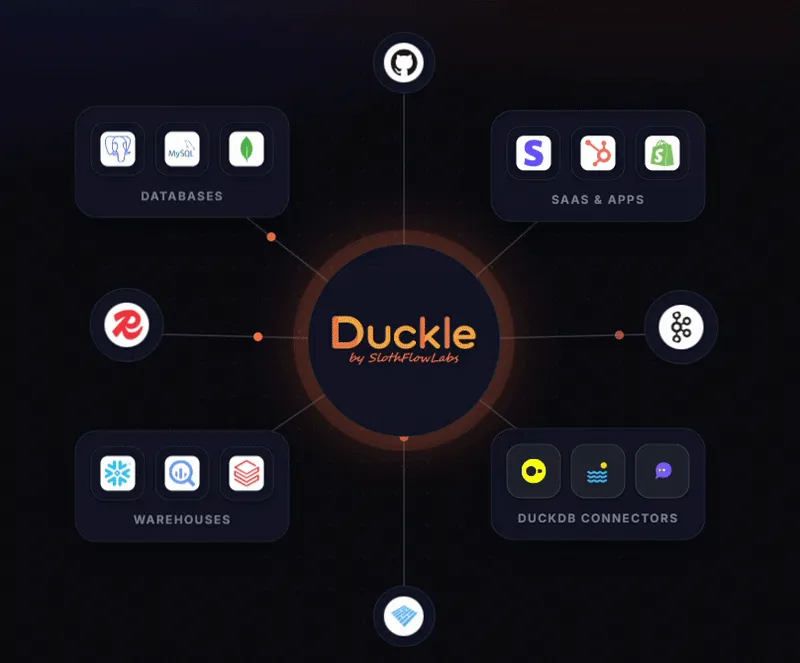
Duckle
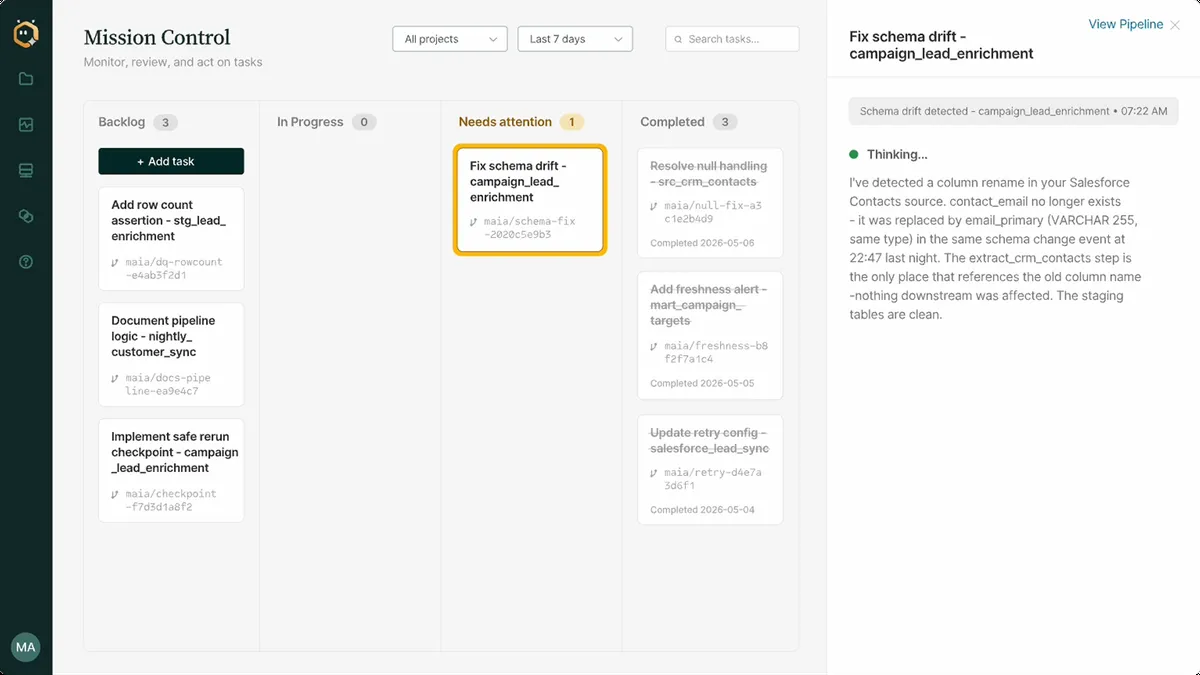
Matillion
Feature Comparison
| Feature | Duckle | Matillion |
|---|---|---|
| Deployment & Execution | ||
| Where pipelines run | Your own servers or cloud account via duckle-runner serve, no vendor cloud | Vendor-managed SaaS agents, with optional hybrid-SaaS for strict security needs |
| Processing engine | Embedded DuckDB 2.0 processes data locally before loading results to sinks | Warehouse-native ELT pushes transforms down to Snowflake, BigQuery, Redshift |
| Scaling model | Uses all cores on one box; larger instance means faster pipeline | Containerized agents run concurrent tasks, more agents for faster runs |
| Pipeline Authoring | ||
| Visual designer | Drag-and-drop canvas of sources, transforms, sinks plus Map join editor | Drag-and-drop job designer with pre-built low-code components |
| Code options | SQL or Python authoring; generated SQL per node visible in Plan tab | SQL and Python components alongside canvas, plus API extensibility |
| AI assistance | Duckie on-device AI assistant and built-in MCP server for agents | Maia agentic AI layer creates, manages and evolves data products |
| Version Control & Governance | ||
| Git integration | Every pipeline is one file in your own git repository | Built-in Git repository; users still cite source control as weakness |
| Access control & audit | Web console with roles and audit trail on self-hosted runner | Managed SaaS projects with team collaboration across Teams and Scale editions |
| Lineage | Column-level lineage tracked per pipeline node | Not documented in the provided product data |
| Connectivity & Data Movement | ||
| Connectors | 204 connectors across databases, warehouses, files and SaaS apps | Pre-built connectors into Snowflake, BigQuery, Redshift and Azure Synapse |
| Change data capture | Built-in CDC with delete propagation to targets | Not detailed in the provided data; focus is batch warehouse ELT |
| Reverse ETL | Reverse ETL components push warehouse data back to operational systems | Not detailed in the provided product data |
| Transformation & Quality | ||
| dbt support | Runs existing dbt projects on the DuckDB engine | Transformations built as Matillion components in SQL/Python |
| Data quality | Validators route bad rows to a dedicated reject port | AI-assisted transformations via Data Productivity Cloud and Maia |
| Testing & test data | Tests tab and Data Generator added in v0.8.0 | Not detailed in the provided product data |
Deployment & Execution
Where pipelines run
Processing engine
Scaling model
Pipeline Authoring
Visual designer
Code options
AI assistance
Version Control & Governance
Git integration
Access control & audit
Lineage
Connectivity & Data Movement
Connectors
Change data capture
Reverse ETL
Transformation & Quality
dbt support
Data quality
Testing & test data
Which to choose
Duckle and Matillion both sell low-code visual ELT into an analytics warehouse, but they make opposite bets: Duckle runs on DuckDB on infrastructure you own, while Matillion runs as managed SaaS that pushes transforms into the warehouse. Duckle wins on cost control, git-native pipelines and avoiding vendor lock-in, especially when pre-aggregating locally cuts Snowflake compute. Matillion wins when you want a supported managed service with horizontal agent scaling, a 99.9% uptime target and the Maia agentic AI layer, and can accept credit-based billing.
Best-fit scenarios
Choose Duckle if:
Choose Duckle if you must keep data and compute on your own EC2/EKS or on-prem servers, want zero license or per-row cost, want pipelines stored as plain files in git, need built-in CDC, reverse ETL, column lineage or existing dbt projects, or want to cut warehouse spend by crunching large Parquet/SQLite data locally and upserting only aggregates into Snowflake.
Choose Matillion if:
Choose Matillion if your team is standardized on Snowflake, BigQuery, Redshift or Azure Synapse and wants a vendor-operated platform with pushdown ELT, concurrent agent-based scaling, commercial support and the Maia agentic AI layer, and you are comfortable with Matillion Credit consumption and some lock-in to Matillion components.
These scenarios reflect the available product evidence. Your requirements, existing stack, and team expertise should guide the final decision.
Frequently Asked Questions
What is the main difference between Duckle and Matillion?
Duckle is an Apache-2.0 open-source ETL/ELT tool written in Rust and built on DuckDB that you deploy on your own servers or cloud; transforms run on the DuckDB engine and pipelines are single files in git. Matillion is a commercial cloud-native SaaS (the Data Productivity Cloud, now called Maia Foundation) that pushes transformations into warehouses such as Snowflake, BigQuery and Redshift, bills in Matillion Credits, and adds Maia, an agentic AI layer, on top.
Which is better for small teams?
For a small team with someone comfortable running Docker or a VM, Duckle is usually the better value: it is free, has no per-row or per-user billing, and one instance with plenty of cores can handle large volumes. Matillion's free Developer edition covers one developer user with unlimited projects, which suits a solo engineer, but adding users or production task hours moves you onto credit-based Teams or Scale editions. Users also report Matillion as more expensive than simpler ETL tools.
Can I migrate from Duckle to Matillion?
There is no automated converter between the two. Because Duckle shows the generated SQL for each node in the Plan tab and stores each pipeline as one git file, you can extract the transformation logic and rebuild it with Matillion's SQL and Python components on its canvas. Connections, schedules, CDC and validator reject-port logic have to be redesigned using Matillion's components, and DuckDB-specific SQL may need rewriting for your warehouse dialect, since Matillion executes in Snowflake, BigQuery or Redshift.
What are the pricing differences?
Duckle is free under Apache-2.0: no vendor cloud, no license fees and no per-row billing, so your cost is the EC2, EKS or on-prem compute you run it on, plus any warehouse costs (which local pre-aggregation can reduce). Matillion offers a free Developer edition (1 developer user, unlimited projects, built-in Git) and a free time-bound Maia trial; Teams and Scale editions consume Matillion Credits metered on agent task hours and additional developer users, with no public per-credit rate, so production pricing requires a sales quote.