Decision comparison
Dagster vs Matillion
Dagster excels as a code-first orchestration platform for engineering teams building complex data and AI pipelines, while Matillion delivers faster time-to-value for teams needing visual, low-code ETL/ELT into cloud warehouses.
Architecture choice. These take different approaches to the same problem. Read the table as a fit question rather than a feature race.
These are different kinds of product — Workflow Orchestrator and ETL Platform.
Quick Comparison
| Decision factor | Dagster | Matillion |
|---|---|---|
| Best For | Engineering teams building asset-centric, code-first data and AI pipelines with full observability and lineage | Data teams needing low-code visual ETL/ELT with drag-and-drop pipeline design for cloud warehouses |
| Pricing | Open-source self-hosted free (Apache-2.0), Solo Plan $10/mo, Starter Plan $100/mo, Starter $1200/mo, Pro and Enterprise Plan contact sales | Matillion offers a time-bound, fair-use Maia trial. Data Productivity Cloud pricing uses consumption-based Matillion Credits for task hours and additional developer users across Developer, Teams, and Scale editions; no public paid currency rates are listed. |
| Ease of Use | Code-first Python approach requiring engineering skills; strong developer tooling with local dev and testing | Low-code visual designer with drag-and-drop canvas; accessible to non-technical users and business analysts |
| Integration Ecosystem | Native integrations for Snowflake, BigQuery, dbt, Databricks, Fivetran, Spark, and Great Expectations | 150+ pre-built connectors for SaaS apps, databases, and APIs; native pushdown to Snowflake, Databricks, Redshift |
| Data Orchestration | Asset-centric orchestration with declarative dependencies, partitioning, versioning, and automated materialization | Pipeline scheduling and automation through visual Designer; job orchestration with monitoring and error handling |
| Deployment Options | Self-hosted (single server or Kubernetes), Dagster+ Cloud with hybrid bring-your-own-infrastructure support | Fully hosted SaaS, hybrid SaaS deployment, or running inside Snowflake itself with pushdown architecture |
Dagster
- Best For:
- Engineering teams building asset-centric, code-first data and AI pipelines with full observability and lineage
- Pricing:
- Open-source self-hosted free (Apache-2.0), Solo Plan $10/mo, Starter Plan $100/mo, Starter $1200/mo, Pro and Enterprise Plan contact sales
- Ease of Use:
- Code-first Python approach requiring engineering skills; strong developer tooling with local dev and testing
- Integration Ecosystem:
- Native integrations for Snowflake, BigQuery, dbt, Databricks, Fivetran, Spark, and Great Expectations
- Data Orchestration:
- Asset-centric orchestration with declarative dependencies, partitioning, versioning, and automated materialization
- Deployment Options:
- Self-hosted (single server or Kubernetes), Dagster+ Cloud with hybrid bring-your-own-infrastructure support
Matillion
- Best For:
- Data teams needing low-code visual ETL/ELT with drag-and-drop pipeline design for cloud warehouses
- Pricing:
- Matillion offers a time-bound, fair-use Maia trial. Data Productivity Cloud pricing uses consumption-based Matillion Credits for task hours and additional developer users across Developer, Teams, and Scale editions; no public paid currency rates are listed.
- Ease of Use:
- Low-code visual designer with drag-and-drop canvas; accessible to non-technical users and business analysts
- Integration Ecosystem:
- 150+ pre-built connectors for SaaS apps, databases, and APIs; native pushdown to Snowflake, Databricks, Redshift
- Data Orchestration:
- Pipeline scheduling and automation through visual Designer; job orchestration with monitoring and error handling
- Deployment Options:
- Fully hosted SaaS, hybrid SaaS deployment, or running inside Snowflake itself with pushdown architecture
Public signals
Verified factual signals only. Bars appear only for like-for-like metrics with five weekly assessments for every tool; missing evidence stays explicit. These signals do not establish enterprise adoption, product quality, or total cost.
| Metric | Dagster | Matillion |
|---|---|---|
| Docker Hub pulls(Developer adoption) | 6.2M | Not available |
| GitHub commits, 90d(Product adoption) | 265 | Not available |
| GitHub stars(Product adoption) | 16,000+ | Not available |
| Search interest(Market interest) | 1 | 0 |
| Hacker News mentions, 90d(Community interest) | 3 | 0 |
| Product Hunt comments(Community interest) | 11 | Not available |
| Product Hunt rating(Community interest) | 5.0/5 | Not available |
| Product Hunt reviews(Community interest) | 1 | Not available |
| Product Hunt votes(Community interest) | 112 | Not available |
| PyPI weekly downloads(Product adoption) | 1.8M | Not available |
| Stack Overflow questions(Community interest) | 171 | 86 |
As of September 21, 2026 — updated weekly.
Health & risk evidence
Observed public-source checks for mapped package versions and repositories.
Dagster
September 21, 2026Package vulnerabilities
PyPI · dagster@1.13.23
0 vulnerabilities
across 1 package
Repository security score
github.com/dagster-io/dagster
5.1/10
Matillion
Package vulnerabilities
Not available
Repository security score
Not available
Interface Preview
Dagster
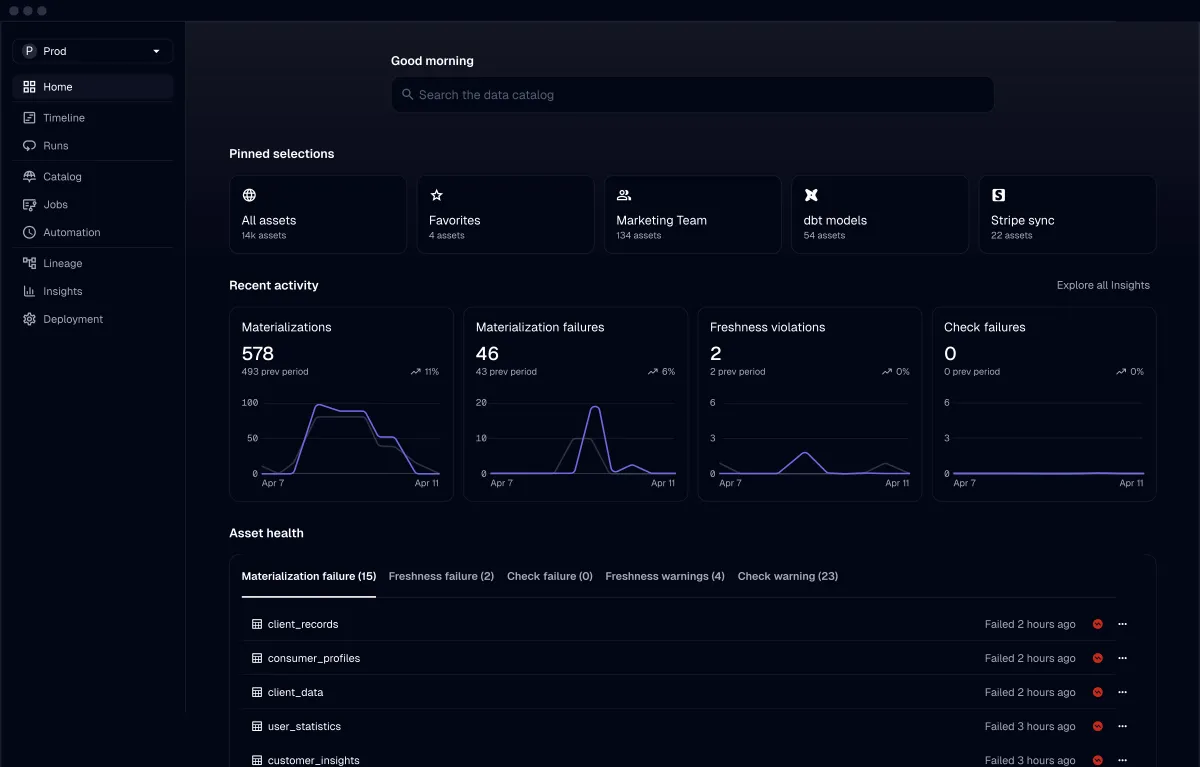
Feature Comparison
| Feature | Dagster | Matillion |
|---|---|---|
| Data Integration | ||
| Data Ingestion | Python-based asset definitions with native connectors for Snowflake, BigQuery, dbt, and Fivetran | 150+ pre-built connectors with batch loading, CDC replication, and custom REST API connector builder |
| Data Transformation | Orchestrates dbt, Databricks, or Python transformations with asset-aware dependency management | Visual drag-and-drop transformation components plus SQL, Python, and dbt code editing in one platform |
| Warehouse Pushdown | Delegates compute to connected warehouses through integration partners like dbt and Databricks | Native pushdown architecture generates SQL directly in Snowflake, Databricks, and Amazon Redshift |
| Orchestration & Automation | ||
| Pipeline Scheduling | Declarative scheduling with sensors, cron-based schedules, and event-driven asset materialization | Flexible scheduling with custom parameters, automated pipeline execution, and Matillion Hub monitoring |
| Asset Management | First-class asset versioning, partitioning, and dependency tracking with automatic lineage graphs | Pipeline-level lineage tracing from source to target with Matillion Lineage for optimization and debugging |
| Error Handling | Built-in retry policies, run monitoring, and AI-powered debugging with impact analysis in Dagster+ | Real-time pipeline observability with fault-tolerant containerized agent model and 99.9% uptime SLA |
| Developer Experience | ||
| Development Approach | Code-first Python SDK with local development, unit testing, and CI/CD-native branch deployments | Low-code visual Designer with drag-and-drop canvas plus SQL, Python, and dbt code editing support |
| Version Control | Full Git-based workflow with branch deployments and code review processes built into Dagster+ | Built-in Git repository with native Git integration for DataOps and collaboration across teams |
| AI Assistance | AI-powered debugging and impact analysis for incident resolution in Dagster+ Cloud platform | Maia agentic AI platform uses natural language prompts to build pipelines and automate engineering tasks |
| Security & Governance | ||
| Access Control | SSO with Google, GitHub, and SAML IdPs; RBAC and SCIM provisioning with multi-tenant instances | Single Sign-On (SSO), Multi-Factor Authentication (MFA), and Role-Based Access Control (RBAC) |
| Compliance | SOC 2 Type II and HIPAA certified with audit logs, retention policies, and enterprise security reviews | Pushdown architecture keeps data in customer cloud; GDPR and HIPAA compliant with encryption |
| Data Security | Hybrid deployment with bring-your-own-infrastructure; data stays in customer environment | Secure-by-design pushdown means data never leaves the customer cloud platform during processing |
| Scalability & Performance | ||
| Architecture | Flexible deployment on single server, Kubernetes, or managed cloud with multi-tenant code isolation | Stateless microservices agents (PipelineOS) running in parallel with containerized task execution |
| Scaling Model | Horizontal scaling through Kubernetes orchestration; unlimited code locations on Pro/Enterprise plans | Unlimited concurrent agents for parallel processing; scales automatically with cloud data platform compute |
| Cloud Platform Support | Supports North American and European cloud regions with multi-cloud deployment flexibility | Purpose-built for Snowflake, Databricks, Amazon Redshift, Google BigQuery, and Azure Synapse |
Data Integration
Data Ingestion
Data Transformation
Warehouse Pushdown
Orchestration & Automation
Pipeline Scheduling
Asset Management
Error Handling
Developer Experience
Development Approach
Version Control
AI Assistance
Security & Governance
Access Control
Compliance
Data Security
Scalability & Performance
Architecture
Scaling Model
Cloud Platform Support
Which approach fits
Dagster excels as a code-first orchestration platform for engineering teams building complex data and AI pipelines, while Matillion delivers faster time-to-value for teams needing visual, low-code ETL/ELT into cloud warehouses.
When each approach fits
Choose Dagster if:
Choose Dagster if your team consists of data engineers comfortable with Python who need asset-centric orchestration with full lineage, observability, and testability. Dagster is the stronger choice for organizations running complex multi-system workflows spanning dbt, Databricks, Spark, and ML pipelines. Its open-source core with Apache-2.0 licensing provides flexibility and avoids vendor lock-in, while Dagster+ Cloud adds enterprise features like branch deployments, cost tracking, and AI-powered debugging for production-scale operations.
Choose Matillion if:
Choose Matillion if your priority is rapid pipeline creation with a visual, low-code interface that empowers both technical and non-technical team members. Matillion is the better fit for organizations focused on cloud warehouse ETL/ELT with native pushdown to Snowflake, Databricks, or Redshift. Its 150+ pre-built connectors, drag-and-drop Designer, and the Maia AI assistant accelerate data delivery without requiring deep coding skills. The consumption-based pricing with unlimited users makes it cost-effective for larger teams scaling their data operations.
These scenarios reflect the available product evidence. Your requirements, existing stack, and team expertise should guide the final decision.
Frequently Asked Questions
What is the main difference between Dagster and Matillion?
Dagster is a code-first, asset-centric data orchestrator built for Python-savvy engineering teams who need full control over pipeline logic, dependency management, and observability across complex data and AI workflows. Matillion is a low-code, visual ETL/ELT platform designed to simplify data integration into cloud warehouses through drag-and-drop pipeline design and 150+ pre-built connectors. Dagster treats data assets as first-class citizens with automatic lineage tracking, while Matillion focuses on accelerating pipeline creation with its visual Designer and native warehouse pushdown architecture.
Can Dagster and Matillion be used together?
Yes, Dagster and Matillion can complement each other in a modern data stack. Dagster serves as the overarching orchestration layer that manages dependencies and scheduling across your entire data platform, while Matillion handles the ETL/ELT workloads for ingesting and transforming data in your cloud warehouse. Organizations sometimes use Matillion for its strong connector library and visual transformation capabilities, then orchestrate those Matillion jobs alongside dbt models, ML pipelines, and other processes through Dagster's asset-aware framework.
Which tool is more cost-effective for small teams?
Dagster offers a free open-source tier under Apache-2.0 licensing that self-hosted teams can use at no cost, making it extremely cost-effective for small engineering teams comfortable managing their own infrastructure. Dagster+ Solo starts at $10/mo for individual users. Matillion provides a free Developer plan for 1 user with unlimited projects and pre-built connectors, then charges on a consumption-based credit model. For small teams with limited engineering resources, Matillion's low-code approach reduces development time, while Dagster's open-source option eliminates licensing costs entirely.
How do Dagster and Matillion compare on data lineage and observability?
Dagster provides built-in, asset-level lineage as a core feature of its orchestration model. Every asset automatically generates lineage graphs showing upstream and downstream dependencies, combined with real-time health metrics, freshness tracking, and integrated monitoring with Slack alerts. Matillion offers pipeline-level lineage through Matillion Lineage, which traces data from source to target for debugging and optimization. Dagster's observability is more deeply integrated into the orchestration layer with its data catalog and automated documentation, while Matillion's lineage focuses specifically on transformation pipeline flows within the cloud warehouse context.