Decision comparison
Amazon QuickSight vs ThoughtSpot
QuickSight and ThoughtSpot attack different bottlenecks. QuickSight is AWS-native BI priced per session, so a wide audience of occasional readers costs what they use. ThoughtSpot puts a search box in front of a modelled dataset so business users can ask their own questions instead of joining the queue in front of the data team.
Direct comparison. These are reviewed substitutes bought for the same job, so the differences below are the ones that decide between them.
All 2 are BI platforms.
Quick Comparison
| Decision factor | Amazon QuickSight | ThoughtSpot |
|---|---|---|
| What it is | AWS's BI service, priced per session for readers and backed by the SPICE in-memory engine | An analytics platform where the primary interface is a search box, aimed at business users asking their own questions |
| Primary interface | Dashboards and analyses, with natural language available on top | A search box: business users type a question and get a chart |
| Pricing model | Per-user pricing: Reader $3 per user/month, Reader Pro $20 per user/month, Author $24 per user/month and Author Pro $40 per user/month. A $250/month per-account infrastructure fee applies to some configurations. Capacity pricing starts at $250/month for 500 sessions with additional sessions at $0.50, or $20,000/year for 50,000 sessions with additional sessions at $0.40. Enterprise pricing on request. The captured pricing page states no free tier. | ThoughtSpot publishes per-user and usage-based options. Essentials starts as low as $25 per user per month billed annually, for 5 to 50 users and up to 25M rows of data. A usage-based option starts as low as $0.10 per unit. Pro and Enterprise are custom priced, with Enterprise covering up to 1,000 users and 250M rows. |
| Cloud fit | AWS-native, with IAM, S3, Redshift and Athena integrated | Cloud-agnostic, querying whichever warehouse holds the data |
| Engine | SPICE in-memory engine, or direct query against the source | Live querying against the warehouse, with caching for responsiveness |
| Prerequisite | A dashboard somebody designs for the audience | A modelled, well-named dataset the search interface can interpret |
| Best fit | AWS organisations with a wide, occasional reading audience | Organisations whose bottleneck is the queue in front of the data team |
| Connectivity | Connects to Snowflake, BigQuery, Redshift and Databricks over standard drivers, with REST APIs for automation | Connects to Snowflake, BigQuery, Redshift and Databricks over standard drivers, with REST APIs for automation |
Amazon QuickSight
- What it is:
- AWS's BI service, priced per session for readers and backed by the SPICE in-memory engine
- Primary interface:
- Dashboards and analyses, with natural language available on top
- Pricing model:
- Per-user pricing: Reader $3 per user/month, Reader Pro $20 per user/month, Author $24 per user/month and Author Pro $40 per user/month. A $250/month per-account infrastructure fee applies to some configurations. Capacity pricing starts at $250/month for 500 sessions with additional sessions at $0.50, or $20,000/year for 50,000 sessions with additional sessions at $0.40. Enterprise pricing on request. The captured pricing page states no free tier.
- Cloud fit:
- AWS-native, with IAM, S3, Redshift and Athena integrated
- Engine:
- SPICE in-memory engine, or direct query against the source
- Prerequisite:
- A dashboard somebody designs for the audience
- Best fit:
- AWS organisations with a wide, occasional reading audience
- Connectivity:
- Connects to Snowflake, BigQuery, Redshift and Databricks over standard drivers, with REST APIs for automation
ThoughtSpot
- What it is:
- An analytics platform where the primary interface is a search box, aimed at business users asking their own questions
- Primary interface:
- A search box: business users type a question and get a chart
- Pricing model:
- ThoughtSpot publishes per-user and usage-based options. Essentials starts as low as $25 per user per month billed annually, for 5 to 50 users and up to 25M rows of data. A usage-based option starts as low as $0.10 per unit. Pro and Enterprise are custom priced, with Enterprise covering up to 1,000 users and 250M rows.
- Cloud fit:
- Cloud-agnostic, querying whichever warehouse holds the data
- Engine:
- Live querying against the warehouse, with caching for responsiveness
- Prerequisite:
- A modelled, well-named dataset the search interface can interpret
- Best fit:
- Organisations whose bottleneck is the queue in front of the data team
- Connectivity:
- Connects to Snowflake, BigQuery, Redshift and Databricks over standard drivers, with REST APIs for automation
Public signals
Verified factual signals only. Bars appear only for like-for-like metrics with five weekly assessments for every tool; missing evidence stays explicit. These signals do not establish enterprise adoption, product quality, or total cost.
| Metric | Amazon QuickSight | ThoughtSpot |
|---|---|---|
| Search interest(Market interest) | 0 | 1 |
| npm weekly downloads(Developer adoption) | 140.3k | 71.7k |
| Product Hunt comments(Community interest) | 2 | 3 |
| Product Hunt rating(Community interest) | 5.0/5 | Unavailable |
| Product Hunt reviews(Community interest) | 1 | 0 |
| Product Hunt votes(Community interest) | 78 | 105 |
| Stack Overflow questions(Community interest) | 718 | Not available |
| GitHub commits, 90d(Developer adoption) | Not available | 79 |
| GitHub stars(Developer adoption) | Not available | 13 |
| Hacker News mentions, 90d(Community interest) | Not available | 0 |
| PyPI weekly downloads(Developer adoption) | Not available | 127 |
As of September 21, 2026 — updated weekly.
Health & risk evidence
Observed public-source checks for mapped package versions and repositories.
Amazon QuickSight
September 21, 2026Package vulnerabilities
npm · amazon-quicksight-embedding-sdk@2.11.3
0 vulnerabilities
across 1 package
Repository security score
Not available
ThoughtSpot
September 21, 2026Package vulnerabilities
npm · @thoughtspot/visual-embed-sdk@1.52.1 · PyPI · thoughtspot-rest-api-sdk@2.28.0
0 vulnerabilities
across 2 packages
Repository security score
github.com/thoughtspot/visual-embed-sdk
6.4/10
Interface Preview
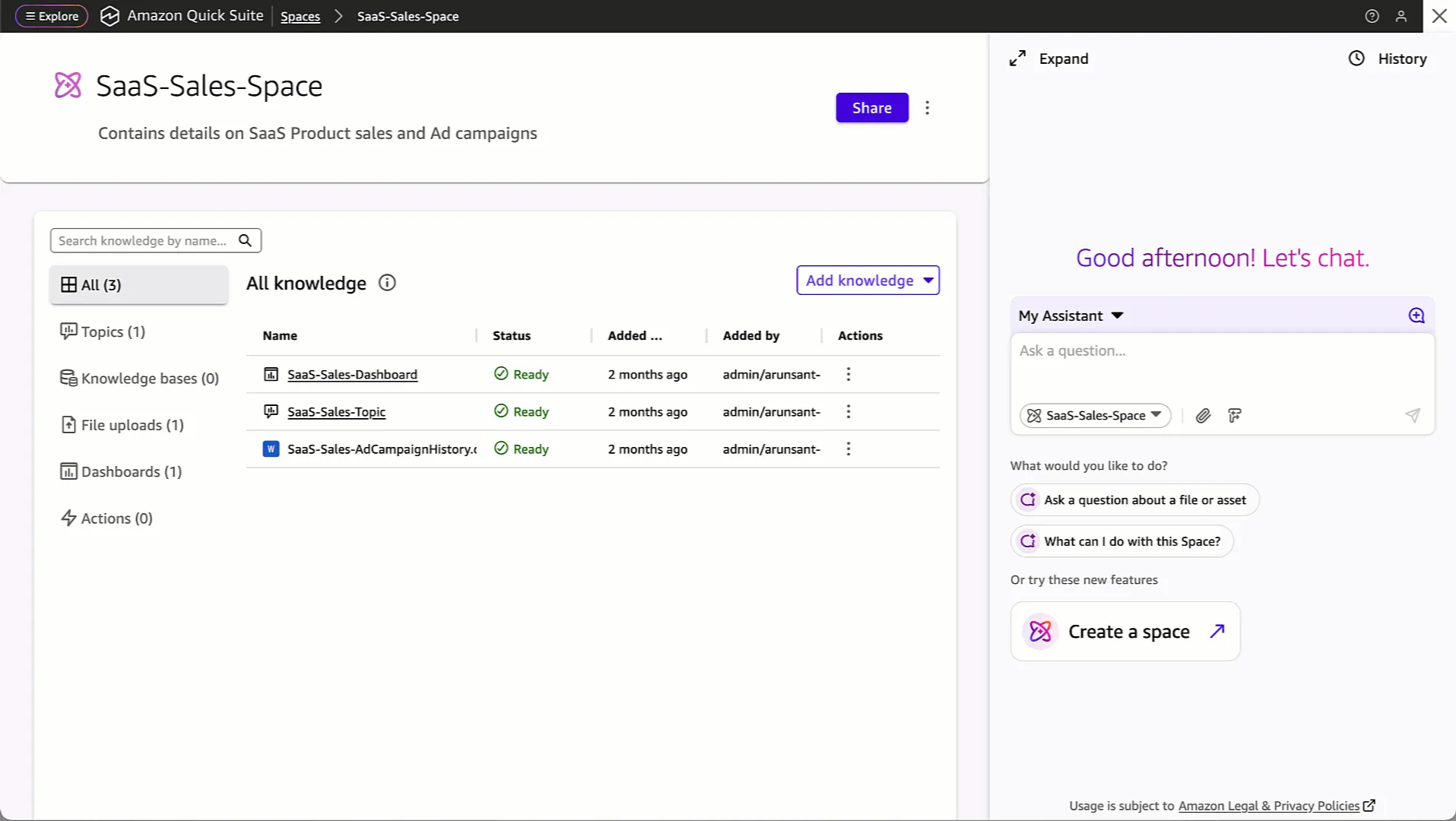
Amazon QuickSight
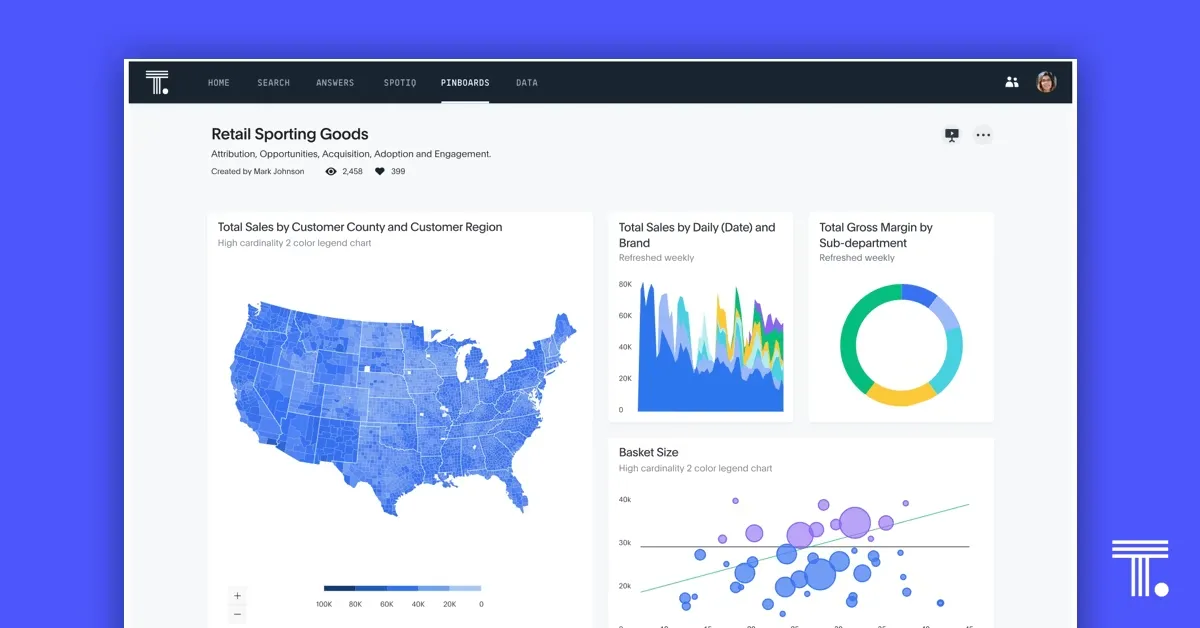
ThoughtSpot
Feature Comparison
| Feature | Amazon QuickSight | ThoughtSpot |
|---|---|---|
| Interface | ||
| Search-driven question answering | Partial support | Full support |
| Natural language querying | Full support | Full support |
| Dashboard authoring | Full support | Full support |
| Ad-hoc exploration by business users | Partial support | Full support |
| Commercial | ||
| Per-session pricing for readers | Full support | Not verified |
| Cost scales with use rather than headcount | Full support | Partial support |
| Native cloud integration | Full support | Partial support |
| Free trial or tier | Full support | Partial support |
| Delivery | ||
| Embedding in your own application | Full support | Full support |
| Alerting on data changes | Full support | Full support |
| Mobile access | Partial support | Full support |
| Governed metric definitions | Partial support | Full support |
| Platform | ||
| Warehouse connectivity | Full support | Full support |
| Scheduled distribution | Full support | Full support |
| Row-level security | Full support | Full support |
| REST API for automation | Full support | Full support |
Interface
Search-driven question answering
Natural language querying
Dashboard authoring
Ad-hoc exploration by business users
Commercial
Per-session pricing for readers
Cost scales with use rather than headcount
Native cloud integration
Free trial or tier
Delivery
Embedding in your own application
Alerting on data changes
Mobile access
Governed metric definitions
Platform
Warehouse connectivity
Scheduled distribution
Row-level security
REST API for automation
Which to choose
QuickSight and ThoughtSpot attack different bottlenecks. QuickSight is AWS-native BI priced per session, so a wide audience of occasional readers costs what they use. ThoughtSpot puts a search box in front of a modelled dataset so business users can ask their own questions instead of joining the queue in front of the data team.
Best-fit scenarios
Choose Amazon QuickSight if:
Choose Amazon QuickSight when the organisation is on AWS and the audience mostly reads. Per-session pricing makes a thousand occasional viewers far cheaper than a thousand seats, IAM handles access with the model you already administer, and SPICE keeps interaction fast without querying the source on every click.
Choose ThoughtSpot if:
Choose ThoughtSpot when the bottleneck is human rather than technical. If managers routinely wait days for answers that are really just a different slice of existing data, a search interface over a well-modelled dataset removes that queue in a way another dashboard cannot.
These scenarios reflect the available product evidence. Your requirements, existing stack, and team expertise should guide the final decision.
Frequently Asked Questions
What has to be true before search-first analytics works?
The model underneath has to be good. A search interface over well-modelled, well-named, governed tables is genuinely useful; the same interface over raw tables with cryptic column names produces confident answers to questions it has misunderstood, which is worse than no answer because nobody knows to check it. Modelling first, search second — in that order.
Does it actually shorten the analyst queue?
It can, and only for the questions the model anticipates. A manager asking which region grew fastest last quarter gets an answer without filing a ticket, which is real relief. A question requiring a join nobody modelled still goes to the data team. The gain is proportional to how much of your ad-hoc demand is straightforward slicing rather than new modelling.
Where do metric definitions live in each?
ThoughtSpot puts the model at the centre by necessity: search is only as good as what it searches, so worksheets and column metadata are the artefact you maintain, and search, Liveboards and alerts all read the same definitions. QuickSight defines calculated fields on datasets, which are reusable across analyses built from them, and nothing stops a second dataset defining the same measure differently. That is the failure that shows up two years in, when revenue is computed three ways across forty dashboards. Whichever you choose, decide who owns the definition and where it lives before the dashboard library grows.
Does it query the warehouse, or a copy?
QuickSight offers both and most deployments use SPICE, its in-memory store: data is loaded on a schedule so dashboards stay fast and Redshift or Athena is not queried on every filter change. The cost is a copy with its own refresh window and its own chance to disagree with the source. Direct query is available when freshness matters more than speed. ThoughtSpot queries the cloud warehouse live, so answers reflect current data and governance stays in one place, and every search becomes warehouse compute. Decide which cost you would rather carry: staleness, or compute.
How does licensing behave as the audience grows?
QuickSight is shaped for a wide, light-touch audience: authors are licensed and readers are charged per session up to a monthly cap, so a thousand people who each open a dashboard twice a month cost far less than a thousand named seats would. ThoughtSpot prices consumption, which matches an interface meant to be used often rather than glanced at. The question to answer first is what your audience actually does. Occasional readers favour session pricing; a population encouraged to ask questions continuously will move a consumption bill, and that is the model working as designed.
How should we evaluate them?
Build the same two things on both: the dashboard your executives read every Monday, and the open-ended question an analyst raised last quarter. The first tests modelling, refresh, delivery and governance; the second tests exploration. Most teams find one platform suited to each, which turns an abstract comparison into a decision about which half of the work matters more.