Decision comparison
Apache Iceberg vs Apache Hudi
Apache Iceberg and Apache Hudi are both excellent open table formats for building data lakehouses, but they serve different primary use cases. Iceberg excels at multi-engine query portability and large-scale analytic workloads with its elegant metadata management, while Hudi leads in streaming ingestion, upsert-heavy pipelines, and automated table maintenance. Your choice should depend on whether you prioritize broad query engine interoperability or real-time data ingestion with built-in operational tooling.
Direct comparison. These are reviewed substitutes bought for the same job, so the differences below are the ones that decide between them.
Applies to: Choosing between two products of the same kind for one job.
All 2 are open table formats.
Quick Comparison
| Decision factor | Apache Iceberg | Apache Hudi |
|---|---|---|
| Best For | Multi-engine analytic workloads requiring schema evolution, time travel, and vendor-neutral query portability across Spark, Trino, Flink, and Snowflake | Streaming ingestion pipelines with frequent upserts, CDC workloads, and near-real-time analytics requiring record-level indexing on cloud storage |
| Architecture | Open table format layer on columnar files (Parquet/ORC/Avro) with metadata tree tracking snapshots, manifest lists, and manifest files for partition pruning | Lakehouse platform with Copy-on-Write and Merge-on-Read table types, pluggable indexing (Bloom, HBase, bucket), timeline-based metadata, and built-in table services |
| Pricing Model | Apache Iceberg is free and open source under the Apache 2.0 license. The table format itself has no license cost. Running Iceberg requires a query engine (Spark, Trino, Flink, or managed services like AWS Athena, Snowflake, Databricks, or AWS Glue) and object storage (S3, GCS, Azure Blob). Commercial managed Iceberg services are available from Tabular (now Databricks), Dremio, and cloud vendors. | Apache Hudi is free and open source under the Apache 2.0 license. No license cost for the software. Operational cost covers running Hudi on Spark or Flink, plus object storage (S3, GCS, Azure Blob, HDFS). Commercial managed Hudi services available via Onehouse (Hudi creators), AWS EMR, Databricks, and Google Cloud Dataproc. |
| Ease of Use | Catalog-centric setup with Hive Metastore, AWS Glue, or Nessie; SQL-based schema evolution and partition transforms simplify table management | Built-in DeltaStreamer tool for ingestion from Kafka and Debezium; automatic compaction, clustering, and cleaning reduce operational overhead |
| Scalability | Snapshot-based metadata tree enables efficient planning over petabyte-scale tables; hidden partitioning eliminates user-facing partition columns | Multimodal indexing subsystem accelerates writes on wide tables; incremental processing framework handles trillion-record-scale data lakes as proven at Uber |
| Community/Support | Apache Software Foundation governance; broad vendor adoption by Snowflake, Databricks, AWS, Google BigQuery, Dremio, and Cloudera | Apache Software Foundation project; production-proven at Uber, deployed by Amazon EMR, used by companies like Zupee and Funding Circle; active Slack community |
Apache Iceberg
- Best For:
- Multi-engine analytic workloads requiring schema evolution, time travel, and vendor-neutral query portability across Spark, Trino, Flink, and Snowflake
- Architecture:
- Open table format layer on columnar files (Parquet/ORC/Avro) with metadata tree tracking snapshots, manifest lists, and manifest files for partition pruning
- Pricing Model:
- Apache Iceberg is free and open source under the Apache 2.0 license. The table format itself has no license cost. Running Iceberg requires a query engine (Spark, Trino, Flink, or managed services like AWS Athena, Snowflake, Databricks, or AWS Glue) and object storage (S3, GCS, Azure Blob). Commercial managed Iceberg services are available from Tabular (now Databricks), Dremio, and cloud vendors.
- Ease of Use:
- Catalog-centric setup with Hive Metastore, AWS Glue, or Nessie; SQL-based schema evolution and partition transforms simplify table management
- Scalability:
- Snapshot-based metadata tree enables efficient planning over petabyte-scale tables; hidden partitioning eliminates user-facing partition columns
- Community/Support:
- Apache Software Foundation governance; broad vendor adoption by Snowflake, Databricks, AWS, Google BigQuery, Dremio, and Cloudera
Apache Hudi
- Best For:
- Streaming ingestion pipelines with frequent upserts, CDC workloads, and near-real-time analytics requiring record-level indexing on cloud storage
- Architecture:
- Lakehouse platform with Copy-on-Write and Merge-on-Read table types, pluggable indexing (Bloom, HBase, bucket), timeline-based metadata, and built-in table services
- Pricing Model:
- Apache Hudi is free and open source under the Apache 2.0 license. No license cost for the software. Operational cost covers running Hudi on Spark or Flink, plus object storage (S3, GCS, Azure Blob, HDFS). Commercial managed Hudi services available via Onehouse (Hudi creators), AWS EMR, Databricks, and Google Cloud Dataproc.
- Ease of Use:
- Built-in DeltaStreamer tool for ingestion from Kafka and Debezium; automatic compaction, clustering, and cleaning reduce operational overhead
- Scalability:
- Multimodal indexing subsystem accelerates writes on wide tables; incremental processing framework handles trillion-record-scale data lakes as proven at Uber
- Community/Support:
- Apache Software Foundation project; production-proven at Uber, deployed by Amazon EMR, used by companies like Zupee and Funding Circle; active Slack community
Public signals
Verified factual signals only. Bars appear only for like-for-like metrics with five weekly assessments for every tool; missing evidence stays explicit. These signals do not establish enterprise adoption, product quality, or total cost.
| Metric | Apache Iceberg | Apache Hudi |
|---|---|---|
| GitHub commits, 90d(Product adoption) | 528 | 411 |
| GitHub stars(Product adoption) | 9,000+ | 6,000+ |
| Search interest(Market interest) | 0 | 0 |
| Hacker News mentions, 90d(Community interest) | 3 | 0 |
| PyPI weekly downloads(Developer adoption) | 4.4M | 9.1k |
| Stack Overflow questions(Community interest) | 312 | 183 |
As of September 14, 2026 — updated weekly.
Health & risk evidence
Observed public-source checks for mapped package versions and repositories.
Apache Iceberg
September 14, 2026Package vulnerabilities
PyPI · pyiceberg@0.12.0
0 vulnerabilities
across 1 package
Repository security score
Not available
Apache Hudi
September 14, 2026Package vulnerabilities
PyPI · hudi@0.4.0
0 vulnerabilities
across 1 package
Repository security score
Not available
Interface Preview
Apache Hudi
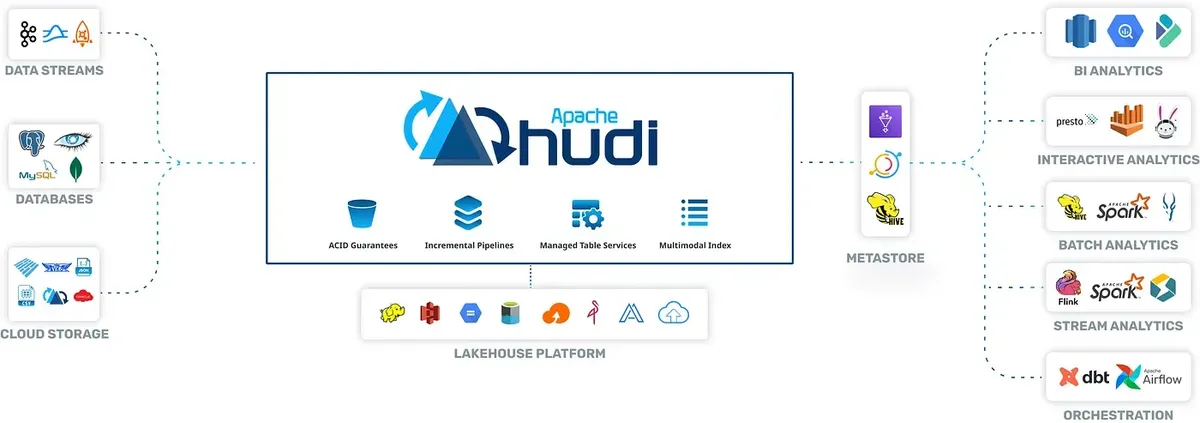
Feature Comparison
| Feature | Apache Iceberg | Apache Hudi |
|---|---|---|
| Data Management | ||
| ACID Transactions | Optimistic concurrency with snapshot isolation via metadata commits | Atomic writes with snapshot isolation and non-blocking concurrency controls |
| Upsert & Delete Operations | Row-level deletes via position and equality delete files | Native upserts with pluggable indexing for fast record-level mutations |
| Schema Evolution | Full schema evolution: add, drop, rename, reorder columns via SQL | Schema evolution with enforcement to fail fast on incompatible changes |
| Query & Analytics | ||
| Time Travel | Query any historical snapshot by timestamp or snapshot ID | Roll back to table versions with full commit history audit trail |
| Incremental Processing | Incremental scan via snapshot diffing for changed data capture | Built-in incremental processing framework for minute-level analytics |
| Query Engine Support | Spark, Trino, Flink, Snowflake, BigQuery, Dremio, Athena, Impala | Spark, Flink, Presto, Trino, Hive, Athena, BigQuery, Redshift, StarRocks |
| Storage & Performance | ||
| Table Types | Single table format with copy-on-write approach for all operations | Copy-on-Write for read-heavy and Merge-on-Read for write-heavy workloads |
| Indexing | Partition pruning and column-level min/max statistics in manifests | Multimodal indexing: Bloom filters, HBase, bucket, and record-level indexes |
| File Formats | Apache Parquet, Apache ORC, and Apache Avro file formats | Apache Parquet, Apache ORC, Apache Avro, plus CSV and JSON |
| Data Ingestion & Streaming | ||
| Streaming Ingestion | Flink and Spark Structured Streaming connectors for continuous writes | DeltaStreamer tool with Kafka and Pulsar sources for automated ingestion |
| CDC Support | CDC via engine-level connectors; no built-in CDC tool | Built-in Debezium and Flink CDC sources for database change capture |
| Table Maintenance | Manual or scheduled compaction, snapshot expiration, and orphan cleanup | Fully automated clustering, compaction, cleaning, and file sizing services |
| Ecosystem & Integration | ||
| Cloud Storage Support | Amazon S3, Google Cloud Storage, Azure Data Lake Storage, HDFS | S3, GCS, Azure Blob, Alibaba Cloud, IBM Cloud, Oracle Cloud, MinIO |
| Catalog Integration | Hive Metastore, AWS Glue, Nessie, REST catalog, JDBC catalog | AWS Glue Data Catalog, Hive Metastore, BigQuery, DataHub, Apache XTable |
| Orchestration Tools | Integrates with Airflow, dbt, and engine-native scheduling | Native dbt and Apache Airflow integration with auto catalog sync |
Data Management
ACID Transactions
Upsert & Delete Operations
Schema Evolution
Query & Analytics
Time Travel
Incremental Processing
Query Engine Support
Storage & Performance
Table Types
Indexing
File Formats
Data Ingestion & Streaming
Streaming Ingestion
CDC Support
Table Maintenance
Ecosystem & Integration
Cloud Storage Support
Catalog Integration
Orchestration Tools
Which to choose
Apache Iceberg and Apache Hudi are both excellent open table formats for building data lakehouses, but they serve different primary use cases. Iceberg excels at multi-engine query portability and large-scale analytic workloads with its elegant metadata management, while Hudi leads in streaming ingestion, upsert-heavy pipelines, and automated table maintenance. Your choice should depend on whether you prioritize broad query engine interoperability or real-time data ingestion with built-in operational tooling.
Best-fit scenarios
Choose Apache Iceberg if:
Choose Apache Iceberg when your primary requirement is multi-engine query portability across diverse analytics tools like Spark, Trino, Snowflake, and BigQuery. Iceberg is the stronger choice if you have large-scale analytic datasets that are mostly append-only or batch-updated, and you need hidden partitioning to simplify partition management. It is also ideal when vendor neutrality matters most, as Iceberg has the broadest adoption among cloud providers and commercial data platforms. Teams that prioritize SQL-based schema evolution and straightforward time-travel queries will appreciate Iceberg's clean metadata-driven approach.
Choose Apache Hudi if:
Choose Apache Hudi when your workloads involve frequent upserts, deletes, and streaming data ingestion from sources like Kafka or database CDC via Debezium. Hudi is the better fit if you need near-real-time analytics with its incremental processing framework that enables minute-level data freshness. Its built-in DeltaStreamer tool, automatic table services for compaction and clustering, and multimodal indexing for fast record-level lookups make it especially suited for operational data lake patterns. Organizations running write-heavy pipelines at scale, particularly those processing CDC workloads or handling out-of-order streaming data, will benefit from Hudi's purpose-built architecture.
These scenarios reflect the available product evidence. Your requirements, existing stack, and team expertise should guide the final decision.
Frequently Asked Questions
What is the main difference between Apache Iceberg and Apache Hudi?
The core difference lies in their design philosophy. Apache Iceberg focuses on being a universal open table format that prioritizes multi-engine compatibility and elegant metadata management for large-scale analytics. It uses a snapshot-based metadata tree with manifest files for efficient query planning across engines like Spark, Trino, Snowflake, and BigQuery. Apache Hudi, by contrast, is designed as a full lakehouse platform optimized for streaming ingestion and record-level mutations. It provides built-in tools like DeltaStreamer for automated data ingestion, pluggable indexing for fast upserts, and automatic table services for compaction and clustering. If your priority is read-heavy analytics across multiple engines, Iceberg is typically the better fit; if you need write-heavy streaming pipelines with frequent upserts, Hudi has the edge.
How much does it cost to run Apache Iceberg versus Apache Hudi?
Both Apache Iceberg and Apache Hudi are free open-source projects under the Apache 2.0 license, so there are no software licensing costs. Your expenses come from cloud infrastructure: storage on S3 at approximately $0.023/GB/month, and compute clusters running Spark, Flink, or Trino. For commercial managed services, Hudi has Onehouse offering a Starter tier free up to 5TB, a Growth tier starting at $0.07/GB/month, and custom Enterprise pricing. Iceberg's commercial ecosystem includes support through Databricks (which acquired Tabular), Snowflake's native Iceberg tables, and AWS integrations. The total cost depends heavily on data volume, query frequency, and your chosen compute engine rather than the table format itself.
Can Apache Iceberg and Apache Hudi handle real-time streaming data?
Both formats support streaming ingestion, but Apache Hudi has a clear advantage for real-time workloads. Hudi provides the DeltaStreamer utility for continuous ingestion from Apache Kafka and Apache Pulsar, built-in CDC support via Debezium and Flink CDC connectors, and an incremental processing framework designed for minute-level analytics. Its Merge-on-Read table type is specifically optimized for write-heavy streaming patterns. Apache Iceberg supports streaming through Flink and Spark Structured Streaming connectors, but it lacks built-in ingestion tooling equivalent to DeltaStreamer. Iceberg's strength is more in batch and micro-batch analytics. For true near-real-time data freshness with frequent upserts, Hudi's architecture is better suited to the task.
Which open table format has better ecosystem support for data warehousing?
Apache Iceberg currently has extensive adoption among major cloud data warehouse and analytics vendors. Snowflake offers native Iceberg table support, Google BigQuery has direct Iceberg integration, Databricks supports Iceberg through UniForm, AWS Athena reads Iceberg tables natively, and Dremio is built around Iceberg as its primary format. Apache Hudi also has strong ecosystem support with integrations for Presto, Trino, Spark, Athena, Redshift, BigQuery, StarRocks, and ClickHouse, plus it supports more cloud storage providers including Alibaba Cloud, IBM Cloud, and Oracle Cloud. For pure query engine breadth and vendor neutrality in the data warehouse space, Iceberg has a slight edge, while Hudi offers richer built-in operational tooling and broader cloud storage compatibility.