Decision comparison
Apache Kafka vs Apache Spark
Apache Kafka excels as a real-time event streaming backbone with sub-millisecond latency and guaranteed delivery, while Apache Spark is a prominent choice for large-scale data analytics, batch processing, and machine learning workloads with its unified engine and in-memory computing.
Used together. These are normally used together rather than chosen between. The comparison explains what each one does in the stack.
These are different kinds of product — Event Streaming Platform and Data Processing Engine.
Quick Comparison
| Decision factor | Apache Kafka | Apache Spark |
|---|---|---|
| Primary Purpose | Distributed event streaming platform built for high-performance data pipelines, real-time messaging, and data integration | Unified analytics engine designed for large-scale batch processing, streaming analytics, machine learning, and SQL queries |
| Processing Model | Continuous event streaming with publish/subscribe pattern, exactly-once processing, and guaranteed message ordering | In-memory distributed computing with micro-batch streaming, RDD-based fault tolerance, and iterative processing |
| Performance | Network-limited throughput with latencies as low as 2ms, scales to trillions of messages per day across thousands of brokers | 100x as fast as MapReduce for in-memory operations, 10x as fast on disk, processes petabyte-scale data sets |
| Language Support | Client libraries for Java, Scala, Python, Go, and many other languages via community-maintained SDKs | Native APIs for Python, Scala, Java, R, and SQL with over 80 built-in operators for development tasks |
| Ecosystem Integration | Out-of-the-box Connect interface with hundreds of sources and sinks including Postgres, Elasticsearch, and AWS S3 | Integrates with Hadoop, Kubernetes, Delta Lake for ACID transactions, and data science frameworks like MLlib and GraphX |
| Community & Adoption | 33,000+ GitHub stars, 151 reviews with 8.6/10 rating, used by 80% of Fortune 100 companies, 5M+ downloads | 44,000+ GitHub stars, 2,000+ open-source contributors, used by 80% of Fortune 500 including Netflix, Uber, and Pinterest |
Apache Kafka
- Primary Purpose:
- Distributed event streaming platform built for high-performance data pipelines, real-time messaging, and data integration
- Processing Model:
- Continuous event streaming with publish/subscribe pattern, exactly-once processing, and guaranteed message ordering
- Performance:
- Network-limited throughput with latencies as low as 2ms, scales to trillions of messages per day across thousands of brokers
- Language Support:
- Client libraries for Java, Scala, Python, Go, and many other languages via community-maintained SDKs
- Ecosystem Integration:
- Out-of-the-box Connect interface with hundreds of sources and sinks including Postgres, Elasticsearch, and AWS S3
- Community & Adoption:
- 33,000+ GitHub stars, 151 reviews with 8.6/10 rating, used by 80% of Fortune 100 companies, 5M+ downloads
Apache Spark
- Primary Purpose:
- Unified analytics engine designed for large-scale batch processing, streaming analytics, machine learning, and SQL queries
- Processing Model:
- In-memory distributed computing with micro-batch streaming, RDD-based fault tolerance, and iterative processing
- Performance:
- 100x as fast as MapReduce for in-memory operations, 10x as fast on disk, processes petabyte-scale data sets
- Language Support:
- Native APIs for Python, Scala, Java, R, and SQL with over 80 built-in operators for development tasks
- Ecosystem Integration:
- Integrates with Hadoop, Kubernetes, Delta Lake for ACID transactions, and data science frameworks like MLlib and GraphX
- Community & Adoption:
- 44,000+ GitHub stars, 2,000+ open-source contributors, used by 80% of Fortune 500 including Netflix, Uber, and Pinterest
Public signals
Verified factual signals only. Bars appear only for like-for-like metrics with five weekly assessments for every tool; missing evidence stays explicit. These signals do not establish enterprise adoption, product quality, or total cost.
| Metric | Apache Kafka | Apache Spark |
|---|---|---|
| Docker Hub pulls(Product adoption) | 43.7M | 29.6M |
| GitHub commits, 90d(Product adoption) | 567 | 1.5k |
| GitHub stars(Product adoption) | 33,000+ | 44,000+ |
| Search interest(Market interest) | 5 | Not available |
| Hacker News mentions, 90d(Community interest) | 8 | 2 |
| npm weekly downloads(Ecosystem adoption) | 2.5M | Not available |
| PyPI weekly downloads(Ecosystem adoption) | 9.6M | Not available |
| Stack Overflow questions(Community interest) | 33.2k | 82.5k |
| PyPI weekly downloads(Developer adoption) | Not available | 11.1M |
As of September 21, 2026 — updated weekly.
Health & risk evidence
Observed public-source checks for mapped package versions and repositories.
Apache Kafka
September 21, 2026Package vulnerabilities
PyPI · confluent-kafka@2.15.1 · npm · kafkajs@2.2.4
0 vulnerabilities
across 2 packages
Repository security score
github.com/apache/kafka
6.1/10
Apache Spark
Package vulnerabilities
PyPI · pyspark@4.2.0
0 vulnerabilities
across 1 package
Repository security score
github.com/apache/spark
5.6/10
Interface Preview
Apache Kafka
Feature Comparison
| Feature | Apache Kafka | Apache Spark |
|---|---|---|
| Data Processing | ||
| Streaming Processing | Built-in stream processing with joins, aggregations, filters, and exactly-once semantics using event-time processing | Structured Streaming processes data in micro-batches with near-real-time latency, unified with batch processing API |
| Batch Processing | Designed primarily for continuous streaming; batch capabilities available through log replay and consumer group offsets | Core strength with in-memory computing for fast batch jobs, RDD abstraction for distributed data processing across clusters |
| Data Throughput | Handles trillions of messages per day with 2ms latency, scales to petabytes of data across thousands of brokers | Processes petabyte-scale data using in-memory caching and optimized query execution across distributed clusters |
| Data Storage & Reliability | ||
| Fault Tolerance | Distributed, durable cluster with built-in replication, zero message loss, and high availability across availability zones | RDD-based fault tolerance tracks transformations and actions, enabling automatic recovery from node failures without data loss |
| Data Persistence | Permanent storage in distributed fault-tolerant clusters with configurable retention policies and log compaction | Primarily in-memory processing with Delta Lake integration providing ACID transactions for persistent storage |
| Exactly-Once Semantics | Native exactly-once processing with guaranteed message ordering and transactional support across producers and consumers | Structured Streaming provides exactly-once guarantees through checkpointing and write-ahead logs for stateful operations |
| Analytics & Machine Learning | ||
| SQL Support | KSQL and ksqlDB provide SQL-like interface for stream processing queries directly on Kafka topics | Spark SQL runs distributed ANSI SQL queries for dashboarding and ad-hoc reporting, faster than most data warehouses |
| Machine Learning | No built-in ML library; relies on external tools like Spark MLlib or TensorFlow consuming from Kafka topics | MLlib provides classification, regression, clustering, collaborative filtering, and dimensionality reduction at scale |
| Graph Processing | No native graph processing capability; requires integration with external graph processing frameworks | GraphX extends Spark for graph-parallel computations, modeling and transforming data as graphs for relationship analysis |
| Deployment & Scalability | ||
| Cluster Management | Runs as a distributed cluster with brokers, supports elastic scaling of storage and processing capacity | Runs on Hadoop YARN, Kubernetes, standalone clusters, or cloud environments with flexible resource management |
| Cloud Deployment | Available as managed services through Confluent Cloud, AWS MSK, Azure Event Hubs, and other cloud providers | Available through Databricks, AWS EMR, Azure HDInsight, Google Dataproc, and other managed cloud offerings |
| Horizontal Scaling | Scales to thousands of brokers and hundreds of thousands of partitions with elastic expand and contract | Scales from single-node machines to clusters of thousands of machines using distributed in-memory processing |
| Integration & Connectivity | ||
| Data Source Connectors | Kafka Connect provides hundreds of pre-built connectors for databases, cloud storage, search engines, and messaging systems | Reads from Parquet, Avro, ORC, JSON, CSV files and integrates with Hive, JDBC databases, and cloud storage systems |
| Ecosystem Compatibility | Integrates with Spark, Flink, Storm, Hadoop, and virtually every major data processing framework as a data source | Integrates with Kafka, Flume, Amazon Kinesis for ingestion and works alongside Hadoop, Delta Lake, and BI tools |
| API & Development | Producer, Consumer, Streams, and Connect APIs in Java with community clients for Python, Go, .NET, and more | Native development APIs in Python, Scala, Java, R with pip install, Docker support, and interactive shell access |
Data Processing
Streaming Processing
Batch Processing
Data Throughput
Data Storage & Reliability
Fault Tolerance
Data Persistence
Exactly-Once Semantics
Analytics & Machine Learning
SQL Support
Machine Learning
Graph Processing
Deployment & Scalability
Cluster Management
Cloud Deployment
Horizontal Scaling
Integration & Connectivity
Data Source Connectors
Ecosystem Compatibility
API & Development
How they fit together
Apache Kafka excels as a real-time event streaming backbone with sub-millisecond latency and guaranteed delivery, while Apache Spark is a prominent choice for large-scale data analytics, batch processing, and machine learning workloads with its unified engine and in-memory computing.
What each one handles
Use Apache Kafka for:
Choose Apache Kafka when your primary requirement is real-time event streaming, messaging between microservices, or building high-throughput data pipelines that demand guaranteed message ordering and zero data loss. Kafka is the right fit for organizations that need to process trillions of messages per day with latencies as low as 2ms. Its publish/subscribe architecture with permanent storage makes it ideal for event-driven architectures, log aggregation, activity tracking, and mission-critical applications where exactly-once processing and fault tolerance are non-negotiable requirements.
Use Apache Spark for:
Choose Apache Spark when your workload centers on large-scale data analytics, batch processing, or machine learning at scale. Spark is the better option for teams that need a unified engine supporting SQL queries, streaming analytics, and ML model training within a single platform. Its in-memory computing delivers speeds up to 100x compared to traditional MapReduce frameworks, and built-in libraries like MLlib, GraphX, and Spark SQL provide a comprehensive analytics toolkit. Spark works well for exploratory data analysis on petabyte-scale datasets and organizations that need multi-language support across Python, Scala, Java, R, and SQL.
These roles reflect the available product evidence. Most teams run both; which one owns a given job depends on your stack and team.
Frequently Asked Questions
Can Apache Kafka and Apache Spark be used together?
Apache Kafka and Apache Spark are frequently used together in production data architectures. Kafka serves as the real-time data ingestion and messaging layer, while Spark consumes from Kafka topics to perform batch analytics, streaming computations, and machine learning. Companies like Netflix use Spark Streaming with Kafka for near-real-time movie recommendations by analyzing millions of viewing habits. Uber combines them for telematics analytics to optimize routes and improve safety. Pinterest relies on this combination to analyze global user behavior and optimize content delivery. Spark Streaming can ingest live data streams directly from Kafka topics, splitting them into micro-batches for processing.
What are the main architectural differences between Kafka and Spark?
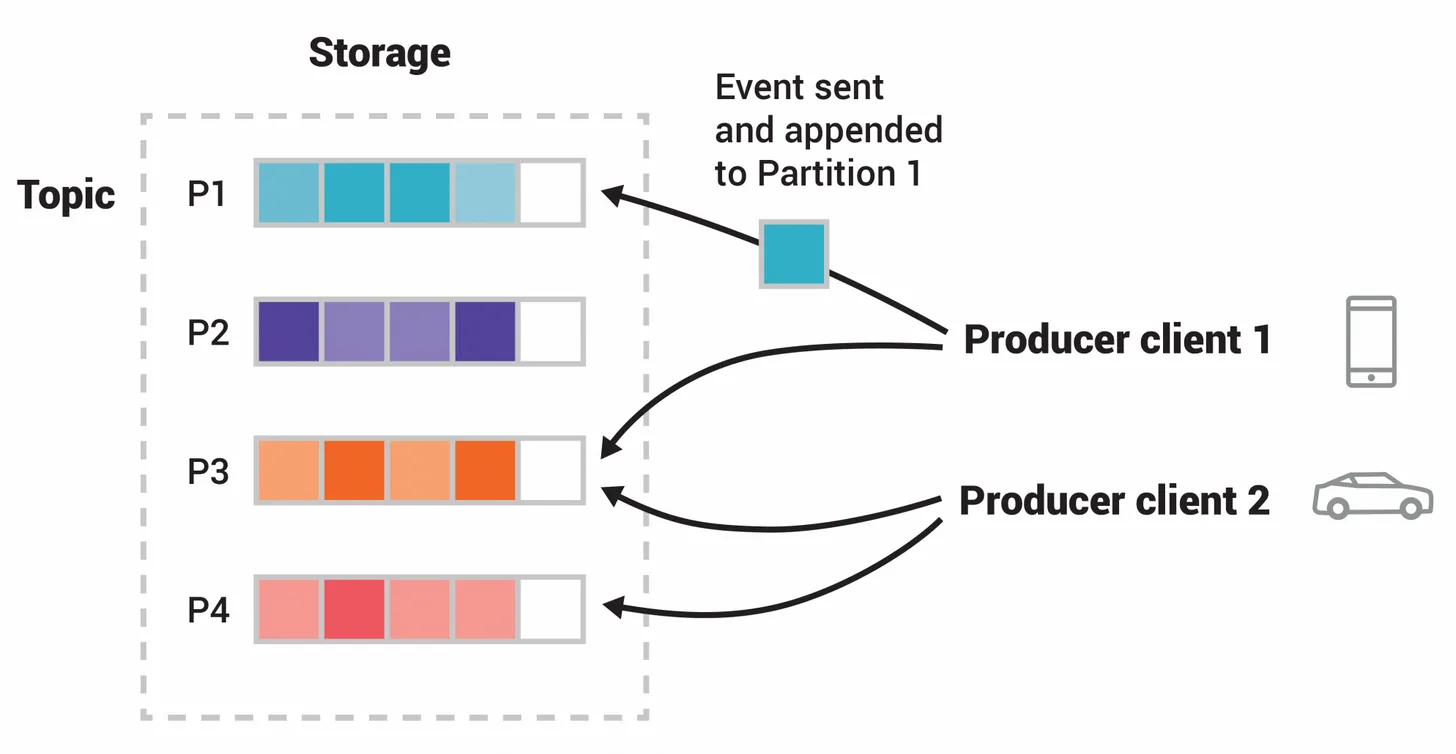
Apache Kafka follows a publish/subscribe architecture where producers write events to a distributed cluster of brokers organized into topics and partitions. Consumers read from these topics independently, and Kafka stores messages permanently in a fault-tolerant cluster. Apache Spark uses a master-worker architecture with a driver program that distributes tasks across worker nodes. Spark processes data using Resilient Distributed Datasets (RDDs) that enable in-memory computing and automatic fault recovery. Kafka is optimized for continuous data movement with 2ms latency, while Spark is optimized for computation-heavy analytics with its in-memory processing engine that runs 100x as fast as disk-based MapReduce.
Which tool is better for real-time data processing?
For true real-time event processing with low latency, Apache Kafka is a strong choice. Kafka delivers messages at network-limited throughput with latencies as low as 2ms and provides exactly-once processing with guaranteed message ordering. Apache Spark offers near-real-time processing through Structured Streaming, but it uses a micro-batch approach that introduces notable latency compared to Kafka's continuous streaming model. However, Spark Structured Streaming provides richer analytics capabilities including SQL queries, windowed aggregations, and machine learning integration on streaming data. Many organizations use Kafka for the ingestion layer and Spark for the analytics layer to get the best of both approaches.
How do the operational complexities of Kafka and Spark compare?
Both platforms involve significant operational complexity. Apache Kafka users report that configuration and setup can be challenging, with historical dependency on ZooKeeper being a bottleneck for implementation. Monitoring and enterprise-grade observability tools are noted as areas needing improvement, and Kafka can consume significant memory resources. Apache Spark requires expertise in distributed computing and cluster management, with memory tuning being critical for performance. Spark can run on Hadoop YARN, Kubernetes, or standalone clusters, each requiring different operational knowledge. Both tools benefit from managed cloud offerings that reduce operational burden, such as Confluent Cloud and AWS MSK for Kafka, or Databricks and AWS EMR for Spark.