Decision comparison
Dagster vs dlt (data load tool)
Dagster is a full data orchestration platform with asset-centric pipelines, built-in observability, and enterprise security, while dlt is a lightweight Python library focused on fast, code-first data loading with automatic schema management.
Used together. These are normally used together rather than chosen between. The comparison explains what each one does in the stack.
These are different kinds of product — Workflow Orchestrator and ELT Platform.
Quick Comparison
| Decision factor | Dagster | dlt (data load tool) |
|---|---|---|
| Ease of Setup | Requires environment configuration with Kubernetes or Docker; Solo Plan offers managed cloud with 30-day free trial starting at $10/mo | pip install dlt and go; runs anywhere Python runs including notebooks, Airflow, and serverless functions with zero backends needed |
| Data Pipeline Approach | Asset-centric orchestration modeling pipelines as data assets with built-in lineage graphs, dependency tracking, and partitioning | Lightweight Python library focused on extract and load with automatic schema inference, incremental loading, and data normalization |
| Integration Ecosystem | Native integrations with Snowflake, BigQuery, dbt, Databricks, Fivetran, Spark, and Azure with Dagster Pipes for external observability | 60+ verified pre-built sources including SQL databases, REST APIs, cloud storage; supports Snowflake, Databricks, DuckDB destinations |
| Scalability | Enterprise-grade with multi-tenant deployments, unlimited code locations on Pro plan, and Kubernetes-native scaling for large teams | Scales from micro infrastructure to large deployments; supports PyArrow and connector-x extraction engines for high-performance processing |
| Observability | Built-in data catalog, lineage visualization, monitoring and alerting via Slack, real-time health metrics, and AI-powered debugging | Observability dashboard available on paid plans with data quality metrics, checks, and schema evolution alerts for pipeline monitoring |
| Best For | Data platform teams needing full orchestration with lineage, scheduling, CI/CD workflows, and enterprise governance across complex stacks | Python-first data teams wanting lightweight, code-first data loading with minimal infrastructure overhead and rapid pipeline development |
Dagster
- Ease of Setup:
- Requires environment configuration with Kubernetes or Docker; Solo Plan offers managed cloud with 30-day free trial starting at $10/mo
- Data Pipeline Approach:
- Asset-centric orchestration modeling pipelines as data assets with built-in lineage graphs, dependency tracking, and partitioning
- Integration Ecosystem:
- Native integrations with Snowflake, BigQuery, dbt, Databricks, Fivetran, Spark, and Azure with Dagster Pipes for external observability
- Scalability:
- Enterprise-grade with multi-tenant deployments, unlimited code locations on Pro plan, and Kubernetes-native scaling for large teams
- Observability:
- Built-in data catalog, lineage visualization, monitoring and alerting via Slack, real-time health metrics, and AI-powered debugging
- Best For:
- Data platform teams needing full orchestration with lineage, scheduling, CI/CD workflows, and enterprise governance across complex stacks
dlt (data load tool)
- Ease of Setup:
- pip install dlt and go; runs anywhere Python runs including notebooks, Airflow, and serverless functions with zero backends needed
- Data Pipeline Approach:
- Lightweight Python library focused on extract and load with automatic schema inference, incremental loading, and data normalization
- Integration Ecosystem:
- 60+ verified pre-built sources including SQL databases, REST APIs, cloud storage; supports Snowflake, Databricks, DuckDB destinations
- Scalability:
- Scales from micro infrastructure to large deployments; supports PyArrow and connector-x extraction engines for high-performance processing
- Observability:
- Observability dashboard available on paid plans with data quality metrics, checks, and schema evolution alerts for pipeline monitoring
- Best For:
- Python-first data teams wanting lightweight, code-first data loading with minimal infrastructure overhead and rapid pipeline development
Public signals
Verified factual signals only. Bars appear only for like-for-like metrics with five weekly assessments for every tool; missing evidence stays explicit. These signals do not establish enterprise adoption, product quality, or total cost.
| Metric | Dagster | dlt (data load tool) |
|---|---|---|
| Docker Hub pulls(Developer adoption) | 6.2M | Not available |
| GitHub commits, 90d(Product adoption) | 265 | 136 |
| GitHub stars(Product adoption) | 16,000+ | 5,500+ |
| Search interest(Market interest) | 1 | Unavailable |
| Hacker News mentions, 90d(Community interest) | 3 | 0 |
| Product Hunt comments(Community interest) | 11 | Not available |
| Product Hunt rating(Community interest) | 5.0/5 | Not available |
| Product Hunt reviews(Community interest) | 1 | Not available |
| Product Hunt votes(Community interest) | 112 | Not available |
| PyPI weekly downloads(Product adoption) | 1.8M | 1.1M |
| Stack Overflow questions(Community interest) | 171 | Not available |
As of September 21, 2026 — updated weekly.
Health & risk evidence
Observed public-source checks for mapped package versions and repositories.
Dagster
September 21, 2026Package vulnerabilities
PyPI · dagster@1.13.23
0 vulnerabilities
across 1 package
Repository security score
github.com/dagster-io/dagster
5.1/10
dlt (data load tool)
September 21, 2026Package vulnerabilities
PyPI · dlt@1.30.0
0 vulnerabilities
across 1 package
Repository security score
Not available
Interface Preview
Dagster
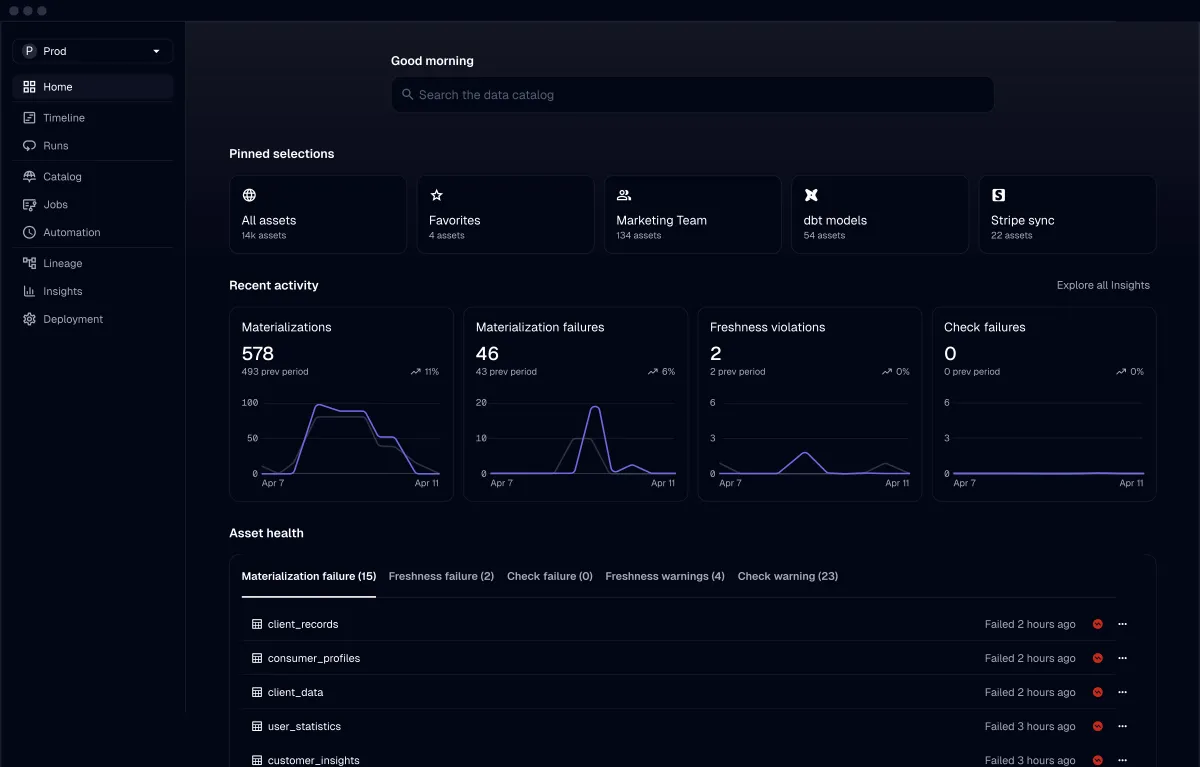
Feature Comparison
| Feature | Dagster | dlt (data load tool) |
|---|---|---|
| Orchestration & Scheduling | ||
| Asset-Based Orchestration | First-class asset-centric orchestration with declarative DAGs, dependency tracking, and automatic materialization scheduling | Not an orchestrator; designed as a library that integrates with existing orchestrators like Airflow for scheduling needs |
| Partitioning & Incremental Runs | Native asset partitioning with time-based and custom partition schemes plus incremental materialization support | Built-in incremental loading with state management, deduplication, and SCD2 materializations for efficient data syncing |
| CI/CD Integration | Branch deployments for continuous integration, GitOps workflows, and CI/CD-native development with staging environments | Runs in any Python CI environment; no dedicated CI/CD features but integrates with standard deployment pipelines |
| Data Loading & Transformation | ||
| Schema Management | Schema tracking through asset metadata and integration with external schema tools like dbt and Great Expectations | Automatic schema inference and evolution with alerts, data normalization, and declarative schema contracts built into the library |
| Source Connectors | Integration-based approach connecting to tools via native integrations for Snowflake, BigQuery, dbt, Databricks, and Fivetran | 60+ verified pre-built sources plus REST API toolkit and OpenAPI toolkit for generating pipeline code from any API spec |
| Data Transformation | Orchestrates dbt, Databricks, and Python transformations with full lineage tracking across transformation steps | Focused on extract and load; transformations handled through Python code or downstream tools like dbt in the pipeline |
| Observability & Quality | ||
| Data Lineage | Built-in lineage graphs showing asset dependencies, upstream and downstream impact analysis, and auto-generated documentation | Complete data lineage tracking available through dltHub platform; OSS version provides basic pipeline state tracking |
| Monitoring & Alerting | Intelligent alerts in Slack, AI-powered debugging, impact analysis, and real-time health metrics for freshness and performance | Data quality metrics and checks on paid plans with observability dashboard; OSS relies on pipeline logs and state files |
| Data Quality | Built-in validation, automated testing, freshness checks, and partitioned asset checks embedded directly in pipeline code | Data quality metrics and checks available on dltHub Pro and Scale plans with schema contract enforcement in the library |
| Deployment & Security | ||
| Deployment Options | Self-hosted on single server or Kubernetes, managed Dagster Cloud with hybrid bring-your-own-infrastructure patterns | Runs anywhere Python runs including notebooks, serverless functions, and containers; managed runtime on dltHub paid plans |
| Enterprise Security | SOC 2 Type II certified, HIPAA compliant, SSO with SAML, RBAC, SCIM provisioning, audit logs, and multi-tenant isolation | Enterprise tier offers custom security and governance controls, SLA support, and custom onboarding for regulated industries |
| Multi-Tenancy | Multi-tenant instances with isolated code deployments, supporting North American and European regions on Dagster Cloud | Team-based access with up to 30 developers on Scale plan and 100 view-only users; Enterprise offers custom configurations |
| Developer Experience | ||
| Learning Curve | Moderate learning curve with comprehensive documentation, Dagster University courses, and structured tutorials for onboarding | Low barrier to entry with simple pip install; declarative interface removes obstacles for beginners while supporting advanced usage |
| AI & LLM Support | AI-driven data engineering courses and AI-powered debugging tools integrated into the Dagster platform for troubleshooting | dltHub Context provides AI-native assets enabling LLMs to code pipelines from any REST API to any destination within minutes |
| Community & Ecosystem | 16,000+ GitHub stars, Apache-2.0 license, active Slack community, extensive integration ecosystem, and regular release cadence | 5,500+ GitHub stars, Apache-2.0 license, 10M+ monthly PyPI downloads, 8,000+ OSS companies in production, active Slack community |
Orchestration & Scheduling
Asset-Based Orchestration
Partitioning & Incremental Runs
CI/CD Integration
Data Loading & Transformation
Schema Management
Source Connectors
Data Transformation
Observability & Quality
Data Lineage
Monitoring & Alerting
Data Quality
Deployment & Security
Deployment Options
Enterprise Security
Multi-Tenancy
Developer Experience
Learning Curve
AI & LLM Support
Community & Ecosystem
How they fit together
Dagster is a full data orchestration platform with asset-centric pipelines, built-in observability, and enterprise security, while dlt is a lightweight Python library focused on fast, code-first data loading with automatic schema management.
What each one handles
Use Dagster for:
Choose Dagster when your team needs a comprehensive data orchestration platform that manages the entire pipeline lifecycle. Dagster excels at coordinating complex workflows across multiple tools like dbt, Snowflake, and Databricks with built-in lineage tracking and dependency management. Its asset-centric approach reduces cognitive load when debugging, and enterprise features like SOC 2 Type II certification, HIPAA compliance, RBAC, and multi-tenant deployments make it suitable for organizations with strict governance requirements. The managed Dagster Cloud option with hybrid deployment patterns means teams can start quickly without sacrificing control over their infrastructure.
Use dlt (data load tool) for:
Choose dlt when your team prioritizes lightweight, Python-native data loading without the overhead of a full orchestration platform. dlt is ideal for Python-first teams that want to write pipelines as simple scripts with automatic schema inference, incremental loading, and data normalization built in. With 60+ verified sources and the ability to run anywhere Python runs, including notebooks, Airflow, and serverless functions, dlt minimizes infrastructure requirements while delivering production-ready data loading. The dltHub platform adds managed runtime and observability for teams that need operational features without leaving the Python ecosystem.
These roles reflect the available product evidence. Most teams run both; which one owns a given job depends on your stack and team.
Frequently Asked Questions
Can Dagster and dlt be used together in the same data stack?
Yes, Dagster and dlt complement each other well in a modern data stack. dlt handles the extract and load portion of the pipeline as a lightweight Python library, while Dagster orchestrates the overall workflow including scheduling, dependency management, and observability. Teams commonly use dlt as a data source within Dagster assets, letting Dagster manage when and how dlt pipelines run while benefiting from dlt's automatic schema inference and incremental loading. This combination gives you Dagster's asset-centric orchestration with dlt's streamlined data loading capabilities.
How do the open-source versions of Dagster and dlt compare?
Both tools are open-source under Apache-2.0 licenses, but they serve different purposes. Dagster's open-source version provides a full orchestration framework with asset management, scheduling, lineage, and a web-based UI for monitoring pipelines. dlt's open-source library focuses specifically on data loading with schema inference, incremental loading, and data normalization, but does not include orchestration or a monitoring UI. Dagster OSS has 16,000+ GitHub stars and includes most core features, while dlt has 5,235 stars with 10M+ monthly PyPI downloads and 8,000+ companies using it in production.
Which tool is better for small data teams with limited resources?
dlt is generally better suited for small teams with limited resources because it requires minimal infrastructure to get started. You can pip install dlt and begin loading data immediately without setting up backends, containers, or dedicated servers. dlt runs anywhere Python runs, including Jupyter notebooks and serverless functions. Dagster requires more initial setup and operational overhead, though its Solo Plan at $10 per month with a 30-day free trial provides a managed option. For small teams that only need data loading, dlt delivers faster time to value, while teams that also need orchestration and monitoring should consider Dagster's managed cloud.
How does pricing compare between Dagster Cloud and dltHub?
The supplied evidence does not provide Dagster Cloud pricing, so a like-for-like price comparison is not available here. dlt is free and Apache 2.0 licensed. dltHub is $12,000 per month and includes 5,000 credits per month, on a 12-month minimum billed monthly. A dltHub trial lasts 14 days and includes $30 in credits with no card required.