Decision comparison
Dagster vs Portable
Dagster is a developer-centric orchestration platform for teams that need full control over complex data pipelines, while Portable is a managed ELT service that eliminates connector engineering entirely through its 1,500+ prebuilt integrations and hands-on support model.
Used together. These are normally used together rather than chosen between. The comparison explains what each one does in the stack.
These are different kinds of product — Workflow Orchestrator and ELT Platform.
Quick Comparison
| Decision factor | Dagster | Portable |
|---|---|---|
| Best For | Data engineering teams building custom asset-centric pipelines with full orchestration control and observability | Data teams needing turnkey ELT connectors with managed support and zero engineering maintenance overhead |
| Pricing | Open-source self-hosted free (Apache-2.0), Solo Plan $10/mo, Starter Plan $100/mo, Starter $1200/mo, Pro and Enterprise Plan contact sales | Standard $1,800 per month, billed monthly, with access to Standard sources. Pro $2,800 per month, billed monthly, adding Pro sources and all destinations. Both include a 14-day trial. Each unique source-destination pair counts as a separate flow. |
| Ease of Use | Developer-focused platform requiring Python proficiency, with strong local development and CI testing support | No-code platform with fully managed connectors, custom connector development handled by in-house team |
| Integration Count | Native integrations for Snowflake, BigQuery, dbt, Databricks, Fivetran, Spark, and Great Expectations | 1,500+ prebuilt ELT connectors covering common platforms and long-tail data sources with custom builds |
| Deployment Model | Self-hosted on single server or Kubernetes, or managed Dagster Cloud with hybrid bring-your-own-infrastructure | Cloud-hosted managed service with 24/7 proactive monitoring and troubleshooting by Portable engineers |
| Data Approach | Asset-centric orchestration treating pipelines as data asset collections with built-in lineage and versioning | ELT-focused data movement from source to warehouse with pre-built connectors and expert services model |
Dagster
- Best For:
- Data engineering teams building custom asset-centric pipelines with full orchestration control and observability
- Pricing:
- Open-source self-hosted free (Apache-2.0), Solo Plan $10/mo, Starter Plan $100/mo, Starter $1200/mo, Pro and Enterprise Plan contact sales
- Ease of Use:
- Developer-focused platform requiring Python proficiency, with strong local development and CI testing support
- Integration Count:
- Native integrations for Snowflake, BigQuery, dbt, Databricks, Fivetran, Spark, and Great Expectations
- Deployment Model:
- Self-hosted on single server or Kubernetes, or managed Dagster Cloud with hybrid bring-your-own-infrastructure
- Data Approach:
- Asset-centric orchestration treating pipelines as data asset collections with built-in lineage and versioning
Portable
- Best For:
- Data teams needing turnkey ELT connectors with managed support and zero engineering maintenance overhead
- Pricing:
- Standard $1,800 per month, billed monthly, with access to Standard sources. Pro $2,800 per month, billed monthly, adding Pro sources and all destinations. Both include a 14-day trial. Each unique source-destination pair counts as a separate flow.
- Ease of Use:
- No-code platform with fully managed connectors, custom connector development handled by in-house team
- Integration Count:
- 1,500+ prebuilt ELT connectors covering common platforms and long-tail data sources with custom builds
- Deployment Model:
- Cloud-hosted managed service with 24/7 proactive monitoring and troubleshooting by Portable engineers
- Data Approach:
- ELT-focused data movement from source to warehouse with pre-built connectors and expert services model
Public signals
Verified factual signals only. Bars appear only for like-for-like metrics with five weekly assessments for every tool; missing evidence stays explicit. These signals do not establish enterprise adoption, product quality, or total cost.
| Metric | Dagster | Portable |
|---|---|---|
| Docker Hub pulls(Developer adoption) | 6.2M | Not available |
| GitHub commits, 90d(Product adoption) | 265 | Not available |
| GitHub stars(Product adoption) | 16,000+ | Not available |
| Search interest(Market interest) | 1 | 0 |
| Hacker News mentions, 90d(Community interest) | 3 | Not available |
| Product Hunt comments(Community interest) | 11 | Not available |
| Product Hunt rating(Community interest) | 5.0/5 | Not available |
| Product Hunt reviews(Community interest) | 1 | Not available |
| Product Hunt votes(Community interest) | 112 | Not available |
| PyPI weekly downloads(Product adoption) | 1.8M | Not available |
| Stack Overflow questions(Community interest) | 171 | Not available |
As of September 21, 2026 — updated weekly.
Health & risk evidence
Observed public-source checks for mapped package versions and repositories.
Dagster
September 21, 2026Package vulnerabilities
PyPI · dagster@1.13.23
0 vulnerabilities
across 1 package
Repository security score
github.com/dagster-io/dagster
5.1/10
Portable
Package vulnerabilities
Not available
Repository security score
Not available
Interface Preview
Dagster
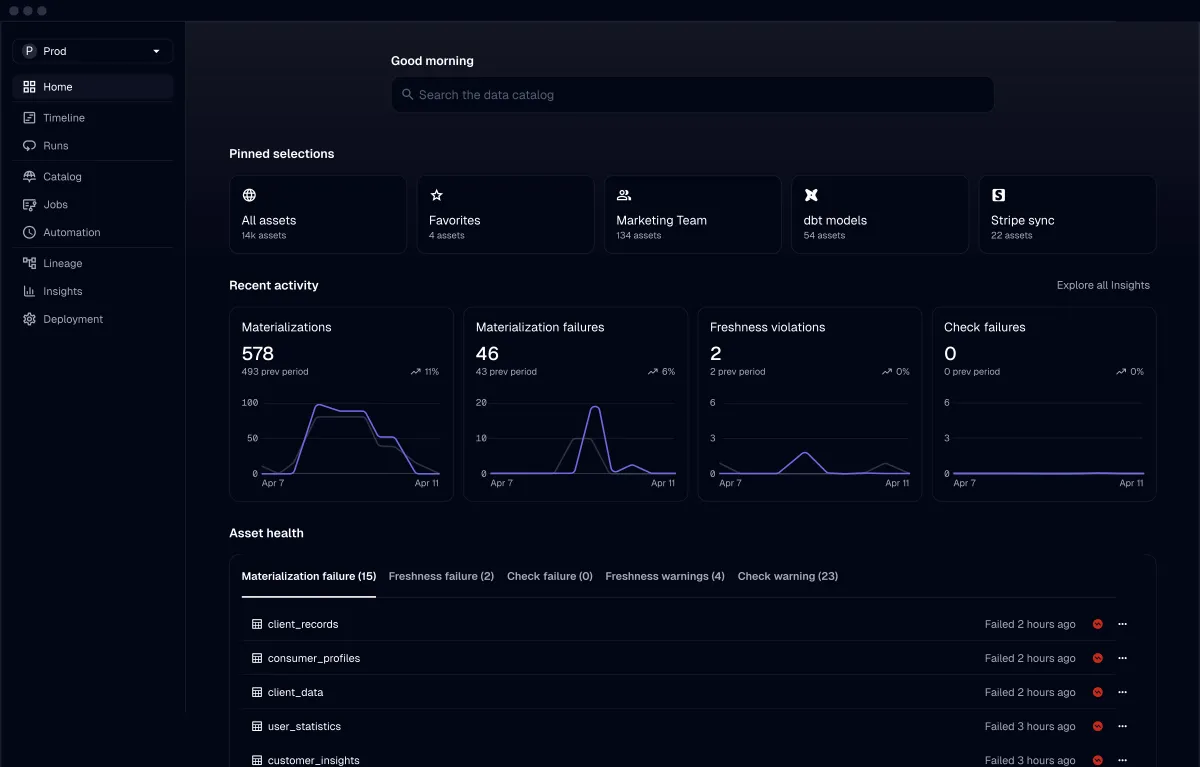
Feature Comparison
| Feature | Dagster | Portable |
|---|---|---|
| Data Orchestration | ||
| Pipeline Architecture | Asset-centric declarative orchestration with dependency graphs, partitioning, and incremental runs | Pre-built ELT connectors that move data from sources to warehouses without custom pipeline code |
| Workflow Scheduling | Built-in scheduler with automation policies, sensor-based triggers, and partition-aware scheduling | Managed scheduling with 24/7 monitoring and automatic error handling and recovery |
| Data Transformation | Orchestrates dbt, Databricks, and Python transformations within the asset graph for clean modeled data | Focuses on ELT data movement; transformations handled downstream in the warehouse |
| Integrations & Connectivity | ||
| Connector Library | Native integrations for Snowflake, BigQuery, dbt, Databricks, Fivetran, Spark, and Great Expectations | 1,500+ prebuilt ELT connectors covering common SaaS platforms, APIs, and long-tail data sources |
| Custom Integrations | Build custom integrations in Python using Dagster Pipes for external system observability and metadata tracking | In-house team researches, builds, and maintains custom connectors for customers in days |
| API & Extensibility | Full Python SDK with modular reusable components, declarative workflows, and CI/CD-native development | Developer API and webhooks for programmatic control and integration with existing workflows |
| Observability & Monitoring | ||
| Data Lineage | Built-in lineage graphs with auto-generated documentation, asset ownership tracking, and dependency visualization | Workflow notifications and monitoring for pipeline status and connector health |
| Data Quality | Embedded data quality with built-in validation, automated testing, freshness checks, and partitioned asset checks | Error handling and recovery with proactive 24/7 monitoring by dedicated support engineers |
| Cost Tracking | Cost transparency features that surface resource utilization insights and operational expense monitoring | Fixed-fee pricing model eliminates cost tracking complexity with predictable monthly bills |
| Security & Governance | ||
| Authentication | SSO with SCIM provisioning supporting Google, GitHub, and SAML identity providers | Single sign-on (SSO) and multi-factor authentication (MFA) for secure access |
| Access Control | Role-based access control (RBAC) with multi-tenant instances and code isolation between deployments | Role-based access control (RBAC) for managing team permissions and data access |
| Compliance | SOC 2 Type II and HIPAA certified with audit logs, retention policies, and custom security questionnaires | Enterprise-grade security features with dedicated technical support for large organizations |
| Developer Experience | ||
| Development Workflow | Local development with unit testing, CI integration, branch deployments, and staging environments | No-code setup with fully managed connectors requiring zero engineering maintenance |
| Learning Curve | Dagster University courses, comprehensive documentation, active Slack community, and YouTube resources | Minimal learning curve with managed service model and direct access to support engineers |
| Open Source | Open-source core under Apache-2.0 license with 16,000+ GitHub stars and active community contributions | Closed-source commercial platform with proprietary connector library and managed service |
Data Orchestration
Pipeline Architecture
Workflow Scheduling
Data Transformation
Integrations & Connectivity
Connector Library
Custom Integrations
API & Extensibility
Observability & Monitoring
Data Lineage
Data Quality
Cost Tracking
Security & Governance
Authentication
Access Control
Compliance
Developer Experience
Development Workflow
Learning Curve
Open Source
How they fit together
Dagster is a developer-centric orchestration platform for teams that need full control over complex data pipelines, while Portable is a managed ELT service that eliminates connector engineering entirely through its 1,500+ prebuilt integrations and hands-on support model.
What each one handles
Use Dagster for:
Choose Dagster if your team has Python-proficient data engineers who need to build and orchestrate complex, multi-step data pipelines with full observability and lineage tracking. Dagster excels when you need asset-centric orchestration across ETL/ELT, dbt transformations, and ML workflows. The open-source core with 15,348 GitHub stars provides flexibility and avoids vendor lock-in, while the managed Dagster Cloud offers Solo plans starting at $10/mo for focused teams scaling up to enterprise deployments with SOC 2 Type II and HIPAA compliance.
Use Portable for:
Choose Portable if your team needs to connect a large number of data sources to your warehouse without dedicating engineering resources to building and maintaining connectors. Portable stands out with 1,500+ prebuilt ELT connectors and an in-house team that builds custom connectors in days. The fully managed service with 24/7 proactive monitoring means zero pipeline maintenance overhead. At $1,800/mo for the Standard plan and $2,800/mo for Pro, Portable delivers predictable fixed-fee pricing that eliminates surprise costs as your data volume grows.
These roles reflect the available product evidence. Most teams run both; which one owns a given job depends on your stack and team.
Frequently Asked Questions
What is the main difference between Dagster and Portable?
Dagster is an open-source data orchestration platform that treats pipelines as collections of data assets, giving engineering teams full control over pipeline logic, scheduling, lineage, and observability using Python code. Portable is a managed no-code ELT service with 1,500+ prebuilt connectors that handles data movement from sources to warehouses without requiring engineering resources. Dagster is built for teams that need custom orchestration across ETL, dbt, and ML workflows, while Portable serves teams that primarily need turnkey data integration with hands-on support.
How do Dagster and Portable compare on pricing?
Dagster offers an open-source self-hosted option under the Apache-2.0 license at no cost, with managed Dagster Cloud plans starting at $10/mo for Solo, $100/mo for Starter, and custom pricing for Pro and Enterprise tiers. Portable uses a fixed-fee pricing model with Standard at $1,800/mo and Pro at $2,800/mo. Dagster provides a lower entry point but requires engineering effort for self-hosting, while Portable includes fully managed infrastructure and support in its pricing, making total cost of ownership dependent on your team's engineering capacity.
Can Dagster and Portable be used together?
Yes, Dagster and Portable can complement each other in a data stack. Portable can handle the ELT layer by moving data from hundreds of sources into your warehouse using its 1,500+ prebuilt connectors, while Dagster orchestrates the downstream transformations, data quality checks, and ML workflows as part of its asset graph. Dagster natively integrates with tools like Fivetran for similar connector-based ingestion, so using Portable for ingestion and Dagster for orchestration is a viable architecture for teams that want broad connector coverage with sophisticated pipeline control.
Which tool is better for a small data team without dedicated data engineers?
Portable is the stronger choice for small teams without dedicated data engineers. Its no-code platform with 1,500+ prebuilt connectors eliminates the need for Python development, and the in-house team builds and maintains custom connectors on your behalf. The 24/7 proactive monitoring and direct access to support engineers means pipeline issues get resolved without internal engineering effort. Dagster, while powerful, requires Python proficiency and data engineering expertise to build and maintain pipelines effectively, making it better suited for teams with existing engineering capacity.