Decision comparison
Dagster vs Prefect
Choose Dagster when your central problem is governing and operating data assets: lineage, partitions, quality signals, dbt/warehouse integration, and a data-platform control plane are core to its model. Choose Prefect when a Python team wants to productionize existing functions quickly through flows, tasks, dynamic execution, retries, and managed or hybrid workers without adopting an asset-first design.
Direct comparison. These are reviewed substitutes bought for the same job, so the differences below are the ones that decide between them.
All 2 are workflow orchestrators.
Quick Comparison
| Decision factor | Dagster | Prefect |
|---|---|---|
| Best For | Teams managing data assets, dbt transformations, warehouse pipelines, and ML workloads requiring lineage, partitioning, testing, and governed operations. | Python teams turning existing functions into resilient ETL, ELT, automation, and ML workflows with dynamic execution, retries, and hybrid workers. |
| Architecture | Asset-centric Python orchestration control plane modeling data products, dependencies, lineage, partitions, and materializations across existing compute and storage systems. | Python-native flows and tasks use a dynamic DAG engine, with self-hosted or Cloud control planes coordinating hybrid execution infrastructure. |
| Pricing Model | Open-source self-hosted free (Apache-2.0), Solo Plan $10/mo, Starter Plan $100/mo, Starter $1200/mo, Pro and Enterprise Plan contact sales | Prefect is open source and self-hostable under Apache 2.0. Prefect Cloud Hobby is free forever, with 2 users, up to 5 deployments, 500 minutes of Prefect Serverless and 7-day run retention. Starter is $100/month for 3 users, up to 20 deployments and 75 hours of Serverless, on your own compute. Team is $100 per user per month for 4 to 8 users, up to 100 deployments and 225 hours of Serverless, with service accounts and a 24-hour audit log. Enterprise is custom. |
| Ease of Use | Developer-oriented local development and unit-testing workflow, with declarative assets that align pipeline definitions directly to produced datasets and lineage. | Turns Python functions into observable workflows with one decorator, minimizing rewrites for teams moving scripts into production automation. |
| Scalability | Deploy on a single server, Kubernetes, or Dagster Cloud; hybrid patterns keep execution infrastructure and data within your environment. | Managed Cloud provides autoscaling workers and a control plane; hybrid execution lets workloads run on infrastructure selected by the user. |
| Community/Support | Apache-2.0 project with 16,122 GitHub stars; Dagster+ offers enterprise support, SSO, RBAC, SCIM, audit logs, and compliance alignment. | Apache-2.0 project with 23,793 GitHub stars; Prefect Cloud provides enterprise authentication and managed production orchestration. |
Dagster
- Best For:
- Teams managing data assets, dbt transformations, warehouse pipelines, and ML workloads requiring lineage, partitioning, testing, and governed operations.
- Architecture:
- Asset-centric Python orchestration control plane modeling data products, dependencies, lineage, partitions, and materializations across existing compute and storage systems.
- Pricing Model:
- Open-source self-hosted free (Apache-2.0), Solo Plan $10/mo, Starter Plan $100/mo, Starter $1200/mo, Pro and Enterprise Plan contact sales
- Ease of Use:
- Developer-oriented local development and unit-testing workflow, with declarative assets that align pipeline definitions directly to produced datasets and lineage.
- Scalability:
- Deploy on a single server, Kubernetes, or Dagster Cloud; hybrid patterns keep execution infrastructure and data within your environment.
- Community/Support:
- Apache-2.0 project with 16,122 GitHub stars; Dagster+ offers enterprise support, SSO, RBAC, SCIM, audit logs, and compliance alignment.
Prefect
- Best For:
- Python teams turning existing functions into resilient ETL, ELT, automation, and ML workflows with dynamic execution, retries, and hybrid workers.
- Architecture:
- Python-native flows and tasks use a dynamic DAG engine, with self-hosted or Cloud control planes coordinating hybrid execution infrastructure.
- Pricing Model:
- Prefect is open source and self-hostable under Apache 2.0. Prefect Cloud Hobby is free forever, with 2 users, up to 5 deployments, 500 minutes of Prefect Serverless and 7-day run retention. Starter is $100/month for 3 users, up to 20 deployments and 75 hours of Serverless, on your own compute. Team is $100 per user per month for 4 to 8 users, up to 100 deployments and 225 hours of Serverless, with service accounts and a 24-hour audit log. Enterprise is custom.
- Ease of Use:
- Turns Python functions into observable workflows with one decorator, minimizing rewrites for teams moving scripts into production automation.
- Scalability:
- Managed Cloud provides autoscaling workers and a control plane; hybrid execution lets workloads run on infrastructure selected by the user.
- Community/Support:
- Apache-2.0 project with 23,793 GitHub stars; Prefect Cloud provides enterprise authentication and managed production orchestration.
Public signals
Verified factual signals only. Bars appear only for like-for-like metrics with five weekly assessments for every tool; missing evidence stays explicit. These signals do not establish enterprise adoption, product quality, or total cost.
| Metric | Dagster | Prefect |
|---|---|---|
| Docker Hub pulls(Developer adoption) | 6.2M | Not available |
| GitHub commits, 90d(Product adoption) | 265 | 394 |
| GitHub stars(Product adoption) | 16,000+ | 23,000+ |
| Search interest(Market interest) | 1 | 0 |
| Hacker News mentions, 90d(Community interest) | 3 | 1 |
| Product Hunt comments(Community interest) | 11 | 0 |
| Product Hunt rating(Community interest) | 5.0/5 | 5.0/5 |
| Product Hunt reviews(Community interest) | 1 | 3 |
| Product Hunt votes(Community interest) | 112 | 5 |
| PyPI weekly downloads(Product adoption) | 1.8M | 1.6M |
| Stack Overflow questions(Community interest) | 171 | 212 |
| Docker Hub pulls(Product adoption) | Not available | 224.6M |
As of September 21, 2026 — updated weekly.
Health & risk evidence
Observed public-source checks for mapped package versions and repositories.
Dagster
September 21, 2026Package vulnerabilities
PyPI · dagster@1.13.23
0 vulnerabilities
across 1 package
Repository security score
github.com/dagster-io/dagster
5.1/10
Prefect
September 21, 2026Package vulnerabilities
PyPI · prefect@3.8.6
0 vulnerabilities
across 1 package
Repository security score
github.com/PrefectHQ/prefect
6.9/10
Interface Preview
Dagster
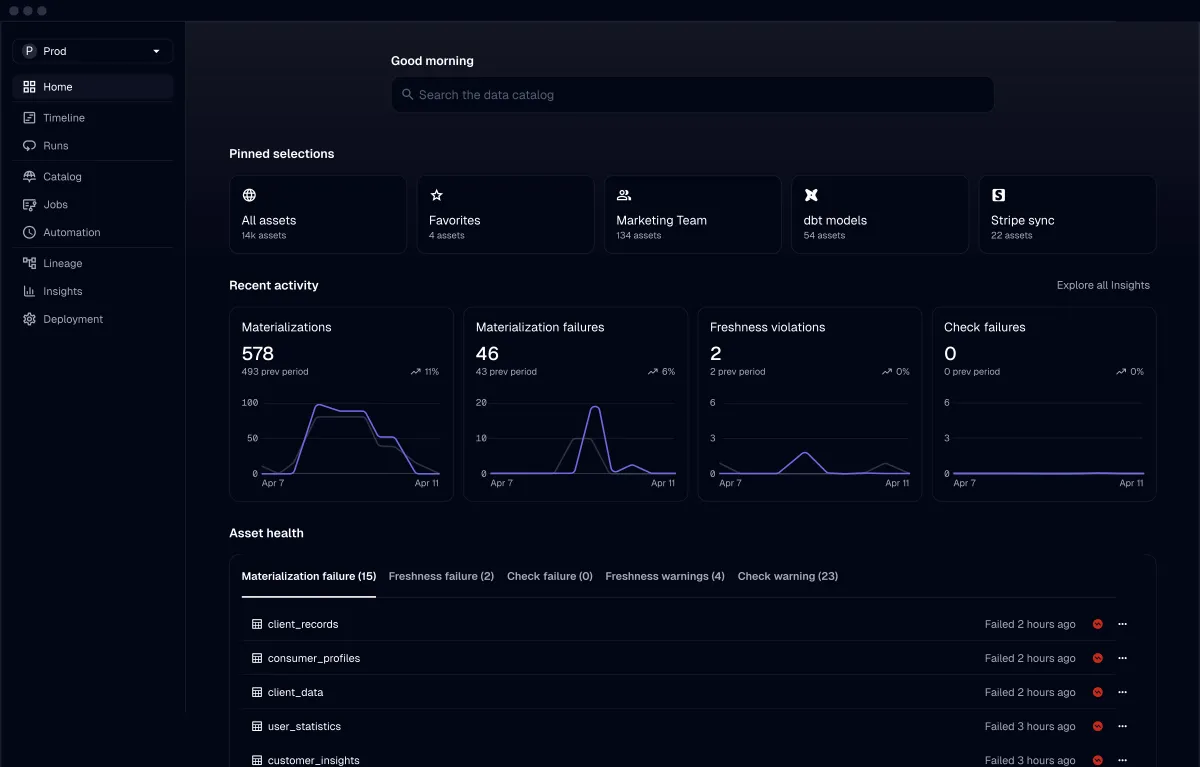
Prefect

Feature Comparison
| Feature | Dagster | Prefect |
|---|---|---|
| Orchestration model | ||
| Primary abstraction | Data assets model tables, datasets, models, and reports | Python flows and tasks wrap existing application functions |
| Dependency representation | Asset dependencies expose lineage between produced data products | Dynamic DAG engine coordinates task execution within flows |
| Operational focus | Keeps declared assets up-to-date at appropriate times | Builds resilient Python workflows with retries and automation |
| Data-platform capabilities | ||
| Lineage and metadata | Built-in lineage graphs, metadata, catalog, and asset health | Cloud observability helps debug workflow execution |
| Data quality | Health checks and Great Expectations integrations support data quality | Data-quality capability is not specified in provided information |
| Partitioning and versions | Asset versioning and partitioning are first-class concepts | Partitioning and asset versioning are not specified in provided information |
| Developer workflow | ||
| Programming interface | Python definitions declare functions and the assets they produce | One decorator turns a Python function into a workflow |
| Testing and delivery | Supports local development, unit tests, integration tests, and CI | No-rewrite Python workflow approach supports script-to-scale adoption |
| Reusable workflow design | Modular reusable components and declarative workflows support scale | Flows and tasks provide Python-native workflow composition |
| Integrations and workloads | ||
| Transformation integrations | Native integrations include dbt, Databricks, Spark, and Fivetran | Integrations include dbt, Kubernetes, and Docker |
| Warehouse and cloud data systems | Native connectors include Snowflake and BigQuery data workflows | Warehouse-specific integrations are not specified in provided information |
| AI and ML scope | Orchestrates AI, ML, data preparation, and model-training pipelines | Supports ML workflows; Horizon manages MCP server infrastructure |
| Deployment and governance | ||
| Deployment choices | Runs self-hosted, on Kubernetes, in Dagster Cloud, or hybrid | Runs self-hosted or through Cloud-managed orchestration |
| Execution infrastructure | Bring-your-own-infrastructure hybrid deployments retain data isolation | Hybrid execution model coordinates user-selected execution environments |
| Enterprise governance | SSO, RBAC, SCIM, audit logs, retention, and multi-tenancy | Cloud provides enterprise authentication; further governance details unspecified |
Orchestration model
Primary abstraction
Dependency representation
Operational focus
Data-platform capabilities
Lineage and metadata
Data quality
Partitioning and versions
Developer workflow
Programming interface
Testing and delivery
Reusable workflow design
Integrations and workloads
Transformation integrations
Warehouse and cloud data systems
AI and ML scope
Deployment and governance
Deployment choices
Execution infrastructure
Enterprise governance
Which to choose
Choose Dagster when your central problem is governing and operating data assets: lineage, partitions, quality signals, dbt/warehouse integration, and a data-platform control plane are core to its model. Choose Prefect when a Python team wants to productionize existing functions quickly through flows, tasks, dynamic execution, retries, and managed or hybrid workers without adopting an asset-first design.
Best-fit scenarios
Choose Dagster if:
Choose Dagster for analytics engineering and data-platform teams that need explicit asset lineage, asset health, partitions, versioning, dbt/Snowflake/BigQuery integrations, and rigorous local-to-CI testing. It is especially suitable when tables, models, reports, and ML datasets—not merely task runs—are the operational units that must be observed and governed.
Choose Prefect if:
Choose Prefect for Python-centric teams evolving scripts into production ETL, automation, or ML workflows. Its flow-and-task model is a strong fit when dynamic DAG behavior, retries, straightforward function decoration, Cloud-managed autoscaling workers, and hybrid execution matter more than maintaining a comprehensive asset catalog and lineage model.
These scenarios reflect the available product evidence. Your requirements, existing stack, and team expertise should guide the final decision.
Frequently Asked Questions
What is the main difference between Dagster and Prefect?
Dagster is designed around data assets: tables, datasets, machine-learning models, and reports are declared as the products of code, and their lineage, health, versions, partitions, and materializations are operational concerns. Prefect is designed around Python-native flows and tasks, using a dynamic DAG engine to run resilient workflows. Both can orchestrate ETL, ELT, and ML work, but Dagster centers data-product governance while Prefect centers flexible Python workflow automation.
Which is better for small teams?
For a small team with existing Python scripts, Prefect is often the more direct starting point because a Python function can become an observable workflow with one decorator and no stated rewrite requirement. Its self-hosted Apache-2.0 option also avoids an initial license cost. A small analytics or data-platform team may instead prefer Dagster when it already needs dbt orchestration, visible data lineage, partitioned assets, and testing practices that will remain important as its warehouse and reporting estate grows.
Can I migrate from Dagster to Prefect?
Yes, but it is an architectural migration rather than a configuration-only change. Dagster definitions organize work around assets and their dependencies, whereas Prefect organizes work around Python flows and tasks. You would typically reimplement asset materialization logic as Prefect tasks and flows, recreate schedules, retries, deployment configuration, and observability practices, and decide how to replace or externalize Dagster-specific asset lineage, partitioning, versioning, and health-check behavior. Shared Python transformation code may be reusable, but orchestration definitions generally need redesign.
What are the pricing differences?
Dagster provides an Apache-2.0 self-hosted option at no software license cost and publishes several paid prices: Solo is $10 per month, Starter Plan is $100 per month, and another Starter offering is listed at $1200 per month; Pro and Enterprise require a sales quote. Prefect also provides Apache-2.0 self-hosting at no software license cost. Its available data identifies Prefect Cloud and enterprise offerings as commercial, but supplies no public dollar amount, meter, or tier-by-tier rate, so those plans require vendor pricing discussion.