Decision comparison
Dagster vs Apache Spark
Dagster and Apache Spark operate at different layers of the modern data stack. Dagster orchestrates and observes data assets across your entire pipeline, while Spark provides the distributed compute engine for processing massive datasets. Many teams use both together, with Dagster orchestrating Spark jobs as part of larger data workflows.
Used together. These are normally used together rather than chosen between. The comparison explains what each one does in the stack.
These are different kinds of product — Workflow Orchestrator and Data Processing Engine.
Quick Comparison
| Decision factor | Dagster | Apache Spark |
|---|---|---|
| Primary Purpose | Asset-centric data orchestration with built-in lineage, observability, and dbt integration for modern pipelines | Unified analytics engine for large-scale batch and streaming data processing with built-in ML and SQL |
| Core Language | Python-based asset and pipeline definitions with native integrations for Snowflake, BigQuery, and Spark | Multi-language support including Python, Scala, Java, R, and SQL for distributed data processing |
| Pricing Model | Open-source self-hosted free (Apache-2.0), Solo Plan $10/mo, Starter Plan $100/mo, Starter $1200/mo, Pro and Enterprise Plan contact sales | Free and open-source under the Apache License |
| Learning Curve | Moderate; Python proficiency required, but asset-centric model reduces cognitive load versus task-based orchestrators | Steep; requires understanding of distributed computing, cluster management, and memory tuning for optimization |
| GitHub Stars | 15,348 stars with 15 topics including data-engineering, orchestration, mlops, and etl | 43,160 stars with active development in Scala, covering big-data, spark, sql, and python topics |
| Best For | Teams building observable, testable data platforms with asset lineage across ETL, dbt, ML, and AI workflows | Processing petabyte-scale datasets across distributed clusters for batch analytics, streaming, and machine learning |
Dagster
- Primary Purpose:
- Asset-centric data orchestration with built-in lineage, observability, and dbt integration for modern pipelines
- Core Language:
- Python-based asset and pipeline definitions with native integrations for Snowflake, BigQuery, and Spark
- Pricing Model:
- Open-source self-hosted free (Apache-2.0), Solo Plan $10/mo, Starter Plan $100/mo, Starter $1200/mo, Pro and Enterprise Plan contact sales
- Learning Curve:
- Moderate; Python proficiency required, but asset-centric model reduces cognitive load versus task-based orchestrators
- GitHub Stars:
- 15,348 stars with 15 topics including data-engineering, orchestration, mlops, and etl
- Best For:
- Teams building observable, testable data platforms with asset lineage across ETL, dbt, ML, and AI workflows
Apache Spark
- Primary Purpose:
- Unified analytics engine for large-scale batch and streaming data processing with built-in ML and SQL
- Core Language:
- Multi-language support including Python, Scala, Java, R, and SQL for distributed data processing
- Pricing Model:
- Free and open-source under the Apache License
- Learning Curve:
- Steep; requires understanding of distributed computing, cluster management, and memory tuning for optimization
- GitHub Stars:
- 43,160 stars with active development in Scala, covering big-data, spark, sql, and python topics
- Best For:
- Processing petabyte-scale datasets across distributed clusters for batch analytics, streaming, and machine learning
Public signals
Verified factual signals only. Bars appear only for like-for-like metrics with five weekly assessments for every tool; missing evidence stays explicit. These signals do not establish enterprise adoption, product quality, or total cost.
| Metric | Dagster | Apache Spark |
|---|---|---|
| Docker Hub pulls(Developer adoption) | 6.2M | Not available |
| GitHub commits, 90d(Product adoption) | 265 | 1.5k |
| GitHub stars(Product adoption) | 16,000+ | 44,000+ |
| Search interest(Market interest) | 1 | Not available |
| Hacker News mentions, 90d(Community interest) | 3 | 2 |
| Product Hunt comments(Community interest) | 11 | Not available |
| Product Hunt rating(Community interest) | 5.0/5 | Not available |
| Product Hunt reviews(Community interest) | 1 | Not available |
| Product Hunt votes(Community interest) | 112 | Not available |
| PyPI weekly downloads(Product adoption) | 1.8M | Not available |
| Stack Overflow questions(Community interest) | 171 | 82.5k |
| Docker Hub pulls(Product adoption) | Not available | 29.6M |
| PyPI weekly downloads(Developer adoption) | Not available | 11.1M |
As of September 21, 2026 — updated weekly.
Health & risk evidence
Observed public-source checks for mapped package versions and repositories.
Dagster
September 21, 2026Package vulnerabilities
PyPI · dagster@1.13.23
0 vulnerabilities
across 1 package
Repository security score
github.com/dagster-io/dagster
5.1/10
Apache Spark
Package vulnerabilities
PyPI · pyspark@4.2.0
0 vulnerabilities
across 1 package
Repository security score
github.com/apache/spark
5.6/10
Interface Preview
Dagster
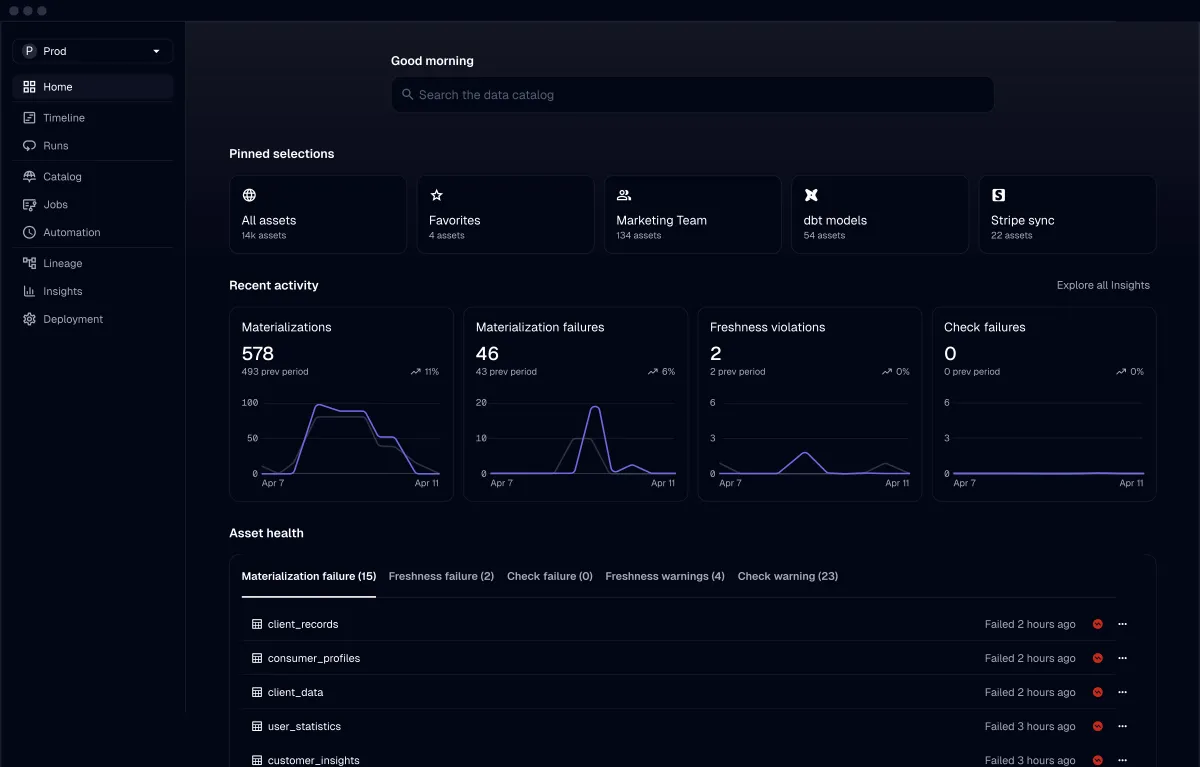
Feature Comparison
| Feature | Dagster | Apache Spark |
|---|---|---|
| Core Architecture | ||
| Processing Model | Asset-centric orchestration that models pipelines as collections of data assets with clear lineage and dependencies rather than just tasks | Distributed in-memory computing engine using Resilient Distributed Datasets (RDDs) that delivers up to 100x quick processing compared to Hadoop MapReduce |
| Execution Model | Declarative asset definitions with partitioning and versioning as first-class concepts; materializes assets on demand or on schedule | Lazy evaluation of transformations on DataFrames with Adaptive Query Execution that optimizes plans at runtime, including automatic reducer and join tuning |
| Deployment Options | Flexible deployment on single server, Kubernetes, or managed Dagster Cloud with hybrid bring-your-own-infrastructure patterns across North American and European regions | Runs on standalone clusters, Hadoop YARN, Kubernetes, or cloud-managed services; installable via pip install pyspark or official Docker images |
| Data Processing Capabilities | ||
| Batch Processing | Orchestrates batch ETL/ELT pipelines across external systems like Snowflake, BigQuery, dbt, and Databricks through native integrations and Dagster Pipes | Native distributed batch processing engine that reads CSV, JSON, Parquet, ORC, and Avro formats with Spark SQL for ANSI SQL queries against any size dataset |
| Stream Processing | Coordinates streaming workflows through integrations with external streaming systems; focuses on orchestrating rather than executing stream processing directly | Built-in Structured Streaming unifies batch and real-time processing using micro-batches from sources like Kafka and Kinesis in Python, Scala, Java, or R |
| Data Transformation | Orchestrates dbt, Databricks, or Python transformations to produce clean modeled data; delegates heavy computation to integrated processing engines | Native transformation engine with DataFrame API supporting select, filter, groupBy, aggregations, joins, and window functions at distributed scale |
| Observability and Governance | ||
| Data Lineage | Built-in data catalog with auto-generated documentation, clear ownership, lineage graphs, and cross-team data discovery integrated into the platform | No native lineage system; relies on external tools like Delta Lake for ACID transactions or third-party data catalogs for tracking data provenance |
| Monitoring and Alerting | Integrated monitoring with Slack alerts, AI-powered debugging, impact analysis, freshness tracking, cost visibility, and real-time health metrics dashboards | Spark UI provides job and stage monitoring with DAG visualization; deeper monitoring requires external tools like Grafana or Datadog for production clusters |
| Data Quality | Built-in validation, automated testing, freshness checks, and observability tools embedded directly into pipeline code to catch issues proactively | No native data quality framework; teams typically integrate Great Expectations, Deequ, or custom validation logic within Spark jobs |
| Machine Learning and AI | ||
| ML Capabilities | Orchestrates ML workflows including data prep, model training, and experiment tracking through integrations with MLflow, Databricks, and custom Python code | MLlib provides distributed machine learning algorithms for classification, regression, clustering, collaborative filtering, and dimensionality reduction at scale |
| AI Workflow Support | Positioned as a platform for AI and data pipelines with dedicated support for AI-driven data engineering and AI agent workflows in production | Serves as the compute backbone for AI/ML pipelines; trains models on laptops and scales the same code to fault-tolerant clusters of thousands of machines |
| Graph Processing | No native graph processing engine; focuses on orchestrating data assets and can coordinate graph workloads running in external systems | GraphX provides native graph-parallel computation for modeling, transforming, and analyzing complex data relationships at distributed scale |
| Enterprise and Security | ||
| Access Controls | SSO with Google, GitHub, and SAML identity providers plus RBAC and SCIM provisioning for granular role-based permissions across teams | Relies on external security frameworks like Kerberos, LDAP, and platform-level access controls from Hadoop, Kubernetes, or cloud provider IAM |
| Compliance and Audit | SOC 2 Type II and HIPAA certified with audit logs, retention policies, and a unified view of all user actions across the platform | No built-in compliance certifications; security and audit depend entirely on the deployment platform and surrounding infrastructure |
| Multi-tenancy | Multi-tenant instances with isolated code deployments keep data and code separated between teams or environments on Dagster Cloud | Multi-tenancy managed at the cluster level through resource pools, namespaces on Kubernetes, or workspace isolation on platforms like Databricks |
Core Architecture
Processing Model
Execution Model
Deployment Options
Data Processing Capabilities
Batch Processing
Stream Processing
Data Transformation
Observability and Governance
Data Lineage
Monitoring and Alerting
Data Quality
Machine Learning and AI
ML Capabilities
AI Workflow Support
Graph Processing
Enterprise and Security
Access Controls
Compliance and Audit
Multi-tenancy
How they fit together
Dagster and Apache Spark operate at different layers of the modern data stack. Dagster orchestrates and observes data assets across your entire pipeline, while Spark provides the distributed compute engine for processing massive datasets. Many teams use both together, with Dagster orchestrating Spark jobs as part of larger data workflows.
What each one handles
Use Dagster for:
We recommend Dagster for teams that need a unified control plane to orchestrate, monitor, and govern data pipelines spanning multiple systems. Dagster excels when your workflows involve coordinating dbt transformations, Snowflake or BigQuery loads, ML training runs, and AI applications into a single observable asset graph. Its built-in data catalog, lineage tracking, and quality validation reduce the operational burden of managing complex pipelines. The managed Dagster Cloud offering with SOC 2 Type II certification, RBAC, and multi-tenant isolation makes it particularly strong for enterprise teams that need governance without heavy infrastructure management. Starting at $10/mo for the Solo plan, teams can begin small and scale to the Pro or Enterprise tiers as their platform grows.
Use Apache Spark for:
We recommend Apache Spark for teams that need to process large-scale datasets at petabyte scale with distributed computing. Spark is the right choice when your primary challenge is raw data processing speed and volume, whether that means running batch ETL across terabytes of files, executing real-time streaming analytics via Structured Streaming, or training machine learning models with MLlib across thousands of nodes. Its multi-language support for Python, Scala, Java, R, and SQL gives flexibility to diverse engineering teams. As a fully free and open-source engine with 43,000+ GitHub stars and broad ecosystem integration, Spark is the industry standard compute engine used by 80% of the Fortune 500 for large-scale data analytics.
These roles reflect the available product evidence. Most teams run both; which one owns a given job depends on your stack and team.
Frequently Asked Questions
Can Dagster and Apache Spark be used together?
Dagster and Apache Spark work together naturally in production data platforms. Dagster lists Spark as one of its native integrations, allowing teams to orchestrate Spark jobs as data assets within their Dagster pipelines. With Dagster Pipes, you get first-class observability and metadata tracking for Spark jobs running in external systems like Databricks or standalone clusters. This combination gives teams the orchestration, lineage, and monitoring capabilities of Dagster while leveraging Spark's distributed compute power for heavy data processing workloads.
What are the main cost differences between Dagster and Apache Spark?
Apache Spark is entirely free and open-source under the Apache License with no commercial tiers. However, running Spark in production requires significant infrastructure investment for clusters, storage, and operational support. Dagster offers a free open-source self-hosted option under Apache-2.0, plus managed Dagster Cloud plans starting at $10/mo for the Solo plan (7,500 credits, 1 user), $100/mo for the Starter plan (30,000 credits, up to 3 users, catalog search), and Pro and Enterprise tiers with unlimited code locations and deployments at custom pricing. Both tools can run on your own infrastructure, but Dagster Cloud reduces operational overhead.
Which tool is better for machine learning workflows?
The tools serve different roles in ML workflows. Apache Spark provides MLlib with distributed algorithms for classification, regression, clustering, and collaborative filtering, making it the compute engine for training models at massive scale. Dagster orchestrates the end-to-end ML lifecycle, coordinating data preparation, model training runs on Spark or other engines, experiment tracking, and deployment. Teams focused on distributed model training at scale should use Spark's MLlib, while teams needing to manage the full ML pipeline with observability and scheduling should add Dagster as the orchestration layer.
How do Dagster and Apache Spark compare in terms of community and ecosystem?
Apache Spark has a sizable open-source community with 44,000+ GitHub stars, over 2,000 contributors, and adoption by 80% of the Fortune 500. It integrates broadly with data science frameworks, SQL analytics tools, and storage systems. Dagster has 16,000+ GitHub stars with an active community and native integrations for Snowflake, BigQuery, dbt, Databricks, Fivetran, Great Expectations, and Spark itself. Dagster's latest release is version 1.13.1, while Spark is written primarily in Scala with active development. Both projects are Apache-2.0 licensed and maintain active mailing lists, Slack communities, and documentation.