Decision comparison
Dagster vs Stitch
Dagster and Stitch serve fundamentally different roles in the data stack. Dagster is a full-featured data orchestration platform for teams that need to build, monitor, and govern complex data pipelines across multiple systems. Stitch is a managed ETL/ELT service focused specifically on data replication from sources to warehouses with minimal setup.
Used together. These are normally used together rather than chosen between. The comparison explains what each one does in the stack.
These are different kinds of product — Workflow Orchestrator and ELT Platform.
Quick Comparison
| Decision factor | Dagster | Stitch |
|---|---|---|
| Primary Use Case | Full data orchestration platform for ETL, dbt, ML, and AI pipeline workflows with asset-centric lineage | Managed cloud ETL/ELT service for replicating SaaS and database data into cloud warehouses |
| Pricing Entry Point | Open-source self-hosted free (Apache-2.0), Solo Plan $10/mo, Starter Plan $100/mo, Starter $1200/mo, Pro and Enterprise Plan contact sales | Standard starts at $100 per month, scaling with monthly row volume. Advanced $1,500 per month and Premium $3,000 per month, both shown as monthly figures but billed annually. A free trial is offered. |
| Deployment Model | Self-hosted on single server or Kubernetes, or fully managed Dagster Cloud with hybrid options | Fully managed cloud-only SaaS platform with no self-hosted deployment option available |
| Connector Ecosystem | Native integrations for Snowflake, BigQuery, dbt, Databricks, Fivetran, Spark, and Great Expectations | 130+ pre-built managed connectors plus extensibility through Singer open-source framework and Import API |
| Learning Curve | Steeper learning curve requiring Python proficiency and understanding of asset-centric orchestration concepts | Low barrier to entry with configure-once approach; no coding required for standard data replication tasks |
| Community & Support | 16,000+ GitHub stars, active open-source community, Slack group, Dagster University training courses available | Rated 8.4/10 from 17 user reviews; now part of Qlik with migration path to Qlik Talend Cloud |
Dagster
- Primary Use Case:
- Full data orchestration platform for ETL, dbt, ML, and AI pipeline workflows with asset-centric lineage
- Pricing Entry Point:
- Open-source self-hosted free (Apache-2.0), Solo Plan $10/mo, Starter Plan $100/mo, Starter $1200/mo, Pro and Enterprise Plan contact sales
- Deployment Model:
- Self-hosted on single server or Kubernetes, or fully managed Dagster Cloud with hybrid options
- Connector Ecosystem:
- Native integrations for Snowflake, BigQuery, dbt, Databricks, Fivetran, Spark, and Great Expectations
- Learning Curve:
- Steeper learning curve requiring Python proficiency and understanding of asset-centric orchestration concepts
- Community & Support:
- 16,000+ GitHub stars, active open-source community, Slack group, Dagster University training courses available
Stitch
- Primary Use Case:
- Managed cloud ETL/ELT service for replicating SaaS and database data into cloud warehouses
- Pricing Entry Point:
- Standard starts at $100 per month, scaling with monthly row volume. Advanced $1,500 per month and Premium $3,000 per month, both shown as monthly figures but billed annually. A free trial is offered.
- Deployment Model:
- Fully managed cloud-only SaaS platform with no self-hosted deployment option available
- Connector Ecosystem:
- 130+ pre-built managed connectors plus extensibility through Singer open-source framework and Import API
- Learning Curve:
- Low barrier to entry with configure-once approach; no coding required for standard data replication tasks
- Community & Support:
- Rated 8.4/10 from 17 user reviews; now part of Qlik with migration path to Qlik Talend Cloud
Public signals
Verified factual signals only. Bars appear only for like-for-like metrics with five weekly assessments for every tool; missing evidence stays explicit. These signals do not establish enterprise adoption, product quality, or total cost.
| Metric | Dagster | Stitch |
|---|---|---|
| Docker Hub pulls(Developer adoption) | 6.2M | Not available |
| GitHub commits, 90d(Product adoption) | 265 | Not available |
| GitHub stars(Product adoption) | 16,000+ | Not available |
| Search interest(Market interest) | 1 | 0 |
| Hacker News mentions, 90d(Community interest) | 3 | 0 |
| Product Hunt comments(Community interest) | 11 | Not available |
| Product Hunt rating(Community interest) | 5.0/5 | Not available |
| Product Hunt reviews(Community interest) | 1 | Not available |
| Product Hunt votes(Community interest) | 112 | Not available |
| PyPI weekly downloads(Product adoption) | 1.8M | Not available |
| Stack Overflow questions(Community interest) | 171 | Not available |
| GitHub commits, 90d(Developer adoption) | Not available | 2 |
| GitHub stars(Developer adoption) | Not available | 26 |
As of September 21, 2026 — updated weekly.
Health & risk evidence
Observed public-source checks for mapped package versions and repositories.
Dagster
September 21, 2026Package vulnerabilities
PyPI · dagster@1.13.23
0 vulnerabilities
across 1 package
Repository security score
github.com/dagster-io/dagster
5.1/10
Stitch
Package vulnerabilities
Not available
Repository security score
Not available
Interface Preview
Dagster
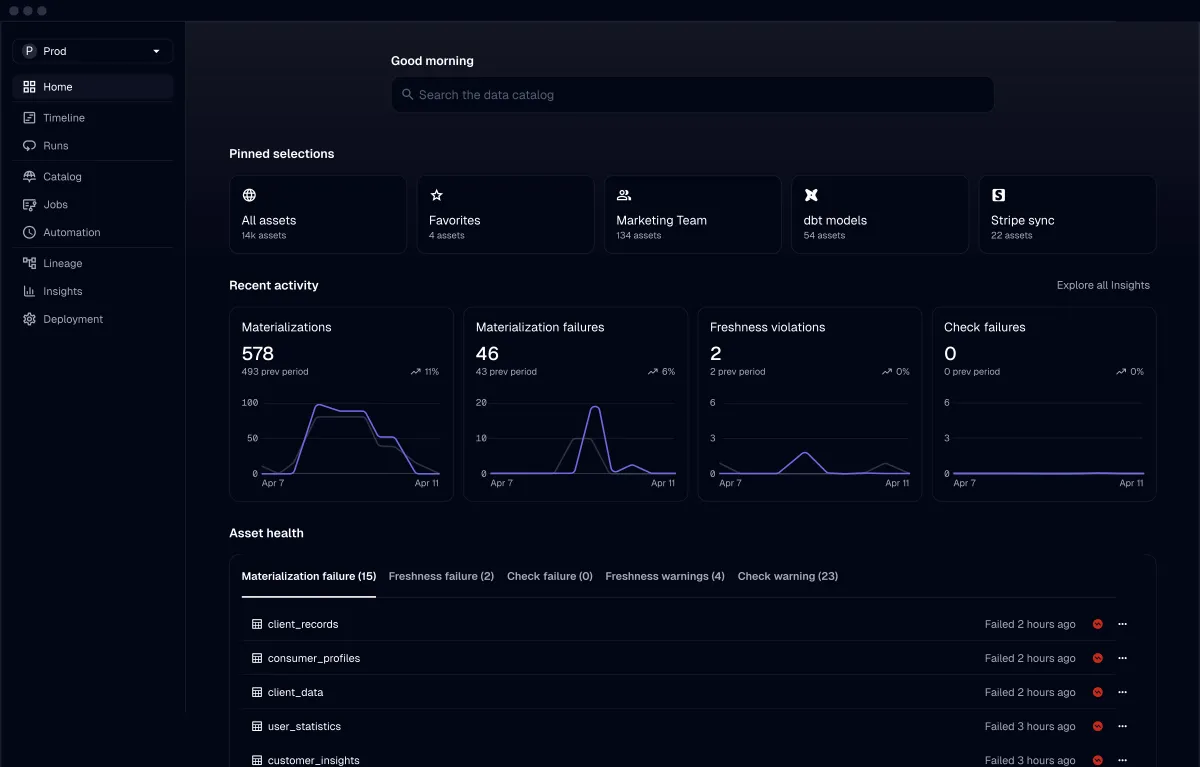
Feature Comparison
| Feature | Dagster | Stitch |
|---|---|---|
| Data Integration | ||
| Connector Library | Native integrations for Snowflake, BigQuery, dbt, Databricks, Fivetran, Spark, and Great Expectations with Dagster Pipes for external observability | 130+ pre-built managed connectors for SaaS apps and databases, extensible via Singer open-source framework and REST Import API |
| Data Replication | Orchestrates data movement through asset-centric pipelines with partitioning, incremental runs, and dependency-aware scheduling | Automated data replication from sources to warehouse destinations with upsert-based deduplication and incremental syncs |
| API Access | GraphQL API for programmatic access to pipeline status, asset metadata, and run management | REST Import API for pushing arbitrary data into warehouses, plus Connect API for pipeline automation |
| Orchestration & Scheduling | ||
| Pipeline Orchestration | Asset-centric orchestration with declarative workflows, dependency graphs, and intelligent materialization of data assets | Configure-once scheduling with monitoring UI for automated extraction pipelines on set intervals |
| Workflow Automation | Declarative automation with sensors, schedules, and auto-materialization policies for complex multi-step workflows | Post-load webhooks and advanced scheduling available on Standard plan and above for downstream triggering |
| Error Handling | Built-in fault tolerance with retry policies, run monitoring, and AI-powered debugging with impact analysis | Notification extensibility for pipeline alerts; users report error messages as a pain point in reviews |
| Observability & Governance | ||
| Data Lineage | Built-in asset lineage graphs showing dependencies, ownership, and auto-generated documentation across the entire pipeline | Source-to-destination tracking for individual integrations without cross-pipeline lineage visualization |
| Data Quality | Embedded data quality with built-in validation, automated testing, freshness checks, and partitioned asset checks | SOC 2 Type II and ISO 27001 compliance for pipeline security; transformation and quality features available as add-on |
| Monitoring & Alerting | Real-time health metrics tracking freshness, performance, costs, and reliability with Slack alerting integration | 7-day extraction log retention on Standard plan, 60-day on Advanced and Premium plans with notification extensibility |
| Security & Compliance | ||
| Authentication & Access Control | SSO with Google, GitHub, and SAML identity providers plus RBAC and SCIM provisioning on enterprise plans | 5 users on Standard plan, unlimited users on Advanced and Premium plans with role-based access |
| Compliance Certifications | SOC 2 Type II and HIPAA compliant with audit logs, retention policies, and custom security questionnaires | SOC 2 Type II and ISO 27001 compliance with HIPAA BAA signing available as add-on across all plans |
| Network Security | Hybrid deployments with bring-your-own-infrastructure, multi-tenant instances, and regional deployment options | Advanced connectivity with site-to-site VPN, AWS Private Link, reverse SSH tunnel, and VPC peering on paid plans |
| Developer Experience | ||
| Development Workflow | Python-first with local development, unit testing, CI/CD-native workflow, and branch deployments for staging | No-code configuration through web UI with Singer framework for custom tap development when needed |
| Extensibility | Open-source Apache-2.0 codebase with modular components, reusable assets, and community-contributed integrations | Singer open-source framework for building custom taps and targets with community-maintained integration library |
| Documentation & Learning | Comprehensive docs, Dagster University courses, tutorials, quickstart guides, and active Slack community | Getting started guides, API documentation, and Singer community Slack group for custom integration support |
Data Integration
Connector Library
Data Replication
API Access
Orchestration & Scheduling
Pipeline Orchestration
Workflow Automation
Error Handling
Observability & Governance
Data Lineage
Data Quality
Monitoring & Alerting
Security & Compliance
Authentication & Access Control
Compliance Certifications
Network Security
Developer Experience
Development Workflow
Extensibility
Documentation & Learning
How they fit together
Dagster and Stitch serve fundamentally different roles in the data stack. Dagster is a full-featured data orchestration platform for teams that need to build, monitor, and govern complex data pipelines across multiple systems. Stitch is a managed ETL/ELT service focused specifically on data replication from sources to warehouses with minimal setup.
What each one handles
Use Dagster for:
We recommend Dagster for data engineering teams that need a comprehensive orchestration platform to manage complex, multi-step data workflows. Dagster excels when your team works with dbt transformations, ML pipelines, or AI workflows and needs asset-centric lineage, built-in observability, and CI/CD-native development. The free open-source tier under Apache-2.0 with 15,348 GitHub stars makes it accessible for teams of any size, while managed Dagster+ plans starting at $10/month provide enterprise features without operational overhead.
Use Stitch for:
We recommend Stitch for teams that need a straightforward, managed data ingestion service to replicate SaaS and database data into cloud warehouses without writing code. Stitch delivers value when your primary goal is getting data from 130+ sources into a warehouse quickly with minimal engineering effort. The Standard plan at $100/month covers most small-to-mid-size workloads. Note that Stitch is now part of Qlik, and the platform is transitioning users to Qlik Talend Cloud, which should be factored into long-term planning decisions.
These roles reflect the available product evidence. Most teams run both; which one owns a given job depends on your stack and team.
Frequently Asked Questions
Can Dagster and Stitch be used together in the same data stack?
Yes, Dagster and Stitch complement each other effectively in a modern data stack. You can use Stitch as your managed data ingestion layer to replicate data from SaaS applications and databases into your warehouse, and then use Dagster to orchestrate downstream transformations, dbt runs, and ML workflows. Dagster includes a native Fivetran integration and can similarly orchestrate Stitch-like ingestion tools while providing asset lineage across the full pipeline. This combination gives you Stitch's simplicity for data ingestion with Dagster's orchestration power for everything after landing.
What are the main architectural differences between Dagster and Stitch?
Dagster uses an asset-centric architecture where pipelines are modeled as collections of data assets with explicit dependencies, versioning, and partitioning. It is open-source under Apache-2.0 and written in Python with 15,000+ GitHub stars. Stitch uses a Singer-based architecture focused on the tap-and-target pattern for extracting data from sources and loading it into destinations. Stitch runs entirely as a managed cloud service, while Dagster supports self-hosted deployment on Kubernetes or single servers, managed Dagster Cloud, and hybrid configurations.
How do Dagster and Stitch pricing models compare for growing teams?
Dagster offers a free open-source self-hosted option with no row limits or user caps, making it cost-effective for teams with engineering resources to manage infrastructure. Managed Dagster+ starts at $10/month for Solo, $100/month for Starter with up to 3 users, and $1,200/month for annual Starter plans. Stitch pricing is usage-based starting at $100/month for the Standard plan with 5-300 million rows and up to 5 users, scaling to $1,500/month for Advanced with unlimited users and $3,000/month for Premium with 1 billion rows. For high-volume workloads, Dagster's self-hosted option avoids per-row costs entirely.
Is Stitch still actively developed or should teams consider alternatives?
Stitch is now part of Qlik and the company is actively transitioning Stitch technology into Qlik Talend Cloud. The Stitch website states that they are building the best of their technology into Qlik Talend Cloud and encourages new users to try Qlik Talend Cloud instead. Existing Stitch customers can still log in with their credentials. For teams evaluating a new data ingestion tool, it is worth considering whether Qlik Talend Cloud or an alternative like Fivetran, Airbyte, or using Dagster with its native integrations provides a more stable long-term foundation.