Decision comparison
LocalAI vs MTPLX
For a self-hosted OpenAI/Anthropic-compatible endpoint spanning CPU machines, GPUs, multiple accelerators, and multimodal workloads, LocalAI is the appropriate fit. For a Mac-only local endpoint where Qwen performance, exact MTP speculative decoding, and coding-agent integration matter most, MTPLX is the appropriate fit; it stops being the right answer when distributed or non-Apple deployment is required.
Architecture choice. These take different approaches to the same problem. Read the table as a fit question rather than a feature race.
All 2 are model runtimes.
Quick Comparison
| Decision factor | LocalAI | MTPLX |
|---|---|---|
| Best For | Teams needing one self-hosted endpoint for text, vision, voice, image, video, 3D, and agent workloads across varied hardware. | Mac teams prioritizing fast local Qwen and compatible-model serving, coding agents, and exact speculative decoding on Apple Silicon. |
| Architecture | Go-based, self-hosted runtime exposing OpenAI, Anthropic, Ollama, and ElevenLabs-compatible APIs while delegating inference to composable backends. | Native macOS Apple Silicon application combining local chat, OpenAI/Anthropic-compatible serving, SSD session caching, and native MTP decoding. |
| Pricing Model | Free and MIT-licensed, with no paid tier. Every feature ships a CPU path first, so it runs on hardware you already own — down to a Raspberry Pi or Jetson — and GPU acceleration is optional. The whole cost is infrastructure, which for CPU-only deployments can be nothing new. | Open source under the Apache-2.0 license; source code at https://github.com/youssofal/mtplx. |
| Ease of Use | One binary and drop-in upstream API compatibility let existing clients generally switch by changing the endpoint URL and model configuration. | Native chat, live performance dashboard, file attachments, model libraries, and one-click launches for OpenCode, Pi, Hermes, and Open WebUI. |
| Scalability | Distributed mode provides VRAM-aware routing, autoscaling, multi-user authentication, and deployment from CPU-only devices through rooms of GPUs. | Optimizes a single Apple Silicon Mac through auto-tuned draft depth and SSD-restored sessions; distributed routing and autoscaling are not specified. |
| Community/Support | MIT GitHub project with 50,272 stars; latest release v4.12.1 and repository push recorded on 2026-11-09. | Apache-2.0 GitHub project with 2,691 stars; latest release v2.12.3 and repository push recorded on 2026-11-07. |
LocalAI
- Best For:
- Teams needing one self-hosted endpoint for text, vision, voice, image, video, 3D, and agent workloads across varied hardware.
- Architecture:
- Go-based, self-hosted runtime exposing OpenAI, Anthropic, Ollama, and ElevenLabs-compatible APIs while delegating inference to composable backends.
- Pricing Model:
- Free and MIT-licensed, with no paid tier. Every feature ships a CPU path first, so it runs on hardware you already own — down to a Raspberry Pi or Jetson — and GPU acceleration is optional. The whole cost is infrastructure, which for CPU-only deployments can be nothing new.
- Ease of Use:
- One binary and drop-in upstream API compatibility let existing clients generally switch by changing the endpoint URL and model configuration.
- Scalability:
- Distributed mode provides VRAM-aware routing, autoscaling, multi-user authentication, and deployment from CPU-only devices through rooms of GPUs.
- Community/Support:
- MIT GitHub project with 50,272 stars; latest release v4.12.1 and repository push recorded on 2026-11-09.
MTPLX
- Best For:
- Mac teams prioritizing fast local Qwen and compatible-model serving, coding agents, and exact speculative decoding on Apple Silicon.
- Architecture:
- Native macOS Apple Silicon application combining local chat, OpenAI/Anthropic-compatible serving, SSD session caching, and native MTP decoding.
- Pricing Model:
- Open source under the Apache-2.0 license; source code at https://github.com/youssofal/mtplx.
- Ease of Use:
- Native chat, live performance dashboard, file attachments, model libraries, and one-click launches for OpenCode, Pi, Hermes, and Open WebUI.
- Scalability:
- Optimizes a single Apple Silicon Mac through auto-tuned draft depth and SSD-restored sessions; distributed routing and autoscaling are not specified.
- Community/Support:
- Apache-2.0 GitHub project with 2,691 stars; latest release v2.12.3 and repository push recorded on 2026-11-07.
Public signals
Verified factual signals only. Bars appear only for like-for-like metrics with five weekly assessments for every tool; missing evidence stays explicit. These signals do not establish enterprise adoption, product quality, or total cost.
| Metric | LocalAI | MTPLX |
|---|---|---|
| Docker Hub pulls(Product adoption) | 10.7M | Not available |
| GitHub commits, 90d(Product adoption) | 2.5k | 1.5k |
| GitHub stars(Product adoption) | 50,000+ | 2,500+ |
| Search interest(Market interest) | 0 | Not available |
| Hacker News mentions, 90d(Community interest) | 3 | Not available |
| PyPI weekly downloads(Developer adoption) | Not available | 604 |
As of November 16, 2026 — updated weekly.
Health & risk evidence
Observed public-source checks for mapped package versions and repositories.
LocalAI
Package vulnerabilities
Not available
Repository security score
Not available
MTPLX
November 16, 2026Package vulnerabilities
PyPI · mtplx@2.12.3
0 vulnerabilities
across 1 package
Repository security score
Not available
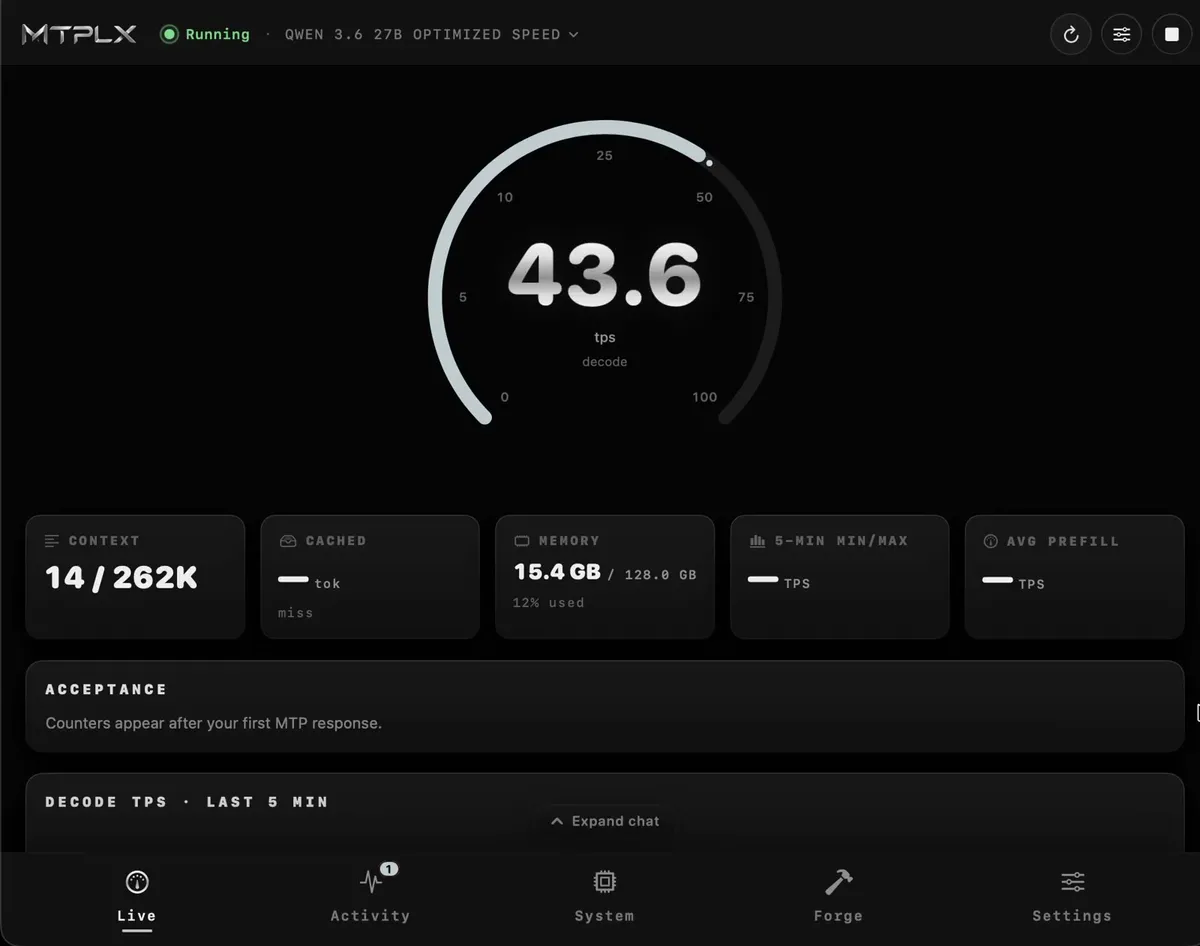
Interface Preview
LocalAI

MTPLX
Feature Comparison
| Feature | LocalAI | MTPLX |
|---|---|---|
| Hardware and deployment | ||
| Supported compute platforms | CPU-first x86_64, ARM64, Jetson, and Raspberry Pi execution with optional GPU accelerators | Native macOS 14+ application designed specifically for Apple Silicon Macs |
| Acceleration approach | Optional CUDA, ROCm, SYCL, Metal, and Vulkan acceleration behind interchangeable backends | Native MTP speculative decoding accelerates supported local models on Apple Silicon |
| Capacity deployment | Distributed mode routes requests by VRAM availability and supports autoscaling | Single-Mac-oriented serving with auto-tuned draft depth for each Mac |
| API and client compatibility | ||
| LLM API compatibility | Exposes OpenAI, Anthropic, and Ollama-compatible APIs from one self-hosted runtime | Provides OpenAI and Anthropic-compatible local server endpoints for local clients |
| Additional API compatibility | Also speaks ElevenLabs APIs and supports Realtime communication over WebRTC | Embeddings and reranking endpoints run alongside its compatible local LLM server |
| Existing-client migration | Existing upstream clients usually continue working after an endpoint URL change | OpenAI or Anthropic-compatible clients can target the local Mac server |
| Model execution | ||
| Inference backends | Composes llama.cpp, vLLM, MLX, whisper.cpp, stable-diffusion, and other backends | Runs Apple Silicon-native MTP execution for Qwen 3.8 and supported models |
| Speculative decoding quality | APEX quantisation compresses models while reporting throughput and perplexity trade-offs | Exact rejection sampling preserves output correctness at any temperature during MTP decoding |
| Model acquisition and organization | Model gallery offers over 1,200 models for one-click local deployment | Model libraries span multiple ordered folders for local model organization |
| Workload breadth and interfaces | ||
| Supported workload modalities | Runs text, voice, vision, image, video, 3D, and agent workloads | Focuses on local LLM chat, coding agents, embeddings, and reranking |
| Interactive user experience | Primarily supplies a unified self-hosted runtime and compatible API surface | Native chat includes thinking cards and file attachments for local conversations |
| External tool launch | Compatible API surface connects existing clients through configurable endpoint URLs | One-click launches connect OpenCode, Pi, Hermes, and Open WebUI |
| Operations and performance tooling | ||
| Authentication and multi-user controls | Distributed deployments include multi-user authentication and centralized runtime access | Multi-user authentication capabilities are not specified in the provided data |
| Performance visibility | APEX publications report compression, tokens-per-second, and perplexity trade-offs | Live dashboard displays tokens per second and speculative-decoding acceptance rates |
| Session persistence and evaluation | Runtime manages models and backends across local or distributed hardware deployments | SSD session cache restores sessions after restart; built-in runner executes AIME benchmarks |
Hardware and deployment
Supported compute platforms
Acceleration approach
Capacity deployment
API and client compatibility
LLM API compatibility
Additional API compatibility
Existing-client migration
Model execution
Inference backends
Speculative decoding quality
Model acquisition and organization
Workload breadth and interfaces
Supported workload modalities
Interactive user experience
External tool launch
Operations and performance tooling
Authentication and multi-user controls
Performance visibility
Session persistence and evaluation
Which approach fits
For a self-hosted OpenAI/Anthropic-compatible endpoint spanning CPU machines, GPUs, multiple accelerators, and multimodal workloads, LocalAI is the appropriate fit. For a Mac-only local endpoint where Qwen performance, exact MTP speculative decoding, and coding-agent integration matter most, MTPLX is the appropriate fit; it stops being the right answer when distributed or non-Apple deployment is required.
When each approach fits
Choose LocalAI if:
Choose LocalAI when your endpoint must run on x86_64, ARM64, Raspberry Pi, Jetson, or mixed GPU infrastructure; when you need multimodal generation; or when VRAM-aware distributed routing and autoscaling are requirements.
Choose MTPLX if:
Choose MTPLX when your team uses Apple Silicon Macs and needs maximum local throughput for supported Qwen models, exact MTP decoding, a native chat interface, or rapid OpenCode and Open WebUI setup.
These scenarios reflect the available product evidence. Your requirements, existing stack, and team expertise should guide the final decision.
Frequently Asked Questions
What is the main difference between LocalAI and MTPLX?
Both can provide a self-hosted OpenAI/Anthropic-compatible local endpoint, but they optimize for different operating environments. LocalAI is a broad, CPU-first runtime that can run across x86_64, ARM64, Jetson, Raspberry Pi, and optional CUDA, ROCm, SYCL, Metal, or Vulkan acceleration. It also covers vision, voice, images, video, 3D, and agents. MTPLX is a native macOS Apple Silicon product focused on fast local LLM execution, especially supported Qwen models, using exact native MTP speculative decoding.
Which is better for small teams?
A small team with mixed laptops, Linux servers, inexpensive CPU hosts, Raspberry Pis, or plans to add GPUs should generally choose LocalAI. Its one-binary deployment, broad compatibility layer, model gallery, and CPU-first design make it suitable when hardware diversity matters. A small team standardized on Apple Silicon Macs should generally choose MTPLX when local coding-agent workflows and performance on supported Qwen models are central. Its native chat, file attachments, dashboard, session cache, and one-click OpenCode or Open WebUI launch reduce local setup friction.
Can I migrate from LocalAI to MTPLX?
For an application using OpenAI-compatible or Anthropic-compatible requests, migration can be largely an endpoint and configuration change because both products expose those compatible local server interfaces. However, it is not a like-for-like infrastructure migration. MTPLX requires macOS 14+ on Apple Silicon and is designed around local LLM workflows and MTP-supported models. LocalAI-specific capabilities such as Ollama and ElevenLabs compatibility, WebRTC Realtime, multimodal backends, distributed VRAM-aware routing, and autoscaling need separate replacement or redesign.
What are the pricing differences?
Neither provided dataset lists a commercial subscription, usage charge, or dollar-denominated tier. LocalAI is MIT-licensed open source with no paid tier; self-hosting software is free, while the practical cost is the CPU, GPU, storage, power, and infrastructure that you operate. MTPLX is Apache-2.0 open source with source code published at its GitHub repository; no paid tier or public dollar rate is provided. Its self-hosted software is free, while users supply a compatible Apple Silicon Mac and associated operating costs.