Decision comparison
MTPLX vs Ollama
For a Mac-only coding-agent workstation where Qwen throughput and exact MTP speculative decoding decide the outcome, MTPLX is the focused choice. For teams that need Windows or Linux support, broad packaged model pulls, official SDKs, and an upgrade path to hosted capacity, Ollama is the operationally broader choice.
Direct comparison. These are reviewed substitutes bought for the same job, so the differences below are the ones that decide between them.
All 2 are model runtimes.
Quick Comparison
| Decision factor | MTPLX | Ollama |
|---|---|---|
| Best For | Mac-based coding agents needing maximum Qwen 3.8 or 27B local throughput, including 16 GB Apple Silicon machines. | Teams needing straightforward cross-platform local model serving, broad model choice, or optional hosted capacity for coding agents. |
| Architecture | Native macOS Apple Silicon application using MTP speculative decoding, with local OpenAI- and Anthropic-compatible serving and SSD session caching. | Self-hosted single-machine runtime that packages model weights and configuration into pulls, with local and optional hosted API serving. |
| Pricing Model | Open source under the Apache-2.0 license; source code at https://github.com/youssofal/mtplx. | The runtime is MIT-licensed and free; running models on your own hardware costs nothing beyond that hardware. Ollama's cloud models are paid for with usage credits at per-model rates per million tokens. Pay as you go is $0 with no subscription: you pay per token, with 3 concurrent requests. Pro is $20 per month, or $200 per year billed annually ($16.67 per month), with $60 of usage credits per month and 3 concurrent requests. Max is $100 per month with $300 of usage credits per month and 10 concurrent requests. Team (early access) is $500 per month with unlimited users, $1,000 of usage credits per month shared across the team, centralized billing and administration, and 10 concurrent requests. Enterprise is custom, with model access controls and cost budgets for users and API keys. Included credits reset monthly and do not roll over. Verified 2026-11-02 against https://ollama.com/pricing and https://github.com/ollama/ollama. |
| Ease of Use | Native chat, model libraries, automatic draft-depth tuning, dashboard, and one-click OpenCode, Pi, Hermes, or Open WebUI launches simplify setup. | Pull a packaged model and serve it through official SDKs or compatible APIs on macOS, Linux, Windows, CPU, or Docker. |
| Scalability | Optimized for one Apple Silicon Mac; restores SSD-cached sessions and serves embeddings, reranking, chat, and agents from one local server. | Primarily single-machine local serving; optional cloud capacity supports larger models, paid concurrency, and regions in US, Europe, and Singapore. |
| Community/Support | Open-source Python project with 2,691 GitHub stars; latest v2.12.3 release shipped November 6, 2026. | Open-source Go project with 186,450 GitHub stars; latest v0.40.15 release shipped November 3, 2026. |
MTPLX
- Best For:
- Mac-based coding agents needing maximum Qwen 3.8 or 27B local throughput, including 16 GB Apple Silicon machines.
- Architecture:
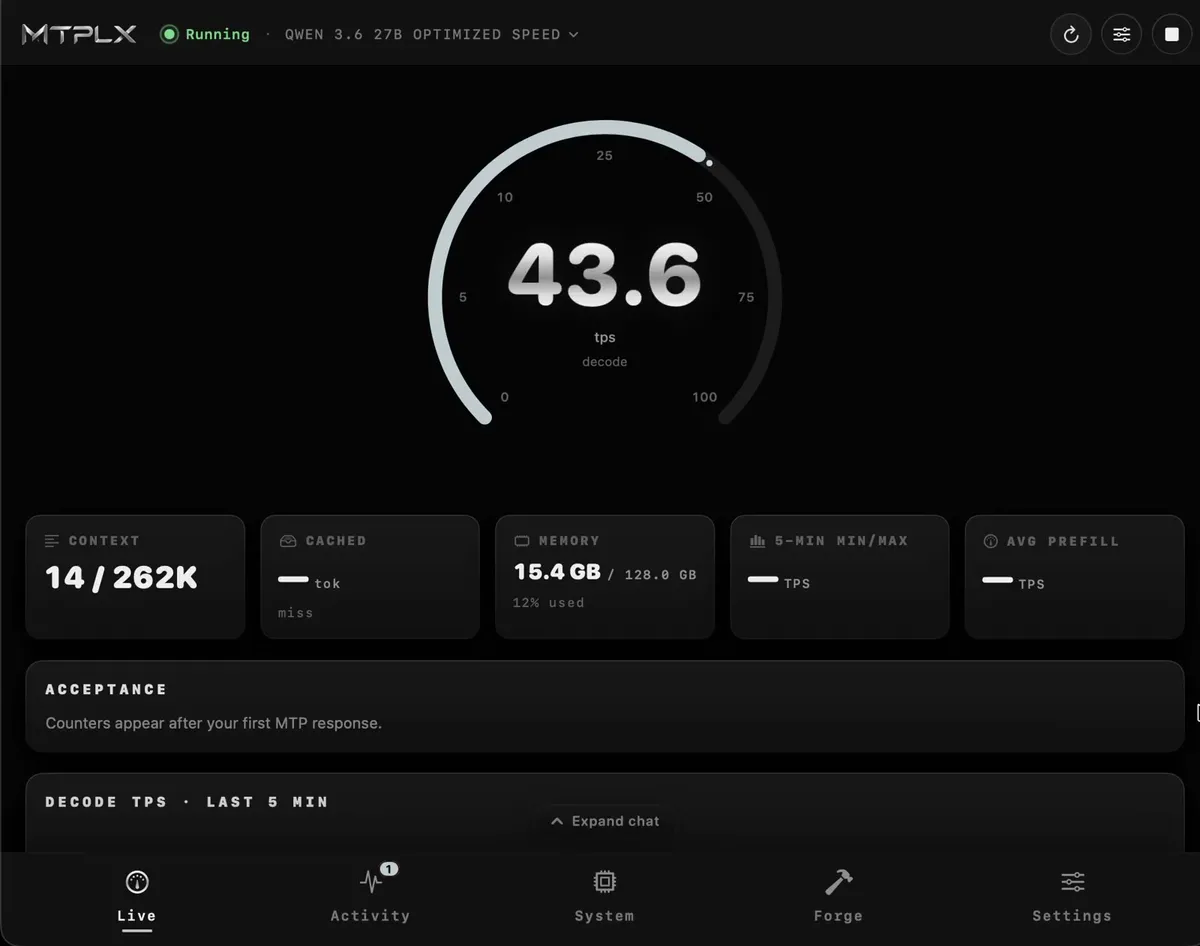
- Native macOS Apple Silicon application using MTP speculative decoding, with local OpenAI- and Anthropic-compatible serving and SSD session caching.
- Pricing Model:
- Open source under the Apache-2.0 license; source code at https://github.com/youssofal/mtplx.
- Ease of Use:
- Native chat, model libraries, automatic draft-depth tuning, dashboard, and one-click OpenCode, Pi, Hermes, or Open WebUI launches simplify setup.
- Scalability:
- Optimized for one Apple Silicon Mac; restores SSD-cached sessions and serves embeddings, reranking, chat, and agents from one local server.
- Community/Support:
- Open-source Python project with 2,691 GitHub stars; latest v2.12.3 release shipped November 6, 2026.
Ollama
- Best For:
- Teams needing straightforward cross-platform local model serving, broad model choice, or optional hosted capacity for coding agents.
- Architecture:
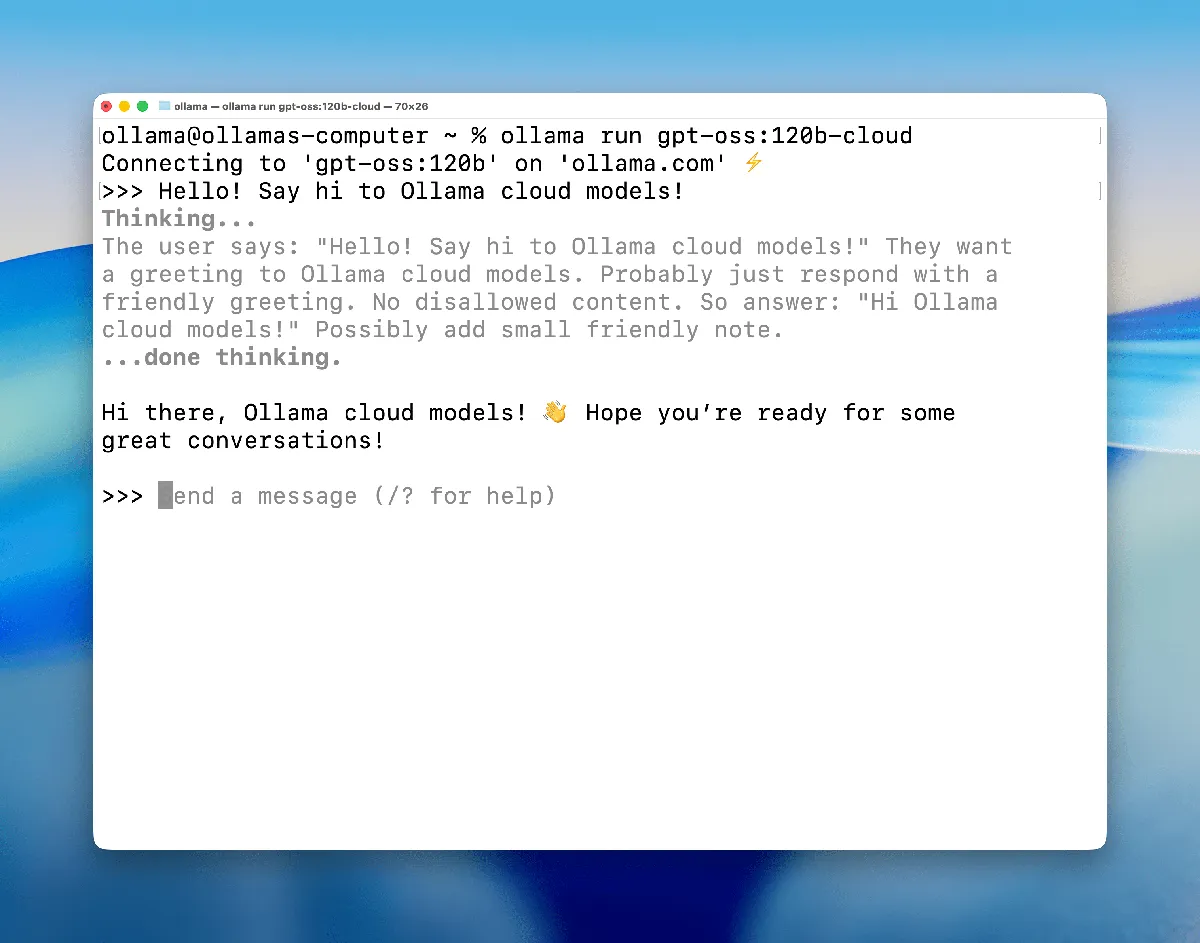
- Self-hosted single-machine runtime that packages model weights and configuration into pulls, with local and optional hosted API serving.
- Pricing Model:
- The runtime is MIT-licensed and free; running models on your own hardware costs nothing beyond that hardware. Ollama's cloud models are paid for with usage credits at per-model rates per million tokens. Pay as you go is $0 with no subscription: you pay per token, with 3 concurrent requests. Pro is $20 per month, or $200 per year billed annually ($16.67 per month), with $60 of usage credits per month and 3 concurrent requests. Max is $100 per month with $300 of usage credits per month and 10 concurrent requests. Team (early access) is $500 per month with unlimited users, $1,000 of usage credits per month shared across the team, centralized billing and administration, and 10 concurrent requests. Enterprise is custom, with model access controls and cost budgets for users and API keys. Included credits reset monthly and do not roll over. Verified 2026-11-02 against https://ollama.com/pricing and https://github.com/ollama/ollama.
- Ease of Use:
- Pull a packaged model and serve it through official SDKs or compatible APIs on macOS, Linux, Windows, CPU, or Docker.
- Scalability:
- Primarily single-machine local serving; optional cloud capacity supports larger models, paid concurrency, and regions in US, Europe, and Singapore.
- Community/Support:
- Open-source Go project with 186,450 GitHub stars; latest v0.40.15 release shipped November 3, 2026.
Public signals
Verified factual signals only. Bars appear only for like-for-like metrics with five weekly assessments for every tool; missing evidence stays explicit. These signals do not establish enterprise adoption, product quality, or total cost.
| Metric | MTPLX | Ollama |
|---|---|---|
| GitHub commits, 90d(Product adoption) | 1.5k | 356 |
| GitHub stars(Product adoption) | 2,500+ | 187,000+ |
| PyPI weekly downloads(Developer adoption) | 604 | Not available |
| Docker Hub pulls(Product adoption) | Not available | 201.3M |
| Search interest(Market interest) | Not available | 44 |
| Hacker News mentions, 90d(Community interest) | Not available | 91 |
| Stack Overflow questions(Community interest) | Not available | 259 |
As of November 16, 2026 — updated weekly.
Health & risk evidence
Observed public-source checks for mapped package versions and repositories.
MTPLX
November 16, 2026Package vulnerabilities
PyPI · mtplx@2.12.3
0 vulnerabilities
across 1 package
Repository security score
Not available
Ollama
Package vulnerabilities
Not available
Repository security score
Not available
Interface Preview
MTPLX
Ollama
Feature Comparison
| Feature | MTPLX | Ollama |
|---|---|---|
| Mac inference performance | ||
| Apple Silicon optimization | Native Apple Silicon application optimized for local Qwen inference | Runs locally on macOS alongside Linux, Windows, and Docker |
| Speculative decoding | Native MTP speculative decoding with exact rejection sampling | No native MTP speculative decoding described in provided data |
| Performance tuning | Auto-tune measures fastest draft depth for each Mac | Packages and serves models for simple single-machine operation |
| API and agent integration | ||
| OpenAI-compatible API | Local server exposes OpenAI-compatible endpoints for agents | Local runtime exposes OpenAI-compatible API endpoints |
| Anthropic-compatible API | Local server exposes Anthropic-compatible endpoints for clients | Supports Anthropic-compatible API endpoints for integrations |
| Coding-agent launchers | One-click launches OpenCode, Pi, Hermes, and Open WebUI | Connects open models to coding agents through APIs |
| Model and workload support | ||
| Model access | Uses model libraries across multiple ordered local folders | Pulls packaged open-weight chat, coding, vision, and reasoning models |
| Embedding and reranking | Serves embeddings and reranking endpoints from the same server | Local model library includes embedding models for retrieval workloads |
| Tool-oriented generation | Native chat supports thinking cards and file attachments | Supports tool calling, structured outputs, streaming, and thinking |
| Operations and observability | ||
| Performance visibility | Live dashboard reports tokens per second and acceptance rates | Cloud service advertises dedicated capacity for concurrent agent throughput |
| Session persistence | SSD session cache restores sessions across application restarts | No session-cache restoration feature described in provided data |
| Benchmarking | Built-in AIME runner benchmarks local model performance | No built-in benchmark runner described in provided data |
| Deployment and commercial options | ||
| Operating system coverage | Requires macOS 14 or later on Apple Silicon | Runs on macOS, Linux, Windows, and Docker environments |
| Hosted capacity | No hosted cloud offering described in provided data | Optional cloud serves models too large for local hardware |
| Cloud geography | No cloud deployment regions described in provided data | Hosted models available in US, Europe, and Singapore |
Mac inference performance
Apple Silicon optimization
Speculative decoding
Performance tuning
API and agent integration
OpenAI-compatible API
Anthropic-compatible API
Coding-agent launchers
Model and workload support
Model access
Embedding and reranking
Tool-oriented generation
Operations and observability
Performance visibility
Session persistence
Benchmarking
Deployment and commercial options
Operating system coverage
Hosted capacity
Cloud geography
Which to choose
For a Mac-only coding-agent workstation where Qwen throughput and exact MTP speculative decoding decide the outcome, MTPLX is the focused choice. For teams that need Windows or Linux support, broad packaged model pulls, official SDKs, and an upgrade path to hosted capacity, Ollama is the operationally broader choice.
Best-fit scenarios
Choose MTPLX if:
Choose MTPLX when developers run local coding agents on Apple Silicon and want native MTP acceleration, automatic tuning, exact output at any temperature, session restoration, and integrated OpenCode launching.
Choose Ollama if:
Choose Ollama when the team operates mixed macOS, Linux, Windows, CPU, or Docker machines; wants packaged model pulls and official SDKs; or needs paid cloud capacity for models beyond local hardware.
These scenarios reflect the available product evidence. Your requirements, existing stack, and team expertise should guide the final decision.
Frequently Asked Questions
What is the main difference between MTPLX and Ollama?
MTPLX is a Mac-focused local AI application built around Apple Silicon performance. Its defining capability is native MTP speculative decoding with exact rejection sampling, plus auto-tuning of draft depth per Mac. Ollama is a cross-platform self-hosted runtime that emphasizes pulling and serving packaged open-weight models on a single machine. It also offers optional cloud-hosted models, whereas the provided MTPLX information describes local macOS deployment.
Which is better for small teams?
A small team standardizing on Apple Silicon Macs and serving local Qwen-based coding agents should choose MTPLX when inference speed, native agent launchers, and local session persistence matter most. A small team with mixed developer operating systems should choose Ollama because it supports macOS, Linux, Windows, and Docker, offers official Python and JavaScript SDKs, and can move demanding workloads to hosted models without replacing its API integration.
Can I migrate from MTPLX to Ollama?
Yes, application migration is practical when clients use the OpenAI-compatible API both products expose; Ollama also provides Anthropic-compatible endpoints. You should still validate model names, model packaging, authentication, endpoint paths, tool-calling behavior, structured-output schemas, context settings, and performance expectations. MTPLX-specific capabilities such as MTP draft-depth auto-tuning, SSD session restoration, its live acceptance-rate dashboard, and one-click agent launchers do not automatically transfer to Ollama.
What are the pricing differences?
MTPLX is Apache-2.0 open source and free to self-host, with its source available on GitHub; the provided information does not list a paid hosted tier. Ollama's MIT-licensed local runtime is also free to run on your own hardware. Cloud model usage is billed per million tokens at the selected model’s input, cached-input and output rates. Cloud plans include Pro at $20 monthly with $60 monthly credits, Max at $100 with $300 credits, and Team at $500 with $1,000 shared credits.