Decision comparison
Monte Carlo vs Elementary
Monte Carlo and Elementary both deliver data observability but target different team profiles and use cases. Monte Carlo is the enterprise-grade platform built for organizations that need end-to-end AI and data observability with deep integrations across legacy and modern stacks. Elementary is the dbt-native control plane that unifies observability, quality, governance, and discovery for engineering teams that treat configuration as code.
Direct comparison. These are reviewed substitutes bought for the same job, so the differences below are the ones that decide between them.
All 2 are data observability.
Quick Comparison
| Decision factor | Monte Carlo | Elementary |
|---|---|---|
| Best For | Enterprise teams needing end-to-end data and AI observability across their entire data stack | dbt-native teams wanting code-first observability with integrated governance and discovery |
| Architecture | SaaS platform with deep integrations across ingestion, warehouses, BI, and AI agents | Unified control plane combining observability, quality, governance, and discovery with a shared context engine |
| Pricing Model | Monte Carlo publishes no amounts. Its tiers are Start, Scale, Enterprise and Business Critical, purchased as credits, and all are quote-only. Every tier includes agent, ML and data observability. | Elementary publishes no amounts. Its open-source dbt package is free and self-hosted. Elementary Cloud is priced by seats and environments: Scale covers up to 10 editor seats and 1K tables, Enterprise up to 20 editor and 40 viewer seats and 3K tables, and Unlimited removes the seat caps; extra tables are charged per additional 1K. A free trial covers the Essentials feature set. Every paid tier is quote-only. |
| Ease of Use | Fast out-of-the-box setup with automatic baseline monitoring and agentic monitor creation | dbt-native design with configuration as code; manages tests and metadata directly in dbt projects |
| Scalability | Enterprise-grade with unlimited users on Scale tier and above, up to 100K API calls per day | Scales from 5K to 15K+ tables with per-extra-1K pricing; Unlimited tier for large deployments |
| Community/Support | Expert-guided onboarding with 4-24 hour support SLAs depending on tier | Open-source dbt package with 2,000+ GitHub stars; dedicated CS engineer on Unlimited tier |
Monte Carlo
- Best For:
- Enterprise teams needing end-to-end data and AI observability across their entire data stack
- Architecture:
- SaaS platform with deep integrations across ingestion, warehouses, BI, and AI agents
- Pricing Model:
- Monte Carlo publishes no amounts. Its tiers are Start, Scale, Enterprise and Business Critical, purchased as credits, and all are quote-only. Every tier includes agent, ML and data observability.
- Ease of Use:
- Fast out-of-the-box setup with automatic baseline monitoring and agentic monitor creation
- Scalability:
- Enterprise-grade with unlimited users on Scale tier and above, up to 100K API calls per day
- Community/Support:
- Expert-guided onboarding with 4-24 hour support SLAs depending on tier
Elementary
- Best For:
- dbt-native teams wanting code-first observability with integrated governance and discovery
- Architecture:
- Unified control plane combining observability, quality, governance, and discovery with a shared context engine
- Pricing Model:
- Elementary publishes no amounts. Its open-source dbt package is free and self-hosted. Elementary Cloud is priced by seats and environments: Scale covers up to 10 editor seats and 1K tables, Enterprise up to 20 editor and 40 viewer seats and 3K tables, and Unlimited removes the seat caps; extra tables are charged per additional 1K. A free trial covers the Essentials feature set. Every paid tier is quote-only.
- Ease of Use:
- dbt-native design with configuration as code; manages tests and metadata directly in dbt projects
- Scalability:
- Scales from 5K to 15K+ tables with per-extra-1K pricing; Unlimited tier for large deployments
- Community/Support:
- Open-source dbt package with 2,000+ GitHub stars; dedicated CS engineer on Unlimited tier
Public signals
Verified factual signals only. Bars appear only for like-for-like metrics with five weekly assessments for every tool; missing evidence stays explicit. These signals do not establish enterprise adoption, product quality, or total cost.
| Metric | Monte Carlo | Elementary |
|---|---|---|
| GitHub commits, 90d(Developer adoption) | 231 | Not available |
| GitHub stars(Developer adoption) | 2 | Not available |
| Search interest(Market interest) | 0 | Unavailable |
| Hacker News mentions, 90d(Community interest) | 0 | Not available |
| PyPI weekly downloads(Developer adoption) | 41.2k | Not available |
| GitHub commits, 90d(Product adoption) | Not available | 19 |
| GitHub stars(Product adoption) | Not available | 2,000+ |
| PyPI weekly downloads(Product adoption) | Not available | 215.3k |
As of September 21, 2026 — updated weekly.
Health & risk evidence
Observed public-source checks for mapped package versions and repositories.
Monte Carlo
September 21, 2026Package vulnerabilities
PyPI · montecarlodata@0.175.0
0 vulnerabilities
across 1 package
Repository security score
Not available
Elementary
September 21, 2026Package vulnerabilities
PyPI · elementary-data@0.26.0
0 vulnerabilities
across 1 package
Repository security score
github.com/elementary-data/elementary
7.4/10
Interface Preview
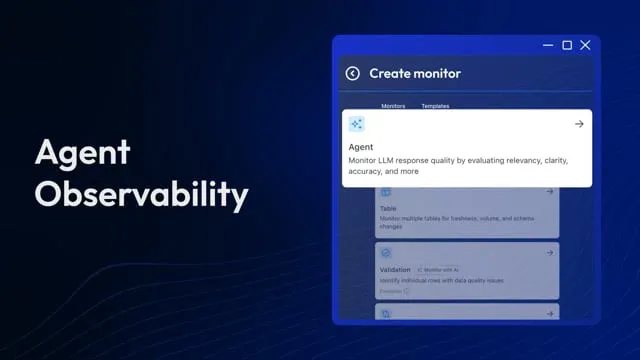
Monte Carlo
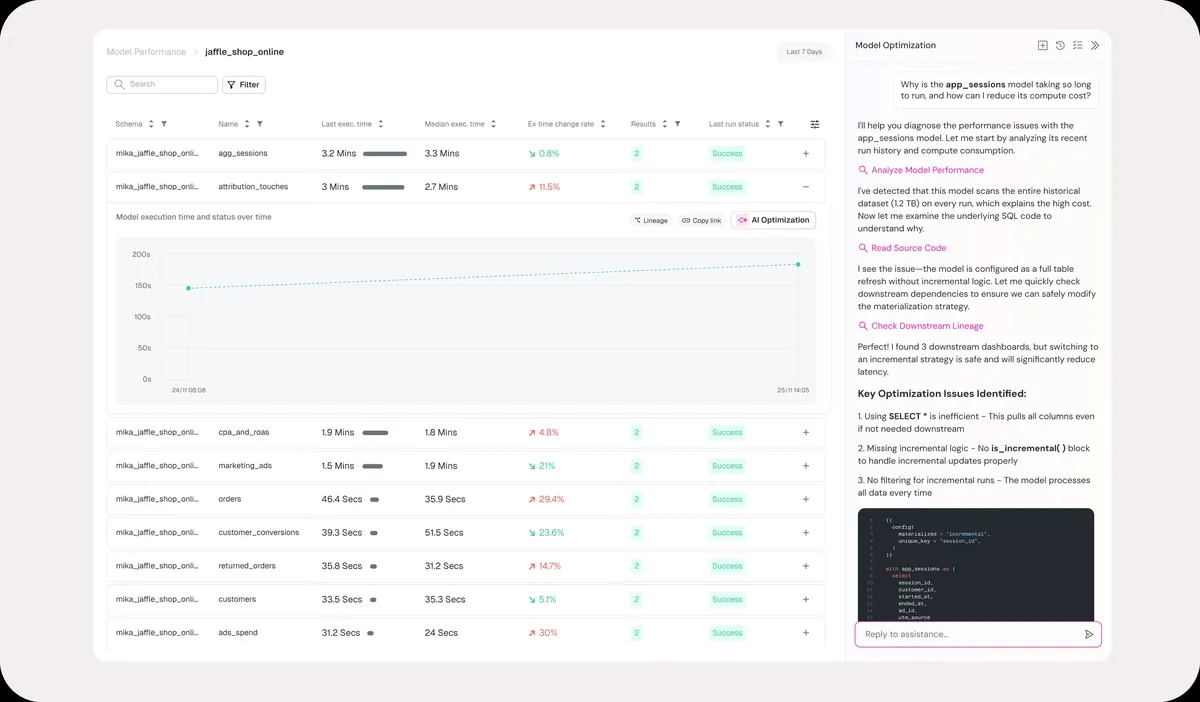
Elementary
Feature Comparison
| Feature | Monte Carlo | Elementary |
|---|---|---|
| Data Quality Monitoring | ||
| Anomaly Detection | ML-driven anomaly detection with automatic baselines for freshness, volume, and schema | Automated anomaly detection for nullness, distribution, dimensions, and completeness |
| Automated Monitors | Out-of-the-box monitors with AI-powered creation and agentic recommendations | Automated freshness, volume, and schema monitors activated without manual configuration |
| Alerting | Granular routing with automated lineage grouping and root-cause insights | Context-aware alerts routed by ownership and severity with incident grouping |
| Data Lineage | ||
| Lineage Scope | End-to-end column-level lineage across the full data and AI ecosystem | Column-level lineage from code to BI tools, enriched with test results across the DAG |
| Root Cause Analysis | Automated root cause analysis with agents and lineage-based context | Lineage-enriched incident tracking showing issue origin and downstream impact |
| Impact Analysis | Dashboard and downstream system impact assessment with BI layer monitoring | BI integration showing how each field is produced and what it impacts downstream |
| Developer Experience | ||
| Code-First Approach | YAML-based CI/CD, codeless UI, or AI-powered monitor creation | Configuration as code in dbt with version control, code review, and CI/CD integration |
| dbt Integration | Integrates with dbt as part of the broader data stack | dbt-native by design; dbt package integrates tests and artifacts directly |
| Data CI/CD | Monitor deployment during CI/CD with YAML configurations | PR-level data quality checks that prevent breaking changes before production |
| AI and Agent Capabilities | ||
| AI Observability | Dedicated agent observability monitoring AI inputs and outputs in production | AI agents for data validation, triage, metadata enrichment, and test coverage |
| MCP Server | No native MCP server support mentioned | MCP server exposing context layer, lineage, metadata, and health to any AI tool |
| Agentic Features | Monitoring agent plus fleet of agents for troubleshooting and root cause analysis | AI agents for quality validation, triage, metadata maintenance, and query optimization |
| Governance and Catalog | ||
| Data Catalog | Focused on observability; not a standalone catalog solution | Built-in catalog with definitions, ownership, tags, tests, usage, and health data |
| Data Governance | Enterprise security with SSO, SCIM, PII filtering, and audit logging | Policy enforcement for compliance and security with SSO and RBAC on Enterprise tier |
| Health Scores | Performance optimization and cost management insights | Data health scores measuring core quality dimensions across domains and teams |
Data Quality Monitoring
Anomaly Detection
Automated Monitors
Alerting
Data Lineage
Lineage Scope
Root Cause Analysis
Impact Analysis
Developer Experience
Code-First Approach
dbt Integration
Data CI/CD
AI and Agent Capabilities
AI Observability
MCP Server
Agentic Features
Governance and Catalog
Data Catalog
Data Governance
Health Scores
Which to choose
Monte Carlo and Elementary both deliver data observability but target different team profiles and use cases. Monte Carlo is the enterprise-grade platform built for organizations that need end-to-end AI and data observability with deep integrations across legacy and modern stacks. Elementary is the dbt-native control plane that unifies observability, quality, governance, and discovery for engineering teams that treat configuration as code.
Best-fit scenarios
Choose Monte Carlo if:
Enterprise teams needing end-to-end AI and data observability across complex, multi-system environments
Choose Elementary if:
dbt-native teams wanting code-first observability with integrated governance and data discovery
These scenarios reflect the available product evidence. Your requirements, existing stack, and team expertise should guide the final decision.
Frequently Asked Questions
What is the main difference between Monte Carlo and Elementary?
Monte Carlo is a commercial SaaS platform built for enterprise-wide data and AI observability across the entire data stack, from ingestion through AI agent outputs. Elementary is a dbt-native control plane that unifies observability, quality, governance, and discovery with a code-first approach. Monte Carlo focuses on breadth of integration and AI agent monitoring, while Elementary focuses on deep dbt integration and treating configuration as code.
How do Monte Carlo and Elementary compare on pricing?
Monte Carlo uses a credit-based consumption model across four tiers (Start, Scale, Enterprise, Business Critical), where you buy credits consumed based on monitors and API calls. Elementary uses seat and environment-based pricing across Scale (up to 10 editors, 5K tables), Enterprise (up to 20 editors, 10K tables with SSO and RBAC), and Unlimited (unlimited seats, 15K+ tables with dedicated CS engineer) tiers. Both require contacting sales for specific pricing.
Is Elementary open source?
Elementary has an open-source dbt package (Apache-2.0 license) with over 2,300 GitHub stars that provides automated anomaly detection, data lineage, and test results visualization directly in dbt projects. The Elementary Cloud platform adds premium features including AI agents, incident management, BI integrations, and a data catalog on top of the open-source foundation.
Which tool has better dbt support?
Elementary has the stronger dbt integration. It was built dbt-native from the ground up, with its core dbt package integrating tests and artifacts directly into the data warehouse. All configurations are managed in dbt code, enabling version control, code review, and CI/CD. Monte Carlo integrates with dbt as part of its broader data stack coverage but is not dbt-specific in its architecture.
Can Monte Carlo monitor AI agents in production?
Yes. Monte Carlo offers dedicated agent observability that monitors AI inputs and outputs from source to agent. This covers the full data and AI lifecycle including agent context, performance, behavior, and outputs. Companies like Axios use Monte Carlo's agent observability for full agent visibility integrated into their incident management workflow.