Decision comparison
Monte Carlo vs Select Star
Monte Carlo and Select Star address two distinct but equally important challenges in the modern data stack. Monte Carlo is the operational control plane for data reliability, deploying ML-driven anomaly detection, automated incident management, and agent observability to ensure your data and AI systems perform as expected. Select Star is the knowledge layer for data understanding, automatically cataloging assets, generating documentation, and building semantic models so every team member and AI tool can find, trust, and use data effectively. Organizations that suffer from frequent data incidents, pipeline failures, or unreliable AI outputs will get the most immediate value from Monte Carlo. Organizations that struggle with data silos, undocumented assets, or teams unable to find the right dataset will benefit most from Select Star.
Architecture choice. These take different approaches to the same problem. Read the table as a fit question rather than a feature race.
These are different kinds of product — Data Observability and Data Catalog.
Quick Comparison
| Decision factor | Monte Carlo | Select Star |
|---|---|---|
| Primary Focus | Data and AI observability with ML-driven anomaly detection and incident management | Automated data cataloging, lineage tracking, and semantic model generation for AI-ready data |
| AI Capabilities | Agent observability for production AI systems, monitoring agent, and agentic root cause analysis | AI-powered documentation generation, Ask AI for data questions, and MCP Server for LLM integration |
| Data Lineage | End-to-end column-level lineage for understanding data flow and dependency impact analysis | Column-level lineage automatically detected and displayed across the full data stack |
| Pricing Model | Monte Carlo publishes no amounts. Its tiers are Start, Scale, Enterprise and Business Critical, purchased as credits, and all are quote-only. Every tier includes agent, ML and data observability. | Free tier available. Starter plan at $300/user/month. Professional and Enterprise plans are quoted on request. |
| Integration Scope | Deep integrations from ingestion to consumption across warehouses, BI, ETL, and AI agent frameworks | One-click integrations with Snowflake, BigQuery, Redshift, Tableau, Looker, dbt, and Salesforce |
| Best For | Enterprise teams needing pipeline reliability, data quality monitoring, and AI agent observability | Data teams needing automated cataloging, data discovery, and semantic models for AI readiness |
Monte Carlo
- Primary Focus:
- Data and AI observability with ML-driven anomaly detection and incident management
- AI Capabilities:
- Agent observability for production AI systems, monitoring agent, and agentic root cause analysis
- Data Lineage:
- End-to-end column-level lineage for understanding data flow and dependency impact analysis
- Pricing Model:
- Monte Carlo publishes no amounts. Its tiers are Start, Scale, Enterprise and Business Critical, purchased as credits, and all are quote-only. Every tier includes agent, ML and data observability.
- Integration Scope:
- Deep integrations from ingestion to consumption across warehouses, BI, ETL, and AI agent frameworks
- Best For:
- Enterprise teams needing pipeline reliability, data quality monitoring, and AI agent observability
Select Star
- Primary Focus:
- Automated data cataloging, lineage tracking, and semantic model generation for AI-ready data
- AI Capabilities:
- AI-powered documentation generation, Ask AI for data questions, and MCP Server for LLM integration
- Data Lineage:
- Column-level lineage automatically detected and displayed across the full data stack
- Pricing Model:
- Free tier available. Starter plan at $300/user/month. Professional and Enterprise plans are quoted on request.
- Integration Scope:
- One-click integrations with Snowflake, BigQuery, Redshift, Tableau, Looker, dbt, and Salesforce
- Best For:
- Data teams needing automated cataloging, data discovery, and semantic models for AI readiness
Public signals
Verified factual signals only. Bars appear only for like-for-like metrics with five weekly assessments for every tool; missing evidence stays explicit. These signals do not establish enterprise adoption, product quality, or total cost.
| Metric | Monte Carlo | Select Star |
|---|---|---|
| GitHub commits, 90d(Developer adoption) | 231 | 0 |
| GitHub stars(Developer adoption) | 2 | 4 |
| Search interest(Market interest) | 0 | Unavailable |
| Hacker News mentions, 90d(Community interest) | 0 | Not available |
| PyPI weekly downloads(Developer adoption) | 41.2k | Not available |
| Product Hunt comments(Community interest) | Not available | 102 |
| Product Hunt reviews(Community interest) | Not available | 0 |
| Product Hunt votes(Community interest) | Not available | 196 |
As of September 21, 2026 — updated weekly.
Health & risk evidence
Observed public-source checks for mapped package versions and repositories.
Monte Carlo
September 21, 2026Package vulnerabilities
PyPI · montecarlodata@0.175.0
0 vulnerabilities
across 1 package
Repository security score
Not available
Select Star
September 21, 2026Package vulnerabilities
Not available
Repository security score
github.com/selectstar/dbt-impact-report-action
5.5/10
Interface Preview
Monte Carlo
Feature Comparison
| Feature | Monte Carlo | Select Star |
|---|---|---|
| Observability & Monitoring | ||
| Data Quality Monitoring | ML-driven anomaly detection with automatic baseline coverage for freshness, volume, and schema | Not a core capability; focused on metadata cataloging rather than active data monitoring |
| Incident Management | Built-in incident management with intelligent alerting, granular routing, and root cause analysis | Not offered; Select Star focuses on data discovery and documentation |
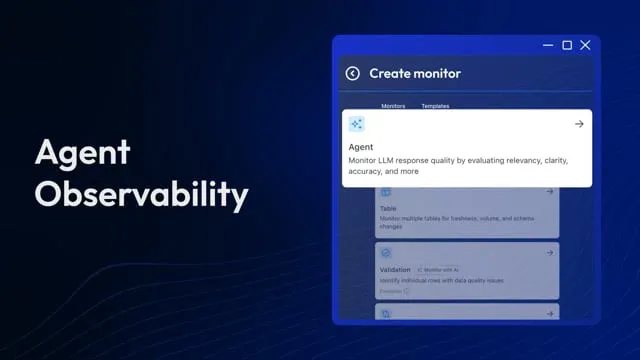
| AI Agent Observability | Full agent observability for monitoring AI inputs, outputs, context, performance, and behavior | Not a core capability; provides metadata to AI agents via MCP Server rather than monitoring them |
| Data Catalog & Discovery | ||
| Automated Data Catalog | Not a standalone data catalog; provides observability metadata and lineage views | Full automated catalog with Google-like search, data dictionary, business glossary, and popularity metrics |
| Data Documentation | Focused on observability dashboards and incident documentation | AI-powered auto-generated documentation with no manual setup required |
| Entity-Relationship Diagrams | Not offered as a standalone feature | Automatically inferred ERDs from SQL queries, joins, and existing primary and foreign keys |
| Lineage & Impact Analysis | ||
| Column-Level Lineage | End-to-end column-level lineage with visual lineage tracking across the data ecosystem | Automatically detected column-level lineage displayed across the full data stack |
| Impact Analysis | Comprehensive downstream impact analysis for data issues on systems and business processes | Lineage-based impact visibility showing downstream effects of upstream changes |
| Root Cause Analysis | Automated root cause analysis with enriched lineage data to understand why breaks happen | Not a core capability; lineage helps trace data flows but does not automate root cause detection |
| AI & Semantic Layer | ||
| MCP Server / API Access | API access available with tiered limits (10K, 50K, 100K calls/day depending on plan) | Dedicated MCP Server for Data providing metadata, lineage, and semantic models to LLMs and agents |
| Semantic Model Generation | Not offered; focused on observability rather than semantic modeling | Reverse-engineers BI dashboard logic to generate semantic models for Snowflake Cortex Analyst and other AI tools |
| AI-Powered Assistance | Monitoring agent that discovers and deploys monitors in minutes; agents for troubleshooting and RCA | Ask AI feature that auto-documents data and answers internal data questions on behalf of analysts |
| Security & Governance | ||
| Access Control | SSO, SCIM, self-hosted storage, PII filtering, and audit logging in Scale tier and above | Data access control with SOC 2 compliance covering security, confidentiality, and availability |
| Data Product Management | Unlimited data products and domains supported in Scale tier with Data Mesh support | Data product creation with adoption tracking and collaboration with data stewards and stakeholders |
| Enterprise Scalability | Multi-workspace support, enterprise cost attribution, and chargebacks in Enterprise tier | Proven accuracy and scale for millions of assets with enterprise SLA and dedicated support |
Observability & Monitoring
Data Quality Monitoring
Incident Management
AI Agent Observability
Data Catalog & Discovery
Automated Data Catalog
Data Documentation
Entity-Relationship Diagrams
Lineage & Impact Analysis
Column-Level Lineage
Impact Analysis
Root Cause Analysis
AI & Semantic Layer
MCP Server / API Access
Semantic Model Generation
AI-Powered Assistance
Security & Governance
Access Control
Data Product Management
Enterprise Scalability
Which approach fits
Monte Carlo and Select Star address two distinct but equally important challenges in the modern data stack. Monte Carlo is the operational control plane for data reliability, deploying ML-driven anomaly detection, automated incident management, and agent observability to ensure your data and AI systems perform as expected. Select Star is the knowledge layer for data understanding, automatically cataloging assets, generating documentation, and building semantic models so every team member and AI tool can find, trust, and use data effectively. Organizations that suffer from frequent data incidents, pipeline failures, or unreliable AI outputs will get the most immediate value from Monte Carlo. Organizations that struggle with data silos, undocumented assets, or teams unable to find the right dataset will benefit most from Select Star.
When each approach fits
Choose Monte Carlo if:
Choose Monte Carlo if your primary challenge is data reliability at scale. The platform delivers end-to-end observability across your entire data and AI ecosystem, with ML-driven anomaly detection that automatically baselines freshness, volume, and schema. Its agent observability capabilities make it particularly valuable for enterprises running AI agents in production, and its incident management workflow with intelligent alerting and root cause analysis has helped customers like JetBlue improve internal Data NPS by 16 points year over year. Monte Carlo is battle-tested in hundreds of production environments at companies including Nasdaq and Axios.
Choose Select Star if:
Choose Select Star if your primary challenge is data discovery and understanding. The platform delivers an automated catalog that indexes metadata, documents your data with AI, and surfaces the most relevant assets with context. Its MCP Server for Data and semantic model generation make it the stronger platform for organizations building AI-ready data infrastructure. Customers report saving 30+ hours on data troubleshooting, achieving 67% more efficient data asset cataloging, and identifying hundreds of unused tables for cleanup. Select Star's instant setup and one-click integrations with Snowflake, BigQuery, Redshift, Tableau, Looker, and dbt mean teams get value within hours.
These scenarios reflect the available product evidence. Your requirements, existing stack, and team expertise should guide the final decision.
Frequently Asked Questions
What is the main difference between Monte Carlo and Select Star?
Monte Carlo is a data and AI observability platform that monitors pipelines, detects anomalies, and manages incidents to keep data reliable. Select Star is an automated data catalog and lineage platform that helps teams find, document, and understand their data. Monte Carlo answers the question of whether your data is healthy and trustworthy in real time, while Select Star answers the question of where your data lives, what it means, and how it flows through your organization.
Can Monte Carlo and Select Star be used together?
Yes, the two platforms serve complementary roles in a modern data stack. Monte Carlo handles the operational side by monitoring data quality, detecting anomalies, and alerting teams to incidents. Select Star handles the knowledge side by cataloging metadata, documenting assets, and providing lineage context. Together, they give data teams both reliability assurance and discoverability across their data estate.
Which platform is better for making data AI-ready?
Both platforms support AI readiness but from different angles. Monte Carlo ensures the data feeding AI models and agents is reliable and trustworthy by monitoring inputs and outputs across the AI lifecycle. Select Star provides the semantic context that AI tools need through its MCP Server for Data, which gives LLMs access to metadata, lineage, and semantic models. If your concern is data quality for AI, Monte Carlo is the stronger choice. If your concern is giving AI agents context to reason about your data, Select Star is the better fit.
How does pricing compare between Monte Carlo and Select Star?
Monte Carlo uses a usage-based credit model across four tiers (Start, Scale, Enterprise, Business Critical), with pricing available on request. Select Star offers per-user pricing with a free tier, a Starter plan at $300/user/month, and Professional and Enterprise plans with custom pricing. Monte Carlo does not publish specific pricing figures.
Which tool has better data lineage capabilities?
Both platforms offer column-level lineage, but they use it for different purposes. Monte Carlo's lineage is deeply integrated into its observability workflow, powering root cause analysis, impact analysis, and incident triaging so teams can quickly understand which downstream dashboards and reports are affected by an issue. Select Star's lineage is the backbone of its catalog, enabling data discovery, change management, and cost optimization by showing exactly how data flows across systems. Monte Carlo's lineage is optimized for incident response; Select Star's lineage is optimized for data understanding.