Decision comparison
Prisma Cloud vs Orca Security
Both Prisma Cloud and Orca Security deliver enterprise-grade CNAPP capabilities, but they take fundamentally different architectural approaches that suit different organizational needs and operational priorities.
Direct comparison. These are reviewed substitutes bought for the same job, so the differences below are the ones that decide between them.
All 2 are cloud security platforms.
Quick Comparison
| Decision factor | Prisma Cloud | Orca Security |
|---|---|---|
| Deployment Model | Agent-based and agentless hybrid deployment with Prisma Cloud Defenders installed across hosts, containers, and serverless functions | Primarily agentless SideScanning technology with optional lightweight eBPF-based Orca Sensor for real-time runtime detection |
| Cloud Coverage | Supports AWS, Azure, GCP, Oracle Cloud, and Alibaba Cloud with deep integration across IaaS, PaaS, and container services | Covers AWS, Azure, GCP, and Alibaba Cloud with unified data model scanning all workloads including VMs, containers, and serverless |
| Security Capabilities | Full CNAPP suite combining CSPM, CWPP, CIEM, code security, and network security modules into one integrated platform | Comprehensive CNAPP with CSPM, CWPP, CIEM, shift-left security, AI security monitoring, and three types of reachability analysis |
| AI and Automation | Uses Palo Alto Networks Cortex AI for threat correlation, automated remediation playbooks, and intelligent alert grouping | Built-in Orca AI with AI-generated code fixes, AI Discovery, AI Assistant, and autonomous AI agents for triage and analysis |
| Compliance | Supports 100+ compliance frameworks including SOC 2, HIPAA, PCI-DSS, GDPR, and custom policy creation with auto-remediation | Checks against 200+ customizable compliance frameworks with automated report exporting and continuous compliance workflow triggers |
| Ease of Deployment | Requires agent deployment across workloads and careful module configuration; typical onboarding takes weeks with professional services | Three-step agentless onboarding connects cloud accounts and delivers full visibility within 24 hours with no agent installation required |
Prisma Cloud
- Deployment Model:
- Agent-based and agentless hybrid deployment with Prisma Cloud Defenders installed across hosts, containers, and serverless functions
- Cloud Coverage:
- Supports AWS, Azure, GCP, Oracle Cloud, and Alibaba Cloud with deep integration across IaaS, PaaS, and container services
- Security Capabilities:
- Full CNAPP suite combining CSPM, CWPP, CIEM, code security, and network security modules into one integrated platform
- AI and Automation:
- Uses Palo Alto Networks Cortex AI for threat correlation, automated remediation playbooks, and intelligent alert grouping
- Compliance:
- Supports 100+ compliance frameworks including SOC 2, HIPAA, PCI-DSS, GDPR, and custom policy creation with auto-remediation
- Ease of Deployment:
- Requires agent deployment across workloads and careful module configuration; typical onboarding takes weeks with professional services
Orca Security
- Deployment Model:
- Primarily agentless SideScanning technology with optional lightweight eBPF-based Orca Sensor for real-time runtime detection
- Cloud Coverage:
- Covers AWS, Azure, GCP, and Alibaba Cloud with unified data model scanning all workloads including VMs, containers, and serverless
- Security Capabilities:
- Comprehensive CNAPP with CSPM, CWPP, CIEM, shift-left security, AI security monitoring, and three types of reachability analysis
- AI and Automation:
- Built-in Orca AI with AI-generated code fixes, AI Discovery, AI Assistant, and autonomous AI agents for triage and analysis
- Compliance:
- Checks against 200+ customizable compliance frameworks with automated report exporting and continuous compliance workflow triggers
- Ease of Deployment:
- Three-step agentless onboarding connects cloud accounts and delivers full visibility within 24 hours with no agent installation required
Public signals
Verified factual signals only. Bars appear only for like-for-like metrics with five weekly assessments for every tool; missing evidence stays explicit. These signals do not establish enterprise adoption, product quality, or total cost.
| Metric | Prisma Cloud | Orca Security |
|---|---|---|
| Search interest(Market interest) | 0 | 0 |
| Hacker News mentions, 90d(Community interest) | 0 | 0 |
| GitHub commits, 90d(Developer adoption) | Not available | 0 |
| GitHub stars(Developer adoption) | Not available | 14 |
As of September 14, 2026 — updated weekly.
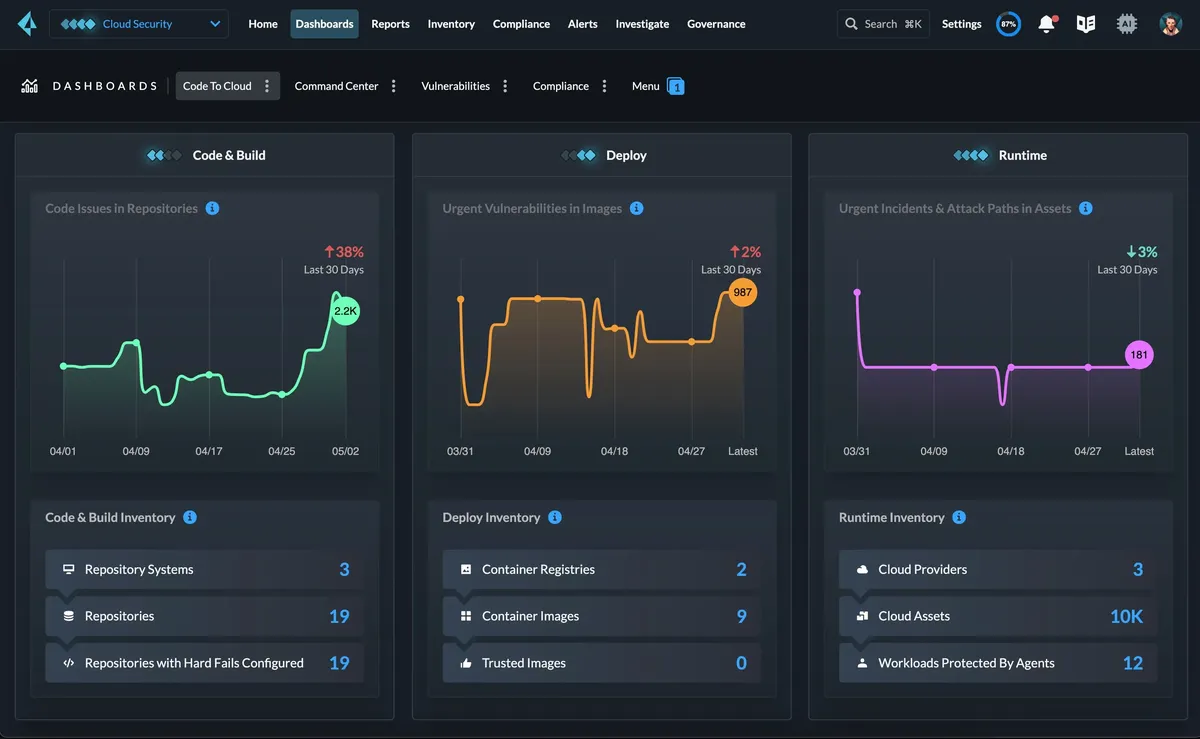
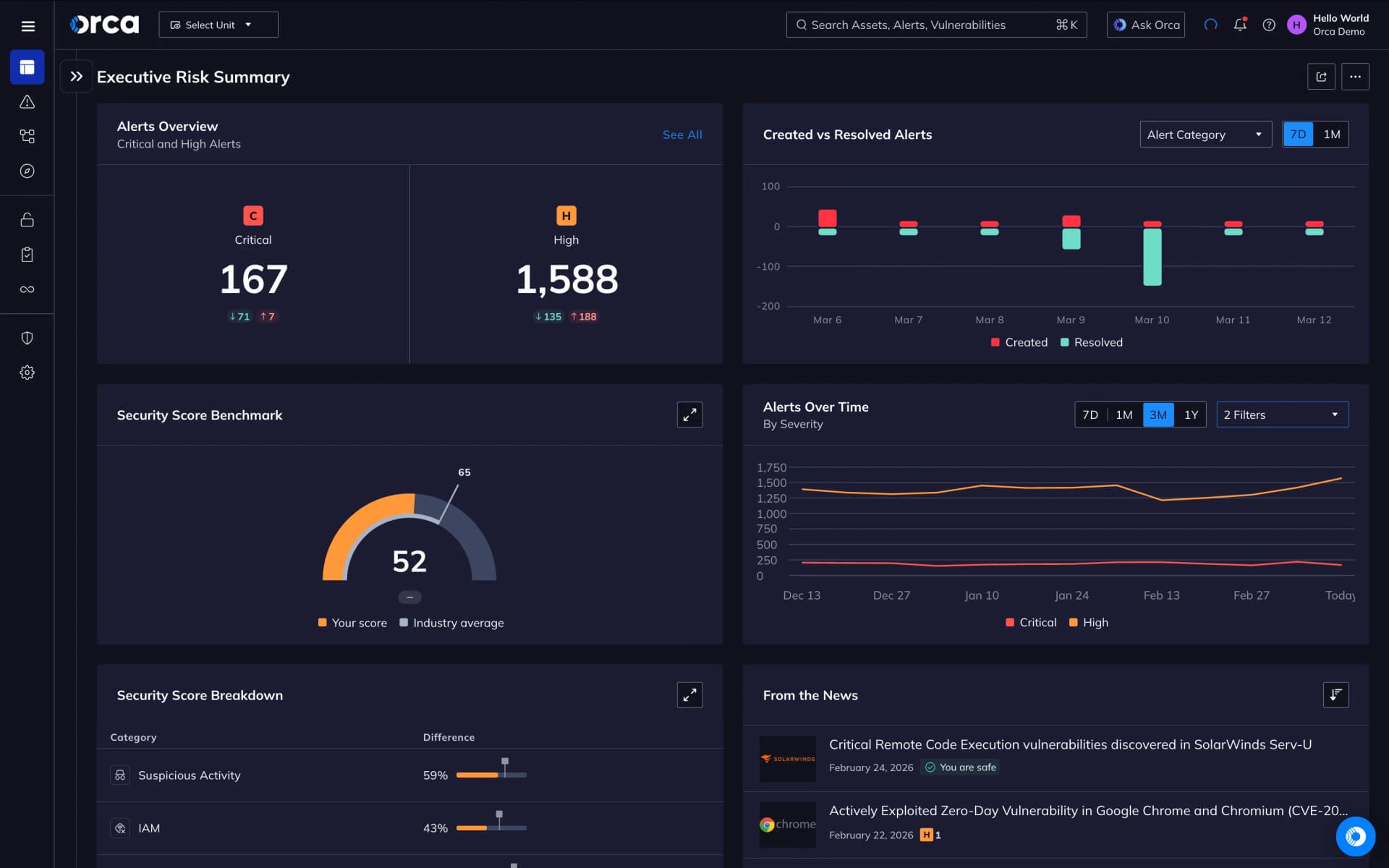
Interface Preview
Prisma Cloud
Orca Security
Feature Comparison
| Feature | Prisma Cloud | Orca Security |
|---|---|---|
| Cloud Security Posture | ||
| Multi-Cloud Asset Inventory | Discovers and inventories assets across AWS, Azure, GCP, Oracle, and Alibaba Cloud with RQL query language for deep inspection | Automatically discovers every cloud resource from compute to AI models and APIs via SideScanning with unified data model indexing |
| Misconfiguration Detection | Continuously monitors cloud configurations against 700+ built-in policies with custom RQL rules and auto-remediation via CLI or API | Identifies misconfigurations across all cloud services using context-aware analysis that factors in network exposure and data sensitivity |
| Identity and Access Analysis | Dedicated CIEM module calculates effective permissions, detects overprivileged identities, and suggests least-privilege IAM policies | Analyzes IAM roles, policies, and trust relationships as part of unified risk model to identify lateral movement paths and privilege escalation |
| Workload Protection | ||
| Container Security | Full container lifecycle protection with image scanning, runtime defense via Defenders, and Kubernetes admission control policies | Agentless container scanning discovers vulnerabilities in running containers plus optional Sensor for real-time container threat detection |
| Vulnerability Management | Scans hosts, containers, and serverless functions for CVEs with risk-based prioritization using CVSS scores and exploit availability | Identifies vulnerabilities across all workloads and eliminates up to 90% of alert noise using three reachability analysis types |
| Runtime Protection | Agent-based runtime defense with process monitoring, network firewall rules, file integrity monitoring, and anti-malware scanning | Lightweight eBPF-based Orca Sensor detects fileless attacks, zero-day exploits, and runtime AI activity without legacy agent overhead |
| Developer Security | ||
| CI/CD Pipeline Scanning | Integrates into CI/CD pipelines to scan IaC templates, container images, and code repositories with pass/fail enforcement gates | Automated scanning of code, container images, and IaC templates in CI/CD pipelines with shift-left enforcement before deployment |
| Code-to-Cloud Tracing | Traces runtime vulnerabilities back to source code repositories and specific commits using code security module integration | Links production alerts to exact lines of source code and the developer who committed them for rapid triage and remediation |
| Automated Remediation | Provides auto-remediation CLI commands and Terraform/CloudFormation fix suggestions for detected misconfigurations and policy violations | Generates AI-driven code fixes and opens one-click pull requests directly within developer workflows to slash remediation time |
| Threat Detection | ||
| Attack Path Analysis | Visualizes attack paths across cloud resources showing how misconfigurations, vulnerabilities, and permissions chain together for exploitation | Evaluates and prioritizes riskiest paths to crown jewels combining misconfigurations, identity risks, and lateral movement vectors |
| Malware Detection | Built-in anti-malware engine scans workload file systems and container images using WildFire threat intelligence signatures | Detects malware across cloud workloads using agentless deep scanning of file systems and memory without requiring agent deployment |
| Anomaly Detection | Uses machine learning models to detect unusual network traffic patterns, user behavior anomalies, and suspicious API activity | Orca Sensor provides real-time behavioral monitoring to detect sophisticated threats including fileless attacks and zero-day exploits |
| Platform and Integration | ||
| SIEM and SOAR Integration | Exports alerts to Splunk, QRadar, Cortex XSOAR, and other SIEMs via API with automated incident response playbook triggers | Streams findings to Slack, Jira, PagerDuty, SIEM platforms, and ticketing systems with prioritized context included in alerts |
| Compliance Reporting | Generates audit-ready reports for 100+ frameworks with downloadable evidence packages and continuous compliance monitoring dashboards | Produces compliance reports across 200+ customizable frameworks with automated exporting and continuous compliance workflow automation |
| API and Extensibility | Full REST API coverage for all platform capabilities with Terraform provider, Checkov integration, and extensive SDK support | Open API ecosystem with native integrations for developer tools, ticketing, alerting, and data streaming across the security stack |
Cloud Security Posture
Multi-Cloud Asset Inventory
Misconfiguration Detection
Identity and Access Analysis
Workload Protection
Container Security
Vulnerability Management
Runtime Protection
Developer Security
CI/CD Pipeline Scanning
Code-to-Cloud Tracing
Automated Remediation
Threat Detection
Attack Path Analysis
Malware Detection
Anomaly Detection
Platform and Integration
SIEM and SOAR Integration
Compliance Reporting
API and Extensibility
Which to choose
Both Prisma Cloud and Orca Security deliver enterprise-grade CNAPP capabilities, but they take fundamentally different architectural approaches that suit different organizational needs and operational priorities.
Best-fit scenarios
Choose Prisma Cloud if:
Choose Prisma Cloud if your organization already uses Palo Alto Networks products and wants deep integration across its security ecosystem. Prisma Cloud is the stronger choice for teams that need granular runtime protection with agent-based defenders, support for Oracle Cloud and Alibaba Cloud alongside the three major providers, and the ability to write custom policies using the Resource Query Language. Its CIEM module is particularly mature for organizations focused on identity governance. Enterprises with dedicated cloud security teams who can manage agent deployments and ongoing configuration will get the most value from this platform.
Choose Orca Security if:
Choose Orca Security if rapid deployment and minimal operational overhead are priorities. Orca's agentless SideScanning technology delivers full visibility within 24 hours without installing agents across your environment, making it ideal for organizations that want immediate coverage. Its three types of reachability analysis can eliminate up to 90% of alert noise, which is a significant advantage for teams struggling with alert fatigue. The built-in AI capabilities for automated code fixes and triage are more advanced than most competitors, and the 200+ compliance frameworks provide broader out-of-the-box regulatory coverage. Mid-market to enterprise teams that want a consolidated security platform with low operational burden will benefit most.
These scenarios reflect the available product evidence. Your requirements, existing stack, and team expertise should guide the final decision.
Frequently Asked Questions
How much does Prisma Cloud cost compared to Orca Security?
Prisma Cloud uses a per-credit pricing model with cloud security credits starting at approximately $1.20 per credit. The CSPM module alone starts at around $18,000 per year, while the full CNAPP suite typically begins at $45,000 per year with volume discounts available for sizable deployments. Orca Security follows enterprise-only custom pricing based on cloud workload count, with typical contracts starting at $36,000 to $60,000 per year depending on the number of cloud assets. Neither platform offers a free tier or self-service purchase option, so both require engaging sales teams for accurate quotes tailored to your environment size.
Can Prisma Cloud and Orca Security both protect multi-cloud environments?
Yes, both platforms support multi-cloud deployments but with different coverage breadth. Prisma Cloud supports AWS, Azure, GCP, Oracle Cloud, and Alibaba Cloud, giving it the widest cloud provider coverage of the two. Orca Security supports AWS, Azure, GCP, and Alibaba Cloud. For most organizations running workloads across the three major cloud providers, both platforms offer equivalent coverage. However, if your organization has significant Oracle Cloud Infrastructure deployments, Prisma Cloud is the only option that provides native support. Both platforms discover and inventory all cloud resources, scan for vulnerabilities, and monitor for misconfigurations across their supported providers.
Which platform is easier to deploy and manage on an ongoing basis?
Orca Security has a clear advantage in deployment speed and operational simplicity. Its agentless SideScanning technology requires only a three-step cloud account connection process and can deliver full visibility within 24 hours without installing any agents. Prisma Cloud requires deploying Defender agents across hosts, containers, and serverless workloads for its CWPP capabilities, which typically takes weeks and may require professional services assistance. On an ongoing basis, Orca's agentless model eliminates the overhead of maintaining and updating agents across your fleet. However, Prisma Cloud's agent-based approach can provide deeper runtime visibility and more granular control for organizations that have the resources to manage it properly.
How do these platforms handle alert prioritization and reducing false positives?
Orca Security takes a particularly innovative approach to alert prioritization with its three types of reachability analysis: agentless reachability analysis for container-level insight, dynamic reachability analysis to confirm runtime access, and code reachability analysis for function-level assessment. This combination can eliminate up to 90% of alert noise by confirming whether vulnerabilities are actually exploitable. Prisma Cloud uses risk-based prioritization combining CVSS scores, exploit availability, and environmental context to rank alerts, along with Cortex AI for intelligent alert grouping. Both platforms support automated workflows to route critical findings to the right teams, but Orca's reachability-based approach tends to produce fewer actionable alerts, which is valuable for teams spending over $36,000 per year and expecting efficient triage.