Decision comparison
Palantir vs Tableau
Palantir and Tableau serve fundamentally different needs in the data analytics landscape. Palantir excels at complex enterprise data integration and operational decision-making for large organizations handling disparate data sources, while Tableau dominates self-service visual analytics and dashboard creation for teams that need intuitive data exploration.
Architecture choice. These take different approaches to the same problem. Read the table as a fit question rather than a feature race.
All 2 are BI platforms.
Quick Comparison
| Decision factor | Palantir | Tableau |
|---|---|---|
| Primary Use Case | Enterprise data integration and operational decision-making across disparate sources | Visual analytics and interactive dashboard creation for business intelligence teams |
| Target User | Government agencies, defense organizations, and large enterprises needing data ontologies | Analysts, business users, and data teams needing self-service visualization tools |
| Pricing Model | Contact for pricing | Tableau Cloud Standard Edition: Viewer $15/user/month, Explorer $42/user/month, Creator $75/user/month; Enterprise Edition: Viewer $35/user/month, Explorer $70/user/month, Creator $115/user/month; Tableau+ Bundle requires contact sales for pricing details. |
| Deployment | On-premises and cloud deployments with Foundry for commercial and Gotham for government | Cloud-hosted (Tableau Cloud), self-hosted (Tableau Server), and desktop options available |
| Learning Curve | Steep learning curve requiring dedicated implementation teams and professional services | Moderate learning curve with drag-and-drop interface praised for ease of use |
| AI Capabilities | Built-in AI/ML for operational decision support with unified data ontology integration | Agentic analytics via Agentforce integration with AI-assisted semantic model creation |
Palantir
- Primary Use Case:
- Enterprise data integration and operational decision-making across disparate sources
- Target User:
- Government agencies, defense organizations, and large enterprises needing data ontologies
- Pricing Model:
- Contact for pricing
- Deployment:
- On-premises and cloud deployments with Foundry for commercial and Gotham for government
- Learning Curve:
- Steep learning curve requiring dedicated implementation teams and professional services
- AI Capabilities:
- Built-in AI/ML for operational decision support with unified data ontology integration
Tableau
- Primary Use Case:
- Visual analytics and interactive dashboard creation for business intelligence teams
- Target User:
- Analysts, business users, and data teams needing self-service visualization tools
- Pricing Model:
- Tableau Cloud Standard Edition: Viewer $15/user/month, Explorer $42/user/month, Creator $75/user/month; Enterprise Edition: Viewer $35/user/month, Explorer $70/user/month, Creator $115/user/month; Tableau+ Bundle requires contact sales for pricing details.
- Deployment:
- Cloud-hosted (Tableau Cloud), self-hosted (Tableau Server), and desktop options available
- Learning Curve:
- Moderate learning curve with drag-and-drop interface praised for ease of use
- AI Capabilities:
- Agentic analytics via Agentforce integration with AI-assisted semantic model creation
Public signals
Verified factual signals only. Bars appear only for like-for-like metrics with five weekly assessments for every tool; missing evidence stays explicit. These signals do not establish enterprise adoption, product quality, or total cost.
| Metric | Palantir | Tableau |
|---|---|---|
| GitHub commits, 90d(Developer adoption) | 26 | 37 |
| GitHub stars(Developer adoption) | 206 | 716 |
| Search interest(Market interest) | 44 | 85 |
| Hacker News mentions, 90d(Community interest) | 92 | 2 |
| Product Hunt comments(Community interest) | 1 | 3 |
| Product Hunt rating(Community interest) | Unavailable | 4.2/5 |
| Product Hunt reviews(Community interest) | 0 | 5 |
| Product Hunt votes(Community interest) | 8 | 7 |
| PyPI weekly downloads(Developer adoption) | 137.2k | 965.7k |
| npm weekly downloads(Developer adoption) | Not available | 32.2k |
| Stack Overflow questions(Community interest) | Not available | 5.4k |
As of September 21, 2026 — updated weekly.
Health & risk evidence
Observed public-source checks for mapped package versions and repositories.
Palantir
September 21, 2026Package vulnerabilities
PyPI · foundry-platform-sdk@1.106.0
0 vulnerabilities
across 1 package
Repository security score
Not available
Tableau
September 21, 2026Package vulnerabilities
npm · @tableau/embedding-api@3.16.1 · PyPI · tableauserverclient@0.41
0 vulnerabilities
across 2 packages
Repository security score
github.com/tableau/server-client-python
5.5/10
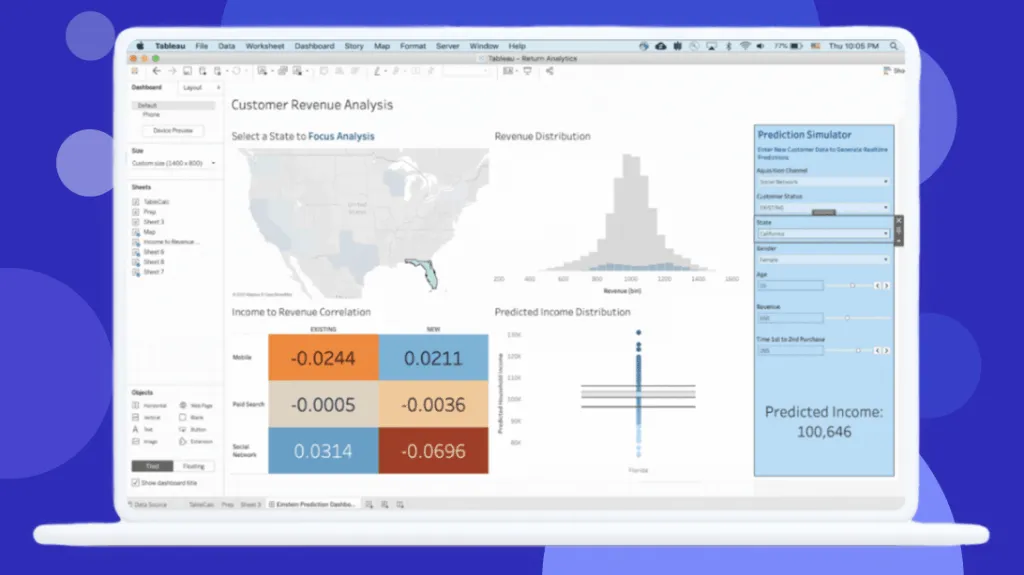
Interface Preview
Tableau
Feature Comparison
| Feature | Palantir | Tableau |
|---|---|---|
| Data Integration | ||
| Multi-Source Data Fusion | Full ontology-based integration across disparate enterprise and government data sources | Connects to databases, cloud services, and spreadsheets with native connectors |
| Real-Time Data Processing | Real-time operational data processing built into Foundry and Gotham platforms | Live connections and scheduled extracts with Hyper engine for fast queries |
| Semantic Layer | Unified ontology layer that maps relationships between all integrated data sources | Tableau Semantics with AI-infused model creation integrated with Data 360 |
| Visualization & Analytics | ||
| Dashboard Creation | Operational dashboards focused on decision workflows rather than visual exploration | Industry-leading drag-and-drop visual analytics with rich interactive dashboards |
| Self-Service Analytics | Limited self-service; typically requires trained operators or professional services | Strong self-service capabilities with Explorer and Creator license tiers |
| Data Storytelling | Focused on operational narratives and mission-critical decision flows | Tableau Public for sharing, built-in annotations, and community visualization gallery |
| AI & Automation | ||
| AI-Powered Insights | Machine learning models embedded in operational workflows for predictive analytics | Agentforce Tableau delivers proactive insights and 24/7 analytics agents |
| Natural Language Queries | AI-assisted data exploration within Foundry platform interfaces | Ask Data and Agentforce integration let users query data in natural language |
| Workflow Automation | Deep enterprise workflow integration with automated decision pipelines | Action-at-point-of-insight with Slack integration for permission-aware analytics |
| Security & Governance | ||
| Access Controls | Military-grade security with granular access controls for classified environments | Enterprise-grade security powered by Hyperforce with role-based permissions |
| Compliance | Built for regulated environments including government defense and intelligence agencies | SOC 2 compliant with Salesforce platform security and data governance features |
| Data Governance | Comprehensive audit trails and data lineage across integrated ontology systems | Unified data governance through Data 360 with certified data source management |
| Deployment & Scalability | ||
| Cloud Options | Private cloud and on-premises deployments with FedRAMP authorization for government | Tableau Cloud (fully hosted), Tableau Server (self-hosted), or hybrid deployment |
| API & Extensibility | Custom application development on Foundry with deep API integration capabilities | API-first composable architecture with embedded analytics and developer tools |
| Team Collaboration | Collaboration within secure mission environments with controlled data sharing | Slack integration, Tableau Public sharing, and permission-aware collaborative workspaces |
Data Integration
Multi-Source Data Fusion
Real-Time Data Processing
Semantic Layer
Visualization & Analytics
Dashboard Creation
Self-Service Analytics
Data Storytelling
AI & Automation
AI-Powered Insights
Natural Language Queries
Workflow Automation
Security & Governance
Access Controls
Compliance
Data Governance
Deployment & Scalability
Cloud Options
API & Extensibility
Team Collaboration
Which approach fits
Palantir and Tableau serve fundamentally different needs in the data analytics landscape. Palantir excels at complex enterprise data integration and operational decision-making for large organizations handling disparate data sources, while Tableau dominates self-service visual analytics and dashboard creation for teams that need intuitive data exploration.
When each approach fits
Choose Palantir if:
Choose Palantir when your organization needs to integrate massive volumes of disparate data sources into a unified operational ontology. Palantir Foundry is purpose-built for enterprises that require complex data fusion, operational decision-making pipelines, and mission-critical analytics in regulated or security-sensitive environments. Organizations with dedicated data engineering teams and enterprise-scale budgets will benefit most from Palantir's deep integration capabilities.
Choose Tableau if:
Choose Tableau when your team needs powerful visual analytics with a self-service approach to data exploration and dashboard creation. With pricing starting at $15/user/month for Viewers and scaling to $115/user/month for Enterprise Creators, Tableau delivers transparent per-seat licensing and a proven drag-and-drop interface. Tableau is the stronger choice for organizations prioritizing business user adoption, interactive reporting, and Salesforce ecosystem integration through Agentforce and Slack.
These scenarios reflect the available product evidence. Your requirements, existing stack, and team expertise should guide the final decision.
Frequently Asked Questions
What is the main difference between Palantir and Tableau?
The main difference lies in their core purpose. Palantir builds enterprise data platforms (Foundry for commercial, Gotham for government) that integrate disparate data sources into unified ontologies for operational decision-making. Tableau is a visual analytics and business intelligence platform focused on interactive dashboards and self-service data exploration. Palantir handles complex data fusion and workflow automation at an enterprise scale, while Tableau excels at making data accessible through intuitive drag-and-drop visualization tools that business users can adopt quickly without extensive technical training.
How does Palantir pricing compare to Tableau pricing?
Palantir uses enterprise contract pricing that requires contacting their sales team directly for custom quotes, with no publicly listed price tiers. Tableau offers transparent per-seat pricing: Standard Edition starts at $15/user/month for Viewers, $42/user/month for Explorers, and $75/user/month for Creators. Enterprise Edition pricing runs $35/user/month for Viewers, $70/user/month for Explorers, and $115/user/month for Creators. The Tableau+ bundle with agentic analytics capabilities requires contacting sales. For a 50-user enterprise deployment, Tableau costs approximately over $30,000/year and scaling with team size depending on the license mix.
Can Palantir and Tableau be used together?
Yes, Palantir and Tableau can complement each other in an enterprise data stack. Palantir Foundry can serve as the data integration and ontology layer, unifying disparate data sources and handling complex data pipelines, while Tableau sits on top as the visualization and self-service analytics layer for business users. This approach leverages Palantir's strength in data fusion and operational workflows alongside Tableau's industry-leading dashboard creation and drag-and-drop analytics. Organizations with both platforms typically use Palantir for data engineering and operational decisions while Tableau handles reporting and ad-hoc visual exploration.
Which platform is better for government and defense use cases?
Palantir is the clear choice for government and defense use cases. Palantir Gotham was specifically built for government agencies and intelligence organizations, with military-grade security, classified environment support, and FedRAMP authorization. Palantir has deep roots in defense and national security, with over 2B in annual revenue significantly driven by government contracts. While Tableau offers enterprise-grade security through Salesforce's Hyperforce infrastructure, it is fundamentally a business intelligence visualization tool rather than a mission-critical operational platform designed for security-sensitive government environments.