Decision comparison
Vald vs Qdrant
Qdrant is the stronger choice for most teams building AI-powered search applications. It delivers a mature feature set with hybrid search, advanced filtering, quantization, a managed cloud offering, and broad SDK support. Vald is a specialized option for organizations already running Kubernetes at scale that need a distributed ANN engine with NGT and can handle the operational overhead of a fully self-managed deployment.
Direct comparison. These are reviewed substitutes bought for the same job, so the differences below are the ones that decide between them.
All 2 are vector databases.
Quick Comparison
| Decision factor | Vald | Qdrant |
|---|---|---|
| Best For | Kubernetes-native billion-scale ANN search | Production AI search with hybrid retrieval |
| Pricing | Fully open source and free (Apache 2.0 license). No paid tiers or managed service. Self-hosted on Kubernetes. Costs come from infrastructure (compute + storage for your Kubernetes cluster). | Free Tier free, $1 (no specific tier mentioned) |
| Deployment | Self-hosted on Kubernetes only | Self-hosted, cloud, hybrid, or edge |
| Search Algorithm | NGT (Neighborhood Graph and Tree) | HNSW (Hierarchical Navigable Small World) |
| Language | Go | Rust |
| Cloud Offering | None — self-managed only | Fully managed Qdrant Cloud on AWS, GCP, Azure |
Vald
- Best For:
- Kubernetes-native billion-scale ANN search
- Pricing:
- Fully open source and free (Apache 2.0 license). No paid tiers or managed service. Self-hosted on Kubernetes. Costs come from infrastructure (compute + storage for your Kubernetes cluster).
- Deployment:
- Self-hosted on Kubernetes only
- Search Algorithm:
- NGT (Neighborhood Graph and Tree)
- Language:
- Go
- Cloud Offering:
- None — self-managed only
Qdrant
- Best For:
- Production AI search with hybrid retrieval
- Pricing:
- Free Tier free, $1 (no specific tier mentioned)
- Deployment:
- Self-hosted, cloud, hybrid, or edge
- Search Algorithm:
- HNSW (Hierarchical Navigable Small World)
- Language:
- Rust
- Cloud Offering:
- Fully managed Qdrant Cloud on AWS, GCP, Azure
Public signals
Verified factual signals only. Bars appear only for like-for-like metrics with five weekly assessments for every tool; missing evidence stays explicit. These signals do not establish enterprise adoption, product quality, or total cost.
| Metric | Vald | Qdrant |
|---|---|---|
| GitHub commits, 90d(Product adoption) | 21 | 754 |
| GitHub stars(Product adoption) | 1,500+ | 34,000+ |
| Search interest(Market interest) | Unavailable | 3 |
| Hacker News mentions, 90d(Community interest) | 0 | 8 |
| PyPI weekly downloads(Developer adoption) | 69 | 2.7M |
| Docker Hub pulls(Product adoption) | Not available | 46.6M |
| Hugging Face downloads(Product adoption) | Not available | 3.9M |
| Hugging Face likes(Product adoption) | Not available | 69 |
| npm weekly downloads(Developer adoption) | Not available | 601.6k |
| Stack Overflow questions(Community interest) | Not available | 60 |
As of September 21, 2026 — updated weekly.
Health & risk evidence
Observed public-source checks for mapped package versions and repositories.
Vald
September 21, 2026Package vulnerabilities
PyPI · vald-client-python@1.8.0
0 vulnerabilities
across 1 package
Repository security score
Not available
Qdrant
September 21, 2026Package vulnerabilities
npm · @qdrant/js-client-rest@1.19.0 · PyPI · qdrant-client@1.19.1
0 vulnerabilities
across 2 packages
Repository security score
Not available
Interface Preview
Vald
Qdrant
Feature Comparison
| Feature | Vald | Qdrant |
|---|---|---|
| Search & Indexing | ||
| ANN Algorithm | NGT (fast approximate nearest neighbor) | HNSW with filterable graph traversal |
| Hybrid Search (Dense + Sparse) | Not supported natively | Native dense + sparse vector search with BM25, SPLADE++, miniCOIL |
| Real-Time Indexing | Asynchronous auto-indexing without stop-the-world locks | Instant indexing — vectors searchable immediately on insert |
| Metadata Filtering | Basic filtering via Ingress/Egress custom filters | Advanced JSON payload filters: nested, text, geo, has_vector |
| Architecture & Scalability | ||
| Distributed Indexing | Each agent stores a different index partition | Sharding and replication across cluster nodes |
| Index Replication | Multi-agent replicas with automatic rebalancing | Built-in replication with configurable replication factor |
| Horizontal Scaling | Scales horizontally on Kubernetes (memory and CPU) | Auto-sharding in cloud; manual sharding in self-hosted |
| Backup & Recovery | Auto backup to Object Storage or Persistent Volumes | Snapshots, backups, and point-in-time restore |
| Developer Experience | ||
| API Protocol | gRPC-based API | REST and gRPC with official Python, JavaScript, Rust, Go clients |
| SDK Languages | Go, Java, Node.js, Python | Python, JavaScript/TypeScript, Rust, Go, Java, .NET |
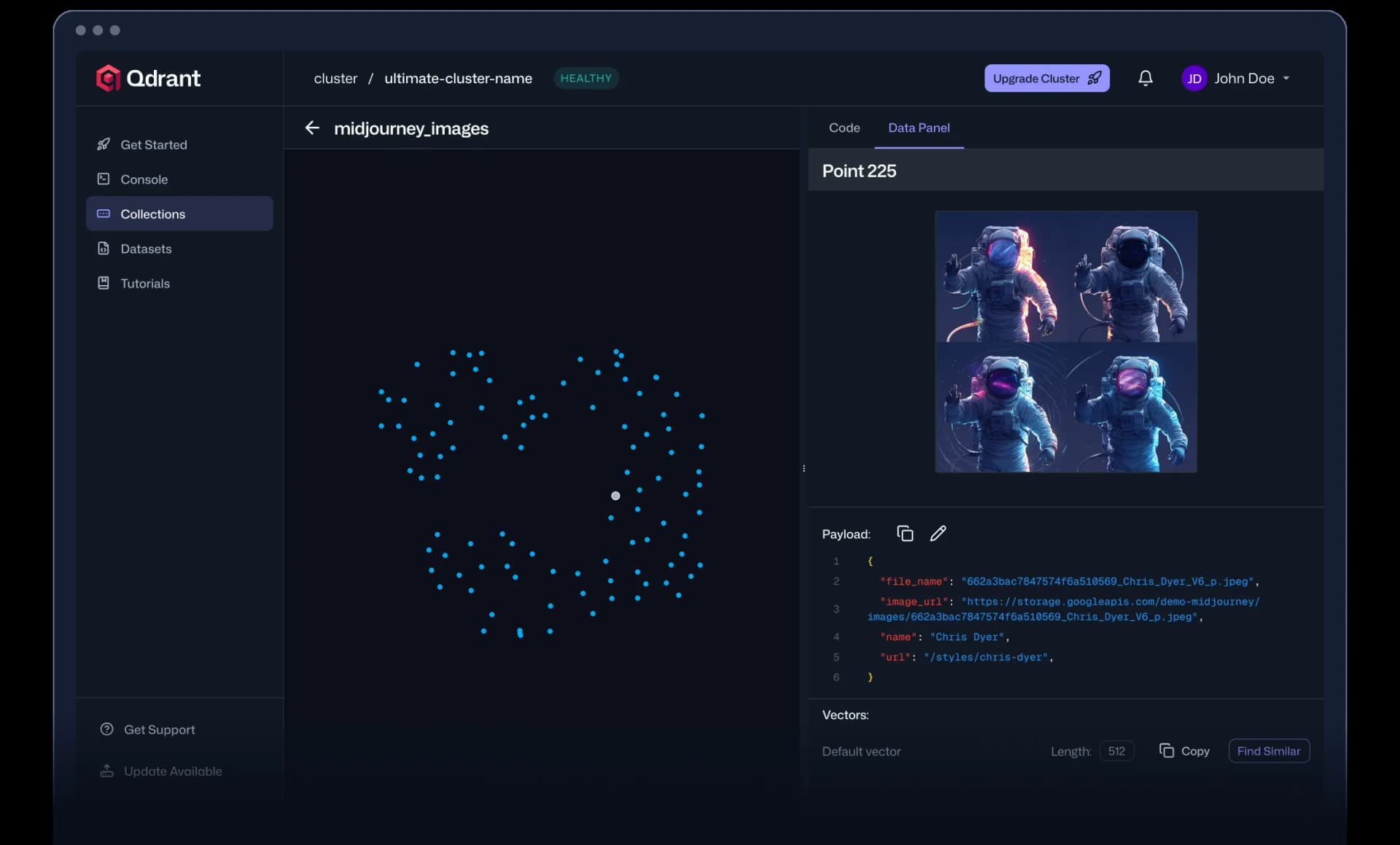
| Web UI | No built-in UI | Built-in Web UI for exploring collections and testing queries |
| Quantization Support | Not verified | Asymmetric, scalar, and binary quantization (up to 64x memory reduction) |
| Deployment & Operations | ||
| Kubernetes Native | Designed exclusively for Kubernetes with Helm charts | Supports Kubernetes via Helm chart and Qdrant Hybrid Cloud |
| Managed Cloud Service | Not verified | Qdrant Cloud with free tier, plus Hybrid and Private Cloud options |
| Edge Deployment | Not verified | Qdrant Edge (Beta) for low-latency local vector search |
| Compliance Certifications | None — depends on your infrastructure | SOC 2 and HIPAA compliant |
Search & Indexing
ANN Algorithm
Hybrid Search (Dense + Sparse)
Real-Time Indexing
Metadata Filtering
Architecture & Scalability
Distributed Indexing
Index Replication
Horizontal Scaling
Backup & Recovery
Developer Experience
API Protocol
SDK Languages
Web UI
Quantization Support
Deployment & Operations
Kubernetes Native
Managed Cloud Service
Edge Deployment
Compliance Certifications
Which to choose
Qdrant is the stronger choice for most teams building AI-powered search applications. It delivers a mature feature set with hybrid search, advanced filtering, quantization, a managed cloud offering, and broad SDK support. Vald is a specialized option for organizations already running Kubernetes at scale that need a distributed ANN engine with NGT and can handle the operational overhead of a fully self-managed deployment.
Best-fit scenarios
Choose Vald if:
Choose Vald if you run large-scale Kubernetes clusters, need billion-vector approximate nearest neighbor search using NGT, and your team has the DevOps expertise to self-manage the entire vector database stack without a managed service.
Choose Qdrant if:
Choose Qdrant if you need production-grade vector search with hybrid dense and sparse retrieval, advanced metadata filtering, quantization for memory efficiency, and the flexibility of managed cloud, hybrid, on-prem, or edge deployment options.
These scenarios reflect the available product evidence. Your requirements, existing stack, and team expertise should guide the final decision.
Frequently Asked Questions
Is Vald or Qdrant better for RAG applications?
Qdrant is the better fit for RAG (Retrieval-Augmented Generation) pipelines. It offers native hybrid search combining dense and sparse vectors, which improves retrieval relevance by blending semantic similarity with keyword matching. Qdrant also provides advanced metadata filtering to scope searches by document source, date, or other attributes. Vald focuses on dense vector ANN search only, so you would need to build keyword search and filtering layers separately. Qdrant's managed cloud and integrations with LangChain, LlamaIndex, and other RAG frameworks also reduce the engineering effort required to build a production RAG system.
Can Vald run without Kubernetes?
No. Vald is designed exclusively for Kubernetes deployments. Its architecture relies on Kubernetes primitives for agent orchestration, service discovery, distributed indexing, and auto-scaling. There is no standalone binary or Docker Compose setup. If your infrastructure does not include Kubernetes, Qdrant is the more accessible option since it runs as a standalone Docker container, a single binary, or through the fully managed Qdrant Cloud service.
How do the search algorithms in Vald and Qdrant compare?
Vald uses NGT (Neighborhood Graph and Tree), a fast ANN algorithm developed by Yahoo Japan that builds a graph-based index for approximate nearest neighbor search. Qdrant uses HNSW (Hierarchical Navigable Small World), which constructs a multi-layer graph for efficient nearest neighbor traversal. Both are proven ANN algorithms, but HNSW is widely adopted across the vector database ecosystem. Qdrant's implementation adds filterable HNSW, where metadata filters are applied during graph traversal rather than as a post-processing step, delivering high recall with low latency even under complex filter conditions.
Which vector database is more cost-effective at scale?
Both Vald and Qdrant are open source under the Apache 2.0 license, so the software itself is free. Vald's cost comes entirely from the Kubernetes infrastructure you provision, and there is no managed service to offload operations. Qdrant offers a free cloud tier for experimentation and usage-based pricing for production workloads. For self-hosted deployments, Qdrant's quantization features (asymmetric, scalar, and binary) can reduce memory usage by up to 64x, significantly lowering infrastructure costs for large vector collections. Vald does not offer built-in quantization, so memory costs scale linearly with collection size.
Does Qdrant or Vald have better community and ecosystem support?
Qdrant has a sizable community and ecosystem. It has over 30,000 GitHub stars, an active 60,000-member community, regular releases (latest v1.17.1), and official integrations with LangChain, LlamaIndex, Haystack, and other AI frameworks. Qdrant also provides comprehensive documentation, tutorials, and a developer certification program. Vald has a focused community, a compact set of integrations, and limited third-party resources. For teams that value ecosystem breadth, active development, and community support, Qdrant has a clear advantage.