Decision comparison
Qdrant vs Zilliz
Qdrant and Zilliz are both production vector stores and the choice between them is mostly a choice about who operates the thing. Qdrant is a self-contained Rust engine you can run yourself or hand to Qdrant Cloud, with filtering applied inside the search rather than after it. Zilliz is managed Milvus from the team that maintains Milvus, with compute and storage scaled independently. If you want the option of running it on your own hardware without changing engines, Qdrant keeps that door open; if you want Milvus without operating Milvus, Zilliz is the direct route.
Architecture choice. These take different approaches to the same problem. Read the table as a fit question rather than a feature race.
All 2 are vector databases.
Quick Comparison
| Decision factor | Qdrant | Zilliz |
|---|---|---|
| Operating model | Open-source Rust engine you run yourself, or Qdrant Cloud managed by the same team | Fully managed Milvus, run as a service by the company that maintains Milvus |
| Underlying engine | Purpose-built Rust engine with its own storage and index layer | Apache-licensed Milvus, with distributed components separated for independent scaling |
| Scale target | Billions of vectors with horizontal sharding and replication | Billion-scale search is the headline claim, with compute and storage scaled separately |
| Filtering | Payload filtering applied inside the search, so filters do not degrade recall the way post-filtering does | Scalar filtering supported alongside vector search, with partitioning for large tenant counts |
| Self-hosting | A single binary runs a useful node; Docker and Kubernetes paths are both first class, with a Helm chart for cluster deployment on AWS, GCP or Azure | Milvus is self-hostable on Kubernetes, but Zilliz itself is the managed offering rather than a package you install |
| Client libraries | Python, JavaScript, Rust, Go and Java clients over REST and gRPC, with JSON payloads on every point | Python, Java, Go and Node.js clients over gRPC and REST, matching the Milvus SDK surface |
| Pricing model | Free Tier free, $1 (no specific tier mentioned) | Free (no cost), Standard $0/mo, Enterprise MOST POPULAR $155/mo |
Qdrant
- Operating model:
- Open-source Rust engine you run yourself, or Qdrant Cloud managed by the same team
- Underlying engine:
- Purpose-built Rust engine with its own storage and index layer
- Scale target:
- Billions of vectors with horizontal sharding and replication
- Filtering:
- Payload filtering applied inside the search, so filters do not degrade recall the way post-filtering does
- Self-hosting:
- A single binary runs a useful node; Docker and Kubernetes paths are both first class, with a Helm chart for cluster deployment on AWS, GCP or Azure
- Client libraries:
- Python, JavaScript, Rust, Go and Java clients over REST and gRPC, with JSON payloads on every point
- Pricing model:
- Free Tier free, $1 (no specific tier mentioned)
Zilliz
- Operating model:
- Fully managed Milvus, run as a service by the company that maintains Milvus
- Underlying engine:
- Apache-licensed Milvus, with distributed components separated for independent scaling
- Scale target:
- Billion-scale search is the headline claim, with compute and storage scaled separately
- Filtering:
- Scalar filtering supported alongside vector search, with partitioning for large tenant counts
- Self-hosting:
- Milvus is self-hostable on Kubernetes, but Zilliz itself is the managed offering rather than a package you install
- Client libraries:
- Python, Java, Go and Node.js clients over gRPC and REST, matching the Milvus SDK surface
- Pricing model:
- Free (no cost), Standard $0/mo, Enterprise MOST POPULAR $155/mo
Public signals
Verified factual signals only. Bars appear only for like-for-like metrics with five weekly assessments for every tool; missing evidence stays explicit. These signals do not establish enterprise adoption, product quality, or total cost.
| Metric | Qdrant | Zilliz |
|---|---|---|
| Docker Hub pulls(Product adoption) | 46.6M | Not available |
| GitHub commits, 90d(Product adoption) | 754 | Not available |
| GitHub stars(Product adoption) | 34,000+ | Not available |
| Search interest(Market interest) | 3 | Unavailable |
| Hacker News mentions, 90d(Community interest) | 8 | Not available |
| Hugging Face downloads(Product adoption) | 3.9M | 832 |
| Hugging Face likes(Product adoption) | 69 | 104 |
| npm weekly downloads(Developer adoption) | 601.6k | 133.5k |
| PyPI weekly downloads(Developer adoption) | 2.7M | Not available |
| Stack Overflow questions(Community interest) | 60 | Not available |
| PyPI weekly downloads(Ecosystem adoption) | Not available | 883.0k |
As of September 21, 2026 — updated weekly.
Health & risk evidence
Observed public-source checks for mapped package versions and repositories.
Qdrant
September 21, 2026Package vulnerabilities
npm · @qdrant/js-client-rest@1.19.0 · PyPI · qdrant-client@1.19.1
0 vulnerabilities
across 2 packages
Repository security score
Not available
Zilliz
September 21, 2026Package vulnerabilities
npm · @zilliz/milvus2-sdk-node@3.0.6 · PyPI · pymilvus@3.0.2
0 vulnerabilities
across 2 packages
Repository security score
Not available
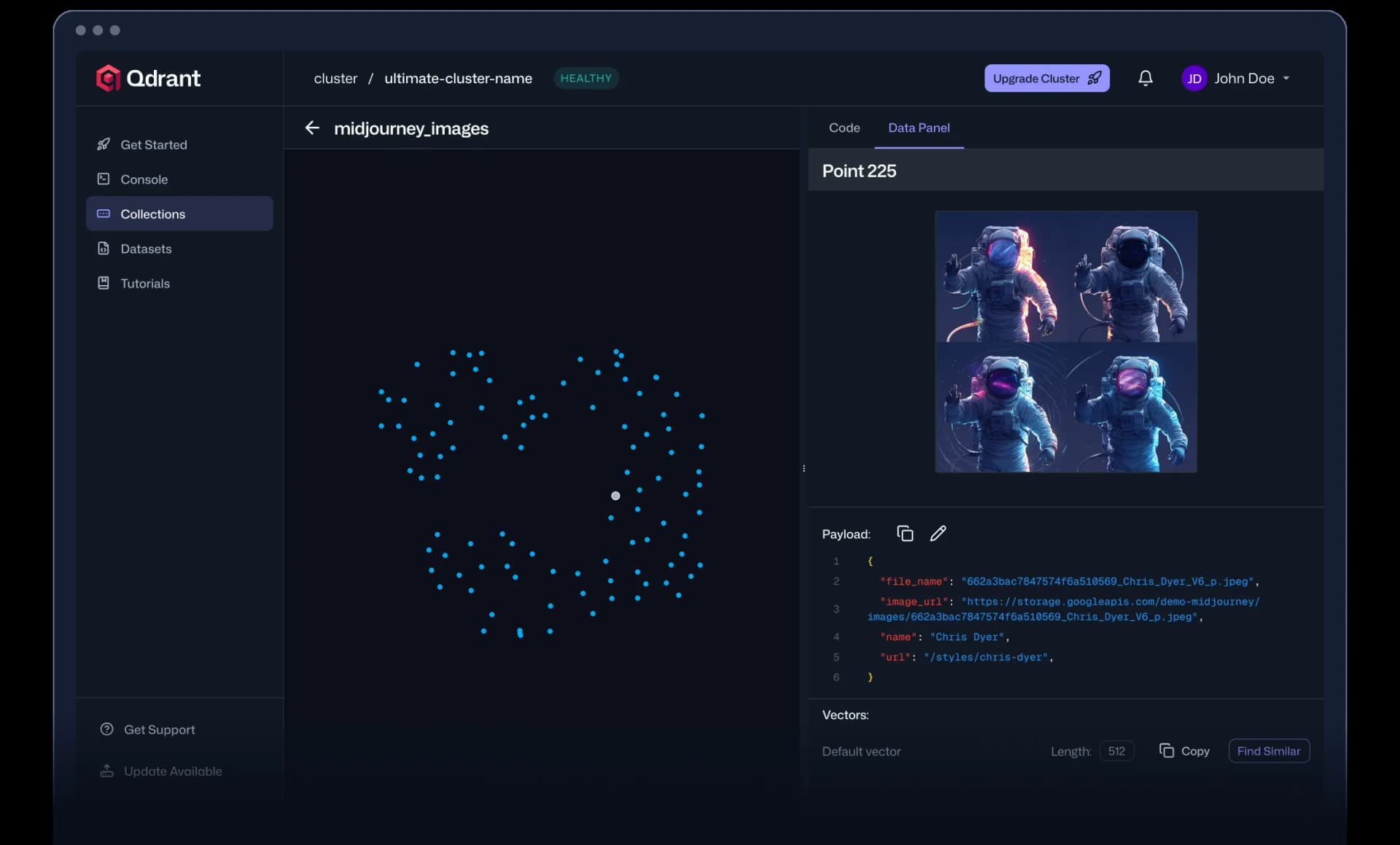
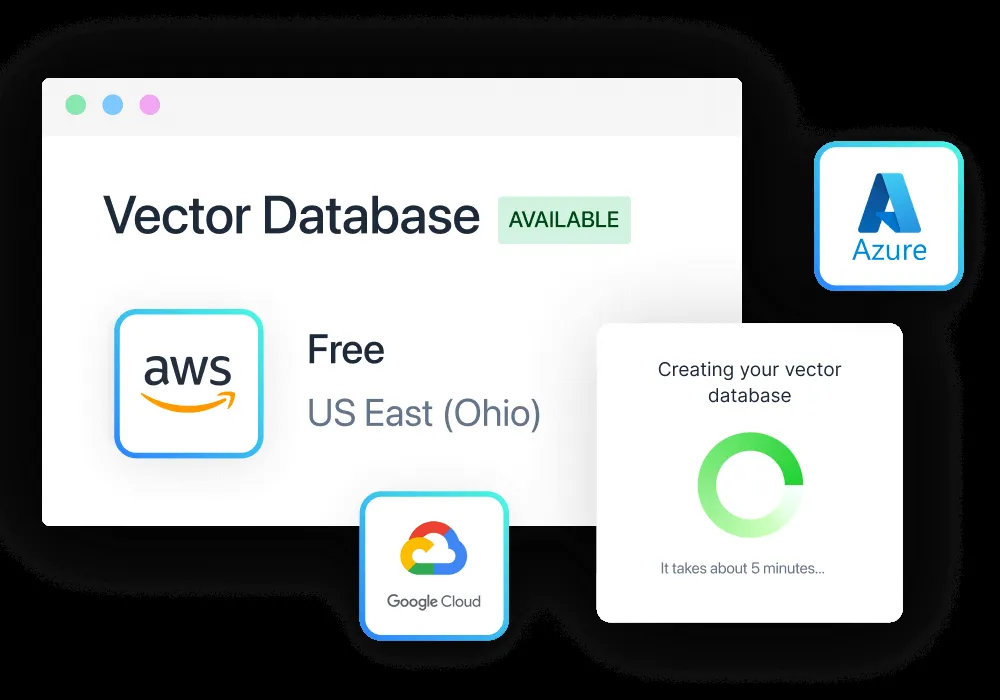
Interface Preview
Qdrant
Zilliz
Feature Comparison
| Feature | Qdrant | Zilliz |
|---|---|---|
| Search | ||
| Approximate nearest-neighbour search | Full support | Full support |
| Filtered vector search | Full support | Full support |
| Hybrid keyword and vector search | Full support | Full support |
| Multi-vector records | Full support | Partial support |
| Scale and operations | ||
| Horizontal sharding | Full support | Full support |
| Replication and failover | Full support | Full support |
| Separated compute and storage | Partial support | Full support |
| Self-hosted deployment | Full support | Partial support |
| Data handling | ||
| Metadata payloads on points | Full support | Full support |
| Quantisation to cut memory | Full support | Full support |
| On-disk index for large sets | Full support | Full support |
| Snapshot and restore | Full support | Full support |
| Developer experience | ||
| Python and JavaScript clients | Full support | Full support |
| REST and gRPC APIs | Full support | Full support |
| Local single-node start | Full support | Partial support |
| Framework integrations | Full support | Full support |
| Commercial | ||
| Open-source core | Full support | Full support |
| First-party managed cloud | Full support | Full support |
| Free tier | Full support | Full support |
Search
Approximate nearest-neighbour search
Filtered vector search
Hybrid keyword and vector search
Multi-vector records
Scale and operations
Horizontal sharding
Replication and failover
Separated compute and storage
Self-hosted deployment
Data handling
Metadata payloads on points
Quantisation to cut memory
On-disk index for large sets
Snapshot and restore
Developer experience
Python and JavaScript clients
REST and gRPC APIs
Local single-node start
Framework integrations
Commercial
Open-source core
First-party managed cloud
Free tier
Which approach fits
Qdrant and Zilliz are both production vector stores and the choice between them is mostly a choice about who operates the thing. Qdrant is a self-contained Rust engine you can run yourself or hand to Qdrant Cloud, with filtering applied inside the search rather than after it. Zilliz is managed Milvus from the team that maintains Milvus, with compute and storage scaled independently. If you want the option of running it on your own hardware without changing engines, Qdrant keeps that door open; if you want Milvus without operating Milvus, Zilliz is the direct route.
When each approach fits
Choose Qdrant if:
Choose Qdrant when you want one engine that runs the same way on a laptop, in your own Kubernetes cluster and in a managed cloud. A single binary gets you a working node, payload filtering is applied during the search so heavily filtered queries keep their recall, and the managed option comes from the same team that writes the engine. It is also the better fit when data residency or air-gapped deployment is a requirement, because self-hosting is a first-class path rather than a fallback.
Choose Zilliz if:
Choose Zilliz when Milvus is the engine you want and operating it is not work you want to own. Milvus separates its components so compute and storage scale independently, which suits very large collections with uneven query load, and Zilliz runs exactly that for you. It is the natural landing place for a team already prototyping on Milvus, since the data model and client code carry over without a rewrite.
These scenarios reflect the available product evidence. Your requirements, existing stack, and team expertise should guide the final decision.
Frequently Asked Questions
Is Zilliz the same thing as Milvus?
Zilliz is the managed cloud service built on Milvus, and Zilliz is the company that maintains Milvus. Running Milvus yourself and buying Zilliz are the same engine with different operational responsibilities, which is why the comparison with Qdrant is really about who runs the cluster rather than about two unrelated products.
Does filtering hurt search quality?
It can, depending on when the filter is applied. If a system retrieves nearest neighbours first and filters afterwards, a restrictive filter can leave very few results and the effective recall drops. Qdrant applies payload filters inside the search so the index walk respects them. If your queries routinely filter to a small slice of the collection, test that behaviour specifically.
Can we start self-hosted and move to managed later?
With Qdrant this is a supported path: the same engine runs in both places. With Milvus and Zilliz the engine is also the same, so a move is realistic, but you are moving between a cluster you operate and a service someone else operates rather than flipping a switch. Plan the data migration either way.
How should we size the decision?
Start from collection size, filter selectivity and who is on call. A few million vectors with simple filters will run comfortably on either. Hundreds of millions with tenant-level partitioning and uneven load is where the architectural differences start to matter, and where the operational question stops being theoretical.