Matillion Data Productivity Cloud tool details
Matillion has repositioned itself as an AI-first data platform with its rebranded offering, Maia (formerly the Matillion Data Productivity Cloud). In this matillion data productivity cloud review, we assess whether the platform delivers on its ambitious promise of autonomous data engineering. Matillion targets enterprise data teams drowning in manual pipeline work, legacy ETL migrations, and ad-hoc data requests. The platform deploys AI agents mapped to real data team roles, aiming to compress weeks of pipeline development into hours. We dig into what works, what remains unproven, and whether this is the right fit for your organization.
Overview
Matillion Data Productivity Cloud, now branded as Maia, positions itself as the first AI Data Automation platform. It operates in the data pipeline and ETL/ELT space, competing with established players like Informatica, Talend, and Airbyte, but differentiates through an agentic AI approach rather than traditional connector-based integration.
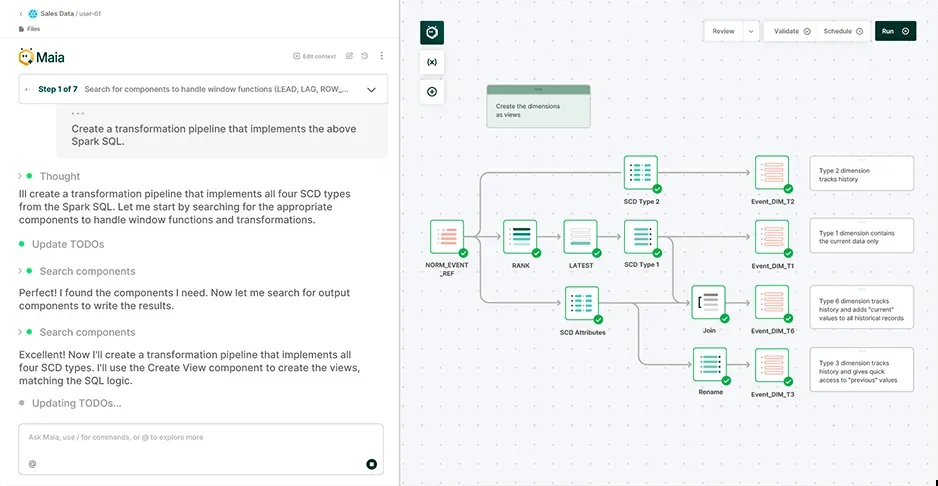
The platform is purpose-built for enterprise data teams that need to scale pipeline development without proportionally scaling headcount. Rather than offering a drag-and-drop pipeline builder or a connector catalog, Maia deploys specialized AI agents across the data lifecycle: Data Engineering, Data Quality, Connectivity, DataOps, FinOps, and Migration agents, each handling a distinct operational domain.
The target audience is mid-to-large enterprises with existing data infrastructure, particularly those running legacy ETL systems from vendors like Informatica, Alteryx, Talend, or Qlik that need cloud migration. Customer testimonials reference organizations like Nature's Touch, Precision Medicine Group, and Edmund Optics, suggesting traction in manufacturing, healthcare, and financial services verticals.
Key Features and Architecture
Maia's architecture centers on six core agent domains, each designed to automate a specific category of data work:
Data Engineering agents handle end-to-end pipeline design, building, and maintenance within a secure, governed architecture. Users can delegate pipeline creation via natural language prompts, and the platform supports both UI-based and direct SQL/Python workflows. Customer reports cite pipeline build times dropping from 2 days to 10 minutes for certain workloads.
Migration agents automate the conversion of legacy ETL/ELT pipelines to cloud-ready equivalents. The platform explicitly supports migration from Alteryx, Informatica, Talend, and Qlik. Matillion demonstrated converting 100 Informatica workloads in 30 minutes during a webinar, which, if reproducible in production, represents a significant acceleration over manual migration timelines.
Data Quality agents implement shift-left validation and cleansing, running data quality checks early in the pipeline rather than post-load. This keeps integrations trusted and resilient by catching issues before they propagate downstream.
Connectivity agents provide API-based integration with secure authentication and reverse ETL capabilities, enabling data syncing from and to diverse sources. The platform supports custom API connector building for sources without pre-built integrations.
DataOps agents automate pipeline monitoring, failure detection, root cause analysis, and remediation. This includes Git-based CI/CD pipelines with auditability, auto-documentation, and lineage tracking.
FinOps agents focus on cost optimization, spotting performance bottlenecks and tuning pipelines to stay within budget constraints. This is a differentiator that most competing ETL platforms lack entirely.
The underlying Maia Foundation layer provides enterprise-grade security, elastic scaling, and centralized control. Code conversion capabilities support SQL, SparkSQL, dbt, and Python optimization.
Ideal Use Cases
Legacy ETL migration to cloud: This is Maia's strongest use case. Organizations running Informatica, Alteryx, Talend, or Qlik workloads on-premises will find the automated migration agents compelling. The platform specifically targets this pain point and has published customer evidence around it.
Small data teams at enterprise scale: The Edmund Optics case study highlights a two-person data team delivering enterprise-level outcomes. If your organization has ambitious data goals but limited engineering headcount, Maia's agentic approach can bridge that gap.
Pipeline cost optimization: Teams running expensive Snowflake or cloud warehouse workloads benefit from the FinOps agents that identify bottlenecks and optimize performance. Nature's Touch caught a significant cost variance using the platform, as documented in their published case study.
Citizen data engineering: Organizations where business analysts need to build production-ready pipelines without relying on engineering teams. Maia's natural language interface enables non-engineers to create and debug complex workflows.
Pricing and Licensing
Matillion Data Productivity Cloud uses an enterprise pricing model that requires contacting their sales team for a custom quote. There are no publicly listed pricing tiers, no self-serve plans, and no free tier available.
This is consistent with the platform's enterprise positioning. Maia targets organizations large enough to have dedicated data teams and legacy ETL systems worth migrating, not individual developers or small startups experimenting with data pipelines.
For budget planning, the enterprise pricing model means you should expect a significant annual commitment. Given that Maia competes with enterprise-priced platforms like Talend and MuleSoft, expect a comparable annual commitment. Actual pricing will depend on data volume, number of agents deployed, and the scope of migration work.
Organizations evaluating Maia should request a proof-of-concept engagement to validate the platform against their specific workloads before committing to an annual contract.
Pros and Cons
Pros:
- Automated legacy ETL migration from Informatica, Alteryx, Talend, and Qlik dramatically reduces migration timelines
- AI agents mapped to distinct data team roles provide specialized automation rather than generic AI assistance
- Natural language pipeline creation enables citizen data engineering for non-technical users
- Built-in FinOps agents for pipeline cost optimization, a capability most competitors lack
- Git-based CI/CD with auto-documentation and lineage tracking supports enterprise governance requirements
- Customer evidence shows measurable outcomes: pipeline build time reduced by up to 85%, significant cost variance detection
Cons:
- No transparent pricing; enterprise-only model creates a high barrier to evaluation
- No free tier or self-serve option for teams wanting to test before committing
- Relatively new AI-first positioning (rebranded from Matillion to Maia) means the agentic capabilities are still maturing
- Limited independent third-party reviews available, making it harder to validate vendor claims
Alternatives and How It Compares
Airbyte is the strongest alternative for teams that want open-source flexibility. With 600+ connectors and a free self-hosted option, Airbyte is far more accessible. However, it focuses on ELT connector plumbing and lacks Maia's AI automation, migration agents, and FinOps capabilities.
Talend (now Qlik Talend Cloud) is the closest enterprise competitor. Talend offers mature data integration and governance across hybrid environments. It is a safer choice for organizations that prefer traditional, proven ETL tooling over AI-driven automation, but it lacks Maia's agentic approach to pipeline generation.
Stitch offers simple cloud ETL/ELT with a free tier and affordable Pro plans. It is best suited for smaller teams with straightforward SaaS data integration needs. Stitch cannot compete with Maia on pipeline complexity, migration, or AI automation.
Hevo Data provides an automated ELT platform with a free tier and low-cost Pro plans. Like Stitch, it excels at straightforward data loading but does not address legacy migration, FinOps, or agentic data engineering.
MuleSoft competes at the enterprise integration level with API-led connectivity and is also enterprise-priced with no public rate card. MuleSoft is stronger for application integration and API management but lacks Maia's dedicated focus on data pipeline automation, agentic data engineering, and legacy ETL migration.