In the four weeks ending 26 October, the clearest signal was that running AI got cheaper. OpenAI listed lower-priced Sol and Luna models, and Union.ai more than halved its entry B200 GPU rate for managed Flyte. Meanwhile, open-source projects that serve models and build agents drew the most developer attention on GitHub.
One thing reversed. Pricing searches, briefly the second-largest kind of search reaching Modern DataTools in September, fell behind comparisons again, which makes September look like a short spike rather than a lasting change.
AI got cheaper to run
OpenAI replaced its GPT-5.6 models with GPT-6 on its API page. The new Sol model costs half what GPT-5.6 Sol did, Luna costs half or less, and a new, more expensive Astra model sits on top. Because these are new models, this is a new price list rather than a discount on the old one. Union.ai, which offers a managed platform built on Flyte, replaced flat GPU rates with volume tiers.
| Vendor | Before | After |
|---|---|---|
| OpenAI, per 1M input / output tokens | GPT-5.6 Sol $4.00 / $20.00; GPT-5.6 Luna $0.20 / $1.20 | GPT-6 Sol $2.00 / $10.00; GPT-6 Luna $0.10 / $0.50; new GPT-6 Astra $10.00 / $50.00 |
| Union.ai for Flyte, per GPU hour | B200 $2.8483; H200 $1.5824 | B200 and H200 $1.2 for the first 1k hours a month, down to $0.8 above 10k |
Prices are as captured from OpenAI's API page on 2026-09-28 and Union.ai's pricing page on 2026-10-05. Vendor pages change often, so check the live page before you rely on a figure.
A rate is easier to judge as a bill. Here are the old and new list prices applied to one workload. The workloads are our assumptions, not typical customer usage.
| Example workload | Before, a month | After, a month |
|---|---|---|
| GPT-5.6 Sol to GPT-6 Sol: 10M input and 2M output tokens a day, for 30 days | $2,400 | $1,200 |
| GPT-5.6 Luna to GPT-6 Luna: the same workload | $132 | $60 |
| Union.ai, GPU-hour charge only: 1,000 B200 hours a month, inside the first volume tier | $2,848.30 | $1,200 |
The Union.ai example covers GPU hours only; Union.ai also charges for actions, CPU and memory. A real model bill also depends on your mix of input and output tokens and on caching or batch discounts, which list prices leave out. If you priced a workload on GPT-5.6, or hold a GPU quote from before October, price it again.
AI serving and agent projects drew the most attention
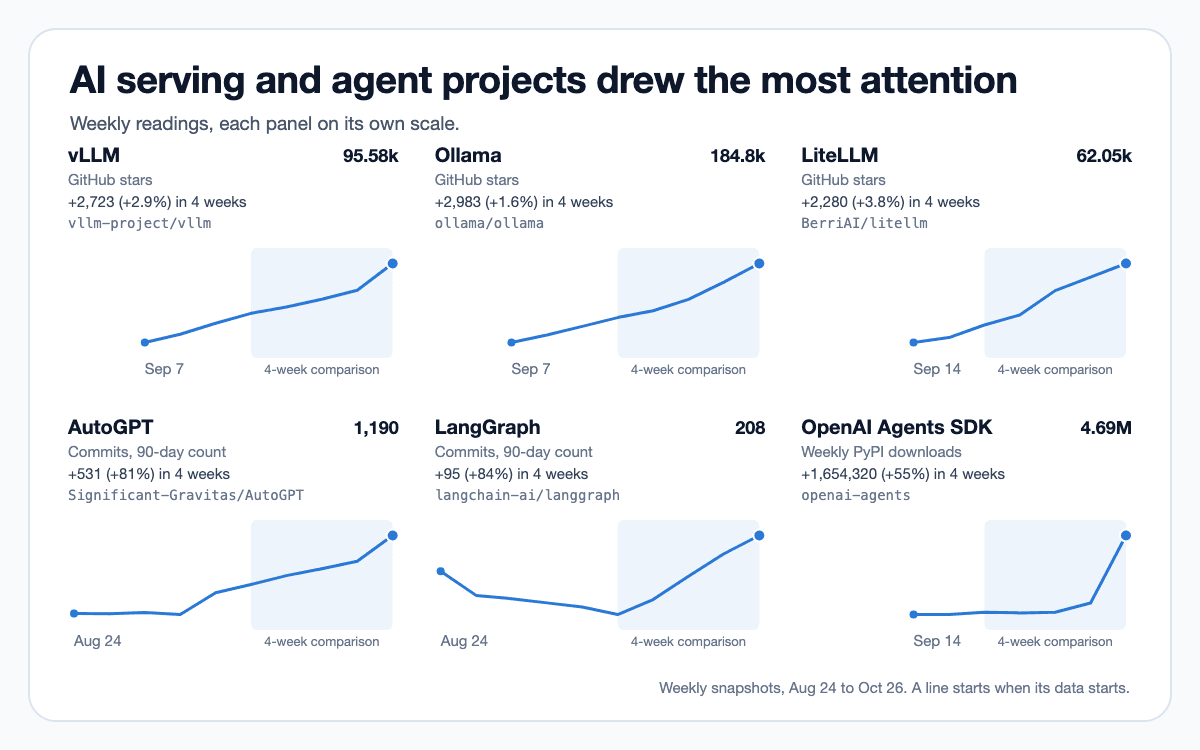
The projects that drew the most developer attention sit close to the model layer. Ollama runs models locally, vLLM serves them and LiteLLM routes calls across providers. All three were among the five repositories that added the most GitHub stars, each adding between 2,280 and 2,983, and vLLM added more forks than any other repository we track.
Agent frameworks sped up. AutoGPT's 90-day commit count rose from 659 to 1,190, after nearly doubling in September too, and it has risen every week since mid-September. LangGraph's rose from 113 to 208.
openai-agents, the package behind the OpenAI Agents SDK, looks impressive at first glance: weekly downloads rose 55%, to 4,7MM. But they had stayed close to 3MM for six weeks, and most of the rise came in the last week of October. For now that is a spike, not a trend. November will show whether the new level holds.
None of these numbers measures how many teams run a tool in production. Stars and forks show developer attention, commit counts show public development work, and weekly downloads include CI pipelines and automated installs.
What stands out is where the activity sits: in the software needed to run AI applications. Model serving, API routing and agent frameworks all drew attention. That suggests developer effort is going not only into the models themselves but into the tools that make them useful. It is an interpretation of where attention went, not evidence of adoption.
Comparison searches came back
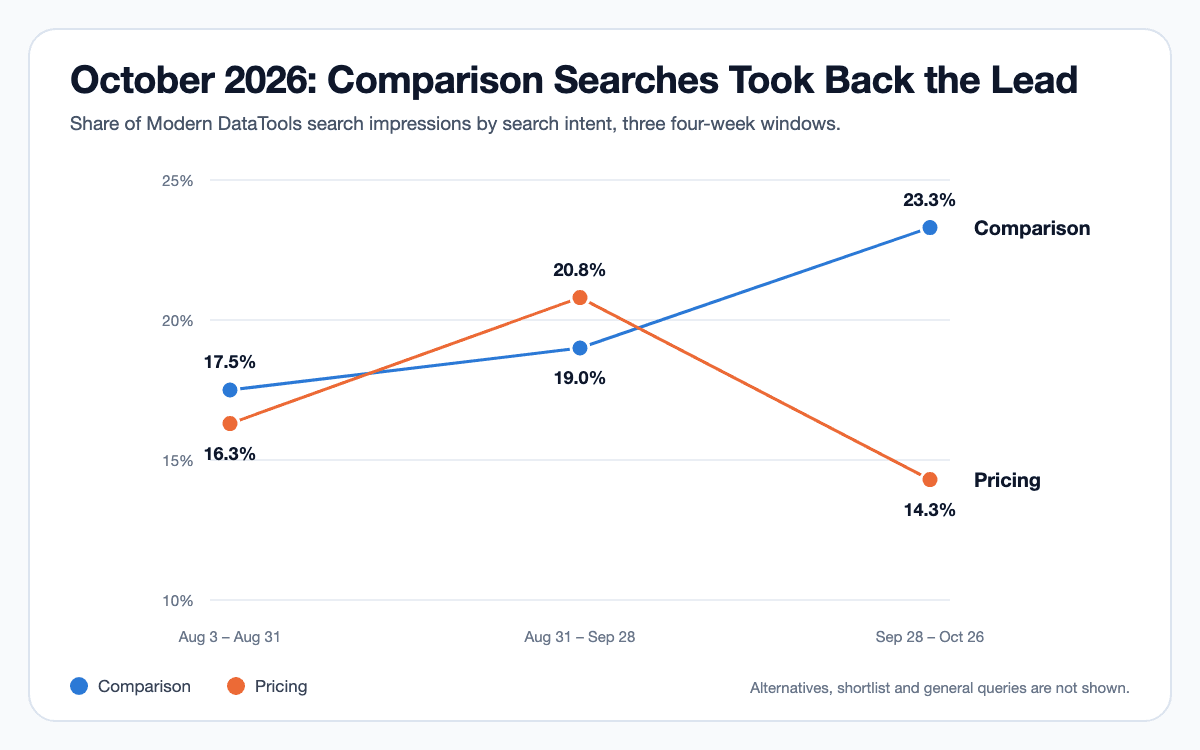
Searches reaching Modern DataTools moved back from pricing toward comparisons and alternatives. Comparison searches took 23.3% of impressions, up from 19.0%, and returned to second place. Pricing fell from 20.8% to 14.3%, and it was the only kind of search whose impressions fell. Alternatives searches grew as fast as comparisons.
This may mean more searchers were early in an evaluation, still choosing which tools to look at. But these are searches that reach our own site, so changes in our rankings and coverage can produce the same pattern.
Metadata tools appeared in more than one signal
The most useful findings are those that show up in more than one kind of evidence. In October, OpenMetadata rose from #7 to #2 in reader interest on Modern DataTools, and weekly downloads of its openmetadata-ingestion package rose 33%, from 38,056 to 50,772. DataHub's acryl-datahub package rose 43% in the same weeks. These measures come from different sources: one captures interest among our readers, the other package downloads. Their agreement is more informative than either alone, although both can respond to the same release or announcement, and one month is too little to establish a trend.
Airbyte had the largest rise in reader interest, from #6 to #1, and its 90-day commit count rose 20%. That fits the move to credit-based pricing we reported in September. We also updated our own Airbyte pages during October, though, so part of the rise may come from our site rather than the market.
What happened to September's signals?
| September's question | October reading | Verdict |
|---|---|---|
| Would pricing searches stay ahead of comparison searches? | Comparison 23.3% of impressions, pricing 14.3% | Did not hold |
| Would the pgvector Docker image keep growing far faster than the PostgreSQL image? | Docker Hub pulls +28.89% against +3.39% | Held |
Would weekly kedro downloads stay near 503,317? | 307,940 (−38.82%) | Did not hold |
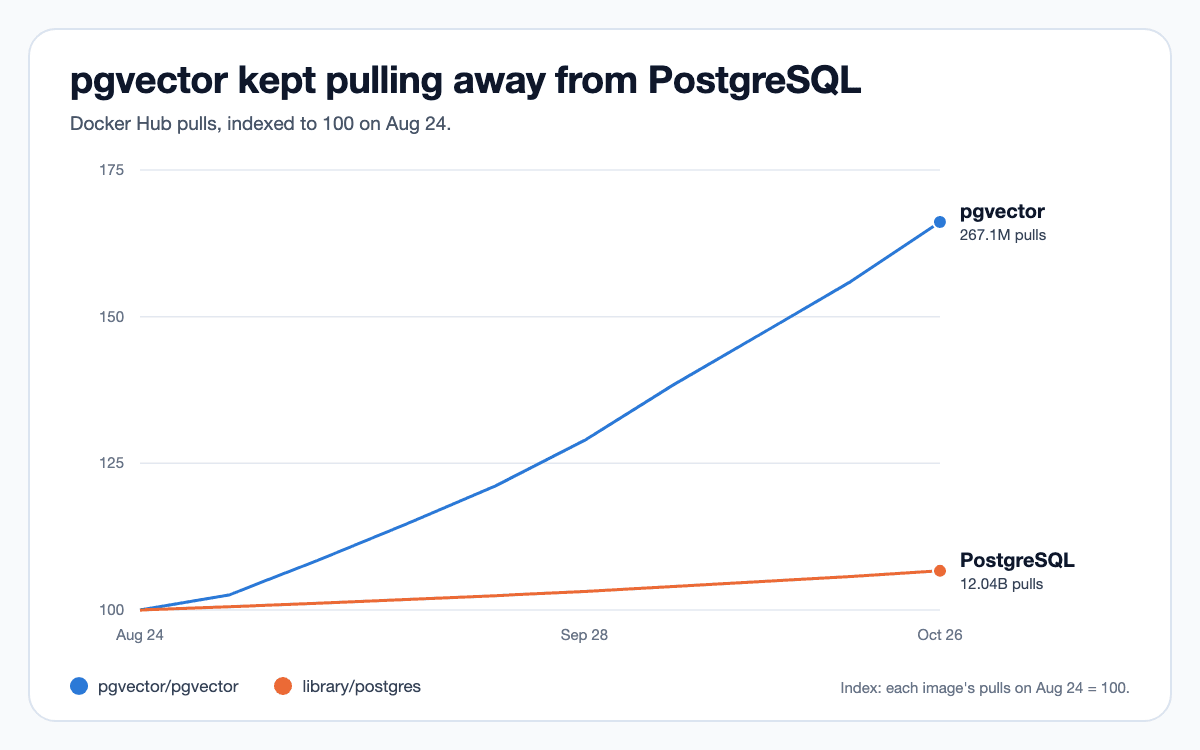
pgvector's Docker image has grown faster than PostgreSQL's in percentage terms for two consecutive months, though PostgreSQL still added far more pulls. The weekly line shows no single jump: pgvector added pulls at a steady, steep rate for ten weeks. It is still one image in one ecosystem, but persistence is the kind of evidence a single month cannot give. Kedro's downloads peaked in early October and then fell three weeks in a row, so September's jump looks like a release or pipeline effect.
Three things to watch in November
openai-agents: October ended with a sharp download spike. Does the new level hold?- Agent frameworks: AutoGPT and LangGraph sped up. Does the pace last?
- Metadata tools: OpenMetadata and DataHub moved together. Do they do it again?
Other verified changes
Smaller changes we verified on vendor pages in the same four weeks.
| Tool | Change |
|---|---|
| Weaviate | Flex backup rate rose from $0.0264 to $0.029 per GiB |
| AutoGPT | Plans now shown with monthly billing: Pro $50.00 and Max $320.00 a month, where the page showed $42.50 and $272.00 billed annually |
| ClawBox | One-time hardware price rose from €579 to €749 |
| OpenClaw | Now needs Node 24.16+ or 26.1+, where it accepted 22.22.3+, 24.15+ and 25.9+ |
| LocalAI | Released v4.11.0, up from v4.8.0 |
Methodology
We compare the Monday snapshots of 2026-09-28 and 2026-10-26, four weeks apart; the trend charts show weekly snapshots from 2026-08-24. GitHub, PyPI and Docker Hub metrics are directional signals for the named repository, package or image, not measures of market share or customer adoption. Vendor price changes come from vendor-published pages and are included only when we captured both the old and the new value. Full methodology.