Decision comparison
AppDynamics vs SigNoz
AppDynamics and SigNoz are at opposite ends of the commercial spectrum. AppDynamics is enterprise APM: vendor agents, automatic topology discovery, business-transaction framing and a support contract. SigNoz is open source and OpenTelemetry-native, covering metrics, logs and traces in one store, run on your infrastructure or theirs.
Direct comparison. These are reviewed substitutes bought for the same job, so the differences below are the ones that decide between them.
Applies to: Choosing between these two for the apm observability decision.
All 2 are observability platforms.
Quick Comparison
| Decision factor | AppDynamics | SigNoz |
|---|---|---|
| What it is | Cisco's enterprise APM platform, agent-based, organised around business transactions and available as SaaS or on-premise | An open-source, OpenTelemetry-native observability platform, self-hosted or run as a managed cloud service |
| Licensing | Commercial, licensed per agent or host | Open source, self-hosted or as SigNoz Cloud |
| Instrumentation | Language agents attached to application runtimes | OpenTelemetry-native, with no proprietary agent |
| Framing | Business transactions, with performance expressed in business terms | The three signals correlated in one store |
| Deployment | SaaS or on-premise | Your own infrastructure, or managed |
| Portability | Telemetry and instrumentation are tied to the vendor's agents | Instrumentation is standard OTLP and works against any compatible backend |
| Best fit | Large estates needing business framing and vendor accountability | Teams wanting an open platform on their own terms |
| Instrumentation path | OpenTelemetry SDKs in Python, Java, Node.js or Go emitting OTLP, or the platform's own agent | OpenTelemetry SDKs in Python, Java, Node.js or Go emitting OTLP, or the platform's own agent |
AppDynamics
- What it is:
- Cisco's enterprise APM platform, agent-based, organised around business transactions and available as SaaS or on-premise
- Licensing:
- Commercial, licensed per agent or host
- Instrumentation:
- Language agents attached to application runtimes
- Framing:
- Business transactions, with performance expressed in business terms
- Deployment:
- SaaS or on-premise
- Portability:
- Telemetry and instrumentation are tied to the vendor's agents
- Best fit:
- Large estates needing business framing and vendor accountability
- Instrumentation path:
- OpenTelemetry SDKs in Python, Java, Node.js or Go emitting OTLP, or the platform's own agent
SigNoz
- What it is:
- An open-source, OpenTelemetry-native observability platform, self-hosted or run as a managed cloud service
- Licensing:
- Open source, self-hosted or as SigNoz Cloud
- Instrumentation:
- OpenTelemetry-native, with no proprietary agent
- Framing:
- The three signals correlated in one store
- Deployment:
- Your own infrastructure, or managed
- Portability:
- Instrumentation is standard OTLP and works against any compatible backend
- Best fit:
- Teams wanting an open platform on their own terms
- Instrumentation path:
- OpenTelemetry SDKs in Python, Java, Node.js or Go emitting OTLP, or the platform's own agent
Public signals
Verified factual signals only. Bars appear only for like-for-like metrics with five weekly assessments for every tool; missing evidence stays explicit. These signals do not establish enterprise adoption, product quality, or total cost.
| Metric | AppDynamics | SigNoz |
|---|---|---|
| GitHub commits, 90d(Developer adoption) | 0 | Not available |
| GitHub stars(Developer adoption) | 7 | Not available |
| Search interest(Market interest) | 0 | 1 |
| Hacker News mentions, 90d(Community interest) | 0 | 3 |
| npm weekly downloads(Developer adoption) | 4.1k | Not available |
| PyPI weekly downloads(Developer adoption) | 60.3k | Not available |
| Stack Overflow questions(Community interest) | 193 | 9 |
| Docker Hub pulls(Product adoption) | Not available | 1.0M |
| GitHub commits, 90d(Product adoption) | Not available | 609 |
| GitHub stars(Product adoption) | Not available | 32,000+ |
As of September 14, 2026 — updated weekly.
Health & risk evidence
Observed public-source checks for mapped package versions and repositories.
AppDynamics
September 14, 2026Package vulnerabilities
npm · appdynamics@26.7.1 · PyPI · appdynamics@26.7.1.9060
0 vulnerabilities
across 2 packages
Repository security score
Not available
SigNoz
Package vulnerabilities
Not available
Repository security score
Not available
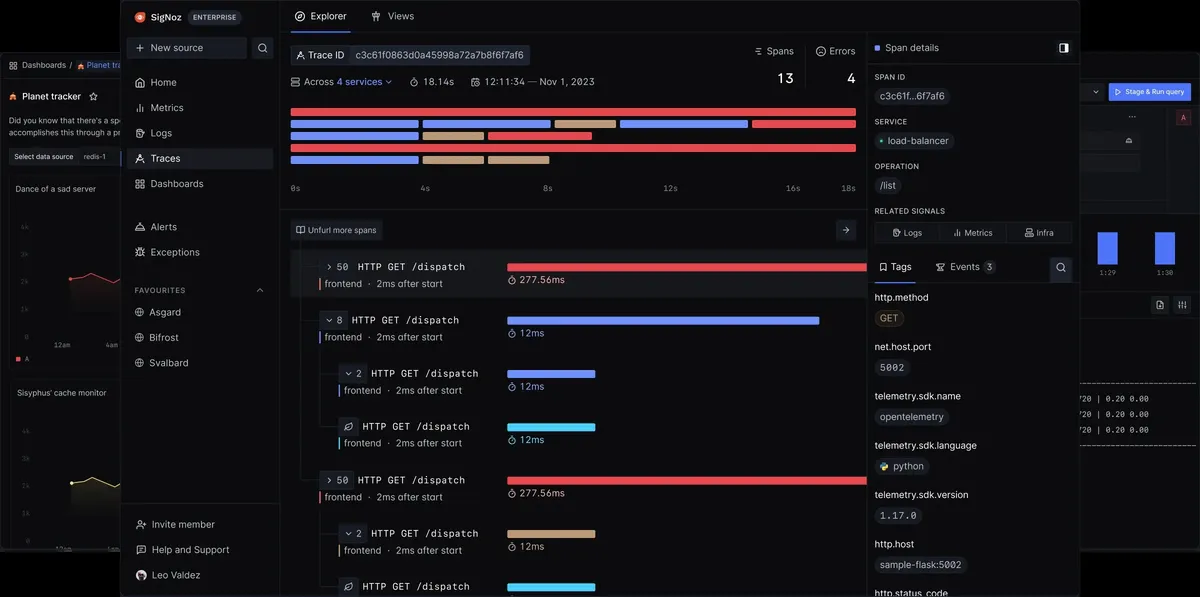
Interface Preview
SigNoz
Feature Comparison
| Feature | AppDynamics | SigNoz |
|---|---|---|
| Application | ||
| Business transaction monitoring | Full support | Not verified |
| Automatic topology discovery | Full support | Partial support |
| Code-level diagnostics | Full support | Partial support |
| Database call analysis | Full support | Partial support |
| Platform | ||
| Open source core | Not verified | Full support |
| Self-host the same software | Partial support | Full support |
| SQL access to telemetry | Not verified | Full support |
| Works without vendor agents | Partial support | Full support |
| Commercial | ||
| Usable free tier | Not verified | Full support |
| Vendor support accountability | Full support | Partial support |
| Enterprise access control | Full support | Partial support |
| Setup measured in minutes | Not verified | Full support |
| Standards | ||
| OpenTelemetry ingestion | Full support | Full support |
| Distributed tracing | Full support | Full support |
| Log search | Full support | Full support |
| Metrics dashboards and alerting | Full support | Full support |
Application
Business transaction monitoring
Automatic topology discovery
Code-level diagnostics
Database call analysis
Platform
Open source core
Self-host the same software
SQL access to telemetry
Works without vendor agents
Commercial
Usable free tier
Vendor support accountability
Enterprise access control
Setup measured in minutes
Standards
OpenTelemetry ingestion
Distributed tracing
Log search
Metrics dashboards and alerting
Which to choose
AppDynamics and SigNoz are at opposite ends of the commercial spectrum. AppDynamics is enterprise APM: vendor agents, automatic topology discovery, business-transaction framing and a support contract. SigNoz is open source and OpenTelemetry-native, covering metrics, logs and traces in one store, run on your infrastructure or theirs.
Best-fit scenarios
Choose AppDynamics if:
Choose AppDynamics when the estate is large and somebody must be accountable. Agents discover services without a map being drawn, code-level diagnostics point at the method, business transactions make performance legible to a non-technical audience, and a vendor is contractually on the hook when it does not work.
Choose SigNoz if:
Choose SigNoz when you want an open platform on your own terms. OpenTelemetry-native means no proprietary agent and instrumentation that works against any compatible backend, one store keeps correlation simple, and self-hosting keeps telemetry and its cost inside infrastructure you already run.
These scenarios reflect the available product evidence. Your requirements, existing stack, and team expertise should guide the final decision.
Frequently Asked Questions
What does OpenTelemetry-native mean in practice?
That the product's data model is the standard's rather than a vendor's, so there is no translation layer and no proprietary agent to install. Instrumentation written for it works unchanged against any other OTLP backend, which is what makes the decision reversible. Vendor agents still collect some application detail that generic instrumentation does not, so check whether the depth you rely on comes from the standard before assuming a clean swap.
What does self-hosting actually cost?
Storage is cheap; the engineer is not. Running an observability backend at production scale means capacity planning, upgrades, cardinality management and an on-call rotation that understands the telemetry system as well as the systems it watches. For a team already operating Kubernetes with ClickHouse or similar underneath, it is an incremental workload on existing skills. For a team without that, it is a job nobody has time for — which is why the open option also sells a managed tier.
How much does vendor accountability matter?
In proportion to how much revenue depends on the systems being watched. A commercial vendor can be escalated to and is contractually obliged to respond; an open-source project has a community whose response time you do not control, though the managed tier sells support for it. Decide whether you need somebody on the hook before weighing the licence saving.
What do these need to run?
An agent or an OpenTelemetry SDK in the application, and a destination. Services in Python, Java, Node.js or Go emit OTLP over HTTP or gRPC, and containers on Kubernetes are instrumented once per pod or once per node depending on the collector you choose. Nothing unusual is required on the application side; the operational weight sits in deciding what to sample, what to retain and for how long.
How portable is the instrumentation?
This is the sharpest difference between them. SigNoz is OpenTelemetry-native, so instrumentation is standard OTLP and the backend is genuinely replaceable — spans and attributes you write transfer anywhere. AppDynamics is built around its own agents, and the automatic discovery and code-level diagnostics that make it valuable are exactly the parts that do not transfer. If portability is a requirement rather than a preference, that settles a great deal before any feature comparison starts.
What actually drives the cost on each?
On AppDynamics, the agent count — so the bill follows hosts, containers and application tiers, and the decisive choices are which tiers get covered; horizontally scaled and ephemeral workloads are where the model strains. On SigNoz self-hosted, no licence and a ClickHouse cluster whose cost grows with hardware rather than telemetry sent, plus the engineering time to run it. That last line never arrives as an invoice, which is exactly why comparisons that conclude self-hosting is free have left it out.
Who is each one for?
AppDynamics is for an organisation with a large estate, services nobody instrumented by hand, and a requirement that a vendor be accountable when the platform fails. SigNoz is for a team whose engineers instrument their own code, who prefer open formats, and who want telemetry and its cost to stay inside infrastructure they already run. The question that separates them is not technical: it is whether you are buying accountability or buying ownership.
How should we evaluate them?
Send a slice of real traffic to both and then debug a real incident on each. Dashboards demo well and tell you very little; what matters is whether an engineer at 3am can go from an alert to the cause without knowing in advance which dashboard to open. OpenTelemetry makes that trial cheap, because the instrumentation is the same and only the destination changes.