Decision comparison
Elastic Observability vs SigNoz
Elastic Observability and SigNoz are both self-hostable and both cover the three signals, and they differ underneath. Elastic builds on Elasticsearch, so the same cluster and query language also serve enterprise search and security analytics — one platform for three jobs. SigNoz builds on ClickHouse and does observability only, which makes it a smaller thing to run and a columnar store better suited to aggregating large volumes of telemetry.
Architecture choice. These take different approaches to the same problem. Read the table as a fit question rather than a feature race.
Applies to: telemetry-retention and AI-assisted troubleshooting workloads
All 2 are observability platforms.
Quick Comparison
| Decision factor | Elastic Observability | SigNoz |
|---|---|---|
| What it is | Observability built on the Elasticsearch stack, sharing its storage and query engine with search and security use cases | An OpenTelemetry-native platform storing telemetry in ClickHouse |
| Storage engine | Elasticsearch, an inverted-index store tuned for text search as much as for telemetry | ClickHouse, a columnar analytical store tuned for aggregation over large event volumes |
| Language coverage | Elastic APM agents and OpenTelemetry for Java, Python, Node.js, Go and .NET | OpenTelemetry SDKs for Java, Python, Node.js, Go and .NET; no proprietary agent |
| Deployment | Self-hosted on Docker or Kubernetes, or Elastic Cloud on AWS, GCP and Azure | Self-hosted on Docker or Kubernetes anywhere, or SigNoz Cloud |
| Beyond observability | The same cluster serves enterprise search and security analytics, so one platform covers three jobs | Observability only; other workloads need other tools |
| Cost model | Open-source-licensed components plus paid tiers, or Elastic Cloud priced on resources | Free software; you pay for the ClickHouse cluster and the engineering time |
| Best fit | Organisations already running Elasticsearch, or wanting search, security and observability on one stack | Teams that want an OpenTelemetry-native backend with efficient telemetry storage |
Elastic Observability
- What it is:
- Observability built on the Elasticsearch stack, sharing its storage and query engine with search and security use cases
- Storage engine:
- Elasticsearch, an inverted-index store tuned for text search as much as for telemetry
- Language coverage:
- Elastic APM agents and OpenTelemetry for Java, Python, Node.js, Go and .NET
- Deployment:
- Self-hosted on Docker or Kubernetes, or Elastic Cloud on AWS, GCP and Azure
- Beyond observability:
- The same cluster serves enterprise search and security analytics, so one platform covers three jobs
- Cost model:
- Open-source-licensed components plus paid tiers, or Elastic Cloud priced on resources
- Best fit:
- Organisations already running Elasticsearch, or wanting search, security and observability on one stack
SigNoz
- What it is:
- An OpenTelemetry-native platform storing telemetry in ClickHouse
- Storage engine:
- ClickHouse, a columnar analytical store tuned for aggregation over large event volumes
- Language coverage:
- OpenTelemetry SDKs for Java, Python, Node.js, Go and .NET; no proprietary agent
- Deployment:
- Self-hosted on Docker or Kubernetes anywhere, or SigNoz Cloud
- Beyond observability:
- Observability only; other workloads need other tools
- Cost model:
- Free software; you pay for the ClickHouse cluster and the engineering time
- Best fit:
- Teams that want an OpenTelemetry-native backend with efficient telemetry storage
Public signals
Verified factual signals only. Bars appear only for like-for-like metrics with five weekly assessments for every tool; missing evidence stays explicit. These signals do not establish enterprise adoption, product quality, or total cost.
| Metric | Elastic Observability | SigNoz |
|---|---|---|
| GitHub commits, 90d(Developer adoption) | 423 | Not available |
| GitHub stars(Developer adoption) | 271 | Not available |
| Search interest(Market interest) | 0 | 1 |
| Hacker News mentions, 90d(Community interest) | 0 | 3 |
| Stack Overflow questions(Community interest) | 3.7k | 9 |
| Docker Hub pulls(Product adoption) | Not available | 1.0M |
| GitHub commits, 90d(Product adoption) | Not available | 609 |
| GitHub stars(Product adoption) | Not available | 32,000+ |
As of September 14, 2026 — updated weekly.
Interface Preview
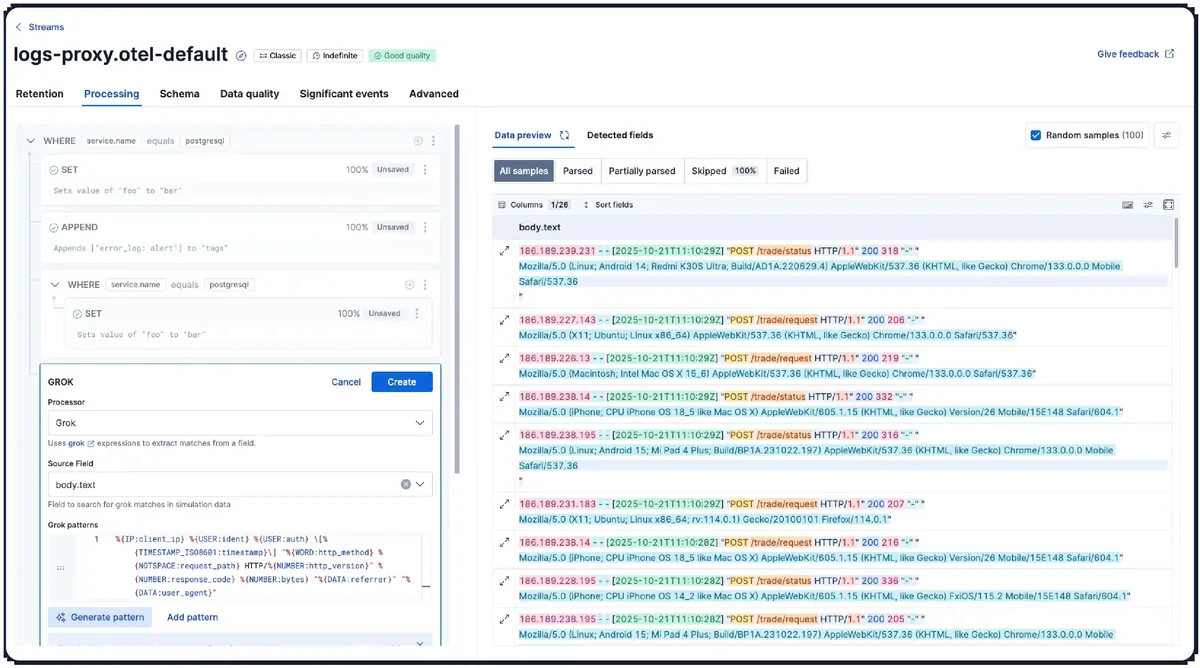
Elastic Observability
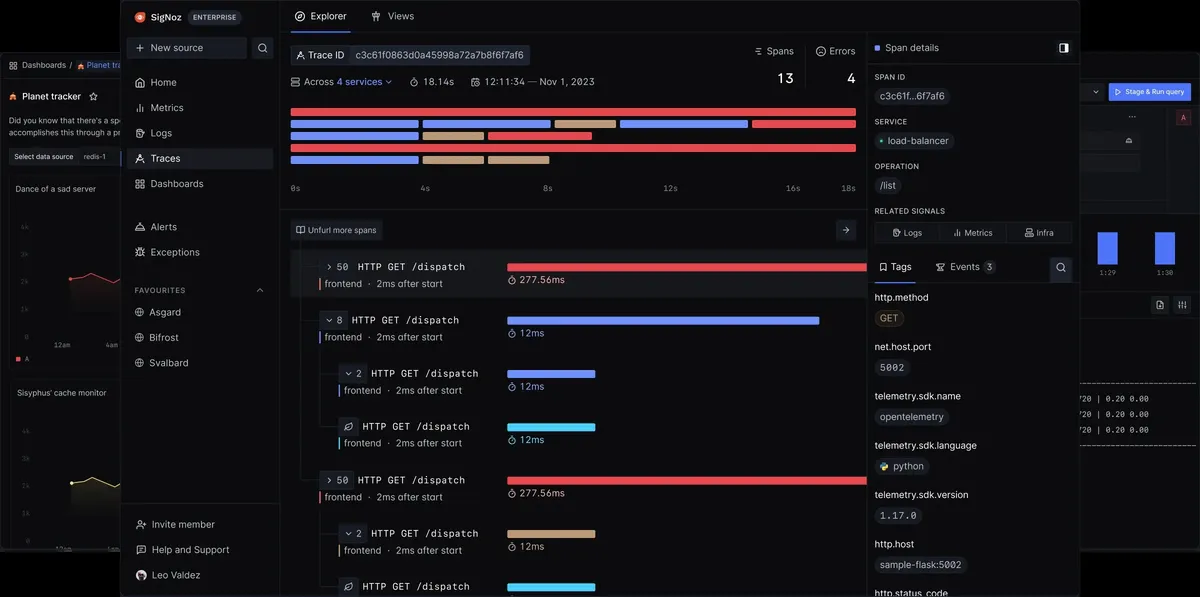
SigNoz
Feature Comparison
| Feature | Elastic Observability | SigNoz |
|---|---|---|
| Telemetry | ||
| Distributed tracing | Full support | Full support |
| Metrics and dashboards | Full support | Full support |
| Log management | Full support | Full support |
| Full-text log search | Full support | Partial support |
| Platform | ||
| Shared stack with enterprise search | Full support | Not verified |
| Security analytics on the same data | Full support | Not verified |
| OpenTelemetry-native | Partial support | Full support |
| Vendor-neutral instrumentation | Partial support | Full support |
| Operations | ||
| Self-hosted deployment | Full support | Full support |
| Managed cloud option | Full support | Full support |
| Data residency under your control | Full support | Full support |
| Single-purpose, smaller surface to run | Not verified | Full support |
| Commercial | ||
| Open-source licence | Partial support | Full support |
| Long retention without indexing charges | Partial support | Full support |
| Enterprise support | Full support | Partial support |
| Predictable cost at growing volume | Partial support | Full support |
Telemetry
Distributed tracing
Metrics and dashboards
Log management
Full-text log search
Platform
Shared stack with enterprise search
Security analytics on the same data
OpenTelemetry-native
Vendor-neutral instrumentation
Operations
Self-hosted deployment
Managed cloud option
Data residency under your control
Single-purpose, smaller surface to run
Commercial
Open-source licence
Long retention without indexing charges
Enterprise support
Predictable cost at growing volume
Which approach fits
Elastic Observability and SigNoz are both self-hostable and both cover the three signals, and they differ underneath. Elastic builds on Elasticsearch, so the same cluster and query language also serve enterprise search and security analytics — one platform for three jobs. SigNoz builds on ClickHouse and does observability only, which makes it a smaller thing to run and a columnar store better suited to aggregating large volumes of telemetry.
When each approach fits
Choose Elastic Observability if:
Choose Elastic Observability when Elasticsearch is already in your organisation, or when search and security analytics are needs alongside observability. Consolidating three workloads on one stack saves genuine operational effort, existing expertise carries over, and full-text log search is a real strength of an inverted-index store. It runs self-hosted or on Elastic Cloud across AWS, GCP and Azure.
Choose SigNoz if:
Choose SigNoz when observability is the only job and you want a smaller system doing it well. ClickHouse is a columnar store built for aggregating event volumes, which suits metrics and spans, and OpenTelemetry-native means instrumentation is not tied to the vendor. One purpose means less surface to operate, which matters when the team running it also has other work.
These scenarios reflect the available product evidence. Your requirements, existing stack, and team expertise should guide the final decision.
Frequently Asked Questions
Does the storage engine actually matter to me?
It shows up in two places. Elasticsearch's inverted index is excellent at full-text search across logs, so finding a rare string in months of data is a strength. ClickHouse's columnar layout is efficient at aggregation — percentile latencies across millions of spans, counts grouped by dimension — which is most of what metrics and trace analysis actually ask. If your work is mostly log grepping, that favours Elastic; if it is mostly aggregate analysis, it favours ClickHouse.
Is consolidating search, security and observability a good idea?
It can be a significant saving when all three are genuine needs, because one cluster, one operational skill set and one licence cover them. The risk is coupling: the three workloads compete for the same resources, and a security investigation running heavy queries can affect observability performance during an incident. Sizing and separation help, but the coupling is real and worth planning for.
Which is lighter to operate?
SigNoz, because it does one thing. Elasticsearch is a powerful and demanding system — shard sizing, index lifecycle management, JVM heap tuning and cluster health are ongoing responsibilities, and most teams that run it seriously have someone who knows it well. A ClickHouse-backed single-purpose platform is a smaller commitment, though not a trivial one.
How do they compare on OpenTelemetry?
Both ingest it. SigNoz is built around it — there is no other instrumentation path, so the data model matches OTel semantics directly. Elastic supports OpenTelemetry alongside its own APM agents, which are mature and well-instrumented for common runtimes. If vendor-neutral instrumentation is a priority, SigNoz's single path is the cleaner commitment.
What about long retention?
Both make it affordable relative to index-priced SaaS, since you control storage. Elasticsearch offers index lifecycle management to move older indices to cheaper tiers, which is mature and configurable. ClickHouse compresses telemetry efficiently, so raw retention is cheap by default. Either is a large improvement on paying per indexed span.