Decision comparison
CrewAI vs AutoGen
CrewAI delivers faster time-to-production for structured business workflows through role-based orchestration, built-in memory, a visual editor, and a managed cloud entry point of 50 free workflow executions per month. Additional CrewAI executions cost $0.50 each, while Enterprise pricing is custom. AutoGen provides deeper control over agent conversations for research-grade and highly customized multi-agent systems under a fully open-source MIT license. The deciding factor is whether teams need structured role-based workflows and managed tooling, or flexible conversation-driven coordination with programmable agent behavior.
AutoGen has a named successor from its own vendor
Microsoft merged AutoGen and Semantic Kernel into the Microsoft Agent Framework. AutoGen is in maintenance mode: it receives no new features or enhancements and is community managed going forward. Microsoft directs new projects to the Agent Framework.
Architecture choice. These take different approaches to the same problem. Read the table as a fit question rather than a feature race.
All 2 are agent frameworks.
Quick Comparison
| Decision factor | CrewAI | AutoGen |
|---|---|---|
| Agent Architecture | Role, backstory, and goal per agent with built-in short-term, long-term, and entity memory; agents collaborate on complex autonomous tasks. | ConversableAgent with configurable reply functions, system messages, and termination conditions; AgentChat builds conversational single- and multi-agent applications on Core. |
| Orchestration Model | Sequential, hierarchical, or consensual processes coordinate role-based agent teams, supporting reliable, controlled execution of complex enterprise workflows. | Conversation-based with group chat, nested chats, and custom speaker selection, enabling flexible coordination patterns for multi-agent applications. |
| Community Size | Growing ecosystem with pre-built crews, tools marketplace, and active GitHub community; the Python repository has 58,187 stars and MIT licensing. | 1.4M+ monthly PyPI downloads with large research community and active GitHub contributors; the Python repository has 60,852 stars. |
| Agent Definition | Role-based with backstory, goal, and tool assignment, enabling teams to define specialized agents for repetitive or time-consuming business work. | ConversableAgent with system message and configurable reply functions, allowing developers to tailor agent behavior, responses, and conversation termination conditions. |
| Pricing Model | Free tier: 50 executions/month, additional executions $0.50 each. Enterprise: custom pricing. | Open-source, MIT-licensed framework with no vendor-published paid tiers, monthly execution allowance, or dollar rate card; deployment and model costs are externally managed. |
| Development Experience | Visual editor and AI copilot support no-code building, while an intuitive API supports code-first teams creating crews and enterprise application integrations. | Studio provides a web-based no-code prototyping UI; AgentChat requires Python 3.10+ and supports programmable conversational agent applications. |
CrewAI
- Agent Architecture:
- Role, backstory, and goal per agent with built-in short-term, long-term, and entity memory; agents collaborate on complex autonomous tasks.
- Orchestration Model:
- Sequential, hierarchical, or consensual processes coordinate role-based agent teams, supporting reliable, controlled execution of complex enterprise workflows.
- Community Size:
- Growing ecosystem with pre-built crews, tools marketplace, and active GitHub community; the Python repository has 58,187 stars and MIT licensing.
- Agent Definition:
- Role-based with backstory, goal, and tool assignment, enabling teams to define specialized agents for repetitive or time-consuming business work.
- Pricing Model:
- Free tier: 50 executions/month, additional executions $0.50 each. Enterprise: custom pricing.
- Development Experience:
- Visual editor and AI copilot support no-code building, while an intuitive API supports code-first teams creating crews and enterprise application integrations.
AutoGen
- Agent Architecture:
- ConversableAgent with configurable reply functions, system messages, and termination conditions; AgentChat builds conversational single- and multi-agent applications on Core.
- Orchestration Model:
- Conversation-based with group chat, nested chats, and custom speaker selection, enabling flexible coordination patterns for multi-agent applications.
- Community Size:
- 1.4M+ monthly PyPI downloads with large research community and active GitHub contributors; the Python repository has 60,852 stars.
- Agent Definition:
- ConversableAgent with system message and configurable reply functions, allowing developers to tailor agent behavior, responses, and conversation termination conditions.
- Pricing Model:
- Open-source, MIT-licensed framework with no vendor-published paid tiers, monthly execution allowance, or dollar rate card; deployment and model costs are externally managed.
- Development Experience:
- Studio provides a web-based no-code prototyping UI; AgentChat requires Python 3.10+ and supports programmable conversational agent applications.
Public signals
Verified factual signals only. Bars appear only for like-for-like metrics with five weekly assessments for every tool; missing evidence stays explicit. These signals do not establish enterprise adoption, product quality, or total cost.
| Metric | CrewAI | AutoGen |
|---|---|---|
| GitHub commits, 90d(Product adoption) | 335 | 0 |
| GitHub stars(Product adoption) | 58,000+ | 60,000+ |
| Search interest(Market interest) | 4 | 1 |
| Hacker News mentions, 90d(Community interest) | 8 | 3 |
| PyPI weekly downloads(Product adoption) | 585.4k | 87.4k |
| Stack Overflow questions(Community interest) | 40 | 37 |
As of September 14, 2026 — updated weekly.
Health & risk evidence
Observed public-source checks for mapped package versions and repositories.
CrewAI
September 14, 2026Package vulnerabilities
PyPI · crewai@1.15.21
0 vulnerabilities
across 1 package
Repository security score
Not available
AutoGen
September 14, 2026Package vulnerabilities
PyPI · autogen-agentchat@0.7.5
0 vulnerabilities
across 1 package
Repository security score
Not available
Interface Preview
CrewAI
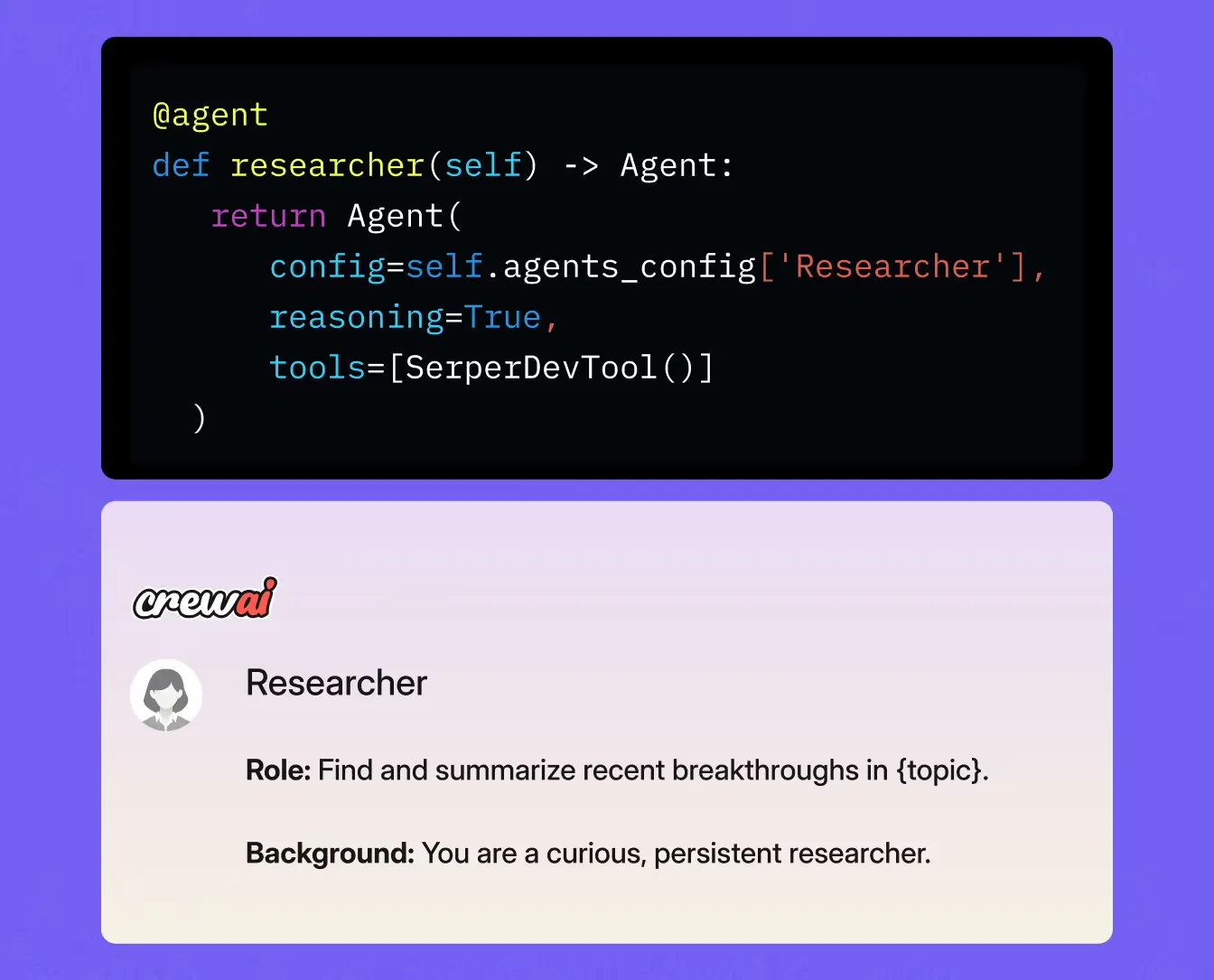
Feature Comparison
| Feature | CrewAI | AutoGen |
|---|---|---|
| Agent Design & Orchestration | ||
| Agent Definition | Role-based with backstory, goal, and tool assignment | ConversableAgent with system message and configurable reply functions |
| Orchestration Model | Sequential, hierarchical, or consensual processes | Conversation-based with group chat, nested chats, and custom speaker selection |
| Memory Systems | Built-in short-term, long-term, and entity memory | No built-in persistent memory; requires external implementation |
| Conversation Patterns | Linear task chains and delegation trees | Two-agent, sequential, group chat, and nested conversations |
| Developer Experience | ||
| Tool Integration | Decorator-based tool creation with 60+ pre-built tools | Function calling with OpenAI-compatible tool schemas |
| Visual Builder | Cloud-based visual editor with AI copilot | AutoGen Studio web UI for no-code prototyping |
| Code Execution | Sandboxed execution via tools | Built-in Docker-based and local code execution sandbox |
| Model Support | 100+ LLMs via LiteLLM including OpenAI, Anthropic, and Ollama | OpenAI, Azure OpenAI, Anthropic, and local models via unified config |
| Production & Operations | ||
| Human-in-the-Loop | Task-level human input configuration | UserProxyAgent with configurable human input mode |
| Error Recovery | Automatic retry with configurable max iterations | Customizable reply functions with termination conditions |
| Observability | Built-in logging and cloud dashboard with execution traces | Event-driven logging; third-party integration required for dashboards |
| Deployment | Managed cloud platform or self-hosted | Self-hosted only with Docker and Kubernetes guides |
| Licensing & Ecosystem | ||
| License | Apache 2.0 (framework), proprietary (cloud platform) | MIT License, fully open-source |
| Community Ecosystem | Growing marketplace of pre-built crews and tool integrations | Large research community with 1.4M+ monthly PyPI downloads |
Agent Design & Orchestration
Agent Definition
Orchestration Model
Memory Systems
Conversation Patterns
Developer Experience
Tool Integration
Visual Builder
Code Execution
Model Support
Production & Operations
Human-in-the-Loop
Error Recovery
Observability
Deployment
Licensing & Ecosystem
License
Community Ecosystem
Which approach fits
CrewAI delivers faster time-to-production for structured business workflows through role-based orchestration, built-in memory, a visual editor, and a managed cloud entry point of 50 free workflow executions per month. Additional CrewAI executions cost $0.50 each, while Enterprise pricing is custom. AutoGen provides deeper control over agent conversations for research-grade and highly customized multi-agent systems under a fully open-source MIT license. The deciding factor is whether teams need structured role-based workflows and managed tooling, or flexible conversation-driven coordination with programmable agent behavior.
When each approach fits
Choose CrewAI if:
Choose CrewAI for teams wanting fast prototype-to-production deployment with built-in memory, a visual editor, and managed cloud infrastructure. It is best for structured business workflows with clear agent role boundaries, particularly when 50 free monthly executions provide a useful starting allowance.
Choose AutoGen if:
Choose AutoGen for teams needing fine-grained control over multi-agent conversation patterns, full open-source ownership with MIT licensing, and Docker-based code execution for AI-assisted engineering workflows. Its Studio UI suits no-code prototyping, while AgentChat supports Python 3.10+ code-first applications with custom reply and termination behavior.
These scenarios reflect the available product evidence. Your requirements, existing stack, and team expertise should guide the final decision.
Frequently Asked Questions
Can CrewAI and AutoGen be used together in the same project?
Yes, although it requires custom integration work. Some teams use AutoGen for complex inner-loop conversation patterns between agents and CrewAI for the outer orchestration layer that manages the overall workflow. Both frameworks are Python-native, so you can instantiate agents from either framework within the same codebase.
Which framework has better support for local and open-source LLMs?
Both frameworks support local models, but through different mechanisms. CrewAI integrates with 100+ LLMs via LiteLLM, making it straightforward to swap between providers by changing a configuration string. AutoGen uses a model client abstraction that supports OpenAI-compatible APIs and custom model configurations.
How do the frameworks handle agent failures and error recovery?
CrewAI provides automatic retry at the task level with configurable maximum iterations, and its hierarchical process mode lets a manager agent reassign failed tasks. AutoGen handles errors through customizable reply functions and termination conditions, requiring more upfront error-handling code but offering finer control.
Is AutoGen still actively maintained after the Microsoft reorganization?
Yes. AutoGen underwent a major rewrite from version 0.2 to 0.4, transitioning to an event-driven architecture with the AgentChat and Core layers. The project continues to receive regular updates on GitHub and has an active community of contributors.