Decision comparison
Dagster vs Dataform
Dagster is the stronger choice for teams building complex, multi-step data pipelines across diverse infrastructure, while Dataform excels as a free, zero-ops SQL transformation layer for BigQuery-centric teams.
Used together. These are normally used together rather than chosen between. The comparison explains what each one does in the stack.
These are different kinds of product — Workflow Orchestrator and Transformation Framework.
Quick Comparison
| Decision factor | Dagster | Dataform |
|---|---|---|
| Primary Focus | Full data orchestration platform with asset-centric pipelines, lineage graphs, and ML workflow support | SQL-based data transformation tool designed specifically for managing BigQuery table definitions |
| Language & Approach | Python-first with declarative asset definitions, partitioning, and native integrations for Snowflake, dbt, Spark | SQLX language extending SQL with JavaScript for dependency management and incremental table support |
| Deployment Model | Self-hosted open-source (Apache-2.0), Dagster Cloud with Solo at $10/mo, Starter at $100/mo, Pro contact sales | Free Google Cloud service fully managed within BigQuery Studio with no separate infrastructure required |
| Observability | Built-in lineage graphs, health dashboards, real-time metrics, Slack alerting, and AI-powered debugging | Basic lineage tracking and data information integrated through BigQuery with manual or scheduled triggers |
| Integration Ecosystem | Native connectors for Snowflake, BigQuery, dbt, Databricks, Fivetran, Great Expectations, and Spark | Deep native BigQuery integration with GitHub and GitLab version control and Cloud Composer scheduling |
| Target User | Data engineering teams building complex multi-step pipelines across ETL, ML, and AI workflows | Data analysts and SQL-focused teams who need managed transformation pipelines inside BigQuery |
Dagster
- Primary Focus:
- Full data orchestration platform with asset-centric pipelines, lineage graphs, and ML workflow support
- Language & Approach:
- Python-first with declarative asset definitions, partitioning, and native integrations for Snowflake, dbt, Spark
- Deployment Model:
- Self-hosted open-source (Apache-2.0), Dagster Cloud with Solo at $10/mo, Starter at $100/mo, Pro contact sales
- Observability:
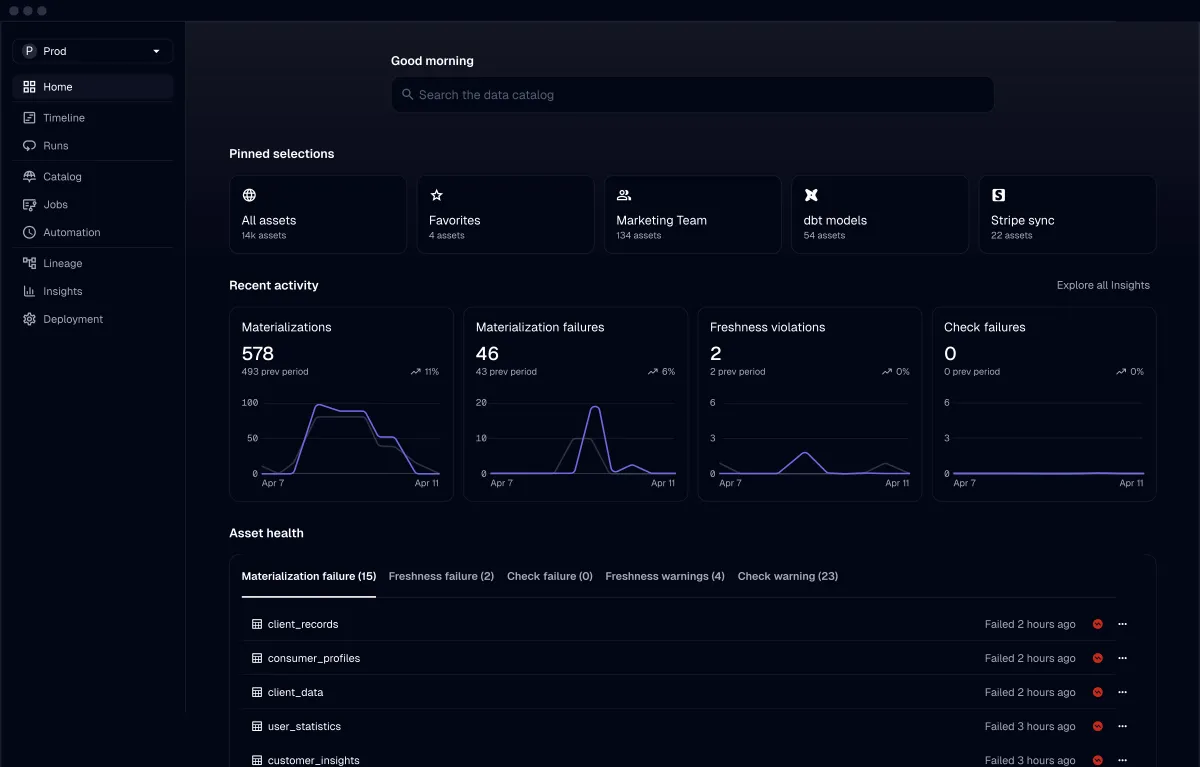
- Built-in lineage graphs, health dashboards, real-time metrics, Slack alerting, and AI-powered debugging
- Integration Ecosystem:
- Native connectors for Snowflake, BigQuery, dbt, Databricks, Fivetran, Great Expectations, and Spark
- Target User:
- Data engineering teams building complex multi-step pipelines across ETL, ML, and AI workflows
Dataform
- Primary Focus:
- SQL-based data transformation tool designed specifically for managing BigQuery table definitions
- Language & Approach:
- SQLX language extending SQL with JavaScript for dependency management and incremental table support
- Deployment Model:
- Free Google Cloud service fully managed within BigQuery Studio with no separate infrastructure required
- Observability:
- Basic lineage tracking and data information integrated through BigQuery with manual or scheduled triggers
- Integration Ecosystem:
- Deep native BigQuery integration with GitHub and GitLab version control and Cloud Composer scheduling
- Target User:
- Data analysts and SQL-focused teams who need managed transformation pipelines inside BigQuery
Public signals
Verified factual signals only. Bars appear only for like-for-like metrics with five weekly assessments for every tool; missing evidence stays explicit. These signals do not establish enterprise adoption, product quality, or total cost.
| Metric | Dagster | Dataform |
|---|---|---|
| Docker Hub pulls(Developer adoption) | 6.2M | Not available |
| GitHub commits, 90d(Product adoption) | 265 | 98 |
| GitHub stars(Product adoption) | 16,000+ | 995 |
| Search interest(Market interest) | 1 | Unavailable |
| Hacker News mentions, 90d(Community interest) | 3 | Not available |
| Product Hunt comments(Community interest) | 11 | 5 |
| Product Hunt rating(Community interest) | 5.0/5 | Unavailable |
| Product Hunt reviews(Community interest) | 1 | 0 |
| Product Hunt votes(Community interest) | 112 | 8 |
| PyPI weekly downloads(Product adoption) | 1.8M | Not available |
| Stack Overflow questions(Community interest) | 171 | 4 |
| npm weekly downloads(Developer adoption) | Not available | 613.6k |
| PyPI weekly downloads(Developer adoption) | Not available | 1.8M |
As of September 21, 2026 — updated weekly.
Health & risk evidence
Observed public-source checks for mapped package versions and repositories.
Dagster
September 21, 2026Package vulnerabilities
PyPI · dagster@1.13.23
0 vulnerabilities
across 1 package
Repository security score
github.com/dagster-io/dagster
5.1/10
Dataform
September 21, 2026Package vulnerabilities
npm · @dataform/core@3.0.70 · PyPI · google-cloud-dataform@0.11.3
0 vulnerabilities
across 2 packages
Repository security score
github.com/dataform-co/dataform
6.1/10
Interface Preview
Dagster
Feature Comparison
| Feature | Dagster | Dataform |
|---|---|---|
| Orchestration & Scheduling | ||
| Pipeline Orchestration | Asset-centric DAG orchestration with partitioning, backfills, and declarative dependency resolution | Serverless orchestration triggers SQL workflows manually or on schedule via Cloud Composer and Workflows |
| Scheduling System | Built-in scheduler with sensor-based triggers, partition-aware scheduling, and cron expressions | Scheduled via Cloud Composer, BigQuery Studio data pipelines, or third-party scheduling services |
| Workflow Triggers | Event-driven sensors, asset materialization triggers, and cross-pipeline dependency sensors | Manual execution, scheduled runs, or external triggers through Google Cloud Workflows |
| Data Transformation | ||
| Transformation Language | Python with native dbt, Databricks, and Spark integration for transformations across multiple engines | SQLX extending standard SQL with JavaScript for table definitions, dependencies, and assertions |
| Incremental Processing | First-class asset partitioning with time-based, static, and dynamic partition schemes | Incremental table support built into SQLX with automatic dependency-aware table updates |
| Data Quality | Built-in validation, freshness checks, and integration with Great Expectations for data quality assertions | Data quality assertions and tests defined directly in SQLX alongside table definitions |
| Development Experience | ||
| Local Development | Full local development with unit testing, CI pipeline support, and branch deployments on Dagster Cloud | Cloud-based development environment in BigQuery Studio with real-time error messages and dependency visualization |
| Version Control | Git-native with branch deployments for testing pipeline changes before production promotion | Git-based version control with GitHub and GitLab integration for commits and code reviews from browser |
| Documentation | Auto-generated data catalog with lineage, ownership metadata, and asset-level documentation | Automatic documentation generation with column descriptions defined alongside SQLX table definitions |
| Infrastructure & Security | ||
| Deployment Options | Single server, Kubernetes, or managed Dagster Cloud with hybrid bring-your-own-infrastructure patterns | Fully managed serverless within Google Cloud with no infrastructure provisioning or management required |
| Security & Compliance | SOC 2 Type II, HIPAA compliance, SSO with SAML, RBAC, SCIM provisioning, and audit logs | Inherits Google Cloud IAM, VPC Service Controls, and BigQuery security policies and encryption |
| Multi-tenancy | Multi-tenant code deployments with isolated instances and dedicated infrastructure per tenant | Managed through BigQuery project-level isolation and Google Cloud organizational policies |
| Monitoring & Observability | ||
| Lineage Tracking | Built-in interactive lineage graphs showing asset dependencies, upstream/downstream impact analysis | Lineage and data information tracked through Dataform integrations with BigQuery metadata |
| Alerting System | Intelligent Slack alerts with AI-powered debugging and automated impact analysis for incidents | Alerting managed through Google Cloud Monitoring and BigQuery audit logs integration |
| Cost Tracking | Built-in cost tracking and insights for monitoring resource utilization and optimizing platform spending | Cost visibility through BigQuery billing reports and Google Cloud cost management tools |
Orchestration & Scheduling
Pipeline Orchestration
Scheduling System
Workflow Triggers
Data Transformation
Transformation Language
Incremental Processing
Data Quality
Development Experience
Local Development
Version Control
Documentation
Infrastructure & Security
Deployment Options
Security & Compliance
Multi-tenancy
Monitoring & Observability
Lineage Tracking
Alerting System
Cost Tracking
How they fit together
Dagster is the stronger choice for teams building complex, multi-step data pipelines across diverse infrastructure, while Dataform excels as a free, zero-ops SQL transformation layer for BigQuery-centric teams.
What each one handles
Use Dagster for:
We recommend Dagster for data engineering teams that need a full orchestration platform spanning ETL, ML, and AI workflows. With 15,000+ GitHub stars and an Apache-2.0 license, Dagster provides asset-centric orchestration, built-in observability with lineage graphs and Slack alerting, and native integrations for Snowflake, BigQuery, dbt, Databricks, and Spark. The self-hosted version is free, while Dagster Cloud starts at $10/mo for solo developers. Enterprise teams benefit from SOC 2 Type II and HIPAA compliance, multi-tenant deployments, and dedicated support.
Use Dataform for:
We recommend Dataform for data analysts and SQL-focused teams working primarily within Google BigQuery. Dataform is a free Google Cloud service that provides a fully managed, serverless environment for writing SQL transformations using SQLX, a language extending SQL with JavaScript. The cloud development environment includes real-time error messages, dependency visualization, and built-in Git integration with GitHub and GitLab. Teams that want zero infrastructure management and need to build production-grade SQL pipelines without leaving their browser will find Dataform a strong fit.
These roles reflect the available product evidence. Most teams run both; which one owns a given job depends on your stack and team.
Frequently Asked Questions
Can Dagster and Dataform work together in the same data stack?
Yes, Dagster and Dataform can complement each other in a data stack. Dagster serves as the top-level orchestrator managing the full pipeline lifecycle, including ETL ingestion, ML workflows, and cross-system dependencies. Dataform handles SQL-based transformations specifically within BigQuery. Teams using this pattern typically run Dataform for their BigQuery transformation layer while Dagster orchestrates the broader pipeline, triggers Dataform workflows, and provides unified lineage across all systems.
What are the main cost differences between Dagster and Dataform?
Dataform is a free Google Cloud service with no direct charges; costs come only from BigQuery compute when executing transformations. Dagster's open-source version is also free to self-host under the Apache-2.0 license, but requires infrastructure management. Dagster Cloud pricing starts at $10/mo for the Solo plan (1 user, 7,500 credits), $100/mo for Starter (3 users, 30,000 credits), and $1,200/mo for annual Starter. Pro and Enterprise plans require contacting sales. The infrastructure and operational overhead of self-hosting Dagster is the primary hidden cost to consider.
Which tool is better for teams that primarily use BigQuery?
For teams working exclusively within BigQuery, Dataform is the more natural choice. It is built directly into Google Cloud and BigQuery Studio, providing a zero-infrastructure SQL transformation environment with native lineage tracking and serverless orchestration. Dagster is the better option if your BigQuery team also needs to orchestrate ingestion from external sources, run dbt models, manage ML pipelines, or coordinate workflows across Snowflake, Databricks, or other systems alongside BigQuery.
How do Dagster and Dataform handle data quality testing?
Dagster embeds data quality directly into its asset-centric model with built-in validation, freshness checks, and automated testing. It integrates natively with Great Expectations for advanced assertion libraries and provides proactive alerting through Slack when quality checks fail. Dataform handles data quality through assertions and tests defined in SQLX files alongside table definitions. These assertions run as part of the workflow execution and validate that output tables meet expected conditions. Dagster offers broader quality coverage across multi-system pipelines, while Dataform keeps quality checks tightly coupled with SQL transformations.