Decision comparison
Dagster vs Hevo Data
Dagster is the superior choice for engineering teams building complex, code-first data platforms with full orchestration control, while Hevo Data wins for teams needing fast no-code ELT setup with 150+ pre-built connectors and automatic pipeline management.
Used together. These are normally used together rather than chosen between. The comparison explains what each one does in the stack.
These are different kinds of product — Workflow Orchestrator and ELT Platform.
Quick Comparison
| Decision factor | Dagster | Hevo Data |
|---|---|---|
| Best For | Engineering teams building asset-centric data platforms with full orchestration control and code-first workflows | Data teams needing no-code ELT pipelines with 150+ pre-built connectors and automatic schema management |
| Pricing Model | Open-source self-hosted free (Apache-2.0), Solo Plan $10/mo, Starter Plan $100/mo, Starter $1200/mo, Pro and Enterprise Plan contact sales | Free plan is free forever for a limited connector set, with up to 1 million events per month. Starter is $265 per month billed annually or $299 billed monthly, from 5 million events. Professional is $750 per month billed annually or $849 billed monthly, from 20 million events. Business Critical is custom priced. Plans scale with monthly event volume, not rows. |
| Ease of Setup | Requires Python development skills for pipeline definitions with flexible Kubernetes or cloud deployment options | No-code setup with point-and-click configuration, pipelines running in minutes with zero engineering overhead |
| Data Integration | Native integrations for Snowflake, BigQuery, dbt, Databricks, Fivetran, Spark with extensible Python framework | 150+ pre-built connectors for databases, SaaS tools, files, and REST APIs with automatic auth and schema handling |
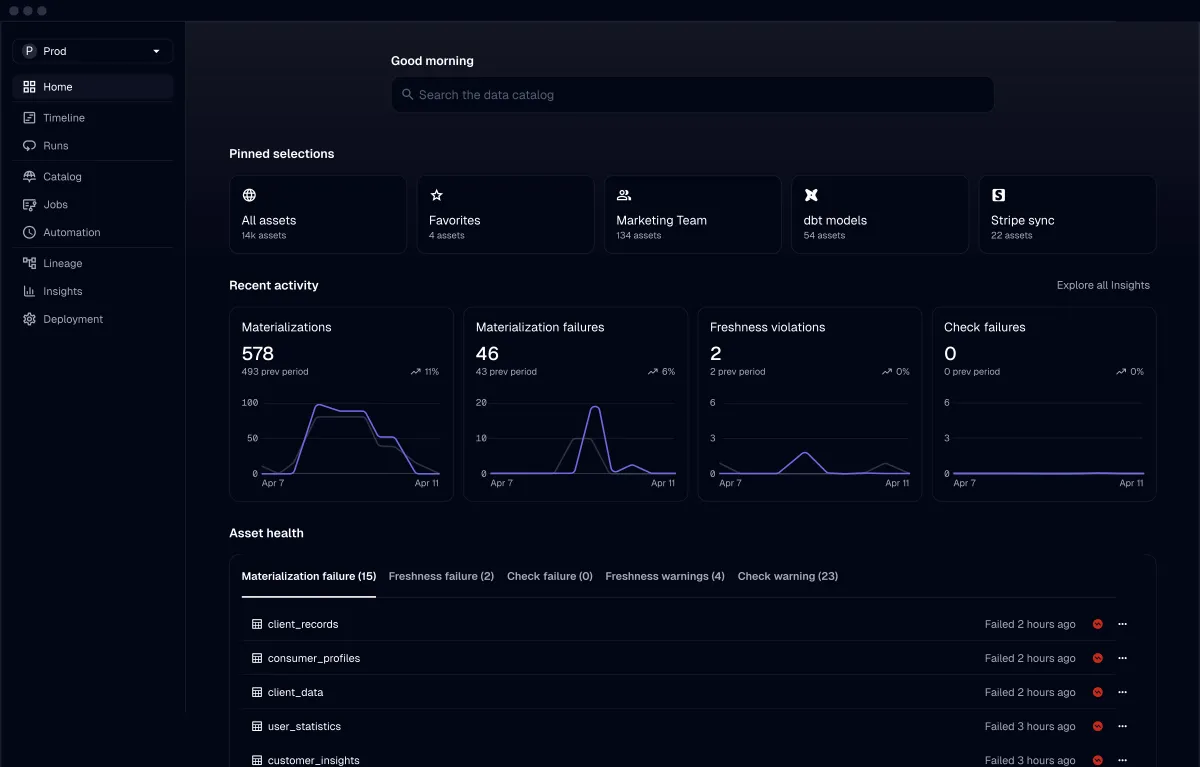
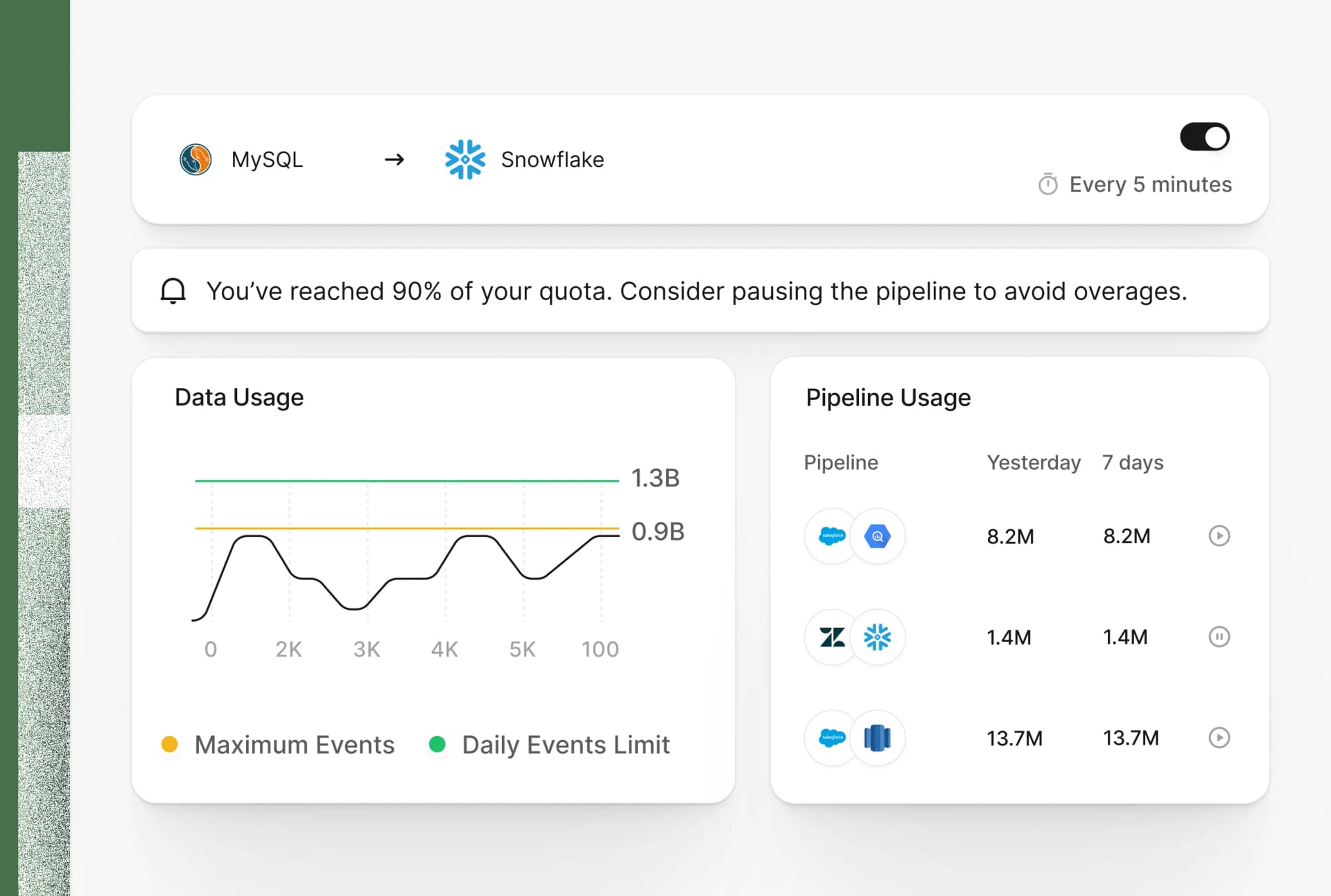
| Observability | Built-in lineage graphs, asset health checks, freshness monitoring, Slack alerting, and AI-powered debugging | Real-time pipeline monitoring with latency tracking, throughput metrics, activity logs, and proactive change alerts |
| Security & Compliance | SOC 2 Type II, HIPAA compliant with SSO, RBAC, SCIM provisioning, audit logs, and multi-tenant isolation | SOC 2 Type II, GDPR, HIPAA certified with dedicated VPCs, SSH/SSL encryption, RBAC, and regional residency |
Dagster
- Best For:
- Engineering teams building asset-centric data platforms with full orchestration control and code-first workflows
- Pricing Model:
- Open-source self-hosted free (Apache-2.0), Solo Plan $10/mo, Starter Plan $100/mo, Starter $1200/mo, Pro and Enterprise Plan contact sales
- Ease of Setup:
- Requires Python development skills for pipeline definitions with flexible Kubernetes or cloud deployment options
- Data Integration:
- Native integrations for Snowflake, BigQuery, dbt, Databricks, Fivetran, Spark with extensible Python framework
- Observability:
- Built-in lineage graphs, asset health checks, freshness monitoring, Slack alerting, and AI-powered debugging
- Security & Compliance:
- SOC 2 Type II, HIPAA compliant with SSO, RBAC, SCIM provisioning, audit logs, and multi-tenant isolation
Hevo Data
- Best For:
- Data teams needing no-code ELT pipelines with 150+ pre-built connectors and automatic schema management
- Pricing Model:
- Free plan is free forever for a limited connector set, with up to 1 million events per month. Starter is $265 per month billed annually or $299 billed monthly, from 5 million events. Professional is $750 per month billed annually or $849 billed monthly, from 20 million events. Business Critical is custom priced. Plans scale with monthly event volume, not rows.
- Ease of Setup:
- No-code setup with point-and-click configuration, pipelines running in minutes with zero engineering overhead
- Data Integration:
- 150+ pre-built connectors for databases, SaaS tools, files, and REST APIs with automatic auth and schema handling
- Observability:
- Real-time pipeline monitoring with latency tracking, throughput metrics, activity logs, and proactive change alerts
- Security & Compliance:
- SOC 2 Type II, GDPR, HIPAA certified with dedicated VPCs, SSH/SSL encryption, RBAC, and regional residency
Public signals
Verified factual signals only. Bars appear only for like-for-like metrics with five weekly assessments for every tool; missing evidence stays explicit. These signals do not establish enterprise adoption, product quality, or total cost.
| Metric | Dagster | Hevo Data |
|---|---|---|
| Docker Hub pulls(Developer adoption) | 6.2M | Not available |
| GitHub commits, 90d(Product adoption) | 265 | Not available |
| GitHub stars(Product adoption) | 16,000+ | Not available |
| Search interest(Market interest) | 1 | 0 |
| Hacker News mentions, 90d(Community interest) | 3 | Not available |
| Product Hunt comments(Community interest) | 11 | 2 |
| Product Hunt rating(Community interest) | 5.0/5 | Unavailable |
| Product Hunt reviews(Community interest) | 1 | 0 |
| Product Hunt votes(Community interest) | 112 | 90 |
| PyPI weekly downloads(Product adoption) | 1.8M | Not available |
| Stack Overflow questions(Community interest) | 171 | Not available |
As of September 21, 2026 — updated weekly.
Health & risk evidence
Observed public-source checks for mapped package versions and repositories.
Dagster
September 21, 2026Package vulnerabilities
PyPI · dagster@1.13.23
0 vulnerabilities
across 1 package
Repository security score
github.com/dagster-io/dagster
5.1/10
Hevo Data
Package vulnerabilities
Not available
Repository security score
Not available
Interface Preview
Dagster
Hevo Data
Feature Comparison
| Feature | Dagster | Hevo Data |
|---|---|---|
| Data Orchestration | ||
| Pipeline Architecture | Asset-centric DAGs with declarative definitions in Python, supporting partitioning and incremental runs | No-code ELT pipelines with isolated execution, auto-retries, and fault-tolerant cascading failure prevention |
| Workflow Scheduling | Flexible scheduling with sensors, cron-based schedules, and asset materialization triggers | 1-hour minimum scheduling interval on Free tier with configurable frequency on paid plans |
| Data Transformation | Orchestrates dbt, Databricks, and Python transformations with full dependency tracking across assets | Built-in dbt integration plus SQL models and Hevo transformers managed within fault-tolerant pipelines |
| Integration & Connectivity | ||
| Source Connectors | Native integrations for Snowflake, BigQuery, dbt, Databricks, Fivetran, Spark, and Great Expectations | 150+ pre-built battle-tested connectors for databases, SaaS tools, files, and REST APIs |
| CDC Capabilities | Supports CDC through integration partners like Fivetran and custom Python-based implementations | Best-in-class log-based CDC pipelines ensuring near real-time replication with zero data loss |
| Reverse ETL | Not a core feature; requires custom pipeline development or third-party integration | Built-in bi-directional data pipeline support with native Reverse ETL capabilities |
| Monitoring & Reliability | ||
| Data Lineage | First-class asset lineage graphs with auto-generated documentation and dependency visualization | Pipeline-level visibility with real-time operational logs and granular system-level monitoring |
| Schema Management | Developer-managed schema changes through code with version control and CI/CD integration | Self-healing schema that automatically detects drift and updates mappings without downtime |
| Error Handling | AI-powered debugging with impact analysis, intelligent alerting, and streamlined resolution workflows | Automatic record failure recovery with isolated pipelines preventing cascading failures across jobs |
| Deployment & Scalability | ||
| Deployment Options | Self-hosted on single server or Kubernetes, or managed Dagster+ Cloud with hybrid bring-your-own-infrastructure | Fully managed SaaS platform with no infrastructure management required from the user |
| Multi-Tenancy | Multi-tenant instances with isolated code deployments, multiple workspaces, and branch deployments | Multiple Workspaces available on Enterprise plan with VPC Peering for network isolation |
| Scalability Architecture | Kubernetes-native scaling with modular code locations and unlimited deployments on Pro plan | Automatically scales with data growth from 10x to 100x without engineering or infrastructure changes |
| Enterprise & Security | ||
| Access Control | SSO with Google, GitHub, and SAML IdPs plus RBAC and SCIM provisioning for team management | Role Based Access Control and Single sign-on available on Enterprise plan with audit trails |
| Compliance Certifications | SOC 2 Type II and HIPAA with independent auditing and custom security questionnaires on Pro/Enterprise | SOC 2 Type II, GDPR, and HIPAA certified with dedicated VPCs and regional data residency |
| Support Model | Community support for open-source, dedicated enterprise support with private Slack channel on Pro plan | 24x7 real engineer support across all plans with email and live chat, dedicated support on Enterprise |
Data Orchestration
Pipeline Architecture
Workflow Scheduling
Data Transformation
Integration & Connectivity
Source Connectors
CDC Capabilities
Reverse ETL
Monitoring & Reliability
Data Lineage
Schema Management
Error Handling
Deployment & Scalability
Deployment Options
Multi-Tenancy
Scalability Architecture
Enterprise & Security
Access Control
Compliance Certifications
Support Model
How they fit together
Dagster is the superior choice for engineering teams building complex, code-first data platforms with full orchestration control, while Hevo Data wins for teams needing fast no-code ELT setup with 150+ pre-built connectors and automatic pipeline management.
What each one handles
Use Dagster for:
Choose Dagster if your team has Python development expertise and needs a comprehensive data orchestration platform. Dagster excels at managing complex asset dependencies, orchestrating dbt and Databricks transformations, and providing deep lineage visibility across your entire data stack. With 15,348 GitHub stars and an Apache-2.0 license, it offers full flexibility for self-hosted deployments on Kubernetes while also providing managed Dagster+ Cloud options starting at just $10/mo for personal projects.
Use Hevo Data for:
Choose Hevo Data if your team prioritizes speed of setup and operational simplicity over orchestration flexibility. Hevo delivers 150+ pre-built connectors with no-code configuration, self-healing schema management, and log-based CDC for near real-time replication. Trusted by 2,000+ companies including ThoughtSpot (85% cost reduction) and Postman (40 hours saved monthly), it handles the entire ELT lifecycle with built-in dbt integration. The Starter plan at $299/mo includes up to 10 users with 24x7 engineer support.
These roles reflect the available product evidence. Most teams run both; which one owns a given job depends on your stack and team.
Frequently Asked Questions
Is Dagster truly free to use, and what are its paid plan limitations?
Dagster's core open-source project is completely free under the Apache-2.0 license, and you can self-host it on your own infrastructure with no restrictions. The managed Dagster+ Cloud service offers a Solo plan at $10/mo with 7,500 credits, 1 user, and 1 code location. The Starter plan costs $100/mo with 30,000 credits, up to 3 users, and 5 code locations. Both include a 30-day free trial. Pro and Enterprise plans require contacting sales and add unlimited code locations, cost tracking insights, uptime SLAs, and a private Slack channel for support.
How does Hevo Data's pricing compare for growing teams?
Hevo Data offers a free tier with 1 million rows of data processing. The Starter plan costs $299/mo (or $239/mo billed annually) and includes up to 10 users, 150+ connectors, dbt integration, and SSH/SSL security. The Professional plan at $849/mo ($679/mo annual) adds unlimited users, Hevo APIs for pipeline automation, and Reverse SSH. The Enterprise plan includes streaming pipelines, RBAC, SSO, multiple workspaces, VPC peering, and advanced security certificates. All paid plans include 24x7 email and live chat support with real engineers.
Can Dagster and Hevo Data work together in the same data stack?
Dagster and Hevo Data serve complementary roles and can work together effectively. Hevo Data handles the ingestion layer, extracting data from 150+ sources using its no-code connectors and log-based CDC replication, then loading it into your data warehouse. Dagster then orchestrates the downstream transformation and modeling workflows, managing dbt runs, Python transformations, and ML pipelines with full asset lineage tracking. This combination gives teams Hevo's operational simplicity for data ingestion paired with Dagster's powerful orchestration for complex multi-step data processing workflows.
Which platform provides better observability and monitoring for production pipelines?
Both platforms provide strong observability, but they approach it differently. Dagster offers integrated lineage graphs that visualize asset dependencies across your entire data platform, real-time health metrics tracking freshness and performance, intelligent Slack alerting, and AI-powered debugging with impact analysis. Hevo Data provides real-time pipeline monitoring with granular system-level operational logs, latency and throughput metrics, proactive alerts on schema changes, and unified live dashboards. Dagster's observability is deeper for complex multi-step orchestration workflows, while Hevo's monitoring focuses on pipeline health and data replication reliability.