Decision comparison
Dagster vs Polytomic
Dagster is the superior choice for data engineering teams orchestrating complex pipelines with code, while Polytomic wins for business teams needing fast, no-code data syncing between SaaS apps and warehouses.
Used together. These are normally used together rather than chosen between. The comparison explains what each one does in the stack.
These are different kinds of product — Workflow Orchestrator and Customer Data Platform.
Quick Comparison
| Decision factor | Dagster | Polytomic |
|---|---|---|
| Best For | Data engineering teams building complex, asset-centric orchestration pipelines with full lineage and observability across dbt, Spark, and ML workflows | Business and operations teams syncing data bidirectionally between warehouses, SaaS apps, spreadsheets, and APIs without writing code |
| Pricing | Open-source self-hosted free (Apache-2.0), Solo Plan $10/mo, Starter Plan $100/mo, Starter $1200/mo, Pro and Enterprise Plan contact sales | Polytomic states that pricing begins at $500 per month. Its published tiers are Standard, which adds syncing to and from databases, warehouses, spreadsheets, apps and APIs with multiple sync destinations and live chat support, and Enterprise, which adds on-prem deployment, SSO, a dedicated engineer and phone support. Both are quote-only beyond the stated starting point. |
| Ease of Use | Developer-focused platform requiring Python code to define assets and pipelines, with built-in testing and branch deployments for CI/CD workflows | No-code point-and-click interface for selecting, filtering, and syncing data, with optional SQL query support for advanced transformations |
| Integration Ecosystem | Native integrations for Snowflake, BigQuery, dbt, Databricks, Fivetran, Spark, with Dagster Pipes for external system observability tracking | Two-way integrations with Snowflake, Salesforce, BigQuery, Marketo, Stripe, Databricks, NetSuite, Google Sheets, HubSpot, and HTTP APIs |
| Deployment Options | Self-hosted on single server or Kubernetes, managed Dagster Cloud with hybrid bring-your-own-infrastructure, North American and European regions | Cloud-hosted SaaS platform with self-hosting available as turnkey deployment to your private cloud via Terraform or code |
| Security & Compliance | SOC 2 Type II and HIPAA certified, SSO with Google/GitHub/SAML, RBAC with SCIM provisioning, multi-tenant instances, and audit logs | SOC 2, GDPR, CCPA, and HIPAA compliant, true RBAC fine-grained user permissions, audit logging, and enterprise SSO support |
Dagster
- Best For:
- Data engineering teams building complex, asset-centric orchestration pipelines with full lineage and observability across dbt, Spark, and ML workflows
- Pricing:
- Open-source self-hosted free (Apache-2.0), Solo Plan $10/mo, Starter Plan $100/mo, Starter $1200/mo, Pro and Enterprise Plan contact sales
- Ease of Use:
- Developer-focused platform requiring Python code to define assets and pipelines, with built-in testing and branch deployments for CI/CD workflows
- Integration Ecosystem:
- Native integrations for Snowflake, BigQuery, dbt, Databricks, Fivetran, Spark, with Dagster Pipes for external system observability tracking
- Deployment Options:
- Self-hosted on single server or Kubernetes, managed Dagster Cloud with hybrid bring-your-own-infrastructure, North American and European regions
- Security & Compliance:
- SOC 2 Type II and HIPAA certified, SSO with Google/GitHub/SAML, RBAC with SCIM provisioning, multi-tenant instances, and audit logs
Polytomic
- Best For:
- Business and operations teams syncing data bidirectionally between warehouses, SaaS apps, spreadsheets, and APIs without writing code
- Pricing:
- Polytomic states that pricing begins at $500 per month. Its published tiers are Standard, which adds syncing to and from databases, warehouses, spreadsheets, apps and APIs with multiple sync destinations and live chat support, and Enterprise, which adds on-prem deployment, SSO, a dedicated engineer and phone support. Both are quote-only beyond the stated starting point.
- Ease of Use:
- No-code point-and-click interface for selecting, filtering, and syncing data, with optional SQL query support for advanced transformations
- Integration Ecosystem:
- Two-way integrations with Snowflake, Salesforce, BigQuery, Marketo, Stripe, Databricks, NetSuite, Google Sheets, HubSpot, and HTTP APIs
- Deployment Options:
- Cloud-hosted SaaS platform with self-hosting available as turnkey deployment to your private cloud via Terraform or code
- Security & Compliance:
- SOC 2, GDPR, CCPA, and HIPAA compliant, true RBAC fine-grained user permissions, audit logging, and enterprise SSO support
Public signals
Verified factual signals only. Bars appear only for like-for-like metrics with five weekly assessments for every tool; missing evidence stays explicit. These signals do not establish enterprise adoption, product quality, or total cost.
| Metric | Dagster | Polytomic |
|---|---|---|
| Docker Hub pulls(Developer adoption) | 6.2M | Not available |
| GitHub commits, 90d(Product adoption) | 265 | Not available |
| GitHub stars(Product adoption) | 16,000+ | Not available |
| Search interest(Market interest) | 1 | Unavailable |
| Hacker News mentions, 90d(Community interest) | 3 | Not available |
| Product Hunt comments(Community interest) | 11 | 57 |
| Product Hunt rating(Community interest) | 5.0/5 | 5.0/5 |
| Product Hunt reviews(Community interest) | 1 | 1 |
| Product Hunt votes(Community interest) | 112 | 224 |
| PyPI weekly downloads(Product adoption) | 1.8M | Not available |
| Stack Overflow questions(Community interest) | 171 | Not available |
| PyPI weekly downloads(Developer adoption) | Not available | 4.1k |
As of September 21, 2026 — updated weekly.
Health & risk evidence
Observed public-source checks for mapped package versions and repositories.
Dagster
September 21, 2026Package vulnerabilities
PyPI · dagster@1.13.23
0 vulnerabilities
across 1 package
Repository security score
github.com/dagster-io/dagster
5.1/10
Polytomic
September 19, 2026Package vulnerabilities
PyPI · polytomic@25.9.6
0 vulnerabilities
across 1 package
Repository security score
Not available
Interface Preview
Dagster
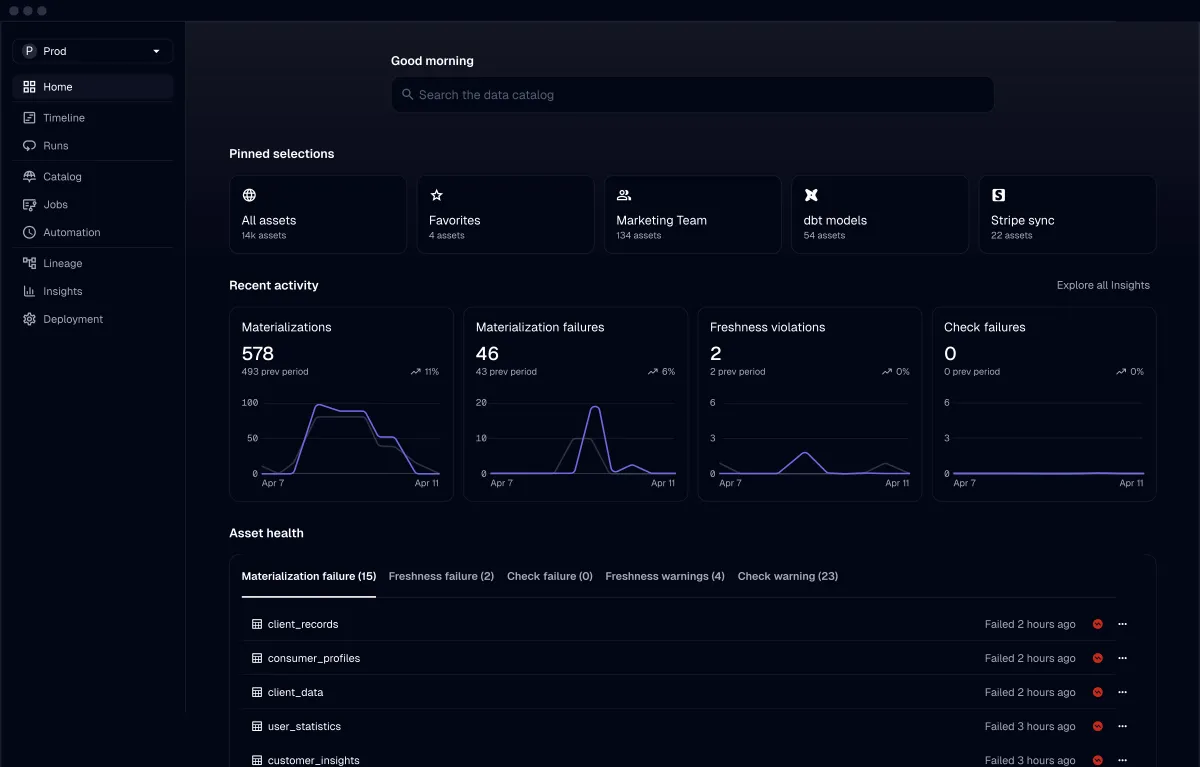
Feature Comparison
| Feature | Dagster | Polytomic |
|---|---|---|
| Data Movement & Orchestration | ||
| Pipeline Orchestration | Asset-centric orchestration with declarative DAGs, dependency management, partitioning, incremental runs, and fault tolerance | Automated data syncs with change detection that syncs only what has changed, saving on API limits and compute costs |
| ETL/ELT Support | Orchestrates ETL and ELT pipelines that move data from SaaS apps and APIs to warehouses like Snowflake or BigQuery | Unified ETL, ELT, CDC streaming, Reverse ETL, and bidirectional data syncing in a single platform |
| Reverse ETL | Activates warehouse data through Compass feature, delivering answers to stakeholders inside their existing tools | Built-in Reverse ETL as a core capability, syncing warehouse data back to SaaS tools and business applications |
| Observability & Monitoring | ||
| Data Lineage | Built-in lineage graphs showing asset dependencies, auto-generated documentation, and data catalog for cross-team discovery | Sync-level visibility showing source-to-destination data flow for each configured sync job |
| Alerting & Monitoring | Intelligent alerts in Slack with AI-powered debugging, impact analysis, and real-time freshness and performance health metrics | Sync status monitoring with audit logs tracking all activity and changes made within the platform |
| Cost Tracking | Built-in cost transparency with resource utilization insights and operational expense tracking for budget management at scale | Reduces costs by replacing multiple vendors and syncing only changed data to minimize API and compute spend |
| Developer Experience | ||
| Code vs No-Code | Python-first with declarative asset definitions, unit testing, local development, and CI/CD branch deployment workflows | No-code point-and-click data selection and filtering with optional SQL query support for complex transformations |
| Testing & CI/CD | Emphasis on unit testing, local development, branch deployments, and CI-native workflow for pipeline development | Infrastructure as code option with Terraform support for managing sync configurations programmatically |
| API & Extensibility | Dagster Pipes for first-class observability of jobs running in external systems, with modular and reusable components | Pull from any API without glue code for custom integrations, with HTTP API connectors for arbitrary endpoints |
| Enterprise & Security | ||
| Authentication & Access Control | SSO with Google, GitHub, and SAML identity providers, RBAC and SCIM provisioning for automated user management | Enterprise SSO, true RBAC with fine-grained user permissions for controlling access across teams |
| Compliance Certifications | SOC 2 Type II and HIPAA certified with independent audits aligned to enterprise standards | SOC 2, GDPR, CCPA, and HIPAA compliant with comprehensive data protection controls |
| Multi-Tenancy | Multi-tenant instances with isolated code and data deployments across separate environments | Enterprise permissions engine with role-based isolation between teams and departments |
| AI & Advanced Capabilities | ||
| AI/ML Workflow Support | Dedicated AI and ML pipeline orchestration for data prep, model training, and experiment tracking workflows | Focused on data movement rather than ML workflows; provides clean data feeds for downstream ML tools |
| Data Quality | Built-in validation, automated testing, freshness checks, and partitioned asset checks embedded directly in pipeline code | Change detection ensures sync accuracy by tracking and moving only modified records between systems |
| Spreadsheet Integration | Connects to data sources through Python-based integrations; no native spreadsheet connector | Direct two-way sync with Google Sheets and spreadsheets as first-class data sources and destinations |
Data Movement & Orchestration
Pipeline Orchestration
ETL/ELT Support
Reverse ETL
Observability & Monitoring
Data Lineage
Alerting & Monitoring
Cost Tracking
Developer Experience
Code vs No-Code
Testing & CI/CD
API & Extensibility
Enterprise & Security
Authentication & Access Control
Compliance Certifications
Multi-Tenancy
AI & Advanced Capabilities
AI/ML Workflow Support
Data Quality
Spreadsheet Integration
How they fit together
Dagster is the superior choice for data engineering teams orchestrating complex pipelines with code, while Polytomic wins for business teams needing fast, no-code data syncing between SaaS apps and warehouses.
What each one handles
Use Dagster for:
Choose Dagster if your team consists of data engineers and developers who need a code-first orchestration platform for building complex, asset-centric data pipelines. Dagster excels when you require full data lineage visualization, built-in testing frameworks, and the ability to orchestrate dbt transformations, Spark jobs, and ML workflows from a single control plane. Its open-source core with 15,348 GitHub stars and Apache-2.0 license gives you maximum flexibility, and the managed Dagster Cloud with hybrid deployment options scales from solo developers at $10/month to enterprise teams. Dagster is the right fit when observability, cost tracking, and CI/CD-native development are priorities for your data platform.
Use Polytomic for:
Choose Polytomic if your team needs to move data bidirectionally between warehouses, SaaS applications, databases, and spreadsheets without writing custom code. Polytomic shines when business and operations teams need self-service data syncing with a point-and-click interface, covering ETL, Reverse ETL, CDC streaming, and API integrations in one unified platform. Starting at $500/month for the Standard plan, it replaces multiple data movement vendors and reduces costs by syncing only changed records. Polytomic is the right fit when you need two-way integrations with tools like Salesforce, HubSpot, NetSuite, and Google Sheets, and your priority is fast setup with a 14-day free trial rather than pipeline orchestration complexity.
These roles reflect the available product evidence. Most teams run both; which one owns a given job depends on your stack and team.
Frequently Asked Questions
What are the main differences between Dagster and Polytomic?
Dagster is a code-first data orchestration platform built for data engineers who define pipelines as collections of data assets in Python. It provides built-in lineage graphs, observability dashboards, testing frameworks, and integrations with tools like dbt, Snowflake, and Databricks. Polytomic is a no-code data sync platform that enables business teams to move data bidirectionally between warehouses, SaaS apps, spreadsheets, and APIs through a point-and-click interface. Dagster focuses on pipeline orchestration and workflow management, while Polytomic focuses on data movement and synchronization across systems.
How do Dagster and Polytomic compare on pricing?
Dagster offers a free open-source self-hosted option under the Apache-2.0 license, with managed cloud plans starting at $10/month for the Solo Plan, $100/month for the Starter Plan, $1,200/month for the annual Starter tier, and custom pricing for Pro and Enterprise plans. All paid plans include a 30-day free trial. Polytomic provides a free tier for up to 5 users, with paid plans starting at $29/user/month. The Standard plan begins at $500/month and includes syncing to databases, warehouses, spreadsheets, apps, and APIs. Enterprise pricing with on-prem deployment and SSO requires a custom quote.
Can Dagster and Polytomic be used together in the same data stack?
Dagster and Polytomic serve complementary roles in a data stack and can work together effectively. Dagster handles the orchestration layer, managing complex pipeline dependencies, dbt transformations, data quality checks, and ML workflows through its asset-centric control plane. Polytomic handles the data movement layer, syncing data between SaaS applications, warehouses, and business tools through its no-code interface. A team could use Dagster to orchestrate data transformations in their warehouse while using Polytomic to sync the resulting clean data back to Salesforce, HubSpot, or Google Sheets for business teams.
Which tool is better for teams without data engineering resources?
Polytomic is the clear choice for teams without dedicated data engineering resources. Its no-code point-and-click interface allows business users to configure data syncs, select and filter data, and set up bidirectional connections without writing Python or SQL. Polytomic handles ETL, Reverse ETL, and CDC streaming through the same visual interface, and its self-hosting option requires only a turnkey deployment. Dagster requires Python proficiency to define assets, build pipelines, and configure orchestration workflows. While Dagster provides excellent developer tooling with unit testing and branch deployments, it assumes a technical audience comfortable with code-driven infrastructure.