Decision comparison
Dagster vs Temporal
Dagster and Temporal solve fundamentally different problems despite both operating in the workflow orchestration space. Dagster is purpose-built for data pipeline orchestration with asset-centric modeling, while Temporal is a general-purpose durable execution platform for building fault-tolerant distributed applications.
Architecture choice. These take different approaches to the same problem. Read the table as a fit question rather than a feature race.
These are different kinds of product — Workflow Orchestrator and Durable Execution.
Quick Comparison
| Decision factor | Dagster | Temporal |
|---|---|---|
| Primary Focus | Asset-centric data orchestration with built-in lineage, observability, and native dbt/Snowflake/BigQuery integrations for ETL pipelines | Durable execution platform for fault-tolerant distributed applications with automatic state persistence and failure recovery |
| Pricing Model | Open-source self-hosted free (Apache-2.0), Solo Plan $10/mo, Starter Plan $100/mo, Starter $1200/mo, Pro and Enterprise Plan contact sales | Self-hosted Temporal is free under the MIT license. Temporal Cloud Essentials starts at $100 per month and includes 1 million actions; Business starts at $500 per month and includes 2.5 million. Enterprise and Mission Critical are quoted. Additional actions are $50 per million, falling to $25 per million at volume. Storage is $0.042 per GB-hour active and $0.00105 per GB-hour retained. New accounts start with $1,000 in credits. |
| Open Source License | Apache-2.0 license with full-featured open-source core and optional managed Dagster+ cloud service | MIT license with fully open-source server including workflow engine, visibility APIs, and web UI |
| Language Ecosystem | Python-native platform with declarative asset definitions, built-in testing framework, and CI/CD-native workflow support | Polyglot SDKs supporting Go, Java, TypeScript, Python, and .NET for building durable workflows in native languages |
| Deployment Options | Single server, Kubernetes, or managed Dagster+ Cloud with hybrid bring-your-own-infrastructure and multi-region support | Self-hosted with Cassandra or PostgreSQL persistence, or fully managed Temporal Cloud in 11+ global regions |
| Community Size | 16,000+ GitHub stars with active Python data engineering community and Dagster University learning resources | 21,000+ GitHub stars with enterprise adoption by NVIDIA, Salesforce, Twilio, Netflix, and Descript |
Dagster
- Primary Focus:
- Asset-centric data orchestration with built-in lineage, observability, and native dbt/Snowflake/BigQuery integrations for ETL pipelines
- Pricing Model:
- Open-source self-hosted free (Apache-2.0), Solo Plan $10/mo, Starter Plan $100/mo, Starter $1200/mo, Pro and Enterprise Plan contact sales
- Open Source License:
- Apache-2.0 license with full-featured open-source core and optional managed Dagster+ cloud service
- Language Ecosystem:
- Python-native platform with declarative asset definitions, built-in testing framework, and CI/CD-native workflow support
- Deployment Options:
- Single server, Kubernetes, or managed Dagster+ Cloud with hybrid bring-your-own-infrastructure and multi-region support
- Community Size:
- 16,000+ GitHub stars with active Python data engineering community and Dagster University learning resources
Temporal
- Primary Focus:
- Durable execution platform for fault-tolerant distributed applications with automatic state persistence and failure recovery
- Pricing Model:
- Self-hosted Temporal is free under the MIT license. Temporal Cloud Essentials starts at $100 per month and includes 1 million actions; Business starts at $500 per month and includes 2.5 million. Enterprise and Mission Critical are quoted. Additional actions are $50 per million, falling to $25 per million at volume. Storage is $0.042 per GB-hour active and $0.00105 per GB-hour retained. New accounts start with $1,000 in credits.
- Open Source License:
- MIT license with fully open-source server including workflow engine, visibility APIs, and web UI
- Language Ecosystem:
- Polyglot SDKs supporting Go, Java, TypeScript, Python, and .NET for building durable workflows in native languages
- Deployment Options:
- Self-hosted with Cassandra or PostgreSQL persistence, or fully managed Temporal Cloud in 11+ global regions
- Community Size:
- 21,000+ GitHub stars with enterprise adoption by NVIDIA, Salesforce, Twilio, Netflix, and Descript
Public signals
Verified factual signals only. Bars appear only for like-for-like metrics with five weekly assessments for every tool; missing evidence stays explicit. These signals do not establish enterprise adoption, product quality, or total cost.
| Metric | Dagster | Temporal |
|---|---|---|
| Docker Hub pulls(Developer adoption) | 6.2M | Not available |
| GitHub commits, 90d(Product adoption) | 265 | 577 |
| GitHub stars(Product adoption) | 16,000+ | 23,000+ |
| Search interest(Market interest) | 1 | Not available |
| Hacker News mentions, 90d(Community interest) | 3 | 7 |
| Product Hunt comments(Community interest) | 11 | 0 |
| Product Hunt rating(Community interest) | 5.0/5 | 5.0/5 |
| Product Hunt reviews(Community interest) | 1 | 27 |
| Product Hunt votes(Community interest) | 112 | 6 |
| PyPI weekly downloads(Product adoption) | 1.8M | Not available |
| Stack Overflow questions(Community interest) | 171 | 175 |
| Docker Hub pulls(Product adoption) | Not available | 60.4M |
| npm weekly downloads(Developer adoption) | Not available | 2.7M |
| PyPI weekly downloads(Developer adoption) | Not available | 9.0M |
As of September 21, 2026 — updated weekly.
Health & risk evidence
Observed public-source checks for mapped package versions and repositories.
Dagster
September 21, 2026Package vulnerabilities
PyPI · dagster@1.13.23
0 vulnerabilities
across 1 package
Repository security score
github.com/dagster-io/dagster
5.1/10
Temporal
Package vulnerabilities
npm · @temporalio/client@1.24.0 · PyPI · temporalio@1.32.0
0 vulnerabilities
across 2 packages
Repository security score
github.com/temporalio/temporal
5.7/10
Interface Preview
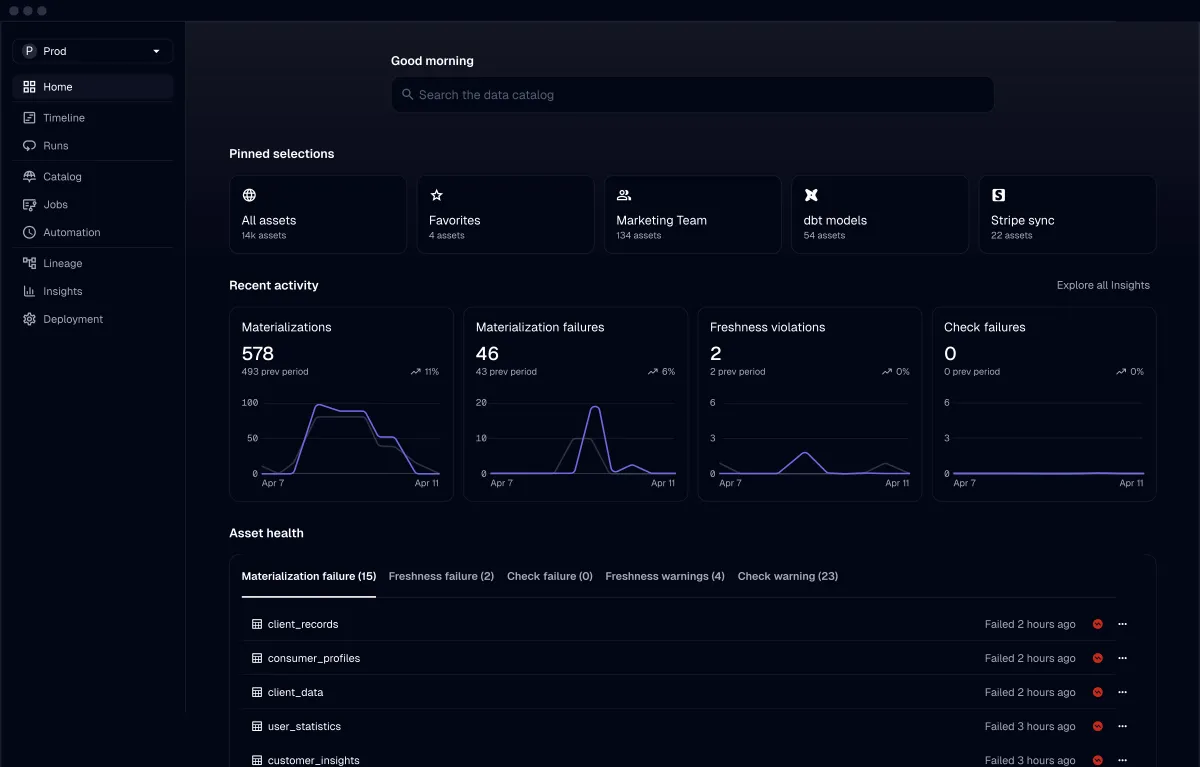
Dagster
Temporal
Feature Comparison
| Feature | Dagster | Temporal |
|---|---|---|
| Core Orchestration | ||
| Workflow Model | Asset-centric DAGs where pipelines are modeled as collections of data assets with dependency tracking and lineage | Durable execution workflows written as deterministic functions with activities handling side effects and retries |
| State Management | Asset versioning and partitioning track materialization state, freshness, and metadata across pipeline runs | Automatic state capture at every workflow step with full persistence, replay, and rewind capabilities |
| Failure Handling | Pipeline-level retry policies with asset-aware re-execution that only reruns failed or stale assets | Native exponential backoff retries with configurable policies per activity, unlimited retry duration support |
| Observability and Monitoring | ||
| Data Lineage | Built-in lineage graphs showing asset dependencies, ownership, and auto-generated documentation across pipelines | Execution visibility with step-by-step workflow inspection, replay, and rewind for debugging distributed flows |
| Health Monitoring | Real-time freshness metrics, performance dashboards, cost tracking, and Slack-integrated alerting system | Workflow execution state monitoring through Temporal Web UI with detailed history and event tracking |
| Data Quality | Built-in validation, automated testing, freshness checks with proactive data quality issue detection | Quality enforced through workflow-level assertions and activity-level validation in application code |
| Developer Experience | ||
| Language Support | Python-only with declarative asset definitions, strong typing, and native pytest integration for testing | Polyglot SDKs in Go, Java, TypeScript, Python, and .NET with idiomatic patterns per language |
| Local Development | Full local development environment with unit testing, CI integration, and branch deployments for staging | Local dev server via brew install with temporal server start-dev, then deploy to remote Kubernetes clusters |
| Learning Curve | Asset-centric mental model requires learning Dagster-specific concepts but Dagster University provides structured courses | Deterministic workflow paradigm requires 2-4 weeks onboarding for experienced engineers to learn the execution model |
| Integration and Ecosystem | ||
| Data Tool Integrations | Native connectors for Snowflake, BigQuery, dbt, Databricks, Fivetran, Great Expectations, and Spark | General-purpose platform without data-tool-specific integrations; connects through custom activity implementations |
| Scheduling | Cron-based schedules with sensor-driven triggers and asset-aware automation for materialization | Built-in schedule system with pause, restart, and stop capabilities replacing traditional cron jobs |
| Human-in-the-Loop | Manual materialization triggers through the Dagster UI for selective asset refreshes | First-class human-in-the-loop support via external signals that interact seamlessly with running workflows |
| Enterprise and Security | ||
| Authentication and Access | SSO with Google, GitHub, and SAML IdPs, RBAC, SCIM provisioning, and comprehensive audit logging | SAML SSO included in Business tier, SCIM as add-on in Business and included in Enterprise tier |
| Compliance | SOC 2 Type II certified and HIPAA compliant with independently audited security standards | 99.9% SLA on Cloud plans with 99.99% HA options and enterprise-grade security configurations |
| Multi-Tenancy | Multi-tenant instances with isolated code deployments and data separation across tenant boundaries | Namespace-based isolation in Temporal Cloud with dedicated infrastructure available on Enterprise tier |
Core Orchestration
Workflow Model
State Management
Failure Handling
Observability and Monitoring
Data Lineage
Health Monitoring
Data Quality
Developer Experience
Language Support
Local Development
Learning Curve
Integration and Ecosystem
Data Tool Integrations
Scheduling
Human-in-the-Loop
Enterprise and Security
Authentication and Access
Compliance
Multi-Tenancy
Which approach fits
Dagster and Temporal solve fundamentally different problems despite both operating in the workflow orchestration space. Dagster is purpose-built for data pipeline orchestration with asset-centric modeling, while Temporal is a general-purpose durable execution platform for building fault-tolerant distributed applications.
When each approach fits
Choose Dagster if:
Choose Dagster if your primary need is orchestrating data pipelines, ETL/ELT workflows, dbt transformations, or ML training pipelines. Dagster's asset-centric model provides built-in data lineage, quality checks, and native integrations with Snowflake, BigQuery, dbt, and Databricks. The Python-native developer experience with Dagster University resources makes onboarding straightforward for data engineering teams. The managed Dagster+ Cloud starting at $10/mo for solo users provides an accessible entry point with SOC 2 Type II and HIPAA compliance for enterprise needs.
Choose Temporal if:
Choose Temporal if you need durable execution for distributed application workflows like payment processing, order fulfillment, CI/CD pipelines, or long-running business processes. Temporal's automatic state persistence and failure recovery eliminate the need for manual reconciliation code. The polyglot SDK support across Go, Java, TypeScript, Python, and .NET makes it ideal for microservice architectures. With 19,703 GitHub stars and production adoption at NVIDIA, Salesforce, and Netflix, Temporal is battle-tested for mission-critical distributed systems requiring guaranteed execution reliability.
These scenarios reflect the available product evidence. Your requirements, existing stack, and team expertise should guide the final decision.
Frequently Asked Questions
Can Dagster and Temporal be used together in the same architecture?
Dagster and Temporal can complement each other in a modern data architecture. Dagster handles data pipeline orchestration, managing asset dependencies, lineage, and data quality checks for ETL/ELT workflows. Temporal handles the durable execution of distributed application logic, such as payment processing or order fulfillment. A common pattern is using Dagster to orchestrate data pipelines that feed into systems where Temporal manages the transactional business logic, keeping each tool focused on its core strength.
What are the key differences in how Dagster and Temporal handle failures?
Dagster handles failures at the asset and pipeline level, allowing selective re-execution of only failed or stale assets without rerunning entire pipelines. It provides freshness monitoring and alerting to detect issues proactively. Temporal handles failures at the workflow and activity level with automatic state capture at every step. When a failure occurs, Temporal workflows pick up exactly where they left off with no lost progress. Temporal also supports native exponential backoff retries with configurable policies per activity, making it particularly strong for transient failures in distributed systems.
How do the self-hosted options compare between Dagster and Temporal?
Dagster's open-source version runs under the Apache-2.0 license and can be deployed on a single server or Kubernetes with no feature restrictions on the orchestration core. Temporal's open-source server runs under the MIT license and includes the complete workflow engine, visibility APIs, worker task queues, and the Temporal Web UI. Temporal self-hosting requires Cassandra or MySQL/PostgreSQL for persistence and Elasticsearch for visibility, which adds operational complexity. Dagster's self-hosted setup is generally simpler for data teams already running Python environments.
Which tool is better for teams that primarily use Python for their data workflows?
Dagster is the stronger choice for Python-centric data teams. It is a Python-native platform where pipeline definitions, asset configurations, and tests are all written in Python with strong typing and native pytest integration. Dagster University provides structured learning resources specifically for Python data engineers. Temporal does offer a Python SDK, but it is one of five supported languages and the platform's core programming model of deterministic workflows with activities requires learning Temporal-specific patterns that differ from typical Python data engineering conventions.